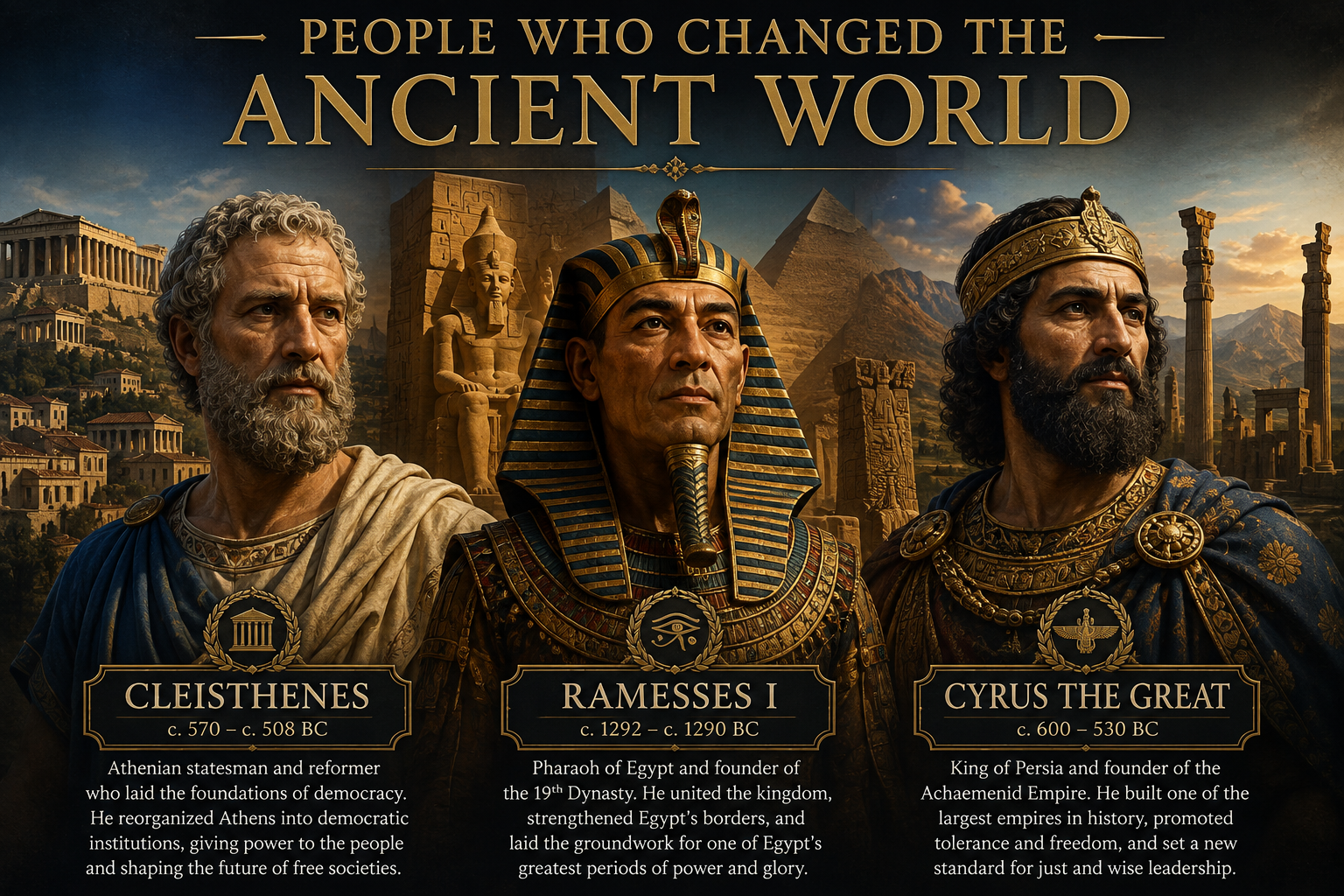
Alexander the Great was one of the most extraordinary military commanders and rulers in ancient history. Born in 356 BCE in Pella, the capital of Macedon, he inherited a powerful kingdom from his father, Philip II, and expanded it into one of the largest empires the world had ever seen. By the time of his death in 323 BCE, Alexander had conquered vast territories stretching from Greece and Egypt to Persia and north-western India. His campaigns reshaped the political and cultural landscape of the ancient world and ushered in the Hellenistic age.
Early Life and Education
Alexander was the son of King Philip II of Macedon and Queen Olympias. From a young age, he displayed intelligence, ambition, and determination. His education was entrusted to the philosopher Aristotle, who instructed him in subjects such as literature, philosophy, science, and politics. This education fostered in Alexander a deep admiration for Greek culture and a desire for glory.
As a youth, Alexander demonstrated courage and leadership. One famous story recounts how he tamed the wild horse Bucephalus, an animal that no one else could control. This early episode symbolised his bold character and confidence.
Accession to the Throne
In 336 BCE, Philip II was assassinated, and Alexander became king at the age of twenty. Although young, he acted swiftly to secure his position. He suppressed internal rebellions and reasserted Macedonian authority over the Greek city-states, which had attempted to break free after Philip’s death.
Having stabilised his rule, Alexander turned his attention to the Persian Empire, continuing the campaign his father had planned.
The Persian Campaign
In 334 BCE, Alexander crossed into Asia Minor with a relatively small but highly disciplined army. His first major victory came at the Battle of the Granicus River. He followed this success with further triumphs, including the decisive Battle of Issus against King Darius III of Persia.
Alexander’s military tactics combined the strength of the Macedonian phalanx with the striking power of the Companion Cavalry. His leadership on the battlefield inspired loyalty and courage among his troops.
In 331 BCE, Alexander defeated Darius once more at the Battle of Gaugamela, effectively bringing the Persian Empire under his control. He entered the great cities of Babylon, Susa, and Persepolis, claiming their wealth and prestige.
Egypt and the Foundation of Cities
Alexander’s campaign extended into Egypt, where he was welcomed as a liberator from Persian rule. He founded the city of Alexandria, which would become one of the most important centres of learning and commerce in the ancient world.
Throughout his conquests, Alexander established numerous cities named after himself. These foundations served as administrative centres and facilitated the spread of Greek culture across vast territories.
Expansion into Asia
Alexander continued his campaign eastwards into Central Asia and north-western India. Despite facing unfamiliar terrain and fierce resistance, he maintained his momentum. However, after years of campaigning, his troops grew weary and refused to march further east. Reluctantly, Alexander agreed to turn back.
The journey home was arduous, involving difficult marches through harsh environments. Nonetheless, Alexander returned to Babylon, where he planned further campaigns before his untimely death.
Administration and Cultural Integration
Alexander sought not only to conquer but also to govern his empire. He adopted elements of Persian administration and encouraged cooperation between Macedonians and local populations. Marriages between his officers and Persian noblewomen symbolised this policy of integration.
Greek language and culture spread widely during his reign, blending with local traditions. This cultural fusion gave rise to the Hellenistic world, characterised by shared artistic, intellectual, and scientific achievements across diverse regions.
Death and Legacy
Alexander died in 323 BCE in Babylon at the age of thirty-two. The cause of his death remains uncertain, with theories ranging from illness to poisoning. His sudden passing left no clear successor, leading to struggles among his generals.
Although his empire fragmented into separate kingdoms, the cultural impact of his conquests endured. Greek ideas, art, and political models influenced vast areas of the eastern Mediterranean and Near East.
Character and Historical Assessment
Ancient accounts portray Alexander as charismatic, ambitious, and often relentless. He combined strategic brilliance with personal bravery, frequently leading charges in battle. However, his later years were marked by increasing severity and suspicion, leading to controversial actions against former allies.
Historians continue to debate his motivations and methods, yet few deny his extraordinary achievements. His conquests reshaped the ancient world and established patterns of cultural exchange that lasted for centuries.
Conclusion
Alexander the Great stands as one of history’s most remarkable figures. In little more than a decade, he conquered an empire of unprecedented scale and initiated a period of profound cultural transformation.
Though his life was brief, his influence was immense. The Hellenistic age that followed bore the mark of his ambition and vision, ensuring that his name would endure as a symbol of military genius and world-changing leadership.