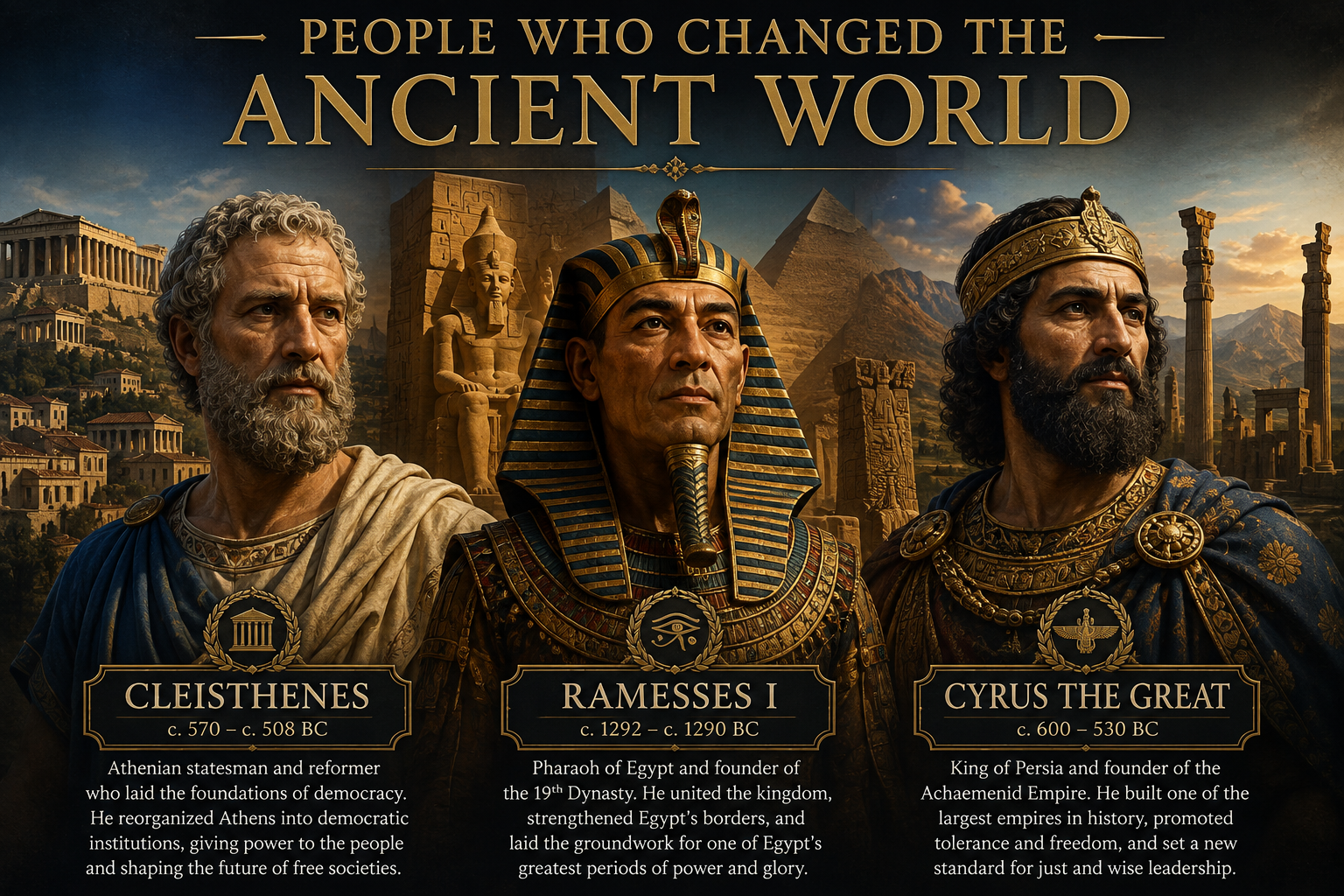
Cyrus II, commonly known as Cyrus the Great, founded the Achaemenid Empire and ruled from approximately 559 to 530 BCE. Through military victories, political alliances and cooperation with existing institutions, he transformed a Persian kingdom into the dominant power of the ancient Near East.
Origins and Early Rule
Cyrus belonged to the ruling family of Anshan, a kingdom in southwestern Iran associated with both Persian and Elamite traditions. Surviving inscriptions identify him as the son of Cambyses I and a descendant of earlier kings of Anshan.
Later Greek writers connected Cyrus with Astyages, the final king of Media. Herodotus described Cyrus as the grandson of Astyages and surrounded his childhood with dreams, prophecies and miraculous survival. These stories contain legendary elements and cannot be treated as a straightforward historical biography.
The Defeat of Astyages
Around 553 BCE, Cyrus rebelled against Median authority. The conflict ended in approximately 550 BCE when Astyages’s army turned against him and delivered the Median king to Cyrus.
Cyrus captured Ecbatana and absorbed Median territories, military forces and court traditions. Medes continued to hold important positions under Persian rule, indicating that the victory produced political integration rather than the destruction of Median society.
The Conquest of Lydia
Cyrus next confronted Croesus, the wealthy king of Lydia in western Anatolia. After an indecisive battle at Pteria, Croesus withdrew to Sardis and expected campaigning to resume after the winter.
Cyrus advanced unexpectedly and defeated the Lydian forces near Sardis. The capital was captured around 547 or 546 BCE, bringing Lydia and its Anatolian territories under Persian authority.
Greek accounts disagree about the fate of Croesus. Some traditions claim that Cyrus spared him and kept him as an adviser, while others suggest that Croesus died during or soon after the conquest.
The Greek Cities of Anatolia
Following the fall of Lydia, Persian commanders extended Achaemenid control over Greek cities along the western coast of Anatolia. Some cities resisted, while others negotiated terms or accepted local rulers supported by Persia.
These conquests gave Cyrus access to Aegean ports, commercial networks and new sources of military manpower. They also began the long and complicated relationship between the Achaemenid Empire and the Greek world.
The Conquest of Babylon
In 539 BCE, Cyrus invaded the Neo-Babylonian Empire. Persian forces defeated the Babylonian army near Opis, after which the important city of Sippar surrendered without a battle.
Troops commanded by Ugbaru entered Babylon without major fighting inside the city. Cyrus arrived several weeks later and adopted traditional Mesopotamian titles, including King of Babylon and King of the Four Quarters.
The Cyrus Cylinder presents the conquest as a divinely approved restoration of order. It claims that Cyrus protected temples, returned divine images to their sanctuaries and restored displaced communities.
The cylinder is sometimes described as an early declaration of human rights. That modern interpretation is misleading because the document followed established Mesopotamian traditions of royal propaganda and was primarily intended to legitimise Cyrus as Babylon’s rightful king.
Ruling a Diverse Empire
Cyrus governed territories containing many languages, religions and political traditions. Rather than replacing every local institution, he frequently worked through existing administrators, priests, nobles and regional rulers.
This approach allowed conquered communities to retain significant elements of their cultural identity while recognising Persian authority. Loyalty, tribute and military service connected local governments to the royal court.
The empire created by Cyrus was less centralised than it would become under Darius I. Nevertheless, Cyrus established the political foundations upon which later Achaemenid administration developed.
Religion and Royal Authority
Cyrus’s personal religious beliefs remain uncertain. Later Achaemenid kings associated their authority closely with Ahuramazda, but the surviving evidence does not allow a complete reconstruction of Cyrus’s faith.
In conquered territories, Cyrus presented himself through local religious traditions. In Babylonian documents, he claimed the support of Marduk and performed the expected duties of a Mesopotamian monarch.
This flexibility was an important feature of Achaemenid kingship. The king could express universal authority while respecting the sacred institutions of different regions.
Death and Succession
Cyrus died around 530 BCE while campaigning on the northeastern frontier of the empire. Greek sources associate his death with a battle against the Massagetae, although their dramatic accounts cannot be independently confirmed.
He was succeeded by his son Cambyses II, who later conquered Egypt. Cyrus was buried at Pasargadae, where a monumental stone tomb traditionally identified as his burial place still survives.
The Legacy of Cyrus
Cyrus was remembered as a successful conqueror and an effective founder of imperial rule. Greek authors sometimes portrayed him as an ideal monarch, while Babylonian texts presented him as the chosen restorer of religious order.
Biblical tradition also remembered Cyrus favourably because Persian policy allowed displaced communities, including the Judeans exiled in Babylonia, to return and rebuild their religious institutions.
The empire Cyrus created endured for approximately two centuries. His ability to combine conquest with political accommodation established a model of kingship that influenced later Achaemenid rulers and shaped the history of the ancient world.