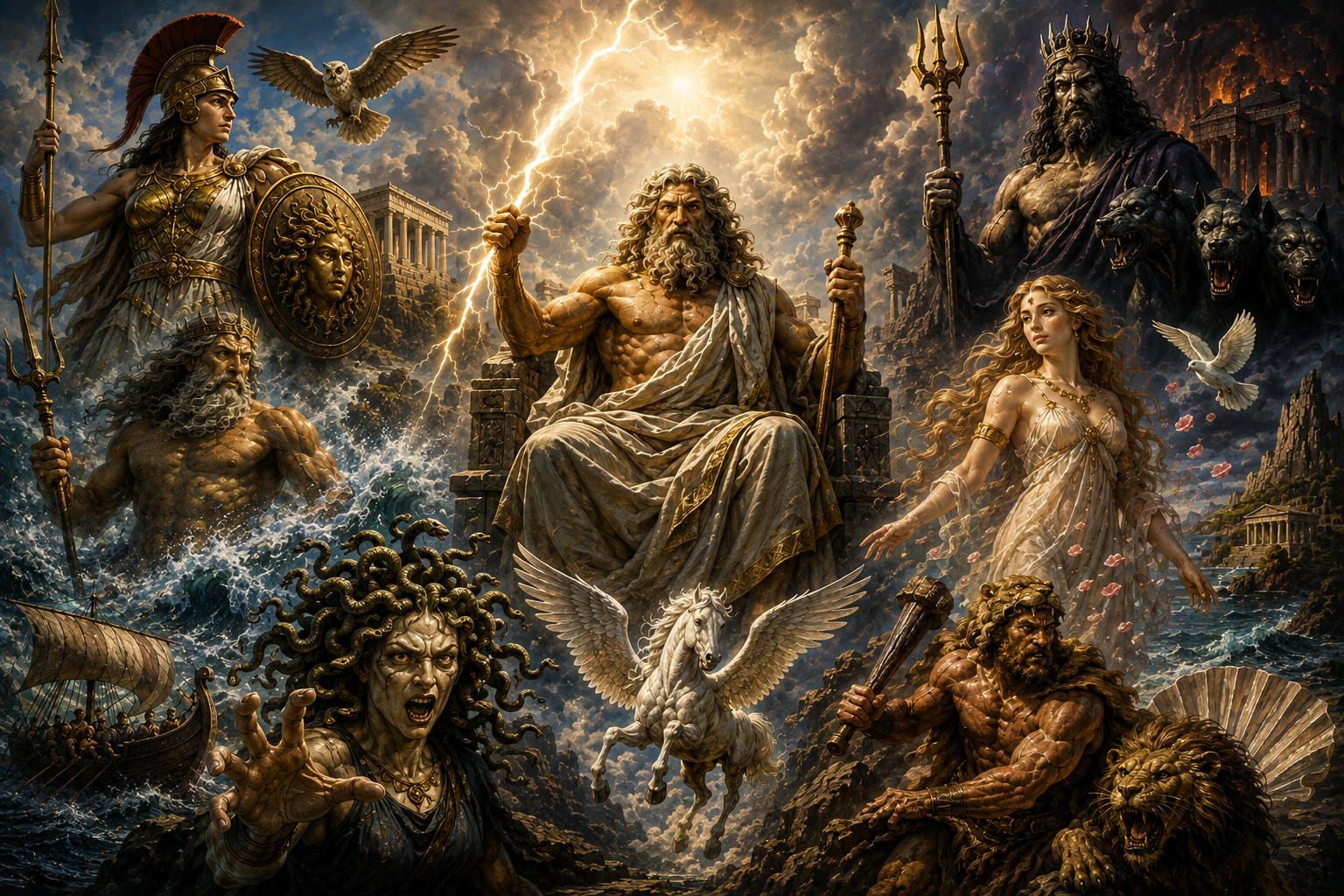
The Olympian gods were the most famous deities of ancient Greek religion. They were imagined as powerful immortal beings whose principal home was Mount Olympus, the highest mountain in Greece. From there Zeus and the other major gods were believed to influence the natural world, human society, warfare, agriculture, the sea, love, craftsmanship, prophecy and countless other aspects of life.
Ancient Greek religion did not possess a single universally fixed list of exactly twelve Olympians. Different traditions included different gods, and the importance of individual deities varied between cities and regions. Nevertheless, a group conventionally known as the Twelve Olympians came to represent the principal gods of the Greek pantheon.
The most commonly recognised Olympians include Zeus, Hera, Poseidon, Demeter, Athena, Apollo, Artemis, Ares, Aphrodite, Hephaestus, Hermes and either Hestia or Dionysus. Hades was one of the most powerful Greek gods and brother of Zeus and Poseidon, but because his kingdom was the Underworld rather than Mount Olympus, he was not usually counted among the Twelve Olympians.
Religion in Ancient Greece
The gods were deeply woven into ancient Greek society.
Greeks prayed to them before journeys, battles, marriages, childbirth, harvests and political decisions.
Temples dominated the sacred landscapes of Greek cities, while festivals, sacrifices and athletic competitions honoured particular deities.
Not a Single Greek Religion
Ancient Greece was divided among numerous independent communities.
Athens, Sparta, Corinth, Thebes, Argos and hundreds of other poleis maintained their own local traditions.
The same god could therefore be worshipped differently in different regions.
The Gods and the Polis
Greek religion was closely connected with civic identity.
Every polis possessed important patron gods, sanctuaries and public festivals.
Athena and Athens
Athena became particularly associated with Athens.
Hera and Argos
Hera possessed especially important cult centres at Argos and nearby regions.
Apollo and Delphi
Apollo's sanctuary at Delphi became one of the most important religious centres in the entire Greek world.
Zeus and Olympia
Olympia became famous for the sanctuary of Zeus and the athletic festival that developed into the ancient Olympic Games.
Mount Olympus
Mount Olympus rises in northern Greece and reaches almost three thousand metres above sea level.
Its summit is frequently hidden by clouds, helping make it an appropriate mythical home for the gods.
The Palace of the Gods
Greek poetry imagined the Olympians gathering in magnificent divine halls.
There they feasted, debated human affairs and argued among themselves.
Ambrosia
The food of the gods was commonly described as ambrosia.
Nectar
Nectar was another substance closely associated with divine immortality.
The Gods Were Immortal
Unlike humans, the Olympians did not experience ordinary mortality.
They possessed extraordinary strength, beauty and supernatural power.
The Gods Were Not All-Powerful
Greek gods were extremely powerful, but mythology does not always portray even Zeus as capable of controlling absolutely everything.
Fate
The concept of fate could stand as a powerful force within Greek mythology.
The Moirai
The three Fates, known as the Moirai, represented the allocation and course of human life.
Anthropomorphic Gods
The Olympians were usually imagined in human form.
They experienced emotions including love, jealousy, anger, pride and grief.
Divine Behaviour
Greek myths frequently portray gods arguing, deceiving one another and intervening dramatically in human affairs.
Myth and Worship
The behaviour of gods in mythology should not be treated as a complete description of how Greeks experienced religion.
A deity who behaved unpredictably in poetry could simultaneously be approached with solemn devotion in a sanctuary.
The Generations Before Olympus
The Olympian gods did not represent the beginning of Greek mythology.
Chaos
Hesiod's Theogony begins with Chaos, followed by primordial powers associated with the earliest structure of existence.
Gaia
Gaia represented the Earth.
Uranus
Uranus represented the Sky.
The Titans
Gaia and Uranus became parents of the divine generation known as the Titans.
Cronus
Cronus became the dominant ruler among the Titans after overthrowing Uranus.
Rhea
Rhea became the mother of several gods who would eventually overthrow Cronus.
The Children of Cronus
Cronus and Rhea produced Hestia, Demeter, Hera, Hades, Poseidon and Zeus.
The Prophecy
Cronus learned that one of his children would overthrow him just as he had overthrown his own father.
Cronus Swallows His Children
To prevent the prophecy, Cronus swallowed his children after their births.
Zeus Is Hidden
When Zeus was born, Rhea concealed him and gave Cronus a stone wrapped like an infant.
Zeus Grows Up
Zeus survived and eventually confronted his father.
The Children Are Released
Cronus was forced to release the children he had swallowed.
The Titanomachy
A great mythical war followed between Zeus and his allies and the older generation of Titans.
Ten Years of War
Greek tradition described the Titanomachy as lasting for ten years.
The Cyclopes
Zeus released the Cyclopes, who provided extraordinary divine weapons.
The Thunderbolt
Zeus received the thunderbolt.
Poseidon's Trident
Poseidon received the trident.
Hades and the Helmet
Hades received a helmet associated with invisibility.
The Hundred-Handers
The terrifying beings known as the Hecatoncheires also joined Zeus's side.
The Titans Defeated
Zeus and his allies eventually defeated Cronus and the Titans.
Tartarus
Many defeated Titans were imprisoned in Tartarus.
The New Divine Order
The victory established the generation of gods associated with Olympus.
Division of the Cosmos
Zeus, Poseidon and Hades divided major realms of existence among themselves.
Zeus Receives the Sky
Zeus became ruler of the heavens.
Poseidon Receives the Sea
Poseidon became ruler of the sea.
Hades Receives the Underworld
Hades became ruler of the realm of the dead.
The Earth
The earth itself remained an area through which the gods could exercise overlapping influence.
Zeus
Zeus was the supreme ruler of the Olympian gods.
King of the Gods
He presided over the divine community of Olympus.
God of the Sky
Zeus was particularly associated with the sky, storms, thunder and lightning.
The Thunderbolt
His thunderbolt became his most famous weapon and symbol.
The Eagle
The eagle was closely associated with Zeus.
The Oak
The oak also possessed strong connections with his worship.
Zeus and Justice
Zeus was not merely a storm god.
He possessed important associations with justice, law, kingship and social order.
Protector of Guests
As Zeus Xenios, he protected the sacred relationship between hosts and guests.
Xenia
Hospitality was considered a serious moral and religious obligation in Greek society.
Protector of Oaths
Zeus also guarded oaths and punished those who violated sacred promises.
Zeus at Olympia
The sanctuary of Zeus at Olympia became one of the great religious centres of Greece.
The Olympic Games
The ancient Olympic festival was held in honour of Zeus.
The Temple of Zeus
A monumental temple dedicated to Zeus dominated the sanctuary.
The Statue of Zeus
The sculptor Phidias created a colossal seated statue of Zeus for the temple.
Wonder of the Ancient World
The statue later became famous as one of the Seven Wonders of the ancient world.
Zeus at Dodona
Another important sanctuary of Zeus stood at Dodona in Epirus.
The Sacred Oak
Priests interpreted signs associated with the sacred oak and other natural sounds to communicate divine responses.
Zeus in Myth
Zeus appears throughout Greek mythology as ruler, judge, father and lover.
Many Children
He fathered numerous gods, heroes and legendary rulers.
Athena
Athena was one of his most important divine children.
Apollo and Artemis
The twins Apollo and Artemis were children of Zeus and Leto.
Hermes
Hermes was born to Zeus and Maia.
Dionysus
Dionysus was associated with Zeus and the mortal Semele.
Heracles
The hero Heracles was another famous son of Zeus.
Zeus and Mortal Women
Many myths describe Zeus pursuing or seducing mortal women in numerous forms.
Transformation
He could transform himself into animals or other forms.
Europa
In one famous myth, Zeus took the form of a bull and carried Europa to Crete.
Danae
In another tradition, Zeus approached Danae in the form of a shower of gold.
Leda
Some traditions describe Zeus approaching Leda in the form of a swan.
Mythological Power
These stories demonstrate Zeus's enormous generative role within Greek genealogy and heroic myth.
Hera
Hera was queen of the Olympian gods and wife of Zeus.
Goddess of Marriage
She was particularly associated with marriage and legitimate union.
Women and Marriage
Greek women could appeal to Hera in relation to marriage and family life.
The Peacock
The peacock became strongly associated with Hera in later artistic traditions.
The Cow
Hera also possessed ancient bovine associations and could receive epithets referring to large or beautiful eyes.
Hera and Zeus
Myths frequently portray a stormy marriage between Hera and Zeus.
Jealousy
Hera often acts against the lovers or children of Zeus.
Heracles
Her hostility toward Heracles forms a central theme in myths surrounding the hero.
The Name Heracles
The hero's Greek name itself means something like glory of Hera, reflecting the complex relationship between them.
Hera at Argos
The Argive Heraion was among her most important sanctuaries.
Hera at Samos
The island of Samos also possessed an ancient and influential cult of Hera.
The Heraion of Samos
A monumental temple there became one of the great architectural projects of the archaic Greek world.
Poseidon
Poseidon was god of the sea and one of the most powerful Olympians.
Brother of Zeus
He belonged to the first generation of children born to Cronus and Rhea.
The Trident
Poseidon's most famous symbol was the three-pronged trident.
God of Earthquakes
Poseidon was also strongly associated with earthquakes.
Earth-Shaker
One of his famous epithets described him as the Earth-Shaker.
God of Horses
Poseidon possessed important associations with horses and horsemanship.
Dangerous Seas
For Greek communities dependent upon maritime travel, Poseidon could be both protector and terrifying threat.
Sailors and Poseidon
Seafarers sought his favour before dangerous voyages.
The Odyssey
Poseidon becomes the principal divine opponent of Odysseus in Homer's Odyssey.
Polyphemus
After Odysseus blinds the Cyclops Polyphemus, the son of Poseidon calls upon his father for revenge.
Odysseus Wanders
Poseidon's anger contributes to the hero's long struggle to return to Ithaca.
Athena and Poseidon
A famous myth describes a contest between Poseidon and Athena for patronage of Athens.
Poseidon's Gift
Different traditions describe Poseidon producing a salt spring or horse.
Athena's Olive Tree
Athena offered the olive tree.
Athena Wins
The city chose Athena as its patron goddess.
The Erechtheion
The Acropolis contained sacred traditions associated with both Athena and Poseidon.
Demeter
Demeter was goddess of agriculture, grain and fertility of the earth.
Life From the Soil
Her importance reflected the absolute dependence of ancient societies upon successful harvests.
Mother of Persephone
Demeter's most famous myth concerns the abduction of her daughter Persephone.
Hades Takes Persephone
Hades carried Persephone into the Underworld to become his queen.
Demeter Searches
Demeter wandered the earth searching for her missing daughter.
The Earth Becomes Barren
In her grief, Demeter prevented crops from growing.
Humanity Faces Famine
Without agricultural fertility, mortals could no longer sustain themselves or provide sacrifices to the gods.
Zeus Intervenes
A compromise was eventually arranged.
The Pomegranate Seeds
Persephone had eaten food associated with the Underworld, linking her permanently with Hades.
Part of the Year Below
She therefore spent part of the year in the Underworld.
Part of the Year With Demeter
For another part she returned to her mother.
Seasonal Interpretation
The myth became closely connected with agricultural cycles and ideas of death and renewal.
The Homeric Hymn to Demeter
One of the principal ancient accounts of this myth survives in the Homeric Hymn to Demeter.
Eleusis
During her search, Demeter came to Eleusis near Athens.
The Eleusinian Mysteries
Eleusis developed one of the most famous mystery cults of the ancient Mediterranean.
Demeter and Persephone
Both goddesses stood at the centre of the Eleusinian Mysteries.
Initiation
Participants underwent secret initiation ceremonies.
Secrecy
Initiates were forbidden to reveal central aspects of the rites.
Hope Beyond Death
Ancient sources suggest that initiation offered powerful hopes concerning human existence and the fate awaiting individuals after death.
Athena
Athena was goddess of wisdom, strategy, craftsmanship and civic order.
Patron of Athens
She became particularly associated with the city that bore her name.
Birth of Athena
Athena possessed one of the most extraordinary births in Greek mythology.
Metis
Zeus had joined with the goddess Metis, whose name was associated with wisdom or cunning intelligence.
Zeus Swallows Metis
After learning of a prophecy concerning her children, Zeus swallowed Metis.
A Terrible Headache
Later Zeus suffered extraordinary pain in his head.
Athena Emerges
Athena sprang fully grown and armed from the head of Zeus.
Warrior Goddess
Athena possessed strong martial associations.
Different From Ares
Where Ares often represented the violence and fury of battle, Athena was particularly associated with disciplined strategy and intelligent warfare.
The Spear
Athena was commonly shown carrying a spear.
The Aegis
The protective aegis became one of her major attributes.
Medusa
The head of the Gorgon Medusa was frequently represented upon Athena's aegis or shield.
The Owl
The owl became one of Athena's most recognisable sacred animals.
The Olive Tree
The olive was another fundamental symbol of the goddess.
Athenian Coinage
Ancient Athenian silver coins famously displayed Athena on one side and an owl on the other.
The Acropolis
The Acropolis of Athens became the greatest monumental centre of Athena's worship.
The Parthenon
The Parthenon was constructed during the fifth century BCE and dedicated to Athena Parthenos.
Phidias
Inside stood an enormous gold-and-ivory cult statue created under the direction of Phidias.
The Panathenaia
The Panathenaic Festival was one of Athens's greatest civic celebrations.
The Peplos
A specially woven garment was presented to Athena during the festival.
Athena and Heroes
Athena frequently assisted Greek heroes.
Odysseus
She became the great divine protector of Odysseus.
Perseus
She also assisted Perseus during his quest against Medusa.
Heracles
Athena could appear as a supporter of Heracles.
Intelligence and Heroism
Her role often demonstrates the importance Greek mythology placed upon intelligence alongside physical courage.
Apollo
Apollo was one of the most influential and complex Olympian gods.
Son of Zeus and Leto
He was the twin brother of Artemis.
Delos
According to important traditions, Apollo and Artemis were born on the island of Delos.
God of Prophecy
Apollo became especially famous as the god of prophecy.
Delphi
His sanctuary at Delphi became perhaps the most prestigious oracle in the Greek world.
The Pythia
A priestess known as the Pythia delivered Apollo's prophetic responses.
Consulting Delphi
Individuals, kings and city-states travelled to Delphi seeking divine guidance.
War and Colonisation
Questions could concern warfare, religious ritual, political decisions and the establishment of colonies.
Ambiguous Prophecies
Greek literary traditions frequently emphasised the danger of misunderstanding prophetic responses.
Croesus
Herodotus famously tells how King Croesus of Lydia interpreted a Delphic prophecy as promising victory over Persia.
A Great Empire Would Fall
The prophecy proved true, but the empire destroyed was his own.
Apollo and Music
Apollo was closely associated with music and the lyre.
The Muses
He could preside over the Muses, divine patrons of artistic and intellectual pursuits.
Apollo and Healing
Apollo possessed important associations with healing.
Apollo and Disease
Like several ancient gods, he could both remove disease and send it.
The Iliad
At the beginning of Homer's Iliad, Apollo sends a plague against the Greek army after his priest is dishonoured.
The Bow
Apollo's arrows could therefore represent sudden divine destruction.
Asclepius
The healing god Asclepius was traditionally regarded as a son of Apollo.
Apollo and the Sun
Apollo eventually developed strong solar associations.
Helios
In earlier Greek tradition, however, Helios was the distinct divine personification of the sun.
Apollo and Helios
Their identities became increasingly associated in later Greek and Roman culture.
Artemis
Artemis was the twin sister of Apollo and daughter of Zeus and Leto.
Goddess of the Hunt
She became strongly associated with hunting and wild landscapes.
The Bow
Artemis, like Apollo, was frequently depicted carrying a bow.
Wild Animals
She possessed powerful associations with animals and the untamed natural world.
Young Women
Artemis played important religious roles connected with girls and transitions into adulthood.
Childbirth
Despite her identity as a virgin goddess, Artemis could also be invoked in connection with childbirth.
Divine Contradiction
Such apparently contradictory roles were common within Greek religion.
Artemis and Actaeon
One famous myth concerns the hunter Actaeon.
The Forbidden Sight
Different traditions describe him offending Artemis, often by seeing the goddess while she bathed.
Transformation Into a Stag
Artemis transformed Actaeon into a deer.
His Own Dogs
Unable to recognise their master, his hunting dogs tore him apart.
Artemis and Niobe
Artemis and Apollo also appear in the tragic story of Niobe.
Niobe's Pride
Niobe boasted that she possessed more children than their mother Leto.
Divine Retribution
Apollo and Artemis killed Niobe's children in punishment for her arrogance.
Hubris
The story reflects the dangerous consequences of challenging divine status.
Artemis at Ephesus
The sanctuary of Artemis at Ephesus became one of the greatest temples of the ancient world.
The Temple of Artemis
Its monumental form was celebrated as one of the Seven Wonders of the ancient world.
Ephesian Artemis
The cult image and traditions of Artemis at Ephesus differed significantly from the familiar Greek image of the youthful huntress.
Local Diversity
This demonstrates how one divine name could encompass substantially different regional cult traditions.
Ares
Ares was the Olympian god most directly associated with the violence of warfare.
Son of Zeus and Hera
He was traditionally regarded as a child of Zeus and Hera.
Fury of Battle
Ares represented the physical violence, bloodshed and terrifying intensity of combat.
Not Strategy
He differed from Athena, whose martial qualities were more closely associated with strategy and disciplined warfare.
Ares in Homer
The Iliad does not consistently portray Ares as an admirable figure.
Wounded God
He can be injured and driven from battle.
Zeus Rebukes Ares
Homer even portrays Zeus expressing contempt for his son's love of conflict.
Worship of Ares
The literary portrayal of Ares should not be confused completely with his religious significance.
Local Cults
Ares received worship in various regions of the Greek world.
Ares and Aphrodite
One of the most famous divine relationships linked Ares with Aphrodite.
Love and War
The pairing of the god of violent warfare with the goddess of desire became a powerful mythological contrast.
Aphrodite
Aphrodite was goddess of love, sexual desire, beauty and attraction.
Two Birth Traditions
Greek literature preserves different accounts of Aphrodite's origins.
Hesiod's Aphrodite
In Hesiod's Theogony, Aphrodite emerges from sea foam after the mutilation of Uranus.
Birth From the Sea
This tradition gives her an origin older than the generation of Zeus.
Homeric Aphrodite
In Homeric tradition, Aphrodite can instead appear as the daughter of Zeus and Dione.
Contradictory Traditions
Ancient Greeks preserved both genealogies.
Cyprus
Aphrodite possessed especially strong associations with Cyprus.
Cythera
The island of Cythera also featured prominently in traditions surrounding her cult.
The Dove
Doves became associated with Aphrodite.
The Rose
Roses also developed strong connections with the goddess of love.
The Golden Apple
Aphrodite played a decisive role in the mythological origins of the Trojan War.
The Wedding of Peleus and Thetis
The goddess Eris was excluded from a divine wedding celebration.
The Apple of Discord
Eris introduced a golden apple intended for the most beautiful goddess.
Hera, Athena and Aphrodite
All three claimed the prize.
The Judgment of Paris
Paris, prince of Troy, was chosen to judge between them.
Hera's Offer
Hera offered political power.
Athena's Offer
Athena offered military success or wisdom according to different traditions.
Aphrodite's Offer
Aphrodite promised Paris the most beautiful woman in the world.
Helen
That woman was Helen, wife of Menelaus of Sparta.
Paris Chooses Aphrodite
His choice set in motion the legendary chain of events leading to the Trojan War.
Hephaestus
Hephaestus was god of fire, metallurgy, craftsmanship and skilled manufacture.
The Divine Smith
He created extraordinary objects for gods and heroes.
Birth of Hephaestus
Different myths provide different accounts of his birth and fall from Olympus.
Hera
Some traditions describe Hera producing Hephaestus without Zeus.
The Lame God
Hephaestus was represented with a physical disability affecting his movement.
Thrown From Olympus
Myths describe him being cast from Olympus by either Hera or Zeus depending upon the tradition.
Lemnos
The island of Lemnos became particularly associated with Hephaestus.
The Forge
Hephaestus worked in a divine workshop where extraordinary objects were created.
Armour of Achilles
In the Iliad, Thetis asks Hephaestus to manufacture magnificent armour for her son Achilles.
The Shield of Achilles
Homer provides an elaborate description of the shield created by the god.
A World in Metal
The shield contains images of cities, agriculture, warfare, dancing and the heavens.
Divine Technology
Hephaestus represented technological skill raised to supernatural perfection.
Automata
Greek mythology even attributes self-moving artificial servants and mechanical creations to Hephaestus.
God of Craftsmen
Artisans and metalworkers could regard him as a divine patron.
Hephaestus and Aphrodite
Some myths make Aphrodite the wife of Hephaestus.
Aphrodite and Ares
Her relationship with Ares produces one of the famous comic episodes of divine mythology.
The Invisible Net
Hephaestus traps the lovers together in a device of extraordinary craftsmanship.
The Gods Laugh
The episode, told in the Odyssey, demonstrates the humorous as well as solemn dimensions of Greek mythology.
Hermes
Hermes was messenger of the gods and one of the most versatile Olympian deities.
Son of Zeus and Maia
He was born to Zeus and the nymph Maia.
The Divine Messenger
Hermes travelled rapidly between divine and human realms.
Winged Sandals
Later artistic tradition strongly associated him with winged footwear.
The Herald's Staff
Hermes carried the herald's staff commonly known as the caduceus.
God of Travellers
He protected travellers and movement across boundaries.
God of Merchants
Commerce and exchange also belonged to his sphere.
God of Thieves
Hermes possessed associations with cleverness, deception and theft.
The Infant Hermes
The Homeric Hymn to Hermes portrays him displaying extraordinary cunning immediately after his birth.
Stealing Apollo's Cattle
The newborn god steals cattle belonging to Apollo.
Hiding the Tracks
He cleverly attempts to conceal evidence of the theft.
Inventing the Lyre
Hermes creates a musical instrument from a tortoise shell.
Reconciliation With Apollo
Hermes gives the lyre to Apollo, helping establish friendship between the gods.
Psychopomp
Hermes possessed another important role as a guide of souls.
Guiding the Dead
He could escort the souls of deceased humans toward the Underworld.
Boundary God
This role fits his broader association with crossing boundaries.
Herms
Stone boundary markers known as herms were associated with Hermes.
Roads and Entrances
These could appear along roads and at important boundaries.
Hestia
Hestia was goddess of the hearth and domestic order.
Sister of Zeus
She belonged to the original generation of children born to Cronus and Rhea.
The Hearth
The household fire possessed profound practical and religious importance.
Family Centre
The hearth represented continuity of family and household.
Public Hearth
Greek communities also maintained communal sacred hearths.
Prytaneion
The civic hearth could be maintained within a public building associated with the polis.
Colonisation
Colonists establishing a new settlement could carry sacred fire from their mother city's hearth.
A Quiet Goddess
Hestia appears relatively rarely in dramatic myth compared with Zeus, Athena or Apollo.
Religious Importance
Her limited mythological adventures should not be interpreted as evidence that she was unimportant in worship.
Hestia or Dionysus
Some conventional lists of the Twelve Olympians include Hestia, while others include Dionysus instead.
No Single Fixed Twelve
This variation reflects the diversity of ancient Greek religious traditions.
Dionysus
Dionysus was god of wine, intoxication, ecstatic celebration and theatre.
Son of Zeus and Semele
His mother Semele was a mortal woman from Thebes.
Hera's Revenge
Myth describes Hera manipulating Semele into demanding that Zeus reveal himself in his full divine form.
Divine Fire
The revelation destroyed the mortal Semele.
Dionysus Saved
Zeus rescued the unborn Dionysus.
Born From Zeus
According to the famous story, Zeus carried the child in his thigh until Dionysus was ready to be born.
Twice Born
Dionysus therefore acquired an unusual mythology of double birth.
God of Wine
Wine formed the most famous aspect of Dionysian worship.
Joy and Danger
Wine could bring pleasure and community but also disorder and loss of control.
Dionysian Duality
Dionysus embodied both sides of intoxication.
Ecstasy
His worship could involve music, dancing and altered states of religious experience.
Maenads
Female followers of Dionysus were represented in mythology and art as maenads or bacchants.
Satyrs
Satyrs also formed part of Dionysus's mythological entourage.
The Thyrsus
Followers of Dionysus frequently carried the thyrsus, a staff wrapped with vegetation and associated with the god.
Dionysus and Theatre
The development of Greek drama was intimately connected with festivals honouring Dionysus.
City Dionysia
Athens hosted the great City Dionysia.
Tragedy
Playwrights competed with tragedies presented during religious festivals.
Comedy
Comedy also developed within these Dionysian celebrations.
Aeschylus
Aeschylus became one of Athens's greatest tragic playwrights.
Sophocles
Sophocles wrote works including Oedipus Tyrannus and Antigone.
Euripides
Euripides explored the dangerous religious power of Dionysus dramatically in the Bacchae.
Aristophanes
Aristophanes became the most famous surviving playwright of Old Comedy.
Theatre as Worship
Greek theatre therefore developed within a fundamentally religious festival context.
Dionysus and Pentheus
The Bacchae tells one of the most powerful myths concerning resistance to Dionysus.
King Pentheus
Pentheus of Thebes refuses to recognise the god's divine authority.
Divine Madness
Dionysus drives events toward catastrophe.
Agave
Pentheus's mother, Agave, participates unknowingly in his destruction while under Dionysian frenzy.
The Danger of Rejecting the God
The story demonstrates the terrifying consequences of refusing divine power.
Hades
Hades was brother of Zeus and Poseidon and ruler of the Underworld.
Not Usually an Olympian
Although belonging to the same divine generation, Hades normally resided in his own realm rather than on Mount Olympus.
God of the Dead
Hades ruled over departed souls.
Not the God of Death Itself
The personification of death was Thanatos.
Hades Was Not Satan
Modern portrayals sometimes turn Hades into an equivalent of a devil ruling a hell of evil souls.
This does not accurately represent ancient Greek religion.
The Underworld
The realm of Hades received the dead regardless of whether they had been especially good or evil.
Persephone
Persephone became queen of the Underworld.
Cerberus
The multi-headed dog Cerberus guarded the entrance to the realm of the dead.
The Rivers of the Underworld
Greek mythology described several supernatural rivers associated with the dead.
Styx
The Styx possessed particularly powerful divine significance.
Acheron
The Acheron was another major river associated with the Underworld.
Charon
Later traditions prominently feature Charon as the ferryman who transports souls.
Funerary Coins
Some Greek burials included coins interpreted as payment for the journey, though practices varied considerably.
Persephone
Persephone occupied an important position between the worlds of the living and dead.
Queen Below
As wife of Hades she ruled beside him in the Underworld.
Daughter Above
As daughter of Demeter she remained connected with agricultural renewal and the living world.
Two Worlds
Her movement between them made her a powerful figure of transition.
The Twelve Olympians
The idea of twelve principal gods appears in several Greek contexts.
Twelve Was Significant
Greek communities could establish altars or cults dedicated collectively to twelve gods.
The Athenian Altar
Athens possessed an Altar of the Twelve Gods in the Agora.
Different Lists
Ancient evidence does not provide one universal list accepted everywhere.
Common Modern List
A widely used modern arrangement consists of Zeus, Hera, Poseidon, Demeter, Athena, Apollo, Artemis, Ares, Aphrodite, Hephaestus, Hermes and Dionysus.
Hestia's Place
Another traditional arrangement substitutes Hestia for Dionysus.
Hades Remains Outside
Hades is generally excluded because his realm was below rather than on Olympus.
Family of the Olympians
The gods were connected through an enormous network of family relationships.
Children of Cronus
Zeus, Hera, Poseidon, Demeter, Hestia and Hades belonged to the older Olympian generation.
Children of Zeus
Athena, Apollo, Artemis, Ares, Hermes and Dionysus were among the gods identified as children of Zeus in major traditions.
Aphrodite's Different Origin
Aphrodite's genealogy varied between Hesiodic and Homeric traditions.
Hephaestus
His parentage also varied between sources.
Mythological Genealogies Were Flexible
Greek mythology did not function as one perfectly consistent family history.
The Olympians and the Trojan War
The Trojan War brought many Olympian rivalries into direct conflict.
The Iliad
Homer's Iliad portrays gods actively intervening on both sides of the war.
Hera Supports the Greeks
Hera becomes a determined supporter of the Greek coalition.
Athena Supports the Greeks
Athena also repeatedly aids Greek warriors.
Poseidon
Poseidon generally favours the Greeks during major portions of the Iliad.
Aphrodite Supports Troy
Aphrodite protects Paris and other Trojan figures.
Apollo Supports Troy
Apollo becomes one of Troy's greatest divine defenders.
Ares Changes Sides
Ares displays the unstable character appropriate to the chaos of warfare.
Zeus Attempts Balance
Zeus occupies a complex position above the conflict while nevertheless intervening at important moments.
Gods Fight Gods
The Iliad even portrays Olympian deities physically confronting one another.
Divine Politics
The human war therefore reflects rivalries existing within the divine family itself.
The Olympians and Heroes
Greek heroes frequently depended upon divine patrons.
Athena and Odysseus
Athena admired Odysseus's intelligence and repeatedly assisted him.
Hera and Jason
Hera became an important supporter of Jason in the story of the Argonauts.
Athena and Perseus
Athena helped Perseus defeat Medusa.
Hermes and Perseus
Hermes also assisted the hero.
Heracles and Zeus
Heracles was the son of Zeus but endured relentless hostility from Hera.
Apollo and Orestes
Apollo played a major role in traditions concerning Orestes and revenge for the murder of Agamemnon.
The Gods Could Help and Harm
Divine favour was powerful but never guaranteed permanent safety.
Sacrifice
Sacrifice formed a central component of Greek religious worship.
Animal Sacrifice
Animals could be dedicated and sacrificed during major ceremonies.
The Altar
Sacrifice normally occurred at an altar outside the temple building itself.
Divine Portion
Parts of the animal were burned for the gods.
Human Feast
Much of the remaining meat could be consumed communally.
Religion and Community
A sacrifice therefore brought humans, gods and civic society together.
Wine Offerings
Libations of wine or other liquids were also common.
First Fruits
Agricultural produce could be offered to the gods.
Votive Offerings
Individuals dedicated objects in gratitude for divine assistance or in hope of receiving favour.
Temples
Greek temples functioned primarily as houses for divine cult images rather than congregational buildings resembling later churches.
The Naos
The central chamber contained the principal cult image.
The Altar Outside
Major sacrifices generally took place outdoors.
Temple Treasures
Sanctuaries accumulated valuable dedications.
Monumental Architecture
Competing cities and rulers sponsored magnificent temples as demonstrations of devotion and prestige.
The Parthenon
Athens created one of the most famous sacred buildings of the ancient world for Athena.
Temple of Zeus at Olympia
Olympia possessed a monumental sanctuary dedicated to Zeus.
Temple of Apollo at Delphi
The Delphic sanctuary centred upon Apollo's oracle.
Temple of Artemis at Ephesus
The Ephesian sanctuary became famous throughout the Mediterranean.
Priests and Priestesses
Greek religion possessed numerous priestly offices.
No Universal Priesthood
There was no single organisation controlling all Greek religious worship.
Local Offices
Priests and priestesses normally served particular gods and sanctuaries.
Civic Religion
Religious offices could be closely linked with local political institutions.
The Pythia
The priestess of Apollo at Delphi became one of the most influential religious figures in the Greek world.
Priestess of Athena Polias
Athens possessed important female priesthoods connected with Athena and other deities.
Women in Greek Religion
Although Greek political life usually excluded women from formal citizenship roles available to men, women could hold highly prestigious religious offices.
Festivals
The calendar of a Greek polis was filled with religious festivals.
Panathenaia
Athens honoured Athena with the Panathenaic Festival.
Dionysia
Dionysian festivals supported the development of tragedy and comedy.
Thesmophoria
The Thesmophoria was an important festival associated particularly with Demeter and Persephone and celebrated by women.
Olympic Games
The Olympics honoured Zeus.
Pythian Games
The Pythian Games at Delphi honoured Apollo.
Isthmian Games
The Isthmian Games were particularly associated with Poseidon.
Nemean Games
The Nemean Games were associated especially with Zeus.
Panhellenic Sanctuaries
Some sacred centres drew visitors from across the Greek world.
Shared Greek Identity
These festivals helped create cultural connections among politically independent Greek communities.
Prayer
Greeks addressed the gods through formal and informal prayer.
Calling the God
A prayer often identified the deity by name and appropriate titles.
Remembering Past Worship
A worshipper might remind the god of previous offerings.
Making the Request
The prayer then asked for assistance.
Reciprocity
The relationship between humans and gods often involved expectations of reciprocal gift and favour.
Do Ut Des
The Latin phrase meaning I give so that you may give is sometimes used comparatively to describe reciprocal sacrifice, although Greek practices possessed their own cultural framework.
Divination
Greeks sought knowledge of divine intentions through many methods.
Oracles
Sanctuaries such as Delphi provided prophetic guidance.
Bird Signs
The movement or behaviour of birds could be interpreted as omens.
Sacrificial Signs
Parts of sacrificed animals could provide information about divine favour.
Dreams
Dreams could be interpreted as messages from gods or supernatural powers.
The Olympians and Fate
Greek mythology often explores tension between divine power and predetermined destiny.
The Iliad
Zeus sometimes knows that a beloved mortal is destined to die but does not simply overturn fate.
Sarpedon
The death of Zeus's son Sarpedon provides a famous example.
Zeus Considers Rescue
Zeus considers saving him from death.
The Divine Order
Hera warns that such intervention could destabilise the relationship between gods and fate.
Sarpedon Dies
The hero's destined death proceeds.
The Limits of Divine Intervention
The episode demonstrates that Greek mythology could imagine cosmic structures constraining even the highest god.
Hubris
One of the most famous ideas associated with Greek myth is hubris.
Excessive Arrogance
Hubris involved behaviour that crossed proper boundaries, particularly acts of outrageous pride or violence.
Mortals and Gods
Myths frequently warn mortals against claiming equality with divine beings.
Arachne
Arachne challenged Athena's supremacy in weaving.
Transformation
The conflict ended with Arachne becoming associated mythologically with the spider.
Niobe
Niobe boasted of her superiority over Leto because of the number of her children.
Divine Punishment
Apollo and Artemis responded catastrophically.
Marsyas
Marsyas challenged Apollo in music.
A Terrible Fate
His defeat resulted in brutal punishment.
Human Limits
Such myths reinforced the dangerous boundary separating mortals from gods.
The Gods Were Not Moral Examples in Every Story
Greek gods themselves frequently behaved in ways that modern readers may judge cruel, deceptive or unjust.
Ancient Religious Context
Greek mythology was not simply a collection of moral stories instructing people to imitate divine behaviour.
Power and Order
The myths explored divine power, human vulnerability and the unpredictable structure of existence.
The Olympians and Natural Forces
The gods provided religious identities for important aspects of the natural world.
Zeus and the Storm
Thunder and lightning belonged to Zeus.
Poseidon and the Sea
Stormy waters and earthquakes reflected Poseidon's power.
Demeter and Grain
Agricultural fertility belonged especially to Demeter.
Artemis and Wilderness
Untamed landscapes belonged to Artemis.
Apollo and Light
Apollo eventually acquired powerful associations with light and the sun.
Dionysus and the Vine
Wine and the cultivated grape belonged to Dionysus.
Nature Was Sacred
Greek religion interpreted the environment as filled with divine presence.
Gods Beyond the Twelve
The Olympians represented only a small part of Greek religion.
Hecate
Hecate possessed associations with crossroads, magic and transitions.
Helios
Helios was the divine personification of the sun.
Selene
Selene represented the moon.
Eos
Eos represented dawn.
Pan
Pan was associated with shepherds, mountains and wild landscapes.
Asclepius
Asclepius became one of the great gods of healing.
Nike
Nike personified victory.
Nemesis
Nemesis represented divine retribution and the correction of excessive good fortune or arrogance.
Eros
Eros embodied desire and erotic attraction.
Iris
Iris served as a divine messenger and possessed associations with the rainbow.
The Muses
The Muses inspired poetry, music and intellectual activity.
The Nymphs
Numerous nymphs inhabited mountains, springs, trees and rivers.
River Gods
Individual rivers could possess their own divine personifications.
Local Heroes
Greek communities also maintained cults honouring legendary heroes.
A Vast Divine World
The Twelve Olympians were therefore the most famous part of a much larger supernatural landscape.
The Gods and the Underworld
Greek religion contained numerous deities associated with death.
Hades
Hades ruled the Underworld.
Persephone
Persephone ruled beside him.
Thanatos
Thanatos personified death.
Hypnos
Hypnos personified sleep.
The Erinyes
The Erinyes, or Furies, pursued those responsible for certain terrible crimes, particularly violations within families.
Hecate
Hecate possessed connections with boundaries, night and the supernatural.
Hermes
As psychopomp, Hermes guided souls toward the realm of the dead.
Olympus and Hades
The divine cosmos therefore stretched from the heights of Olympus to the depths of the Underworld.
The Gods and the Homeric Epics
Homer's Iliad and Odyssey became foundational works for later Greek culture.
Gods in the Iliad
The Olympians intervene constantly in the Trojan War.
Apollo Sends Plague
The Iliad begins with Apollo punishing the Greek army.
Athena Restrains Achilles
Athena prevents Achilles from killing Agamemnon during their confrontation.
Aphrodite Rescues Paris
Aphrodite removes Paris from danger during his duel with Menelaus.
Poseidon Encourages the Greeks
Poseidon intervenes to strengthen Greek resistance.
Zeus Watches
Zeus constantly weighs competing divine and human interests.
The Odyssey
The return journey of Odysseus is similarly shaped by the gods.
Athena Protects Odysseus
Athena becomes his principal divine supporter.
Poseidon Opposes Him
Poseidon delays his journey after the blinding of Polyphemus.
Hermes Helps
Hermes provides assistance during the encounter with Circe.
Divine and Human Action
The epics repeatedly explore how human choices operate within a world influenced by supernatural powers.
Hesiod
The poet Hesiod provides another essential source for Greek religion and mythology.
The Theogony
The Theogony describes the generations and conflicts of the gods.
Genealogy of the Cosmos
Creation is expressed through the births and relationships of divine beings.
Zeus Establishes Order
The poem culminates in the establishment of Zeus's authority.
Works and Days
Hesiod's Works and Days explores justice, agriculture, labour and the human relationship with Zeus.
Prometheus
The conflict between Zeus and Prometheus forms an important component of Hesiodic mythology.
Fire for Humanity
Prometheus steals fire and gives it to humans.
Zeus Punishes Prometheus
The Titan suffers prolonged punishment.
Pandora
Hesiod also connects the creation of Pandora with divine punishment directed toward humanity.
The Olympians and Greek Art
Gods appeared throughout Greek sculpture, pottery, architecture and coinage.
Recognising the Gods
Artists used attributes to identify individual deities.
Zeus
The thunderbolt and eagle identified Zeus.
Poseidon
The trident identified Poseidon.
Athena
Helmet, spear, aegis and owl identified Athena.
Apollo
The lyre and bow were strongly associated with Apollo.
Artemis
The bow and hunting imagery identified Artemis.
Hermes
The herald's staff and traveller's attributes identified Hermes.
Dionysus
Vines, drinking vessels and the thyrsus identified Dionysus.
Demeter
Grain and agricultural imagery identified Demeter.
Hephaestus
Tools of metalworking identified Hephaestus.
Aphrodite
Beauty, nudity in later art, doves and Erotes could identify Aphrodite.
Ares
Weapons and armour characterised Ares.
Hera
Royal clothing and symbols of queenship distinguished Hera.
Idealised Bodies
Greek artists frequently represented gods in perfected human forms.
Divine Beauty
Physical perfection communicated immortality and supernatural status.
The Gods and Greek Sculpture
Some of the greatest masterpieces of Greek sculpture represented Olympian deities.
Athena Parthenos
Phidias's colossal statue stood within the Parthenon.
Zeus at Olympia
His enormous statue of Zeus became famous throughout antiquity.
Aphrodite of Knidos
Praxiteles created one of antiquity's most celebrated statues of Aphrodite.
Hermes
A famous statue associated with Praxiteles represents Hermes carrying the infant Dionysus.
Lost Originals
Many celebrated Greek sculptures survive only through later copies or descriptions.
The Olympians and Greek Coins
Coins provide valuable evidence for local religious identity.
Athena and the Owl
Athenian tetradrachms displayed Athena and her owl.
Zeus
Numerous Greek states and later kingdoms placed Zeus on their coinage.
Apollo
Apollo's image appeared widely throughout the Greek world.
Divine Symbols
Coins carried sacred imagery across international trade networks.
The Olympians and Alexander the Great
Greek gods remained central to religion during the age of Alexander the Great.
Zeus-Ammon
Alexander famously visited the oracle of Zeus-Ammon at Siwa in Egypt.
Divine Kingship
Traditions concerning Alexander's relationship with Zeus-Ammon contributed to the development of his extraordinary royal image.
Heracles
Alexander's dynasty claimed descent from Heracles, the son of Zeus.
Greek Religion Spreads East
Alexander's conquests carried Greek religious traditions into Egypt and Asia.
The Hellenistic World
After Alexander's death, Greek gods were worshipped across kingdoms stretching from the Mediterranean toward Central Asia.
Religious Interaction
Greek gods were increasingly identified or combined with deities from Egypt, Anatolia, Syria and other regions.
Zeus-Ammon
The combination of Greek Zeus and Egyptian Amun became especially famous.
Serapis
Ptolemaic Egypt developed the god Serapis within a religious environment combining Greek and Egyptian traditions.
Isis
The Egyptian goddess Isis gained worshippers throughout the Greek-speaking Mediterranean.
A Connected Religious World
Greek religion continually adapted through contact with neighbouring cultures.
The Olympians and Rome
Roman religion increasingly identified major Roman gods with Greek Olympians.
Zeus and Jupiter
Zeus was identified with Jupiter.
Hera and Juno
Hera was associated with Juno.
Poseidon and Neptune
Poseidon was associated with Neptune.
Athena and Minerva
Athena was associated with Minerva.
Ares and Mars
Ares was identified with Mars.
Aphrodite and Venus
Aphrodite was identified with Venus.
Hermes and Mercury
Hermes was associated with Mercury.
Artemis and Diana
Artemis was associated with Diana.
Hephaestus and Vulcan
Hephaestus was associated with Vulcan.
Demeter and Ceres
Demeter was associated with Ceres.
Hestia and Vesta
Hestia was associated with Vesta.
Dionysus and Bacchus
Dionysus became associated with Bacchus and Liber.
Apollo Remains Apollo
Apollo was unusual because the Romans largely retained his Greek name.
Not Identical Traditions
Roman gods should not simply be treated as Greek gods with different names.
Roman religious traditions possessed their own histories before and after Greek influence.
Greek Mythology Under Rome
Greek mythology continued flourishing during Roman rule.
Ovid
The Roman poet Ovid preserved numerous Greek and Roman myths in his Metamorphoses.
Virgil
Virgil's Aeneid presents gods intervening in the legendary origins of Rome.
Greek Gods Become European Cultural Figures
Through Roman literature, many Greek divine stories became deeply embedded within later European culture.
The Decline of Olympian Worship
Traditional Greek religion continued for centuries after the Classical period.
Roman Imperial Religion
The gods remained important throughout much of the Roman Empire.
Christianity
Christian communities gradually expanded across the Greek and Roman worlds.
Fourth Century CE
Imperial support for Christianity dramatically altered the religious environment.
Traditional Cults Decline
Public sacrifices and traditional temple institutions increasingly faced restrictions.
Theodosius I
During the late fourth century CE, imperial policies strongly favoured Nicene Christianity and restricted traditional public pagan cult practices.
The Olympic Games
The ancient Olympic festival eventually disappeared during Late Antiquity.
Temples Close
Many sanctuaries ceased functioning as active religious centres.
The Gods Become Literature
Although organised worship declined, the Olympian gods survived within texts, art and education.
Byzantine Scholars
Greek literary traditions continued to be copied within the eastern Roman world.
Renaissance
Western European interest in Classical antiquity later revived extensive artistic use of Greek mythology.
Zeus Becomes Jupiter in Art
Renaissance and later artists frequently moved freely between Greek and Roman names.
Aphrodite and Venus
The goddess of love became one of the most frequently represented mythological figures in European art.
Apollo
Apollo became a symbol of artistic beauty, music and cultural refinement.
Athena
Athena or Minerva continued to represent wisdom and learning.
The Olympians in Modern Culture
The Greek gods remain extraordinarily prominent today.
Literature
Modern novels continually reinterpret their myths.
Film
Cinema has transformed Zeus, Hades, Poseidon and other gods into popular fantasy figures.
Television
Greek mythology supplies characters and narratives for numerous television productions.
Video Games
Olympian gods feature prominently in games drawing upon ancient mythology.
Comics
Modern comics repeatedly adapt Greek gods and heroes.
Historical Accuracy
These adaptations frequently alter ancient myths substantially for dramatic purposes.
No Single Canon
Even ancient Greek mythology itself possessed multiple competing traditions.
Homer and Hesiod Differ
Different poets could provide different genealogies or interpretations.
Local Myths Differ
Cities maintained stories connecting particular gods with their landscapes and political identities.
Tragedians Reworked Myth
Aeschylus, Sophocles and Euripides adapted familiar myths for dramatic purposes.
Myth Was Flexible
Greek myths therefore evolved continually rather than remaining frozen in one authoritative version.
The Olympian Gods Were Not Superheroes
Modern popular culture often portrays Olympus like a team of supernatural heroes with clearly defined powers.
Ancient Religion Was More Complex
Each god could possess numerous overlapping domains.
Apollo Was More Than the Sun
He was associated with prophecy, music, archery, healing and disease.
Athena Was More Than Wisdom
She represented warfare, craftsmanship and civic identity.
Poseidon Was More Than the Sea
He was associated with earthquakes and horses.
Artemis Was More Than Hunting
She protected young people and possessed associations with childbirth.
Aphrodite Was More Than Romance
Her divine power concerned irresistible desire capable of affecting mortals and gods alike.
The Gods Had Epithets
A major reason for their complexity was the enormous number of divine epithets used in worship.
Zeus Xenios
Zeus Xenios protected guests and hospitality.
Zeus Horkios
Zeus Horkios guarded oaths.
Athena Polias
Athena Polias protected the city.
Athena Nike
Athena could be associated with victory.
Apollo Pythios
Apollo Pythios referred particularly to his Delphic identity.
Poseidon Hippios
Poseidon Hippios expressed his connection with horses.
Different Aspects of One God
Epithets allowed worshippers to address the specific divine function appropriate to their circumstances.
The Gods and Human Identity
Greek families and cities sometimes claimed special relationships with particular gods.
Divine Ancestry
Aristocratic families could claim descent from heroes whose ancestry ultimately reached an Olympian deity.
Spartan Kings
The royal families of Sparta claimed descent from Heracles and therefore ultimately from Zeus.
Athenian Identity
Athena's patronage became inseparable from the identity of Athens.
Political Mythology
Religious genealogy could therefore reinforce political legitimacy.
The Gods and War
Greek armies did not regard warfare as separate from religion.
Sacrifices Before Battle
Commanders performed sacrifices and sought favourable signs.
Ares
Ares represented the violence of combat.
Athena
Athena represented strategic and disciplined warfare.
Zeus
Zeus could grant victory and protect political order.
Artemis
Spartans maintained important religious traditions involving Artemis.
Delphi
Greek states consulted Apollo on matters connected with war.
Victory Dedications
After victories, armies dedicated captured weapons and monuments to gods.
Persian Wars
Greek victories over Persian forces produced numerous religious dedications.
The Serpent Column
After Plataea, Greek states dedicated a famous monument at Delphi celebrating their victory.
War and Worship
Military success could therefore become permanently incorporated into sacred landscapes.
The Gods and Seafaring
The sea was central to Greek civilisation.
Poseidon
Sailors naturally sought favour from the ruler of the sea.
Aphrodite
Some forms of Aphrodite also possessed maritime associations.
The Dioscuri
Castor and Polydeuces could protect sailors in dangerous conditions.
Storms
Sudden Mediterranean storms made divine protection a practical religious concern.
Offerings After Safe Arrival
Travellers could fulfil vows after surviving dangerous journeys.
The Gods and Agriculture
Agricultural survival depended upon divine favour.
Demeter
Demeter protected grain and agricultural fertility.
Dionysus
Dionysus represented the vine and wine production.
Zeus
Rain and weather linked agriculture with Zeus.
Seasonal Festivals
Religious calendars reflected sowing, harvest and other agricultural cycles.
The Gods and Craftsmanship
Skilled labour also possessed divine patrons.
Hephaestus
Metalworkers and craftsmen were closely associated with Hephaestus.
Athena
Athena possessed important associations with weaving and skilled production.
Craft and Intelligence
Greek religion treated technical skill as a form of intelligence worthy of divine representation.
Athena and Arachne
The myth of Arachne demonstrates both admiration for craftsmanship and the danger of challenging divine supremacy.
The Gods and Healing
Healing was also embedded within Greek religious practice.
Apollo
Apollo could both inflict and remove disease.
Asclepius
His son Asclepius became the principal Greek healing god.
Asclepieia
Sanctuaries dedicated to Asclepius attracted people seeking cures.
Epidaurus
The sanctuary at Epidaurus became particularly famous.
Incubation
Worshippers could sleep within sacred areas hoping to receive healing dreams.
Medical and Religious Worlds
Greek religious healing existed alongside developing traditions of medical observation.
The Gods and Music
Music possessed strong divine associations.
Apollo
Apollo was master of the lyre.
The Muses
The Muses inspired poetry, song and intellectual creation.
Dionysus
Dionysian worship frequently involved music and ecstatic dance.
Hermes
Myth credited Hermes with inventing the lyre.
Music as Divine Gift
Artistic creativity could therefore be understood as something inspired by supernatural power.
The Gods and Theatre
Theatre was among ancient Greece's greatest cultural achievements and was rooted in religious celebration.
Theatre of Dionysus
Athens constructed a major theatre beside the sanctuary of Dionysus on the southern slope of the Acropolis.
Dramatic Competition
Playwrights competed for prizes during religious festivals.
Myth on Stage
Many tragedies retold stories involving gods and heroic families.
Questioning Divine Justice
Greek drama often explored difficult questions about suffering, fate and responsibility.
The Gods Were Not Simple Answers
Greek literature could question or complicate the relationship between divine power and human justice.
The Olympians and Philosophy
Greek philosophers developed increasingly diverse ideas about the gods.
Xenophanes
Xenophanes criticised the human-like behaviour attributed to gods by poets.
Anthropomorphism
He famously observed that different peoples imagined gods resembling themselves.
Plato
Plato criticised some traditional myths because he believed stories depicting immoral divine behaviour could influence education badly.
Aristotle
Aristotle developed philosophical concepts of divine causation very different from the dramatic Olympian family of Homer.
Philosophy Did Not Immediately End Traditional Religion
Philosophers could develop abstract theology while Greek cities continued traditional sacrifices and festivals.
The Gods and Mystery Religions
Greek religious life included forms of worship offering experiences beyond ordinary civic cult.
Eleusinian Mysteries
Demeter and Persephone stood at the centre of the most famous mysteries.
Dionysian Traditions
Dionysus also became connected with initiatory and ecstatic religious practices.
Orphic Traditions
Texts and ritual traditions conventionally described as Orphic developed distinctive ideas concerning gods, purity and the afterlife.
No Single Greek Afterlife Doctrine
Ideas about death varied substantially between periods, authors and religious traditions.
The Gods and the Dead
Olympian religion was not concerned only with life above ground.
Hermes
Hermes guided souls.
Demeter and Persephone
The Eleusinian goddesses offered hope associated with death and renewal.
Dionysus
Some Dionysian and Orphic traditions also developed ideas concerning posthumous existence.
Hades and Persephone
The rulers of the Underworld remained central to Greek understandings of death.
The Olympian Order
Zeus's rule represented a new cosmic order emerging after generations of divine conflict.
Uranus Is Overthrown
Cronus replaced the primordial sky god.
Cronus Is Overthrown
Zeus then replaced Cronus.
Will Zeus Be Overthrown?
Several myths explore threats that might repeat the cycle.
Metis
The prophecy surrounding Metis threatened Zeus with a potentially more powerful son.
Zeus Prevents the Cycle
By swallowing Metis, Zeus symbolically absorbs wisdom and prevents the predicted challenger from emerging in the expected form.
A Stable Divine Kingdom
Unlike Uranus and Cronus, Zeus establishes a divine order that survives throughout the major mythological tradition.
Olympus as Political Society
The Olympian family often resembles an idealised and exaggerated aristocratic household.
Zeus as King
He presides but must negotiate competing divine personalities.
Hera as Queen
She possesses independent authority and repeatedly challenges Zeus.
Divine Councils
The gods gather to discuss human and divine affairs.
Arguments
Olympus is frequently divided by rivalries.
Feasts
The gods also share communal celebrations.
Reflection of Human Society
Greek mythology used the divine world to explore relationships familiar from aristocratic and civic life.
The Gods Could Disguise Themselves
Olympian gods frequently appeared among humans in altered forms.
Testing Hospitality
Stories sometimes describe gods visiting mortals secretly to judge their behaviour.
Baucis and Philemon
A later famous tradition describes an elderly couple showing hospitality to disguised gods when others refused them.
Divine Reward
Their hospitality receives supernatural reward.
Never Ignore a Stranger
Such traditions reinforced the sacred importance of hospitality.
The Gods Could Have Children With Mortals
Many Greek heroes possessed one divine and one mortal parent.
Heracles
Heracles was the son of Zeus and Alcmene.
Perseus
Perseus was the son of Zeus and Danae.
Achilles
Achilles was the son of the mortal Peleus and the sea goddess Thetis.
Aeneas
In Trojan and later Roman tradition, Aeneas was the son of Aphrodite and Anchises.
Divine Blood Does Not Guarantee Immortality
Most heroes with divine ancestry remained mortal.
Heroes Between Gods and Humans
Their mixed ancestry placed them between ordinary humanity and the divine world.
The Olympians and Monsters
The establishment of Olympian order involved struggles against monstrous forces.
Typhon
Typhon was among the greatest threats to Zeus.
A Cosmic Monster
Hesiod portrays Typhon as a terrifying opponent produced by Gaia and Tartarus.
Zeus Defeats Typhon
The thunderbolt ultimately allows Zeus to overcome him.
Gigantomachy
The gods also fought the Giants in another great mythical conflict.
Heracles Helps the Gods
Several traditions required the mortal-born hero Heracles to assist in defeating the Giants.
Order Against Chaos
These myths presented Olympian rule as continually overcoming forces threatening cosmic stability.
The Parthenon and Divine Victory
The sculptural programme of the Parthenon included mythological battles expressing themes of civilisation and order defeating dangerous opponents.
Gigantomachy
The battle between gods and Giants appeared prominently within Greek monumental art.
Centauromachy
The battle between Lapiths and Centaurs provided another image of controlled order confronting violent disorder.
Myth and Civic Identity
Such stories could acquire political meaning when displayed upon public monuments.
Were the Olympian Gods Real to the Greeks?
For ancient worshippers, the gods were religious realities rather than merely fictional characters.
Belief Was Diverse
Individuals naturally possessed different levels and forms of belief just as people do in other religious cultures.
Public Ritual
Participation in sacrifices and festivals was often as important as holding one precisely defined theological doctrine.
Orthopraxy
Modern scholars sometimes emphasise the importance of correct religious practice within Greek civic worship.
No Sacred Creed
Greek religion lacked a single creed that every worshipper was required to recite.
No Single Scripture
Homer and Hesiod were enormously influential but were not sacred scriptures in exactly the same sense as canonical texts of some later religions.
Poets Shaped the Gods
Their works nevertheless profoundly influenced Greek ideas about divine genealogy and personality.
The Names of the Olympians
Some Greek divine names may preserve linguistic traditions extending deep into Indo-European prehistory.
Zeus
The name Zeus is related linguistically to an ancient Indo-European sky-god tradition.
Poseidon
Poseidon's origins remain complex and may reach far into Bronze Age Greek religion.
Linear B
Several gods familiar from later Greek mythology already appear in Mycenaean Linear B tablets.
Mycenaean Religion
These documents demonstrate that important Greek deities were worshipped centuries before Homer.
Poseidon in Linear B
Poseidon appears prominently in Mycenaean religious records.
Zeus in Linear B
Zeus is also attested.
Hera
Hera appears within the surviving Bronze Age religious evidence.
Dionysus
Evidence indicates that Dionysus was known in Mycenaean Greece, contradicting older theories that his worship necessarily entered Greece only much later.
Athena
Possible early forms related to Athena also appear in Mycenaean evidence.
Olympian Religion Has Bronze Age Roots
The Classical Greek pantheon therefore developed from traditions extending centuries into the earlier Aegean world.
The Bronze Age Collapse
Around the end of the second millennium BCE, the Mycenaean palace system collapsed.
Religion Survives Transformation
Although political institutions changed dramatically, many divine names and traditions survived into later Greek religion.
Oral Tradition
Stories transmitted across generations eventually contributed to the mythological world preserved by Homer and Hesiod.
The Olympians Through Time
The gods themselves changed as Greek society changed.
Archaic Period
Homer and Hesiod helped shape the familiar literary pantheon.
Classical Period
City-states constructed monumental temples and developed elaborate civic festivals.
Hellenistic Period
Greek gods spread across the kingdoms created after Alexander.
Roman Period
The Olympians merged extensively with Roman religious traditions.
Late Antiquity
Christianity gradually replaced traditional public cults.
Modern Era
The gods survived through literature, archaeology, art and popular culture.
Zeus the King
At the summit of the Olympian order stood Zeus, wielder of the thunderbolt and guardian of divine and human law.
Hera the Queen
Beside him stood Hera, guardian of marriage and royal dignity.
Poseidon the Earth-Shaker
Across the seas ruled Poseidon, whose anger could raise storms and shake the earth.
Demeter the Grain Mother
In cultivated fields, Demeter represented the fertility upon which human civilisation depended.
Athena the Strategist
Within cities and battle plans, Athena represented disciplined intelligence, craftsmanship and civic order.
Apollo the Prophet
At Delphi, Apollo spoke through his oracle and represented music, prophecy, healing and destructive divine power.
Artemis the Huntress
In mountains and forests, Artemis protected the wild world and presided over important transitions in human life.
Ares the Warrior
On the battlefield, Ares embodied the terror and fury of violent combat.
Aphrodite the Goddess of Desire
Aphrodite represented the irresistible force of attraction capable of transforming both divine and human lives.
Hephaestus the Smith
At the divine forge, Hephaestus transformed raw material into extraordinary works of craftsmanship.
Hermes the Messenger
Across every boundary moved Hermes, protector of travellers, merchants and messages and guide of souls.
Hestia the Hearth
At the centre of household and community burned the sacred fire of Hestia.
Dionysus the Liberator
Within wine, theatre and ecstatic celebration, Dionysus represented experiences capable of dissolving ordinary boundaries.
The Olympians Were Everywhere
Their presence extended far beyond the summit of Mount Olympus.
Zeus was heard in thunder.
Poseidon moved within the sea and earthquake.
Demeter lived in the grain.
Athena protected the city.
Apollo spoke through prophecy.
Artemis moved through the wilderness.
Ares entered the battlefield.
Aphrodite awakened desire.
Hephaestus inspired craftsmanship.
Hermes travelled along roads and across boundaries.
Hestia burned within the household hearth.
Dionysus transformed wine, theatre and religious ecstasy.
The Gods and Human Life
For the Greeks, divine powers could influence every stage of existence.
Birth
Women appealed to gods connected with childbirth and family protection.
Childhood
Young people participated in rituals marking their growth and social development.
Marriage
Hera and other gods received offerings connected with marriage.
Work
Farmers, sailors, craftsmen and merchants sought divine protection appropriate to their occupations.
War
Armies performed sacrifices before confronting enemies.
Illness
People visited healing sanctuaries seeking divine assistance.
Death
Funerary rituals helped the dead enter the world associated with Hades and Persephone.
The Olympian World
The result was a religious landscape in which gods, heroes, ancestors, spirits and mortals were linked through ritual and myth.
The Legacy of the Olympian Gods
Few religious traditions from antiquity have influenced later culture as deeply as the mythology of Olympus.
Art
Greek gods inspired sculpture, pottery, mosaics and monumental architecture.
Literature
Homer, Hesiod and the tragedians preserved stories that have been read and retold for more than two thousand years.
Philosophy
Greek thinkers used questions about divine nature to explore morality, causation and the structure of reality.
Rome
The Romans absorbed and transformed Greek mythology within their own religious traditions.
Renaissance Europe
Classical gods returned prominently to painting, sculpture and literature.
Modern Culture
The Olympians continue appearing in novels, films, television, games and art.
More Than Mythological Characters
To understand ancient Greece, however, they must be seen as more than characters in entertaining stories.
They were the objects of genuine worship.
Temples were built for them.
Animals were sacrificed to them.
Festivals were celebrated in their honour.
Wars were begun after consulting their oracles.
Victories were dedicated to them.
Families prayed to them.
Cities placed themselves beneath their protection.
The Twelve Gods
Although historians conventionally speak of the Twelve Olympians, Greek religion remained too diverse to be reduced completely to twelve names.
Different communities worshipped different combinations of gods.
Local deities remained important.
Ancient traditions changed across centuries.
The Family of Olympus
The Olympian gods formed a dramatic divine family filled with alliances, rivalries and conflicts.
Zeus ruled them but did not always control them easily.
Hera challenged him.
Athena advised heroes.
Poseidon shook the earth.
Apollo revealed prophecy.
Artemis guarded the wilderness.
Ares delighted in battle.
Aphrodite commanded desire.
Hephaestus created impossible objects.
Hermes crossed every boundary.
Demeter sustained agriculture.
Dionysus shattered ordinary social restraint.
The Gods of Ancient Greece
Together the Olympians represented the forces that ancient Greeks saw operating throughout their world.
They explained thunder and storms.
They represented love and anger.
They protected cities and destroyed armies.
They inspired poets and craftsmen.
They watched over marriage and childbirth.
They governed sea voyages and harvests.
They rewarded hospitality and punished arrogance.
Between Mortals and Immortals
Greek mythology continually emphasised the enormous distance separating mortal humans from the deathless gods.
Heroes could achieve extraordinary glory.
Kings could command enormous armies.
Poets could create works remembered for centuries.
But mortals remained vulnerable to ageing, suffering and death.
The Immortal Olympians
The gods occupied the opposite side of that boundary.
They remained eternally powerful.
They moved freely between heaven and earth.
They changed shape.
They controlled forces beyond human ability.
And their decisions could transform the lives of individuals and entire cities.
The Enduring Power of Olympus
The ancient temples eventually fell silent and sacrifices ceased, but the stories of Olympus survived.
Zeus still raises the thunderbolt in art.
Poseidon still carries his trident.
Athena still stands with spear and owl.
Apollo still holds the lyre.
Artemis still carries her bow.
Hermes still travels with the herald's staff.
Aphrodite still emerges from the sea.
Dionysus still represents the intoxicating power of wine and theatre.
The Olympian Gods
For centuries, the Olympian gods stood at the centre of Greek religious imagination.
They inhabited a cosmos in which divine power existed everywhere: in the storm above the mountains, the waves of the Aegean, the grain growing in the fields, the fire of the forge, the inspiration of poetry and the dangerous passions of the human heart.
The Greeks built temples to them, created festivals for them and told stories about them generation after generation.
Those stories survived the disappearance of their ancient cults and became one of the greatest mythological traditions inherited from the classical world.
From the thunderbolt of Zeus to the wisdom of Athena, from Poseidon's raging sea to the music of Apollo, the Olympians continue to represent the extraordinary divine world imagined by the civilisation of ancient Greece.