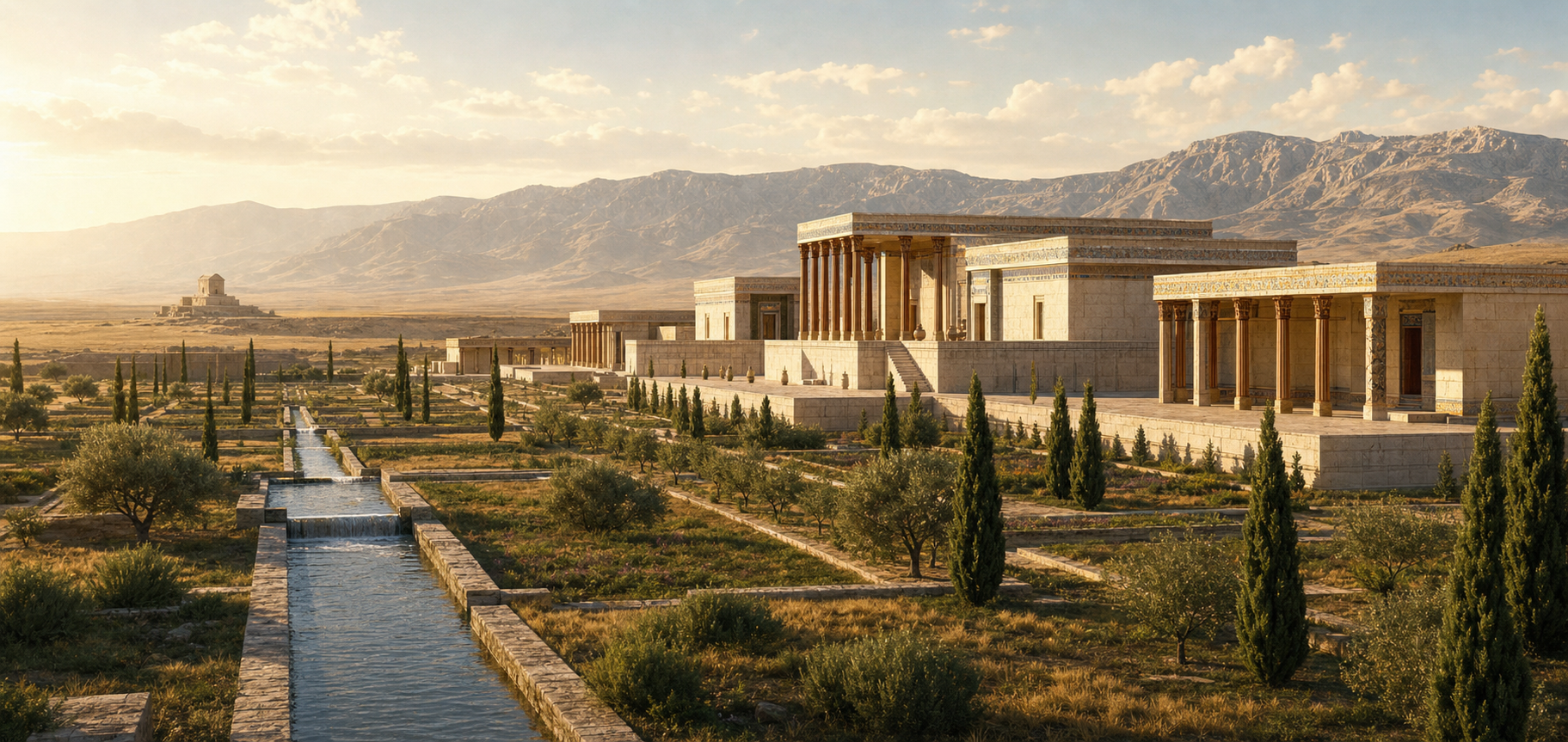
Between approximately 4000 and 2500 BCE, human society underwent one of the most important transformations in history. Across parts of the ancient Near East, especially Mesopotamia, large permanent settlements developed into the world's earliest true cities. These communities were far larger and more complex than the farming villages that had preceded them. They contained temples, workshops, administrative buildings, marketplaces and densely packed homes, while thousands of inhabitants depended upon organised systems of agriculture, trade, government and religion.
The emergence of cities did not happen suddenly. It was the result of developments that had been taking place for thousands of years. Agriculture allowed communities to produce reliable food supplies, while irrigation made it possible to cultivate fertile but dry landscapes. Growing populations encouraged greater cooperation, specialisation and administration. Eventually some settlements became centres of political power, religious authority, craft production and long-distance trade.
From Villages to Cities
For most of human existence, people lived in relatively small communities. The development of agriculture during the Neolithic period gradually changed this pattern. Farmers established permanent settlements where they cultivated crops, raised animals and constructed increasingly substantial houses.
As agricultural techniques improved, some communities were able to produce more food than their inhabitants immediately required. This surplus could support people who were not directly involved in farming. Craftspeople, builders, merchants, priests, administrators and soldiers could therefore become permanent members of society.
The growth of specialised occupations was one of the defining features of urban civilisation. Instead of every family producing everything it needed, people increasingly relied upon one another. Farmers supplied grain, herders provided animals, potters produced containers, metalworkers made tools and weapons, while merchants moved goods between communities.
This growing interdependence required new forms of organisation. Food had to be collected and stored, irrigation systems maintained, disputes resolved and major building projects coordinated. These demands encouraged the emergence of institutions capable of governing increasingly large populations.
Mesopotamia and the Birth of Urban Life
The earliest large-scale urban development occurred in Mesopotamia, the region between the Tigris and Euphrates rivers in what is now primarily Iraq. The southern part of this region contained extremely fertile soils, but agriculture depended heavily upon careful control of water.
Communities constructed canals, channels and embankments to direct river water towards their fields. Irrigation made it possible to produce large quantities of barley, dates and other crops, supporting populations much larger than those of earlier villages.
By the fourth millennium BCE, several settlements in southern Mesopotamia were expanding dramatically. Among them was Uruk, which became one of the most important cities of the ancient world. Its growth was so significant that archaeologists use the term Uruk period to describe an important phase of Mesopotamian development between roughly 4000 and 3100 BCE.
Uruk: The First Great City
Uruk is often described as one of the world's earliest true cities. By the later fourth millennium BCE, it had grown into an enormous settlement by the standards of the ancient world. Its population may have numbered tens of thousands, although exact estimates remain uncertain.
The city contained monumental buildings, religious precincts, workshops and residential areas. Two particularly important sacred districts were associated with the deities Anu and Inanna. These religious complexes contained large temples constructed on elevated platforms, demonstrating both the importance of religion and the ability of the community to organise large numbers of workers.
Temples were more than places of worship. They could control agricultural land, receive goods, employ workers and redistribute food and materials. Religious institutions therefore played an important role in the economic organisation of early Mesopotamian cities.
Uruk also became a centre of craft production. Pottery, textiles, stone objects and metal goods were manufactured on a scale far greater than that found in earlier farming communities. Standardised objects, including large numbers of simple pottery bowls, suggest organised systems for distributing food or rations to workers.
The Development of Writing
The administration of growing cities created a need to record increasingly complicated economic transactions. Officials needed methods for tracking grain, livestock, labour and goods stored in temples and other institutions.
Small clay tokens had been used for accounting purposes before the appearance of cities, but during the late fourth millennium BCE new recording systems developed in southern Mesopotamia. Symbols were impressed or drawn onto clay tablets to represent quantities and commodities.
These early signs gradually developed into the writing system known as cuneiform. Initially, writing was used primarily for administration rather than literature. Early tablets recorded deliveries of grain, livestock, land, labour and other economic information.
The invention of writing was one of the most important consequences of urbanisation. It allowed governments and institutions to maintain records on a scale impossible through memory alone. Over time, writing would also be used for laws, letters, religious texts, royal inscriptions, mathematics, literature and historical accounts.
Temples and Religion
Religion occupied a central position in the earliest cities. Mesopotamians believed that powerful gods controlled natural forces and influenced the prosperity of their communities. Each city was normally associated with particular divine patrons whose temples stood at the heart of urban life.
Temple complexes represented the relationship between the community and its gods. Priests performed rituals, organised offerings and supervised property belonging to the temple. Agricultural produce, animals and manufactured goods could all pass through temple institutions.
Monumental religious architecture also demonstrated the power and wealth of the city. Constructing enormous buildings from mud brick required large labour forces, skilled planners and substantial supplies of food. Such projects could only be achieved by highly organised communities.
The Rise of Government
As cities grew larger, systems of authority became increasingly important. Managing irrigation canals, defending agricultural land, organising labour and resolving disputes required leadership.
The exact nature of government in the earliest cities remains difficult to reconstruct. Religious institutions clearly possessed considerable influence, but powerful secular leaders also emerged. Over time, rulers who could command soldiers, supervise construction and control resources became increasingly important.
By the third millennium BCE, Mesopotamian cities were frequently ruled by kings. Royal authority was often presented as having divine approval. Kings claimed responsibility for protecting their cities, maintaining temples, administering justice and leading armies against enemies.
City-States of Sumer
By about 3000 BCE, southern Mesopotamia contained numerous independent city-states. This region later became known as Sumer. Important centres included Uruk, Ur, Eridu, Lagash, Kish, Nippur and Umma.
Each city-state controlled not only the urban centre itself but also surrounding villages, farmland and irrigation networks. Although the inhabitants shared many aspects of language, religion and culture, the cities were politically independent and frequently competed with one another.
Conflict often centred upon land and access to water. Agricultural fields depended upon irrigation canals, and controlling these systems could determine the prosperity of an entire city. Rival rulers therefore fought wars over territory, boundaries and resources.
The existence of competing city-states created a political landscape very different from that of a single unified kingdom. Alliances shifted, cities rose and fell in power, and rulers attempted to extend their influence over neighbouring territories.
Ur and the Growth of Sumerian Cities
Ur became one of the most important cities of southern Mesopotamia during the third millennium BCE. Located close to ancient waterways that connected the city with the Persian Gulf, Ur was well positioned for trade.
The surrounding countryside produced agricultural wealth, while merchants brought valuable materials from distant regions. Archaeological evidence from Ur demonstrates the sophistication and prosperity achieved by early urban society.
By around 2600 BCE, elite tombs at Ur contained remarkable quantities of gold, silver, precious stones, musical instruments, weapons and decorated objects. These discoveries reveal both the wealth of the city's ruling elite and the extensive trade networks connecting Mesopotamia with distant lands.
Trade and the First Cities
The growth of cities depended upon trade because southern Mesopotamia lacked many important natural resources. The region possessed fertile soil and clay but had relatively little high-quality timber, building stone or metal ore.
Merchants therefore established connections with distant regions. Timber could come from the mountains to the north and west, metals from Anatolia, Iran and Oman, and precious stones from even farther away.
Lapis lazuli, a deep blue stone highly valued by Mesopotamian elites, was transported across enormous distances from sources in what is now Afghanistan. Its presence in Mesopotamian cities demonstrates that extensive exchange networks existed thousands of years before modern transportation.
Trade did more than move goods. It also carried ideas, artistic styles, technologies and cultural influences between societies. Early cities became centres where people from different regions encountered one another and exchanged knowledge.
Crafts and Specialised Labour
Urban life allowed unprecedented levels of occupational specialisation. Skilled craftspeople could devote much of their working lives to producing particular goods rather than growing their own food.
Potters created vessels for cooking, storage and trade. Weavers produced textiles from wool and plant fibres. Metalworkers developed techniques for shaping copper and increasingly experimented with alloys that eventually contributed to the wider use of bronze.
Stoneworkers carved seals, sculptures and decorative objects. Carpenters constructed furniture, boats and buildings, while builders created monumental structures from mud brick.
One particularly important object was the cylinder seal. These small carved stones were rolled across wet clay to create detailed images. They could identify individuals, seal containers and authenticate administrative documents. Cylinder seals became both practical tools and sophisticated works of art.
Social Hierarchy
The first cities were not socially equal communities. Urban society became increasingly divided according to wealth, occupation and status.
At the top stood rulers, powerful families and high-ranking religious officials. Beneath them were administrators, merchants, soldiers and skilled craftspeople. Farmers provided much of the food that supported the population, while labourers constructed buildings, maintained canals and performed other essential work.
Slavery also existed in early Mesopotamian society. People could become enslaved through warfare, debt or other circumstances. Their experiences varied considerably, but slavery formed part of the increasingly complex social and economic systems of the ancient cities.
Differences in wealth can be seen archaeologically in houses, graves and possessions. Some families lived in large homes and possessed valuable imported goods, while others occupied much smaller residences with fewer material possessions.
Life Inside an Ancient City
The experience of living in an early city would have been very different from life in a small farming village. Streets passed between densely packed mud-brick houses, while workshops, markets, temples and administrative buildings created areas of constant activity.
Most ordinary houses were constructed around internal courtyards. These spaces provided light and ventilation while also serving as areas for cooking, craftwork and family life.
City streets were often narrow and irregular. Waste disposal and drainage presented continuing challenges, while mud-brick buildings required regular repair because of weather and erosion.
Despite these difficulties, cities offered opportunities unavailable in smaller settlements. People could participate in specialised trades, exchange goods in markets, work for temples or rulers and become part of large religious and political communities.
The Importance of Irrigation
Water management was fundamental to Mesopotamian urban civilisation. The rivers provided essential water, but their behaviour could be unpredictable. Communities therefore constructed extensive networks of canals to bring water to agricultural fields.
Building and maintaining irrigation systems required cooperation on a large scale. Canals had to be dug, cleared and repaired, while water had to be distributed between different farming areas.
Control over irrigation could therefore become a source of political power. Authorities capable of organising labour and regulating access to water possessed enormous influence over agricultural production.
Irrigation also created environmental challenges. Continued irrigation in southern Mesopotamia could increase soil salinity as water evaporated and left minerals behind. Over long periods this affected agricultural productivity and encouraged farmers to rely increasingly upon salt-tolerant crops such as barley.
Walls, Warfare and Defence
As cities became wealthier, competition between them intensified. Fortifications became an important feature of urban landscapes.
City walls served practical and symbolic purposes. They protected inhabitants against raids and rival armies while also marking the boundary between the organised urban community and the surrounding countryside.
Later Mesopotamian traditions associated Uruk with enormous defensive walls. Although stories about their construction became legendary, archaeological evidence confirms that fortifications were an important feature of early cities.
Warfare encouraged the development of organised armies and strengthened the authority of military leaders. Successful rulers could gain territory, control trade routes and seize agricultural resources from rival states.
Early Cities Beyond Mesopotamia
Although southern Mesopotamia experienced some of the earliest large-scale urbanisation, cities eventually developed independently or through complex interactions in several parts of the ancient world.
Egypt underwent political and social transformation during the late fourth millennium BCE. Settlements expanded along the Nile, regional rulers competed for power and eventually a unified Egyptian kingdom emerged around the beginning of the third millennium BCE.
Unlike Mesopotamia, where many independent city-states remained politically important, Egypt became organised around a territorial kingdom ruled by a pharaoh. Major centres such as Memphis played important administrative, religious and economic roles within this larger state.
Egypt and the Nile
The Nile provided Egypt with a very different environment from southern Mesopotamia. Its annual flood deposited fertile soil along the river valley, creating highly productive farmland surrounded by desert.
The concentration of settlement along the Nile encouraged communication and political integration. Boats could transport grain, stone, officials and soldiers over long distances, connecting communities throughout the kingdom.
By the Early Dynastic Period, Egyptian rulers commanded resources on an extraordinary scale. Royal tombs, temples and eventually monumental stone architecture demonstrated the ability of the state to organise large labour forces and redistribute agricultural surplus.
The construction of the great pyramids during the third millennium BCE would become one of the most spectacular expressions of this centralised political system.
Urban Development in the Indus Valley
Farther east, communities of the Indus region were also developing increasingly complex settlements. During the centuries approaching 2500 BCE, this process culminated in the emergence of the Indus civilisation, one of the great urban cultures of the ancient world.
Cities such as Harappa and Mohenjo-daro reached their greatest development after approximately 2600 BCE. They differed significantly from Mesopotamian cities in their layout and architecture.
Indus cities were notable for carefully planned streets, standardised bricks and sophisticated drainage systems. Many houses were connected to covered drains, demonstrating remarkable attention to sanitation and urban infrastructure.
Trade connected the Indus civilisation with regions to the west, including Mesopotamia. Mesopotamian texts later referred to a distant land called Meluhha, which many scholars associate with the Indus region.
Urban Centres and Long-Distance Connections
By 2500 BCE, the ancient world contained several major centres of complex civilisation. Mesopotamian city-states flourished between the Tigris and Euphrates, Egypt possessed a powerful centralised monarchy along the Nile, and cities were developing across the Indus region.
These civilisations were not completely isolated from one another. Networks of trade connected communities across the Persian Gulf, Iranian plateau, Arabian Peninsula and eastern Mediterranean.
Ships carried timber, metals, stone and luxury goods between ports. Caravans transported commodities across deserts and mountain passes. Through these routes, technological ideas and cultural influences could travel enormous distances.
The City and the Countryside
Ancient cities could not survive without the countryside surrounding them. Urban populations depended upon farmers and herders for food, raw materials and labour.
Grain produced in rural villages could be collected as taxes or offerings and transported into cities. Wool from sheep supplied textile workshops, while animals provided meat, leather and transport.
In return, cities provided manufactured goods, religious institutions, markets, political administration and military protection. The relationship between city and countryside therefore formed the economic foundation of early civilisation.
Administration and Record Keeping
Managing thousands of people required systems far more sophisticated than those needed by small villages. Officials supervised workers, collected agricultural produce and distributed rations.
Clay tablets became essential tools of administration in Mesopotamia. Scribes recorded quantities of grain, animals, textiles and labour. They also used seals to identify individuals and institutions responsible for particular transactions.
Scribes became highly specialised professionals because writing required extensive training. Their skills gave them an important role within temples, palaces and governments.
The existence of bureaucratic administration was one of the defining characteristics of early urban civilisation. Governments could now manage resources across large territories and preserve information beyond the memory of individual officials.
Monumental Architecture
The first cities transformed the physical landscape through monumental construction. Temples, walls, palaces and ceremonial buildings rose above ordinary houses and could often be seen from far outside the settlement.
Such structures demonstrated more than architectural skill. They represented the ability of rulers and institutions to gather materials, feed workers and organise labour over long periods.
In Mesopotamia, temple platforms eventually developed into the massive stepped structures known as ziggurats. In Egypt, royal funerary architecture developed from mastaba tombs into enormous stone pyramids.
Monuments gave permanent physical form to political and religious authority. Their ruins remain among the most visible surviving symbols of the world's earliest civilisations.
Why the First Cities Mattered
The emergence of cities changed human history permanently. For the first time, enormous populations lived together in densely settled communities governed by complex institutions.
Urban civilisation encouraged the development of writing, taxation, organised religion, specialised labour, large-scale trade and formal government. It also produced new inequalities, organised warfare and competition for land and resources.
Cities became centres of innovation because they brought together skilled people, resources and ideas. Technologies could spread rapidly, administrative systems became increasingly sophisticated and artistic traditions flourished.
Many institutions that later became fundamental to civilisation first appeared or greatly expanded within these early urban societies. Governments maintained records, merchants organised long-distance commerce, rulers commissioned public works and communities created laws and systems of administration.
A New Stage in Human History
Between approximately 4000 and 2500 BCE, humanity entered a new stage of social development. The small farming settlements of earlier periods did not disappear, but they became increasingly connected to much larger political and economic systems dominated by cities.
Uruk and the other cities of Sumer demonstrated how agricultural surplus, specialised labour, religious authority and administration could support populations of unprecedented size. Egypt developed a different model based upon a highly centralised territorial kingdom, while the Indus region produced carefully planned urban centres of its own.
The first cities were places of extraordinary achievement but also places of inequality, conflict and environmental pressure. Their inhabitants faced many of the same fundamental challenges that later urban societies would confront: securing food and water, governing large populations, maintaining infrastructure, managing trade and defending communities from attack.
By 2500 BCE, urban civilisation had become firmly established across several regions of the ancient world. The cities created during these centuries laid the foundations for kingdoms and empires that would dominate history for thousands of years. Writing, bureaucracy, monumental architecture, organised trade and state government all developed alongside urban life, making the rise of the first cities one of the great turning points in human civilisation.