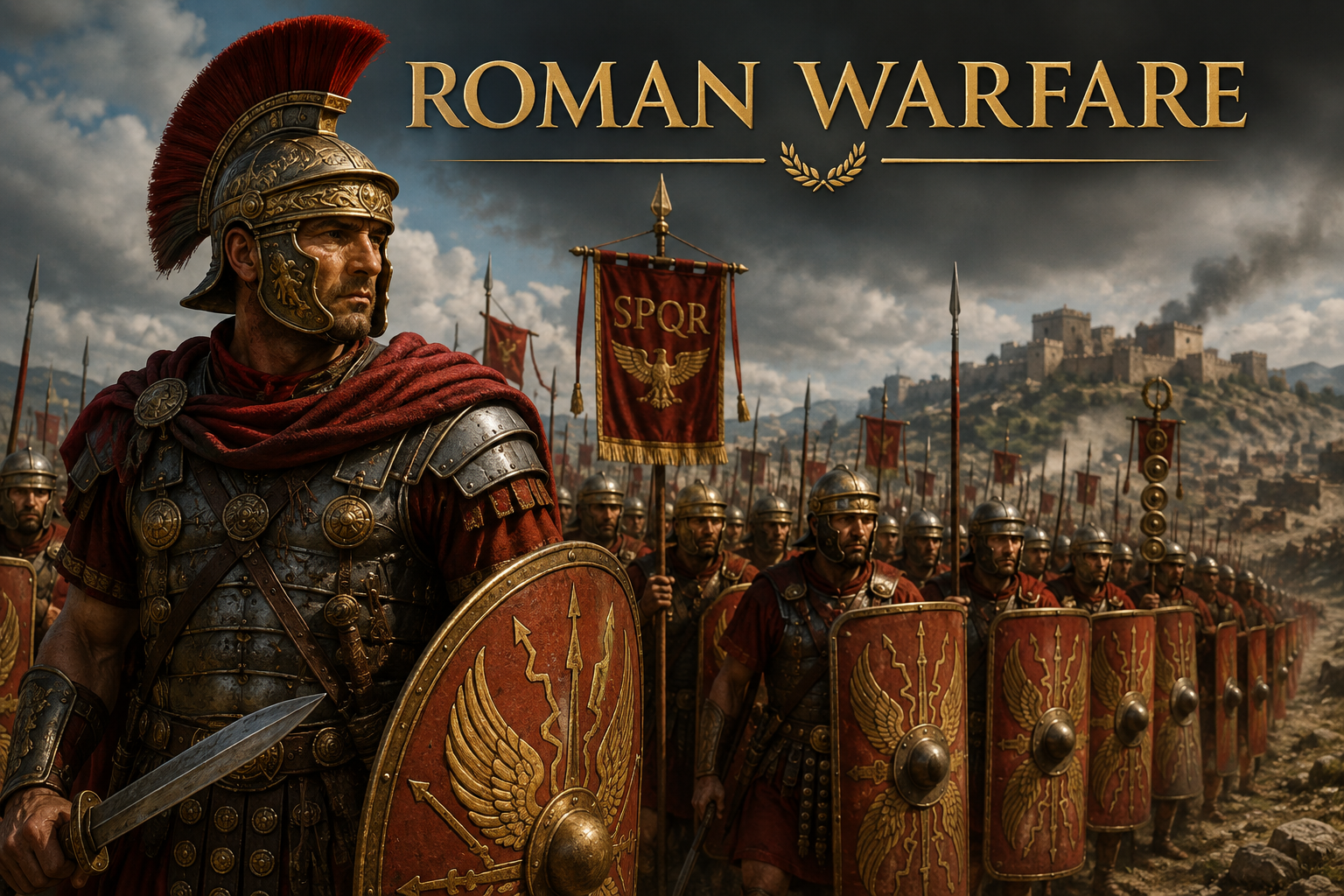
The Roman legion was one of the most influential military institutions of the ancient world. For centuries, Roman legions fought across Europe, North Africa and the Near East, helping transform Rome from a small community in central Italy into the dominant power of the Mediterranean and eventually the centre of a vast empire.
The legion was far more than a mass of soldiers carrying swords and shields. It was a highly organised military formation supported by officers, engineers, craftsmen, medical personnel, surveyors, administrators and extensive logistical systems. Roman soldiers built roads, bridges, forts and siege works as well as fighting battles.
The organisation, weapons and tactics of Roman legions changed significantly over the many centuries of Roman history. The legion that fought against Carthage during the Punic Wars was not identical to the professional imperial legion stationed along the Rhine in the second century CE, and both differed from the armies of Late Antiquity.
Nevertheless, several characteristics repeatedly defined Roman military success: organisation, discipline, engineering, logistical endurance, tactical adaptability and the ability to replace losses after severe defeats.
The Origins of the Roman Army
Rome's earliest military history is difficult to reconstruct with certainty.
Later Roman writers described armies serving the legendary kings of Rome, but their accounts were written centuries after the period they attempted to describe.
The Traditional Foundation of Rome
Roman tradition placed the foundation of the city in 753 BCE and associated it with Romulus.
According to legend, Romulus organised Rome's earliest citizens into military and political groups.
Legend and History
These traditions should not be treated as reliable descriptions of an actual eighth-century Roman army.
Archaeology indicates that early Rome developed gradually from communities occupying hills around the lower Tiber.
Early Italian Warfare
Rome belonged to a wider Italian world containing Latins, Etruscans, Sabines, Samnites and numerous other peoples.
Military practices developed through interactions between these communities and through influence from the Greek cities of southern Italy.
The Greek Hoplite Influence
During the Archaic period, heavily armed spear infantry fighting in close formations became important across parts of the Mediterranean.
Early Roman warfare appears to have been influenced by hoplite-style equipment and tactics.
Servius Tullius
Roman tradition associated King Servius Tullius with a military and political organisation based partly upon property classes.
The historical details are uncertain, but the tradition reflects a close connection between wealth, citizenship and military obligation.
The Roman Republic
According to Roman tradition, the monarchy ended around 509 BCE and was replaced by the Roman Republic.
Military command became closely connected with elected magistrates.
The Consuls
Two consuls normally served as Rome's highest annually elected magistrates.
Each possessed imperium, the authority to command armies.
Citizen Soldiers
Early Republican armies consisted primarily of Roman citizens called to serve when military campaigns required them.
They were not initially permanent full-time professional soldiers serving continuously for decades.
Military Obligation
Citizens of appropriate age and property status could be required to perform military service.
As Rome's wars became larger and more distant, these obligations became increasingly demanding.
The Meaning of Legion
The word legion comes from the Latin legio.
It was connected with the idea of choosing, selecting or levying soldiers.
An Army Raised From Citizens
The original meaning therefore reflected the legion's origins as a force levied from the Roman citizen body.
Rome Expands in Italy
During the fifth, fourth and third centuries BCE, Rome gradually expanded its authority across the Italian peninsula.
This process involved warfare, treaties, colonies and alliances.
The Samnite Wars
Rome fought several major conflicts against the Samnites of the central and southern Apennines.
These wars played an important role in Rome's rise to dominance in Italy.
The Caudine Forks
In 321 BCE, a Roman army was trapped by Samnite forces at the Caudine Forks.
The Romans were compelled to surrender under humiliating circumstances.
Rome Could Be Defeated
Roman expansion was not an uninterrupted sequence of victories.
The Republic suffered numerous severe military disasters.
Roman Resilience
One of Rome's most important strengths was its ability to recover from defeat and return to war with new armies.
The Manipular Legion
By the middle Republican period, Roman heavy infantry was organised in a system traditionally described as the manipular legion.
The Manipulus
The manipulus, or maniple, was a tactical subdivision of the legion.
Its relatively small size offered flexibility compared with an army functioning as one continuous dense spear formation.
The Triplex Acies
Roman heavy infantry was commonly arranged in three principal lines.
This formation is conventionally called the triplex acies.
The Hastati
The first major line consisted of soldiers known as hastati.
They were generally younger men within the traditional organisation.
The Principes
The second line consisted of the principes.
They were generally more mature and experienced heavy infantrymen.
The Triarii
The third line consisted of the triarii.
These were veteran soldiers who traditionally carried longer thrusting spears.
Ad Triarios Redisse
A Roman expression meaning that matters had come down to the triarii became associated with reaching a final desperate stage.
The phrase reflected the triarii's position as the last major reserve line.
Velites
Light infantry known as velites operated ahead of or around the heavier infantry.
They carried javelins and lighter defensive equipment.
Roman Cavalry
Citizen cavalry also served alongside the legion.
Rome increasingly relied upon allied and foreign cavalry as its territories expanded.
The Roman Shield
The large Roman shield commonly associated with legionaries was the scutum.
The Scutum
Middle Republican shields were often large and curved, providing extensive protection to the soldier's body.
Construction
Roman shields could be constructed from layers of wood and strengthened with leather, metal edging or other materials.
The Shield Boss
A metal boss protected the soldier's hand and strengthened the centre of the shield.
Using the Shield
The scutum was not simply passive protection.
A legionary could use it aggressively to strike, shove or create space before attacking with his sword.
The Pilum
One of the most famous Roman weapons was the heavy javelin known as the pilum.
A Disruptive Weapon
The pilum was designed to be thrown at relatively short range before close combat.
It could wound opponents or penetrate shields.
Penetrating Shields
A pilum embedded deeply into an enemy shield could make that shield difficult to use effectively.
The Bending Pilum
Popular accounts often claim that every pilum was deliberately designed to bend on impact so it could not be thrown back.
Some pila could bend under particular circumstances, but the idea should not be turned into an absolute rule applying identically to every Roman javelin in every period.
The Gladius
The short sword commonly associated with Roman legionaries is known as the gladius.
Gladius Hispaniensis
Romans adopted or developed sword forms influenced by weapons encountered in Iberia.
The term gladius Hispaniensis is traditionally associated with the Roman sword of the middle Republic.
Cutting and Thrusting
The gladius was capable of both cutting and thrusting.
Roman military doctrine is frequently associated with effective thrusts from behind the protection of the shield.
Not Every Sword Was Identical
Different forms of Roman sword developed across the centuries.
Modern archaeologists classify several types based upon surviving examples.
The Pugio
Roman soldiers could also carry a dagger known as the pugio.
It functioned as a secondary weapon and could also possess decorative importance.
Roman Helmets
Roman military helmets changed considerably over time.
There was no single helmet design worn throughout the entire history of the Roman army.
Montefortino Helmets
During the Republican period, helmets commonly classified as Montefortino types were widely used.
Imperial Gallic Helmets
During the early Empire, helmet styles commonly called Imperial Gallic became prominent.
Imperial Italic Helmets
Other forms classified as Imperial Italic were also used.
Helmet Protection
Roman helmets protected the skull while cheek pieces helped defend the sides of the face.
Neck Guards
Many later helmets included substantial protection at the rear of the head and neck.
Body Armour
Roman legionaries used several forms of body armour.
The relative frequency of different types varied by period and region.
Lorica Hamata
Mail armour known conventionally as lorica hamata was widely used by Roman soldiers.
Thousands of interlocking metal rings created a flexible protective garment.
Mail remained important in Roman service for centuries.
Lorica Segmentata
The armour most strongly associated with the stereotypical imperial legionary is the segmented plate armour commonly called lorica segmentata.
A Modern Name
Lorica segmentata is a modern scholarly term rather than the securely known ancient Roman name for this armour.
Iron Plates
Curved iron strips were connected with fittings to protect the torso and shoulders.
Not Worn by Every Legionary
Segmented armour was only one form of Roman body protection.
Mail and scale armour continued to be widely used during the same periods.
Lorica Squamata
Scale armour is conventionally called lorica squamata.
It consisted of many small overlapping scales attached to a supporting garment.
The Roman Soldier Was Not Uniform
Modern films often show every soldier in one legion wearing perfectly identical equipment.
Ancient armies generally displayed more variation.
Equipment Changed Over Time
Replacement, regional supply, personal preference and changing military fashion could all produce differences within Roman forces.
The Punic Wars
The Roman legion faced one of its greatest tests during the wars against Carthage.
The First Punic War
Beginning in 264 BCE, Rome and Carthage fought primarily over control and influence in Sicily.
Rome Builds a Navy
The Republic developed major naval forces despite having less maritime experience than Carthage.
Roman Persistence
Rome repeatedly replaced fleets after storms and defeats.
This willingness to continue despite extraordinary losses foreshadowed its response to later disasters.
The Second Punic War
In 218 BCE, Hannibal Barca invaded Italy after marching from Iberia through Gaul and across the Alps.
The Trebia
Hannibal defeated Roman forces at the River Trebia in 218 BCE.
Lake Trasimene
In 217 BCE, Hannibal trapped and destroyed much of a Roman army near Lake Trasimene.
Cannae
The greatest catastrophe came at Cannae in 216 BCE.
A Massive Roman Army
Rome assembled an exceptionally large force intended to crush Hannibal through overwhelming infantry strength.
Hannibal's Trap
Hannibal allowed his centre to give ground while strong infantry formations engaged the Roman flanks.
Carthaginian Cavalry
Carthaginian and allied cavalry defeated Roman horsemen and eventually attacked the Roman infantry from behind.
Encirclement
The Roman army became surrounded.
Tens of thousands of Romans and allies were killed or captured.
The Legion Was Not Invincible
Cannae demonstrated that Roman infantry could be destroyed when an enemy successfully manipulated its strengths and weaknesses.
Rome Refuses to Surrender
The Republic responded not by negotiating immediate peace but by raising additional armies.
The Fabian Strategy
Roman commanders increasingly avoided fighting Hannibal under conditions favourable to him.
They attacked Carthaginian interests elsewhere while gradually recovering rebellious Italian communities.
Scipio Africanus
Publius Cornelius Scipio eventually emerged as one of Rome's greatest commanders.
Spain
Scipio destroyed much of Carthaginian power in Iberia.
Ilipa
His victory at Ilipa demonstrated tactical flexibility and careful deployment.
Africa
Scipio later carried the war into North Africa.
Zama
In 202 BCE, Roman forces defeated Hannibal at the Battle of Zama.
Rome Wins the War
Carthage accepted severe peace terms.
The Roman Republic emerged as the dominant power of the western Mediterranean.
The Legion and Roman Expansion
After the Punic Wars, Roman armies increasingly campaigned across the Mediterranean.
Macedonia
Rome fought a series of wars against the Macedonian kingdom.
Cynoscephalae
In 197 BCE, Roman forces defeated the Macedonian army of Philip V at Cynoscephalae.
Legion Against Phalanx
The battle became famous in later discussions comparing the Roman legion with the Macedonian sarissa phalanx.
The Macedonian Phalanx
Phalangites carried extremely long pikes known as sarissas.
In good order on suitable terrain, the formation presented a formidable wall of spear points.
Roman Flexibility
The Roman manipular system could operate through smaller tactical subdivisions.
This could become advantageous when terrain or battlefield disorder disrupted the phalanx.
Not a Simple Weapon Test
Cynoscephalae was not an abstract experiment proving that one military system was always superior to another.
Terrain, command decisions and battlefield circumstances were decisive.
Pydna
In 168 BCE, Rome defeated King Perseus of Macedon at Pydna.
The Phalanx Advances
The Macedonian formation initially demonstrated enormous frontal power.
The Ground Becomes Uneven
As the formation moved over difficult ground, gaps developed.
Roman Soldiers Enter the Gaps
Roman units exploited breaks in the formation and fought at close range, where the long sarissas were less useful.
Macedonia Falls
The victory accelerated the end of Macedonian independence.
Rome in the Eastern Mediterranean
Roman legions increasingly intervened in Greece, Asia Minor and the wider Hellenistic world.
The Third Punic War
Rome fought Carthage again from 149 to 146 BCE.
The Siege of Carthage
The city resisted for years before Roman forces under Scipio Aemilianus finally captured it.
146 BCE
In the same year, Roman forces also destroyed Corinth after conflict with the Achaean League.
Roman Military Power Expands
By the middle of the second century BCE, the legion had become the principal military instrument of a rapidly expanding Mediterranean state.
The Social Cost of Expansion
Long overseas campaigns placed increasing strain upon the traditional citizen levy system.
Farmers and Soldiers
Citizens could spend extended periods away from their land while serving in distant wars.
Political Conflict
Questions surrounding land ownership, military recruitment and economic inequality contributed to intense political disputes within the late Republic.
The Gracchi
Tiberius and Gaius Gracchus attempted major reforms during the second century BCE.
Their careers ended violently.
The Marian Reforms
Roman military history often speaks of the Marian reforms associated with Gaius Marius around the end of the second century BCE.
A Traditional Story
Older accounts sometimes portray Marius as completely transforming the Roman army in a single reform programme.
A More Gradual Change
Modern scholarship generally views Roman military professionalisation as a longer process rather than one sudden revolution created entirely by Marius.
Gaius Marius
Marius was an important Roman general and politician who held the consulship multiple times.
Recruitment
During major military emergencies, Marius recruited men without the substantial property qualifications traditionally associated with legionary service.
Military Service as a Career
Increasing numbers of poorer citizens could view military service as a route to pay, loot and eventual land grants.
The Cohort
During the late Republic, the cohort became increasingly important as the legion's principal tactical subdivision.
Ten Cohorts
A legion eventually consisted conventionally of ten cohorts, although exact strengths and organisation varied.
The End of the Manipular Lines
The older distinctions between hastati, principes and triarii gradually disappeared as legionary equipment and organisation became more standardised.
The Eagle
One of the most important symbols of the legion became the eagle standard.
Aquila
The legionary eagle was known as the aquila.
Marius and the Eagle
Ancient tradition associates Marius with establishing the eagle as the supreme standard of the legion.
The Aquilifer
The soldier responsible for carrying the eagle was the aquilifer.
A Position of Honour
The aquilifer occupied an important and prestigious position within the legion.
Losing the Eagle
The loss of a legionary eagle was considered a profound military and symbolic humiliation.
The Standards
Roman units carried several types of military standards.
Signum
Centuries and other formations carried standards that helped soldiers maintain organisation and identify their units.
Signifer
A soldier responsible for carrying such a standard was known as a signifer.
Standards as Rallying Points
In the confusion of battle, standards helped troops determine where their unit should be positioned.
Religious Significance
Military standards also possessed sacred importance.
They were closely connected with the collective identity of the soldiers.
The Late Republican Legion
By the first century BCE, Roman legions had become deeply connected with political power.
Generals and Soldiers
Soldiers increasingly depended upon successful commanders for rewards, booty and support after military service.
Personal Loyalty
This could strengthen personal relationships between troops and generals.
The Republic's Political Crisis
Military commands became central to the violent competition between Roman political leaders.
Sulla
Lucius Cornelius Sulla demonstrated the danger dramatically when he marched his army on Rome.
Roman Soldiers Against Rome
The act shattered an important political taboo.
Roman legions could now become instruments in civil war.
Marius and Sulla
Their rivalry contributed to massacres, proscriptions and repeated political violence.
Pompey
Gnaeus Pompeius Magnus, known as Pompey the Great, gained immense prestige through military victories.
Pompey's Eastern Campaigns
He defeated pirates, campaigned against Mithridates VI and reorganised large territories in the eastern Mediterranean.
Julius Caesar
Perhaps no Roman commander became more closely associated with his legions than Julius Caesar.
The Gallic Wars
From 58 to 50 BCE, Caesar conducted extensive campaigns throughout Gaul.
Professional Experience
Years of continuous campaigning turned many of Caesar's legionaries into highly experienced soldiers.
Roman Engineering
Caesar's narratives repeatedly demonstrate the importance of engineering to legionary warfare.
The Rhine Bridge
Roman soldiers constructed a major bridge across the Rhine during Caesar's campaigns.
Speed of Construction
The project demonstrated the ability of a disciplined army to undertake enormous engineering tasks rapidly.
Britain
Caesar crossed the English Channel and led expeditions into Britain in 55 and 54 BCE.
Alesia
One of Caesar's greatest military achievements occurred during the siege of Alesia in 52 BCE.
Vercingetorix
A Gallic coalition under Vercingetorix concentrated at the fortified settlement.
Roman Circumvallation
Caesar's army constructed extensive fortifications surrounding Alesia.
Contravallation
A second defensive line protected the Romans against a Gallic relief army approaching from outside.
A Fortress Around a Fortress
The Roman army effectively created an enormous fortified system around the enemy position.
Engineering and Discipline
Alesia demonstrated that legionary warfare involved far more than sword fighting.
Vercingetorix Surrenders
The Gallic commander eventually surrendered.
The Rubicon
In 49 BCE, Caesar crossed the Rubicon River with troops and entered Italy against the authority of his political enemies.
Civil War
The Roman military system again became the instrument of internal political conflict.
Caesar Versus Pompey
The two great Roman commanders confronted one another in a struggle for control of the Republic.
Pharsalus
In 48 BCE, Caesar defeated Pompey's army at Pharsalus.
Veteran Legionaries
Caesar's experienced soldiers played a major role in his battlefield success.
Caesar's Assassination
Caesar was murdered in 44 BCE by senators who feared his concentration of power.
More Civil Wars
His death did not restore political stability.
Instead, rival Roman armies fought again.
Octavian
Caesar's adopted heir Octavian emerged as one of the principal contenders.
Mark Antony
Mark Antony commanded substantial military support and controlled much of the Roman East.
Philippi
In 42 BCE, the forces of Antony and Octavian defeated Brutus and Cassius at Philippi.
Actium
In 31 BCE, Octavian's forces defeated Antony and Cleopatra in the campaign culminating at Actium.
The End of Republican Civil War
Octavian emerged as the undisputed ruler of the Roman world.
Augustus
In 27 BCE, Octavian received the title Augustus.
This marked an important stage in the establishment of the Roman Principate.
The Imperial Legion
Augustus reorganised Rome's military forces following decades of civil war.
A Permanent Army
The Roman Empire maintained standing professional legions stationed throughout strategic frontier regions.
Reducing the Number of Legions
After the civil wars, Augustus discharged large numbers of soldiers and reduced the enormous wartime forces to a more sustainable establishment.
Approximately Twenty-Eight Legions
At the beginning of the imperial period, around twenty-eight legions formed the core of the permanent army.
The number changed over subsequent centuries.
Legionary Strength
An imperial legion is often described as containing roughly five thousand soldiers.
Actual strength varied according to recruitment, casualties, detachments and period.
Roman Citizens
During much of the early Empire, legionaries were normally Roman citizens.
Auxiliaries
Non-citizens frequently served in auxiliary units rather than the legions themselves.
The Auxilia
Auxiliary forces became essential to the Roman military system.
Infantry
Auxiliary cohorts provided additional infantry.
Cavalry
Auxiliary alae supplied much of Rome's cavalry.
Archers
Specialist archers could be recruited from regions with strong traditions of missile warfare.
Combined Arms
A Roman field force normally depended upon cooperation between legionaries and auxiliary troops.
The Myth of the Legion Alone
Popular culture often portrays legionaries winning battles almost entirely by themselves.
In reality, cavalry, archers, scouts and other supporting forces could be essential.
Citizenship Through Service
Auxiliary soldiers completing their terms of service could receive Roman citizenship under many imperial arrangements.
Military Diplomas
Bronze military diplomas preserve evidence for grants of citizenship to veterans and their families.
Service Length
Imperial legionaries commonly served for lengthy terms measured in decades rather than short seasonal campaigns.
Twenty Years or More
Terms changed over time, but approximately twenty years of regular service followed in some periods by additional obligations is often associated with the early imperial army.
A Soldier's Career
Military service therefore became a major portion of a man's adult life.
Pay
Legionaries received regular military pay.
Deductions
Expenses for food, clothing or equipment could be deducted under some arrangements.
Donatives
Emperors could distribute special payments to soldiers.
Political Importance of Pay
The army's expectation of reliable compensation became critically important to imperial stability.
The Military Treasury
Augustus created the aerarium militare to help finance veteran benefits.
Veterans
Soldiers completing their service could receive money or land.
Veteran Colonies
Retired soldiers were sometimes settled in colonies throughout the empire.
Romanisation
Veteran settlement contributed to the spread of Roman institutions, Latin language and cultural practices, although local identities continued.
The Structure of an Imperial Legion
The legion possessed a hierarchy allowing thousands of soldiers to operate as an organised force.
The Legatus Legionis
A legion was normally commanded by a legate, conventionally called the legatus legionis.
Senatorial Command
During much of the Principate, legionary legates usually came from the senatorial elite.
The Tribunes
Military tribunes served as senior officers within the legion.
Tribunus Laticlavius
The senior tribune was commonly a young senator gaining military and administrative experience.
Tribuni Angusticlavii
Other tribunes generally came from the equestrian order.
The Praefectus Castrorum
The camp prefect was one of the legion's most experienced senior officers.
A Veteran Officer
He was often a former senior centurion with extensive military experience.
The Centurion
Centurions were among the most important officers in the Roman army.
Commanding the Century
A centurion commanded a unit traditionally called a century.
Not Always One Hundred
Despite the name, an imperial century normally contained fewer than one hundred soldiers.
Eighty Men
Approximately eighty soldiers is commonly given as the nominal strength of many imperial centuries.
Experienced Leaders
Centurions enforced discipline, supervised training and led soldiers in battle.
Fighting From the Front
Roman sources frequently portray centurions occupying dangerous positions during combat.
High Casualties
The visibility and leadership role of centurions could expose them to substantial danger.
Centurion Promotion
Centurions existed in a hierarchy and could advance through increasingly prestigious positions.
Primus Pilus
The highest-ranking centurion of a legion was known as the primus pilus.
The First Spear
The primus pilus was a highly respected veteran officer.
Optio
An optio served as an important subordinate officer within a century.
Supporting the Centurion
He could help maintain order and potentially succeed the centurion.
Tesserarius
A tesserarius performed responsibilities associated with guard duties and watchwords.
Cornicen
Musicians such as the cornicen used horns to communicate commands.
Battlefield Communication
Music, standards and shouted commands helped coordinate troops amid the noise of combat.
Contubernium
The smallest everyday social unit of legionary life was often the contubernium.
Eight Soldiers
A contubernium commonly consisted of around eight men who shared living arrangements and equipment.
Tent Mates
On campaign, members could share a tent.
Military Family
Years of service together could create strong social bonds among soldiers.
The Century
Several contubernia formed a century.
The Cohort
Several centuries formed a cohort.
The Legion
Ten cohorts formed the conventional organisational framework of an imperial legion.
The First Cohort
The first cohort held exceptional prestige and eventually possessed a distinctive organisation.
Double Strength
In some imperial arrangements, the first cohort appears to have contained larger centuries than ordinary cohorts.
The Eagle and First Cohort
The legion's eagle and senior centurions were closely associated with this prestigious formation.
Legionary Identity
Each legion developed its own history, symbols, titles and traditions.
Legion Numbers
Legions were identified by numbers, although duplicate numbers existed because different rulers raised units independently.
Legion Names
Honorific names helped distinguish legions.
Legio X Equestris
Caesar's Tenth Legion became famous during the Gallic Wars.
Legio X Fretensis
Another Tenth Legion, Fretensis, later served prominently in the imperial period.
Legio II Augusta
Legio II Augusta participated in the Roman conquest of Britain.
Legio IX Hispana
The Ninth Legion has become especially famous because its later history is incompletely documented.
The Lost Ninth
Popular stories often claim that the entire legion mysteriously disappeared in northern Britain.
A More Complicated History
Evidence indicates that the Ninth continued to exist after some of the dates traditionally proposed for its supposed British destruction.
Its ultimate fate remains uncertain.
Legio VI Victrix
Legio VI Victrix was later stationed in Britain and associated particularly with York.
Legio XX Valeria Victrix
The Twentieth Legion also played an important role in Roman Britain.
Legio XXX Ulpia Victrix
Trajan created Legio XXX Ulpia Victrix during the imperial period.
Titles as Memory
Legionary titles could commemorate emperors, victories, loyalty or geographical associations.
The Legionary Standard
The standards preserved the collective honour of the unit.
The Imago
Some standards carried images associated with the emperor.
The Emperor and Army
Military loyalty increasingly focused upon the emperor as commander-in-chief.
Sacramentum
Soldiers swore a military oath, conventionally called the sacramentum.
Loyalty
The oath bound soldiers to military service and imperial authority.
Discipline
Roman military writers repeatedly emphasised disciplina.
Training
Soldiers practised weapons, marching and formation drills.
Vegetius
The late Roman writer Vegetius provides extensive descriptions of military training.
He wrote centuries after the height of the early imperial legion and sometimes idealised earlier practices, so his evidence must be used carefully.
Practice Weapons
Vegetius describes soldiers training with practice weapons that could be heavier than normal equipment.
The Training Post
Soldiers could practise striking wooden posts to develop weapon skills.
Marching
Roman soldiers were expected to march substantial distances while carrying equipment.
Marius's Mules
Late Republican legionaries became humorously associated with carrying substantial personal loads and were sometimes called Marius's mules.
The Legionary Pack
A soldier carried weapons, clothing, food and tools.
Self-Sufficiency
Requiring soldiers to carry much of their equipment reduced dependence upon enormous baggage trains.
The Marching Column
The arrangement of a Roman army on the march depended upon terrain and danger.
Scouts
Reconnaissance helped identify threats and suitable routes.
Advance Guards
Units could protect the front of the column.
Baggage
Animals, supplies and non-combatants accompanied large armies.
Rear Guards
Troops could protect the army from attack from behind.
The Roman Marching Camp
One of the legion's most famous practices was constructing fortified camps.
Castra
Roman military camps were known as castra.
Protection Every Night
When campaigning, soldiers could construct defensive camps even after a long day's march.
Ditches
Troops excavated defensive ditches around the position.
Ramparts
Earth from the ditch could contribute to a defensive bank.
Stakes
Wooden stakes or other obstacles strengthened temporary defences.
Gates
The camp contained organised entrances connected by internal roads.
Order Inside the Camp
Units were assigned regular positions.
This allowed soldiers to know where to go even when a new camp had been constructed.
Military Routine
Standardised camp organisation contributed to discipline and security.
Permanent Fortresses
On imperial frontiers, temporary camps evolved into permanent legionary bases.
Stone Fortifications
Many major bases eventually contained stone walls, headquarters buildings, barracks, workshops and hospitals.
Principia
The headquarters building of a permanent fort is conventionally known as the principia.
Praetorium
The commander's residence could occupy another important part of the fortress.
Barracks
Soldiers lived in organised barrack blocks.
Granaries
Food supplies were protected in specially designed storage buildings.
Horrea
Roman granaries are conventionally called horrea.
Valetudinarium
Some military bases contained hospitals generally called valetudinaria.
Military Medicine
Roman armies possessed organised medical personnel, although ancient medicine remained limited compared with modern standards.
Workshops
Military bases included craftsmen capable of maintaining weapons, armour and equipment.
Fabrica
Workshops associated with military production and repair are commonly described as fabricae.
The Legion as a Community
A permanent legionary fortress could become the centre of a large settlement.
Canabae
Civilian communities often developed around military bases.
Traders
Merchants provided goods and services to soldiers.
Families
Although ordinary soldiers were restricted from contracting legal marriages during significant parts of the early Empire, many formed long-term relationships and had children.
Septimius Severus
Policies concerning soldiers and family life changed during the imperial period, especially under later emperors.
Frontier Society
Roman soldiers became deeply connected with provincial communities.
The Roman Road
Military movement depended heavily upon roads.
Viae
Roman roads connected forts, cities and administrative centres.
Not Built Only by Soldiers
The Roman road network resulted from military, governmental and civilian labour across centuries.
Military Engineering
Legionaries nevertheless played important roles in constructing and maintaining roads, particularly in frontier regions.
Straight Roads
Roman roads are famous for long straight sections, although routes adapted to geography when necessary.
Surveying
Roman engineers used surveying instruments to establish routes and construction levels.
The Groma
The groma was an important Roman surveying instrument used for establishing straight lines and right angles.
Bridges
Roman armies built temporary and permanent bridges.
River Crossings
Bridge construction could transform strategic situations by allowing troops to move rapidly across major rivers.
Pontoon Bridges
Boats could be connected to create temporary crossings.
Siege Warfare
Roman military success depended heavily upon the ability to capture fortified settlements.
Siege Camps
Roman armies could surround cities with extensive fortified lines.
Blockade
One strategy was simply to cut a city off from food and reinforcements.
Siege Towers
Large towers allowed attackers to approach or reach defensive walls.
Battering Rams
Rams could attack gates and masonry.
Artillery
Roman armies used mechanical artillery for both field and siege warfare.
Ballista
Machines conventionally called ballistae could launch bolts or stones depending upon design.
Scorpio
Smaller torsion-powered bolt shooters are frequently described as scorpiones.
Onager
Later Roman sources describe stone-throwing artillery commonly called the onager.
Siege Ramps
Roman engineers could construct enormous ramps to reach elevated fortifications.
Masada
The siege of Masada in Judaea provides one of the most dramatic surviving examples.
Jewish Revolt
Following the great Jewish revolt against Rome, defenders occupied the fortress overlooking the Dead Sea.
The Roman Ramp
Roman troops constructed a massive assault ramp against the western side of the fortress.
Archaeological Survival
Substantial traces of Roman siege works remain visible around Masada today.
The Siege of Jerusalem
Roman legions also played a central role in the siege and capture of Jerusalem in 70 CE.
Titus
The campaign was commanded by Titus, son of the emperor Vespasian.
Legio X Fretensis
The Tenth Legion Fretensis participated prominently.
The Second Temple
The Temple was destroyed during the fighting.
The Arch of Titus
A relief on the Arch of Titus in Rome famously depicts Roman soldiers carrying sacred objects taken from Jerusalem.
The Menorah
The seven-branched menorah appears prominently in the relief.
The Roman Legion in Britain
Roman legions began the permanent conquest of Britain under Emperor Claudius in 43 CE.
Aulus Plautius
The invasion force was commanded by Aulus Plautius.
Four Legions
The invasion involved multiple legions supported by auxiliary forces.
Legio II Augusta
The future emperor Vespasian commanded Legio II Augusta during part of the conquest.
Southern Britain
Roman forces rapidly established control over substantial territories.
Resistance Continues
Conquest was neither immediate nor complete.
Different British communities resisted Roman rule for decades.
Caratacus
The British leader Caratacus resisted Roman expansion before eventually being captured.
Boudica
In 60 or 61 CE, Queen Boudica of the Iceni led a major rebellion.
Camulodunum
The Roman colony at Camulodunum was destroyed.
Londinium
Londinium was also attacked and burned.
Legio IX Hispana
A detachment of the Ninth Legion suffered a serious defeat while attempting to confront the uprising.
Roman Recovery
Governor Gaius Suetonius Paulinus assembled available forces and eventually defeated Boudica's army.
Rome Remains in Britain
The province was reconstructed rather than abandoned.
Northern Britain
Roman armies later advanced into Wales and northern Britain.
Agricola
Governor Gnaeus Julius Agricola conducted major campaigns during the late first century CE.
Mons Graupius
Tacitus describes Agricola defeating a northern British coalition at a battle traditionally called Mons Graupius.
The precise battlefield location remains uncertain.
Hadrian's Wall
Beginning around 122 CE under Emperor Hadrian, Roman troops constructed a major frontier system across northern Britain.
Not Simply a Wall
Hadrian's Wall consisted of stone and turf sections, forts, milecastles, towers, roads and defensive works.
Legionary Construction
Legions stationed in Britain contributed heavily to its construction.
Auxiliary Garrisons
Most forts directly along the Wall were occupied principally by auxiliary troops rather than entire legions.
Antonine Wall
During the reign of Antoninus Pius, Roman forces advanced farther north and constructed the Antonine Wall across central Scotland.
Temporary Occupation
The frontier eventually returned south to Hadrian's Wall.
The Rhine Frontier
Some of the Roman Empire's most important legions were stationed along the Rhine.
Germania
Rome repeatedly campaigned east of the Rhine during the late Republic and early Empire.
Drusus
Nero Claudius Drusus conducted extensive campaigns into Germania during the reign of Augustus.
Tiberius
The future emperor Tiberius also commanded major operations in the region.
Teutoburg Forest
In 9 CE, Rome suffered one of the most famous military disasters of the imperial period.
Publius Quinctilius Varus
Varus led several legions through German territory.
Arminius
Arminius, a Germanic aristocrat who had served Rome and possessed Roman citizenship, organised a coalition against the Roman forces.
The Ambush
The Romans were attacked over an extended march through difficult terrain.
Three Legions Destroyed
Legions XVII, XVIII and XIX were destroyed as effective formations.
The Numbers Disappear
The legion numbers seventeen, eighteen and nineteen were not subsequently reused in the standard imperial sequence.
Augustus and Varus
Suetonius later claimed that Augustus lamented the disaster and called upon Varus to give back his legions.
The dramatic wording belongs to later literary tradition.
Rome Strikes Back
Roman armies later returned to Germania under Germanicus.
Recovered Eagles
Some legionary standards lost in the Varian disaster were eventually recovered.
No Permanent Conquest Beyond the Rhine
Rome ultimately did not transform most territory between the Rhine and Elbe into permanent imperial provinces.
Frontier Strategy
The Rhine became one of the major military frontiers of the empire.
The Danube Frontier
The Danube formed another major defensive and operational zone.
Legionary Bases
Numerous legions were stationed along the river and surrounding provinces.
The Dacian Wars
Emperor Trajan conducted major wars against the Dacian kingdom north of the Danube.
Decebalus
King Decebalus led Dacian resistance.
Trajan's Bridge
The Roman army constructed an enormous bridge across the Danube associated with the architect Apollodorus of Damascus.
Dacia Conquered
Following the wars ending in 106 CE, Dacia became a Roman province.
Trajan's Column
The monumental column erected in Rome depicts scenes from the Dacian campaigns.
Roman Soldiers in Stone
The relief provides valuable visual evidence for soldiers, camps, bridges, equipment and military labour.
Artistic Source
Like all imperial monuments, the column communicates political messages and should not be treated as a neutral photographic record.
Roman Soldiers Building
Many scenes emphasise soldiers constructing fortifications and infrastructure rather than simply fighting.
The Eastern Frontier
Rome's greatest eastern rivals included the Parthian and later Sasanian empires.
Parthia
The Parthian Empire controlled large territories stretching across Iran and Mesopotamia.
Carrhae
In 53 BCE, Roman forces under Marcus Licinius Crassus suffered a disastrous defeat at Carrhae.
Parthian Horse Archers
Highly mobile mounted archers repeatedly attacked the Roman formations.
Cataphracts
Heavily armoured Parthian cavalry provided additional striking power.
Roman Limitations
The battle demonstrated the difficulties legionary heavy infantry could face against highly mobile cavalry on open terrain.
Crassus Is Killed
Crassus died during the failed campaign.
Roman Standards Captured
Parthia captured prestigious Roman standards.
Augustus Recovers the Standards
In 20 BCE, Augustus secured their return through diplomacy.
Diplomatic Victory
Augustan propaganda represented the recovery as a major restoration of Roman honour.
Trajan in Mesopotamia
Trajan later invaded the Parthian Empire and temporarily extended Roman control deep into Mesopotamia.
Temporary Conquest
His successor Hadrian abandoned much of the newly conquered eastern territory.
The Sasanian Empire
During the third century CE, the Sasanians replaced the Parthian dynasty as Rome's great eastern rival.
A Formidable Enemy
Sasanian armies combined heavy cavalry, mounted archery, infantry and siege capabilities.
Emperor Valerian
In 260 CE, Roman emperor Valerian was defeated and captured by the Sasanian king Shapur I.
An Emperor Captured
The event was one of the greatest humiliations suffered by Roman imperial authority.
Rome Was Never Militarily Untouchable
The history of the legion contains remarkable victories but also defeats at Cannae, Carrhae, Teutoburg and numerous other battles.
The Strength Was Recovery
Roman power often depended less upon never losing than upon possessing the resources and institutions necessary to survive losses.
Roman Logistics
Successful campaigning depended upon feeding men and animals across enormous distances.
Grain
Grain formed a crucial part of the soldier's diet.
Bread and Porridge
Soldiers could consume grain in several forms, including bread and porridge-like preparations.
Meat
Archaeological and textual evidence indicates Roman soldiers also consumed meat.
Wine
Wine or diluted wine could form part of military supplies.
Posca
A sour wine or vinegar-based drink commonly called posca is associated with Roman soldiers and lower-status consumers.
Water
Access to clean or usable water was critical.
Supply Depots
Armies established supply centres and drew resources from provinces.
Pack Animals
Mules and other animals carried heavy equipment and supplies.
Ships
Sea and river transport could move enormous quantities of material more efficiently than land transport.
The Mediterranean
Roman control of Mediterranean sea routes became a major strategic advantage.
Military Grain Supply
Provincial agriculture helped support armies stationed far from Italy.
The Legionary Diet Was Not Universal
Food varied according to region, season, availability and military circumstances.
Roman Discipline
The legion became famous for strict military discipline.
Punishments
Roman military law included financial penalties, demotion, corporal punishment and execution for serious offences.
Fustuarium
Some ancient sources describe collective punishment in which soldiers convicted of severe military crimes could be beaten to death by fellow troops.
Decimation
The most notorious Roman military punishment was decimation.
One in Ten
In its traditional form, a disgraced group could be divided and one man in ten selected for execution.
Rare Rather Than Routine
Decimation was an exceptional punishment, not a normal daily feature of Roman military life.
Crassus and Decimation
Crassus is famously associated with using decimation during the war against Spartacus.
Discipline Through Rewards
The Roman army did not operate through punishment alone.
Military Decorations
Soldiers could receive awards for exceptional courage.
Corona Civica
The Civic Crown was a prestigious honour associated with saving the life of a Roman citizen in battle.
Corona Muralis
Tradition associated the Mural Crown with being among the first to scale an enemy wall.
Torques and Armillae
Decorations including neck ornaments and bracelets could be granted for military distinction.
Promotion
Competence and bravery could lead to advancement.
Booty
Campaigns could provide soldiers with shares of plunder.
Military Honour
Reputation among fellow soldiers and commanders formed another powerful incentive.
The Roman Battle Line
Roman tactical deployment varied enormously across centuries.
No Single Universal Formation
Descriptions presenting one exact legionary formation as standard for every Roman battle are misleading.
Cohort Deployment
Imperial and late Republican armies frequently deployed cohorts in several lines.
Reserves
Commanders could retain units behind the main battle line to reinforce weak points.
Intervals
Roman formations could contain spaces allowing movement and tactical adjustment.
The Initial Missile Exchange
Depending upon period and enemy, legionaries could throw pila before closing for hand-to-hand fighting.
Close Combat
Shields and swords then became central.
Battle Was Chaotic
Modern depictions sometimes show Roman formations operating with perfect mechanical precision throughout an entire battle.
Actual combat was noisy, frightening and confused.
Centurions Maintain Order
Experienced officers helped maintain cohesion and direct soldiers through changing circumstances.
Standards Guide Units
Visible standards provided important orientation.
Trumpet Signals
Musical signals helped communicate commands.
The Testudo
One of the most famous Roman formations was the testudo, or tortoise.
Shield Roof
Soldiers positioned shields in front, at the sides and overhead to create protection against missiles.
Siege Use
The formation was particularly useful when approaching defended positions exposed to arrows or projectiles.
Not the Standard Battle Formation
The testudo should not be imagined as the normal formation used for every Roman infantry engagement.
Reduced Mobility
Maintaining the formation limited visibility, mobility and offensive capability.
The Wedge
Roman armies could also employ concentrated attacking formations described as wedges.
Breaking a Line
The objective was to concentrate pressure against a particular point.
Defensive Formations
Troops could form dense defensive groups when surrounded or threatened by cavalry.
Adaptability
The precise arrangement depended upon the tactical situation.
Roman Siege Engineering
Legions possessed extraordinary ability to transform landscapes through military labour.
Ditches and Walls
Fortification could protect camps or imprison enemy forces.
Roads
New roads accelerated movement and supply.
Bridges
Bridges overcame river barriers.
Ramps
Siege ramps allowed attacks on fortified heights.
Tunnels
Roman soldiers and specialist engineers could conduct mining operations against fortifications.
The Legionary Spade
The digging tool was almost as important to Roman warfare as the sword.
Victory Before the Battle
Many Roman campaigns were decided partly through preparation, logistics and fortification before armies met in close combat.
Roman Military Intelligence
Scouting and intelligence were essential.
Exploratores
Roman sources refer to scouts conventionally called exploratores.
Speculatores
Other personnel known as speculatores could perform reconnaissance, courier and security functions.
Local Intelligence
Roman commanders depended upon guides, allied communities and political contacts.
Interrogation
Prisoners and deserters could provide information about enemy movements.
Maps and Geography
Roman military planning relied upon practical geographical knowledge rather than modern-style detailed maps alone.
The Importance of Roads
Known routes, distances and supply stations helped armies move efficiently.
Roman Military Medicine
Injury was an unavoidable reality of legionary service.
Battle Wounds
Soldiers suffered cuts, punctures, fractures and missile wounds.
Infection
Without modern antibiotics, infection could make relatively limited injuries fatal.
Medical Specialists
The Roman military employed people with medical responsibilities.
Hospitals
Purpose-built military hospitals have been identified at several permanent bases.
Surgical Instruments
Archaeological discoveries include instruments associated with Roman medical treatment.
Limits of Ancient Medicine
Roman medical knowledge could treat some injuries effectively, but many serious wounds remained extremely dangerous.
The Daily Life of a Legionary
A soldier's life involved far more routine labour than spectacular battles.
Guard Duty
Soldiers guarded gates, walls, stores and important officials.
Training
Military exercises maintained physical fitness and unit cohesion.
Construction
Legionaries built and repaired roads, forts and public infrastructure.
Maintenance
Weapons and armour required regular care.
Administrative Duties
Literate soldiers could serve as clerks and record keepers.
Beneficiarii
Certain soldiers were detached to administrative or policing duties.
Immunes
Specialists known broadly as immunes could be exempt from some ordinary fatigues because of their technical skills.
Engineers
Technical specialists supported construction and military machinery.
Surveyors
Surveying expertise was necessary for camps, roads and building projects.
Craftsmen
Blacksmiths, carpenters and other craftsmen supported the military system.
Musicians
Military musicians transmitted signals and performed ceremonial duties.
Clerks
The Roman army generated large quantities of paperwork.
Vindolanda Tablets
Wooden writing tablets discovered at Vindolanda near Hadrian's Wall provide extraordinary evidence for Roman military life.
Letters
The tablets preserve personal correspondence, supply requests and administrative records.
Ordinary Voices
They reveal aspects of military life often absent from grand historical narratives.
Socks and Clothing
Some records mention practical items such as socks and clothing suited to Britain's climate.
Birthday Invitation
A famous tablet preserves an invitation associated with a birthday celebration.
Soldiers Were People
Such evidence reminds us that Roman military communities contained friendships, families, complaints and everyday concerns.
Religion in the Legion
Religion was deeply integrated into Roman military life.
Jupiter
Jupiter was central to Roman state religion and military victory.
Mars
Mars possessed obvious importance as a god associated with warfare and the Roman people.
Standards
The legionary standards themselves received religious reverence.
The Imperial Cult
Soldiers participated in ceremonies honouring the emperor and imperial household.
Local Gods
Troops stationed throughout the empire also worshipped regional deities.
Religious Diversity
The Roman army brought together people from many cultural and religious backgrounds.
Mithras
The cult of Mithras became popular among some soldiers during the imperial period.
Mithraea
Small temples associated with the cult have been discovered at military sites.
Not the Religion of Every Soldier
Mithraism was only one among many religious traditions represented within Roman military communities.
Christian Soldiers
Christianity gradually spread through the empire, including among members of the military.
Changing Religious World
By Late Antiquity, Christianity became increasingly connected with the Roman state and army.
The Legion and the Emperor
The permanent army gave Roman emperors enormous power.
The Emperor Needed the Army
No emperor could rule securely without military support.
The Army Needed the Emperor
Soldiers expected pay, rewards and competent leadership from the imperial government.
Mutiny
When conditions deteriorated, legions could mutiny.
14 CE
Following the death of Augustus, serious mutinies occurred among troops on the Rhine and Danube.
Germanicus
Germanicus helped restore discipline among the Rhine legions.
Imperial Politics
Military commanders with popular armies could become potential rivals for the throne.
69 CE
The Year of the Four Emperors demonstrated how legions could determine imperial succession.
Galba
Galba gained support after rebellion against Nero.
Otho
Otho replaced Galba after another violent political change.
Vitellius
Rhine legions supported Vitellius and marched into Italy.
Vespasian
Eastern armies eventually supported Vespasian.
Legions Make Emperors
Military loyalty became a decisive factor in the struggle for imperial power.
The Praetorian Guard
The Praetorian Guard was distinct from the ordinary legions.
Imperial Bodyguard
Praetorians were elite troops stationed close to Rome and the emperor.
Political Influence
They became notorious for participating in imperial assassinations and succession crises.
Not Legionaries
The Praetorians should not simply be treated as another ordinary legion.
The Third-Century Crisis
During the third century CE, the Roman Empire experienced severe military and political instability.
Rapid Imperial Succession
Numerous emperors were proclaimed by armies and then overthrown or killed.
Civil War
Roman armies repeatedly fought one another.
Foreign Invasion
Germanic groups and the Sasanian Empire placed increasing pressure upon the frontiers.
Economic Problems
Inflation, taxation and disruption complicated military financing.
Legionary Organisation Changes
The army evolved in response to the changing strategic environment.
Gallienus
Emperor Gallienus is associated with important military developments during the third century.
Mobile Cavalry
Cavalry became increasingly important as emperors needed forces capable of responding quickly to threats.
Aurelian
Emperor Aurelian restored much of imperial unity after severe fragmentation.
Military Emperors
Several third-century rulers rose from military backgrounds rather than the traditional senatorial aristocracy.
Diocletian
Beginning in 284 CE, Diocletian reorganised imperial government and military administration.
The Tetrarchy
Power was divided among multiple emperors intended to govern different regions and respond more effectively to military threats.
More Provinces
Administrative reorganisation created smaller provinces grouped into larger units.
Frontier Troops
The late Roman military increasingly distinguished between troops associated with frontier defence and more mobile field forces, although categories evolved over time.
Limitanei
The term limitanei became associated with troops stationed in frontier regions.
Comitatenses
Comitatenses were mobile field troops associated with imperial field armies.
Palatini
Elite field formations known as palatini became especially prestigious.
The Legion Changes
Late Roman legions were often considerably smaller than the large early imperial formations traditionally imagined when people hear the word legion.
More Units
The army could contain a greater number of smaller units distributed across different commands.
The Late Roman Army Was Not Simply Declining
Changes in organisation should not automatically be interpreted as evidence of military incompetence.
They often represented responses to new strategic circumstances.
Constantine
Constantine I emerged victorious from civil wars during the early fourth century CE.
Milvian Bridge
In 312 CE, Constantine defeated Maxentius near Rome.
Christianity
Constantine subsequently became closely associated with Christianity and imperial support for the religion.
313 CE
The agreement commonly called the Edict of Milan established policies of religious toleration associated with Constantine and Licinius.
A Christian Empire Develops
During the fourth century, Christianity became increasingly influential within imperial institutions.
Military Symbols Change
Christian symbols increasingly appeared alongside older Roman military traditions.
The Chi-Rho
The Chi-Rho became one important Christian imperial symbol associated particularly with Constantine.
The Army Remains Roman
Religious transformation did not suddenly erase centuries of military organisation and tradition.
The Battle of Adrianople
In 378 CE, the eastern Roman army suffered a major defeat against Gothic forces near Adrianople.
Emperor Valens
Valens personally commanded the Roman army.
The Goths
Gothic groups had entered Roman territory after displacement and conflict connected partly with the Huns.
Roman Mismanagement
Abuse and administrative failures contributed to rebellion.
The Battle
Valens attacked before all Roman forces had been successfully coordinated.
Roman Defeat
The imperial army suffered devastating casualties.
Valens Dies
The emperor was killed.
Not the End of the Roman Army
Adrianople was a major disaster, but the eastern Roman state recovered and remained a formidable military power.
Foederati
Late Roman emperors increasingly used groups settled under treaties requiring military service.
Barbarian Soldiers
People conventionally labelled barbarians had served within Roman armies for centuries.
Increasing Importance
During Late Antiquity, commanders and troops of Germanic and other non-Roman origins became increasingly prominent.
Roman Identity Was Changing
Many soldiers of non-Italian ancestry considered themselves Roman through citizenship, military service and imperial allegiance.
No Simple Roman Versus Barbarian Divide
Late Roman military history involved complex alliances, migrations and identities.
Stilicho
Flavius Stilicho became one of the most powerful western Roman generals around the beginning of the fifth century.
Mixed Background
Stilicho possessed Vandal ancestry through his father while serving at the highest levels of Roman government.
Alaric
The Gothic leader Alaric repeatedly negotiated and fought with Roman authorities.
410 CE
Alaric's forces entered and sacked Rome.
A Psychological Shock
Rome had not been captured by a foreign enemy for centuries.
The Western Army Weakens
Political instability, civil wars, territorial losses and financial problems reduced the resources available to the western imperial government.
The Eastern Empire Remains Stronger
The eastern Roman state possessed greater financial and administrative resources and survived the fifth-century crises.
Attila and the Huns
During the fifth century, the Hunnic Empire created another major military threat.
Aetius
The Roman general Flavius Aetius became one of the most important western commanders.
The Battle of the Catalaunian Plains
In 451 CE, Roman and allied forces confronted Attila's coalition in Gaul.
A Coalition Army
The Roman side included powerful Visigothic allies.
Late Roman Warfare
The battle demonstrates how far warfare had evolved from the classic image of an early imperial legion fighting alone.
476 CE
The conventional date for the fall of the Western Roman Empire is 476 CE.
Romulus Augustulus
The young western emperor Romulus Augustulus was deposed by the military commander Odoacer.
No Dramatic Final Legion
There was no single final battle in which the last traditional Roman legion was destroyed and the empire instantly disappeared.
A Long Transformation
The western imperial government had been weakening and transforming for decades.
The Roman Army Continues in the East
The eastern Roman Empire survived.
Constantinople
Its government centred upon Constantinople.
Eastern Romans
The inhabitants of the empire continued to regard themselves as Romans.
The Byzantine Label
Modern historians often call the later eastern empire Byzantine, but its people continued to identify their state as Roman.
Roman Military Tradition Continues
Eastern Roman armies developed new organisations while maintaining many traditions inherited from the ancient empire.
Justinian
During the sixth century CE, Emperor Justinian attempted to recover large territories of the former western empire.
Belisarius
The general Belisarius achieved major victories in North Africa and Italy.
Narses
Narses also commanded successful eastern Roman armies.
Not the Classical Legion
These armies differed greatly from the formations of Caesar or Trajan.
A Continuous Military Heritage
Nevertheless, they belonged to the continuing Roman state.
Why the Legion Was Successful
No single explanation accounts for Roman military success across centuries.
Organisation
Clear subdivisions allowed large armies to operate through manageable units.
Discipline
Training and military law supported cohesion.
Engineering
Roman soldiers could construct camps, roads, bridges and siege works.
Logistics
Imperial resources allowed armies to remain in the field for long periods.
Citizens and Allies
Rome drew manpower from an expanding network of citizens, Italian allies and eventually provincial populations.
Adaptation
Roman armies changed equipment and tactics when circumstances required.
Learning From Enemies
Rome repeatedly adopted useful weapons and military ideas from other peoples.
The Sword From Iberia
Roman sword traditions were influenced by contact with Iberian warfare.
Naval Warfare From Necessity
Rome built major fleets when Carthage forced it to fight at sea.
Auxiliary Specialists
The empire recruited cavalry, archers and other specialised troops from regions where those military traditions were strong.
Fortifications
Roman armies adopted and developed siege techniques influenced by Greek and Hellenistic engineering.
Pragmatism
Roman military culture could be conservative, but it was capable of significant practical adaptation.
Strategic Depth
Rome could often replace defeated armies because its political system controlled enormous manpower resources.
Italian Alliance System
During the Republic, allied communities supplied enormous numbers of troops.
The Empire
Later, provincial recruitment expanded the military manpower base still further.
Money
Taxation supported permanent military forces.
Infrastructure
Roads, ports and supply centres connected frontier armies with the wider empire.
Political Will
Roman governments repeatedly demonstrated willingness to continue wars after severe losses.
Cannae
Rome raised new armies.
Teutoburg
The empire reinforced the Rhine and continued military operations.
Adrianople
The eastern government rebuilt its military power.
Defeat Was Not Automatically Collapse
Roman strength depended upon institutions extending far beyond the soldiers present on one battlefield.
The Limits of the Legion
The legion was powerful but never universally dominant.
Cavalry Armies
Parthian horse archers demonstrated the danger of highly mobile opponents.
Mountain Warfare
Rough terrain could reduce the advantages of heavy organised infantry.
Ambush
At Teutoburg, movement through difficult terrain prevented Roman forces from forming effectively.
Supply Problems
An army without food could not fight indefinitely.
Disease
Illness could destroy military effectiveness without any major battle.
Civil War
Perhaps the greatest recurring threat to Roman military power came when Roman armies fought one another.
Resources Destroyed Internally
Civil wars consumed soldiers, money and political stability.
The Army Could Threaten the State
The same legions that defended the empire could overthrow emperors and create new ones.
Roman Weapons and Myth
Popular media often gives the impression that every legionary carried exactly the same equipment from Caesar to Constantine.
Centuries of Change
Roman military history covers an enormous span of time.
The Republican Legionary
A soldier fighting Hannibal differed from a soldier serving under Trajan.
The Imperial Legionary
A second-century soldier differed again from the troops of the fourth century.
The Gladius Changes
Sword forms evolved.
The Spatha
A longer sword known as the spatha became increasingly common during the imperial period and eventually widespread among infantry.
Spears Return to Prominence
Late Roman infantry made extensive use of thrusting and throwing spears.
Shields Change
Large rectangular scuta associated with early imperial imagery gradually gave way to other oval and round shield forms.
Armour Changes
Mail, scale and other armour forms continued while segmented armour disappeared from widespread use.
Helmets Change
Late Roman helmets often differed dramatically from first-century designs.
The Army Evolves
These changes reflected cost, manufacturing, tactical needs and broader military developments.
The Roman Legionary Appearance
The stereotypical legionary of modern imagination usually represents the first and second centuries CE.
Red Tunics
Roman soldiers are frequently shown wearing uniformly bright red tunics.
Colour Is More Complicated
Textile evidence and ancient art do not prove that every legionary throughout the empire always wore one standard red tunic.
Cloaks
Soldiers wore different cloaks suited to military and environmental conditions.
Caligae
Military footwear commonly associated with early imperial soldiers is known as caligae.
Caligula
The emperor commonly called Caligula received his famous nickname from a diminutive form associated with soldiers' boots when he was a child among troops.
Footwear Changes
Roman military footwear evolved over time and varied with climate.
Cold Frontiers
Soldiers stationed in Britain, Germany and the Danube regions required practical adaptations to colder conditions.
Trousers
Although trousers were once associated strongly with non-Roman peoples, Roman soldiers increasingly adopted them in colder regions.
The Army Adapts to Climate
Practical military necessity could override older cultural preferences.
Legionary Recruitment
Early imperial legions initially drew heavily from Italy.
Provincial Recruitment
Over time, increasing numbers of citizens from the provinces entered legionary service.
Spain
Romanised communities in Hispania supplied soldiers and emperors.
Gaul
Citizens from Gallic provinces became increasingly integrated into imperial structures.
The Balkans
The Danubian provinces became particularly important sources of soldiers and emperors during later centuries.
Syria and the East
Eastern provinces also supplied major military forces.
An Imperial Army
The Roman legion gradually became less an army of Italians ruling foreigners and more an institution staffed by citizens from across the empire.
Citizenship Expands
Roman citizenship spread widely during the imperial period.
Caracalla
In 212 CE, Emperor Caracalla issued the Constitutio Antoniniana.
Citizenship Across the Empire
The measure granted Roman citizenship to most free inhabitants of the empire.
Recruitment Distinctions Change
The traditional distinction between citizen legionaries and non-citizen auxiliaries therefore became less meaningful over time.
Legionary Fortresses Become Cities
Military bases could stimulate urban development.
Eboracum
Roman York developed around important military and administrative activity.
Deva Victrix
Roman Chester became associated with the fortress of Legio XX Valeria Victrix.
Vindobona
The settlement associated with Roman Vienna developed around a frontier military presence.
Mogontiacum
Mainz grew as an important Roman military centre on the Rhine.
Colonia Agrippinensis
Cologne became one of the major cities of Roman Germany.
Military Geography Shapes Europe
Many modern European cities possess origins or major phases of development connected with Roman military settlements.
The Legion and Romanisation
The concept of Romanisation describes processes through which Roman institutions and cultural practices spread through conquered regions.
Not One-Way Cultural Replacement
Modern historians increasingly emphasise that provincial cultural change involved negotiation, adaptation and local continuity.
Soldiers as Cultural Agents
Legionaries carried Latin language, Roman law, religious practices and material culture into frontier areas.
Provincial Influence on Soldiers
The process also worked in the opposite direction.
Soldiers adopted local foods, gods, clothing and customs.
A Multicultural Army
By the high Empire, the Roman military represented the extraordinary diversity of the imperial population.
Roman Military Law
Military personnel existed within a distinctive legal and disciplinary system.
Desertion
Desertion could receive severe punishment.
Cowardice
Failure under battle conditions could bring disciplinary consequences.
Theft
Military communities also needed laws governing ordinary crimes and disputes.
Command Responsibility
Officers were expected to maintain order among their troops.
Military Justice
The command hierarchy possessed substantial authority over soldiers.
The Legionary and Politics
Although ordinary soldiers were not senators deciding imperial policy, their collective support could determine who ruled the Roman world.
Imperial Acclamations
Armies sometimes proclaimed successful generals as emperors.
Vespasian
Eastern legions supported Vespasian in 69 CE.
Septimius Severus
Severus marched on Rome after being proclaimed emperor by his troops in 193 CE.
The Danubian Emperors
During the third century, several emperors rose from military commands in the Balkan provinces.
Military Loyalty Becomes Political Currency
Pay rises and donatives could help emperors secure support.
A Dangerous Dependency
Emperors who lost military confidence could rapidly lose the throne and their lives.
The Legion in Peace
Roman soldiers spent long periods without major warfare.
Frontier Patrols
Troops guarded roads, rivers and crossing points.
Policing
Military personnel could assist in maintaining order.
Construction
Soldiers built infrastructure and repaired public works.
Tax and Administration
Military detachments sometimes supported imperial officials.
Quarries
Soldiers could be involved in extracting stone and other resources for government projects.
Mines
Military forces protected economically important mining regions.
Factories
The state required enormous quantities of armour, weapons, clothing and equipment.
A Military Economy
Supplying the army formed one of the largest economic responsibilities of the Roman state.
The Cost of the Army
The imperial military consumed a substantial proportion of government revenue.
Taxes
Provincial taxation helped finance soldiers and fortifications.
Army Pay and Inflation
Increasing military pay placed pressure upon imperial finances.
Coinage
Changes in the precious metal content of Roman coinage were connected with broader fiscal pressures, including military expenditure.
The Army Was Necessary
Despite its enormous expense, the empire could not survive without troops defending frontiers and enforcing imperial authority.
The Legionary Eagle
No object represented legionary identity more powerfully than the eagle.
Protecting the Aquila
Soldiers could risk their lives to save the standard during battle.
Captured Eagles
Enemies who captured Roman standards gained symbols of extraordinary prestige.
Recovery
Roman governments could spend years attempting to recover lost standards.
Memory
The eagle connected living soldiers with generations who had served before them.
The Legion as a Brotherhood
Long periods of shared danger and hardship created powerful bonds.
Comradeship
Soldiers depended upon one another in combat and daily life.
Burial Clubs
Military communities developed arrangements helping ensure proper burial and commemoration.
Tombstones
Thousands of surviving military tombstones provide information about individual soldiers.
Name
Inscriptions could record a soldier's name.
Origin
They sometimes preserve where he had been born.
Unit
His legion, cohort or century might be identified.
Years of Service
Some inscriptions record exactly how long a soldier served.
Age at Death
They can also preserve his age.
Ordinary Legionaries Become Visible
These inscriptions allow historians to reconstruct the lives of people often ignored by elite literary authors.
Marcus Caelius
One famous tombstone commemorates Marcus Caelius, a centurion of Legio XVIII who died in the disaster associated with Varus.
Teutoburg Memory
The inscription provides a personal connection with one of Rome's most famous defeats.
The Legion and Slavery
Roman society depended heavily upon slavery, but ordinary legionary service during much of the Republic and early Empire was fundamentally associated with free citizens.
Emergency Recruitment
During severe crises, Rome could depart from normal rules.
Cannae
After the disaster at Cannae, Rome recruited enslaved men who were promised freedom for military service.
Exceptional Circumstances
This reflected the extraordinary manpower emergency rather than ordinary legionary recruitment practice.
Freedmen
Freedmen could serve in certain military and naval contexts.
Roman Navy
The social and recruitment patterns of naval forces differed from those of the citizen legions.
The Legion and the Navy
The Roman military was not solely a land force.
Fleets
Permanent imperial fleets protected major seas and rivers.
Classis Britannica
The British fleet supported operations around Roman Britain.
Rhine Fleet
River fleets assisted operations along the Rhine.
Danube Fleet
Naval units also operated along the Danube.
Transport
Ships moved soldiers, animals, grain and heavy equipment.
Amphibious Operations
Legions could be transported by sea to distant theatres of war.
Caesar in Britain
Caesar's British expeditions demonstrated both the possibilities and dangers of amphibious campaigning.
Claudius's Invasion
The conquest beginning in 43 CE depended upon transporting a major Roman army across the Channel.
The Roman Legion Versus the Greek Hoplite
The legion developed within a Mediterranean military world strongly influenced by earlier Greek heavy infantry.
Hoplite Phalanx
Greek hoplites fought with large shields and spears in close formation.
Roman Manipular System
Middle Republican Romans organised infantry into smaller tactical units arranged in multiple lines.
Greater Tactical Subdivision
The manipular system offered commanders ways to reinforce or manoeuvre sections of the battle line.
Different Historical Periods
Comparisons must be careful because Classical Greek hoplites and imperial Roman legionaries were separated by centuries of military change.
The Roman Legion Versus the Macedonian Phalanx
This comparison became famous after Rome defeated Hellenistic Macedonian armies.
Sarissa
The Macedonian pike offered enormous frontal reach.
Dense Formation
When properly organised, a sarissa phalanx could be extremely difficult to attack from the front.
Dependence on Cohesion
Its effectiveness declined when rough terrain or disruption created gaps.
The Legion
Roman subdivisions could exploit such disorder.
Combined Arms Matter
Neither formation operated independently of cavalry and other supporting troops.
Rome Learned From Hellenistic Armies
Roman warfare incorporated siege engineering, artillery and other technologies developed throughout the Mediterranean.
No Civilisation Fought in Isolation
Ancient military development resulted from centuries of contact and adaptation.
The Roman Legion Versus Carthage
Carthaginian armies differed substantially from Roman citizen forces.
Multinational Armies
Carthage recruited Africans, Iberians, Numidians, Gauls and other troops.
Hannibal's Skill
Hannibal coordinated these different soldiers exceptionally well.
Rome's Manpower
Rome possessed a powerful Italian alliance network capable of replacing enormous losses.
Cannae and Zama
The contrast between these battles demonstrates the danger of judging an entire military system from a single encounter.
The Roman Legion Versus Parthia
Parthian warfare highlighted another challenge.
Mobility
Horse archers could avoid close combat while continuously attacking slower infantry.
Heavy Cavalry
Cataphracts could exploit weakness after missile attacks disrupted formations.
Roman Adaptation
Later Roman armies employed more cavalry, archers and specialised troops when fighting eastern enemies.
No Universal Weapon
The legion's success came partly from operating within a broader adaptable military system rather than possessing one unbeatable formation.
Famous Roman Legions
Individual legions developed reputations that survived long beyond their active service.
Legio X
Caesar's Tenth Legion became legendary for loyalty and combat experience.
Legio XIII Gemina
The Thirteenth Legion was associated with Caesar's crossing of the Rubicon.
Legio III Gallica
The Third Gallica served in important eastern campaigns and political conflicts.
Legio V Macedonica
The Fifth Macedonica had an exceptionally long history extending across centuries.
Legio VI Ferrata
The Sixth Ferrata served in eastern regions of the empire.
Legio X Fretensis
The Tenth Fretensis became strongly associated with Judaea.
Legio II Parthica
Septimius Severus raised the Second Parthica as part of changes to the imperial military establishment.
Legionary Longevity
Some units survived for centuries while others were destroyed, disbanded or reorganised.
Legionary Titles
Successful legions might receive honourific names from emperors.
Pia Fidelis
Titles meaning loyal and faithful could commemorate political loyalty.
Augusta
The title Augusta connected a legion with imperial prestige.
Victrix
Victrix meant victorious.
Gemina
Gemina was associated with units formed or reinforced through combinations of existing forces.
Legionary Pride
Such titles helped create strong corporate identity.
The Legionary Camp as a Weapon
Roman fortification practices could affect enemy decision-making before battle.
A Protected Army
A secure camp reduced vulnerability to night attacks.
Safe Storage
Supplies and equipment could remain protected.
Retreat Point
A fortified camp offered a place where defeated or disorganised soldiers might regroup.
Psychological Security
Knowing that a fortified position stood behind them may have provided soldiers with confidence.
Enemy Frustration
An opponent who refused battle could still face Roman roads, forts and systematic territorial occupation.
Conquest Through Construction
Roman military power was therefore physically embedded into conquered landscapes.
Frontier Systems
The Roman frontier was not simply a continuous defensive wall separating civilisation from enemies.
Limes
The Latin word limes became associated with boundaries and frontier systems, although its meaning changed over time.
Forts and Roads
Frontiers included forts, watchtowers, roads, rivers and controlled crossing points.
Movement Across Frontiers
Trade, migration, diplomacy and military recruitment crossed these zones.
Not an Iron Curtain
The Roman frontier was often a region of interaction rather than an impenetrable boundary.
Legionary Bases Behind the Frontier
Entire legions were commonly stationed at major bases from which detachments could operate across wider areas.
Vexillationes
Detachments taken from larger units are commonly called vexillationes.
Flexible Deployment
Such detachments allowed emperors to move troops without always transferring an entire legion.
Long-Distance Reinforcement
Soldiers from one frontier could be sent to another region during emergencies.
The Empire as Military Network
Roads and shipping connected these forces across extraordinary distances.
The Legion and Roman Citizenship
Military service helped redefine what it meant to be Roman.
Italy
In the early Republic, Roman citizenship centred primarily upon Rome and surrounding Italian communities.
Allied War Service
Italian allies supplied enormous manpower without initially possessing full Roman citizenship.
The Social War
From 91 to 87 BCE, Rome fought a major conflict against Italian allies demanding political rights.
Citizenship Expands in Italy
The conflict resulted in citizenship being extended widely across the Italian peninsula.
The Empire
Citizenship later spread progressively through provincial communities.
The Legion Becomes Provincial
Men from Spain, Gaul, the Balkans, Africa and the East increasingly served in formations once dominated by Italians.
A Roman Soldier Could Be Born Far From Rome
By the imperial period, Roman identity had become much broader than simple Italian ancestry.
Language
Latin was especially important within western military administration.
Greek
Greek remained extremely important throughout the eastern Mediterranean and within the wider Roman world.
Multilingual Soldiers
Roman armies stationed in diverse provinces operated among communities speaking many languages.
The Legion and Imperial Expansion
Legions conquered territory but also allowed emperors to retain it.
Occupation
Permanent bases established a continuing military presence.
Road Networks
Infrastructure linked new provinces with established imperial centres.
Taxation
Revenue from provinces helped finance the very military system maintaining Roman authority.
Local Elites
Rome often governed through cooperation with existing regional elites.
Military Force Behind Diplomacy
The possibility of legionary intervention strengthened Roman political influence even where troops were not permanently stationed.
The Pax Romana
The first and second centuries CE are often associated with the Pax Romana.
Roman Peace
The phrase describes a period of relative imperial stability rather than a complete absence of warfare.
Legions Make Peace Possible
Frontier armies, suppression of rebellion and the threat of force formed essential foundations of imperial order.
Peace for Some, Conquest for Others
The Pax Romana looked very different from the perspective of peoples resisting Roman expansion.
Imperial Stability and Violence
Roman order depended ultimately upon the state's ability to use organised military force.
The Roman Legion in Art
Roman monuments provide extensive images of soldiers.
Trajan's Column
The Dacian campaigns appear in a continuous spiral relief.
Column of Marcus Aurelius
Another monumental column depicts Roman warfare along the Danube frontier.
Triumphal Arches
Military victory appeared repeatedly on imperial arches.
Coins
Roman emperors used coinage to celebrate military victories and relations with armies.
Legionary Coins
Mark Antony issued famous coins naming individual legions before Actium.
Military Propaganda
Images of standards, victories and defeated enemies communicated the emperor's role as military leader.
Imperator
The title imperator was deeply connected with military command and victory.
From Commander to Emperor
The word eventually became central to the political language from which the modern word emperor derives.
Roman Military Writing
Several ancient authors provide evidence for the legion.
Polybius
The Greek historian Polybius provides one of the most important descriptions of the middle Republican Roman military system.
Eyewitness Context
Polybius lived in the second century BCE and had close connections with leading Roman families.
Julius Caesar
Caesar's accounts of the Gallic and Civil Wars provide detailed descriptions of campaigns, sieges and military decisions.
Caesar's Perspective
His works also served political purposes and naturally emphasised his own achievements.
Livy
Livy wrote an enormous history of Rome containing many military narratives.
Later Reconstruction
For early Republican warfare, Livy wrote centuries after many events and incorporated legendary traditions.
Tacitus
Tacitus provides invaluable evidence for the Roman army during the early imperial period.
Josephus
Flavius Josephus offers detailed descriptions of Roman military organisation during the Jewish War.
Arrian
Arrian's writings preserve important information about Roman military deployment and frontier warfare.
Vegetius
Vegetius wrote during Late Antiquity about Roman military institutions and ideals.
Archaeology
Excavated forts, weapons, armour and written documents are essential for checking and expanding literary evidence.
No Single Source Tells the Whole Story
The Roman army existed for centuries and changed continuously.
The Legionary Myth
Modern culture often presents the Roman legionary as an almost machine-like soldier.
Perfect Discipline
Films may show Roman troops acting with flawless coordination under every circumstance.
Historical Soldiers Experienced Fear
Roman troops could panic, flee, mutiny and surrender.
Roman Units Could Collapse
Cannae, Teutoburg and Adrianople demonstrate that Roman organisation did not eliminate battlefield chaos.
The Army Was Still Exceptional
What distinguished Rome was its repeated ability to organise, rebuild and adapt.
Not Superhuman Soldiers
Roman legionaries were ordinary human beings operating within an unusually powerful institutional system.
Training Matters
Repeated drill increased the probability that soldiers would continue functioning under stress.
Officers Matter
Experienced centurions helped maintain order.
Organisation Matters
Smaller units allowed commanders to manage thousands of men.
Logistics Matter
Food and equipment kept soldiers operational.
Engineering Matters
Fortifications reduced vulnerability.
Replacement Matters
The empire's manpower resources allowed damaged units to be rebuilt.
The Legion Was a System
Its power came from the combination of these factors rather than from one sword, shield or formation.
Why Rome Conquered So Much
The legion was a central explanation, but military organisation alone does not explain Roman expansion.
Politics
Roman aristocrats competed intensely for military commands and glory.
Alliances
Rome repeatedly incorporated former enemies into political and military networks.
Citizenship
Granting different levels of citizenship helped bind communities to the Roman state.
Colonies
Roman and Latin colonies strengthened control over strategic territories.
Economics
Conquest produced land, tribute, taxation and enslaved labour.
Strategic Fear
Some wars emerged from Roman concerns about potential threats rather than simple planned conquest.
Expansion Creates More Frontiers
Every conquest brought Rome into contact with new neighbours and potential enemies.
The Legion Enables the Process
Whatever the political motives, sustained expansion would have been impossible without organised armies.
The Roman Legion and Empire
By the second century CE, legions were stationed around the edges of an empire extending from Britain to Mesopotamia and from the Rhine to North Africa.
Britain
Legions helped maintain Rome's northernmost major province.
Rhine
Large garrisons watched Germanic regions across the river.
Danube
Legions defended and campaigned along one of Europe's greatest river systems.
Syria
Eastern legions guarded routes toward the Euphrates and rival empires.
Egypt
Roman troops protected the strategically and economically important province of Egypt.
Africa
Legio III Augusta became particularly associated with Roman North Africa.
Spain
Permanent military presence declined after conquest stabilised, demonstrating that legion distribution responded to strategic requirements.
Italy
The majority of legions were normally stationed away from Italy under the Principate.
Protecting the Emperor From Generals
Keeping powerful armies far from Rome could reduce some political dangers, although frontier commanders still became emperors.
The Legionary Frontier
The distribution of legions reveals where Rome expected serious military threats.
The Height of the Empire
Under Trajan in the early second century CE, Roman territory reached its greatest geographical extent.
Expansion Was Not Permanent
Some conquests were abandoned when the costs of holding them exceeded their strategic value.
Hadrian
Hadrian placed greater emphasis upon consolidation and frontier organisation.
Military Inspection
Ancient sources portray Hadrian personally inspecting troops and maintaining strict military standards.
Antoninus Pius
His reign was comparatively stable, though Roman troops continued operating across several frontiers.
Marcus Aurelius
Later in the second century, major wars erupted along the Danube.
Marcomannic Wars
Marcus Aurelius spent substantial periods campaigning against groups north of the empire.
The Antonine Plague
A devastating epidemic simultaneously placed pressure upon Roman society and military manpower.
The Empire Faces New Pressures
The long peace associated with the high Empire was never guaranteed.
The Third Century
Repeated invasions and civil wars forced the military system to evolve rapidly.
The Fourth Century
Mobile armies and smaller legions became increasingly important.
The Fifth Century
Western Roman armies relied heavily upon federate forces and powerful military commanders.
The Legion Does Not Vanish Overnight
The familiar imperial legion transformed gradually into the military institutions of Late Antiquity.
Roman Military Legacy
The influence of the legion extended far beyond the ancient empire.
Military Terminology
Words derived from Roman military organisation entered later European languages.
Legion
The word itself remains used for large military or symbolic organisations.
Centurion
The title continues to evoke Roman military authority.
Camp
Roman military settlements influenced numerous European place names.
Chester
English place names containing forms such as Chester derive ultimately from Latin castra, meaning camp.
Manchester
The name Manchester similarly preserves a linguistic connection with Roman military settlement.
Lancaster
Lancaster contains the same historical element.
Roman Roads
Routes established or developed under Roman rule influenced later transport networks.
Military Engineering
Roman bridges, walls and fortifications became enduring symbols of organised state power.
Military Study
Later European commanders studied Roman authors and campaigns.
Vegetius in Medieval Europe
Vegetius became one of the most influential military writers of the medieval period.
Caesar's Campaigns
Caesar continued to be studied as a model of military leadership.
Napoleon
Commanders of the modern era remained fascinated by Roman military organisation and strategy.
Modern Military Language
Concepts of logistics, engineering, discipline and unit identity remain fundamental despite enormous technological change.
The Roman Legion in Popular Culture
Films, television programmes, games and novels frequently depict Roman soldiers.
The Rectangular Shield
The curved rectangular scutum has become one of the most recognisable symbols of Rome.
The Lorica Segmentata
Segmented armour has become almost synonymous with the Roman legionary despite being used only during part of Roman military history.
The Red Tunic
Uniform red clothing is another popular convention that creates a visually recognisable army but oversimplifies historical evidence.
The Testudo
The tortoise formation appears repeatedly because of its dramatic visual impact.
The Eagle
The legionary eagle remains perhaps the most historically meaningful symbol reproduced in modern portrayals.
The Roman Salute
The straight-armed gesture popularly called the Roman salute is not securely documented as a standard greeting used by Roman legionaries.
Its modern history owes much more to later artistic and political traditions than to reliable ancient evidence.
Hollywood Rome
Modern portrayals should therefore be separated carefully from archaeological and textual evidence.
The Real Legion Was More Interesting
Historical Roman soldiers did not need perfect uniforms or invented ceremonies to create one of antiquity's most formidable military systems.
Roman Close Combat
Close combat was one of the most dangerous experiences a legionary could face.
The Shield First
The scutum protected much of the body and allowed soldiers to remain close to companions.
The Pilum Before Contact
When tactical conditions permitted, legionaries could throw pila shortly before the lines met.
Disruption
The missile attack could wound enemy soldiers or interfere with shields and formations.
The Sword
The legionary could then fight with the gladius at close range.
Thrusting
Short controlled thrusts were effective when fighting from behind a large shield.
Cutting
Roman swords were also capable of severe cutting wounds.
Space Matters
A soldier required enough room to move his weapon without abandoning the support of the formation.
Formation and Individual Skill
Roman close combat balanced collective organisation with personal fighting ability.
Battle Fatigue
Fighting continuously in armour was exhausting.
Rotation
Roman tactical systems may have allowed fresh troops to replace exhausted fighters under some circumstances, although exactly how systematic battlefield rotation worked remains debated.
Fear and Adrenaline
Ancient writers emphasise courage, but Roman soldiers experienced the same fear and exhaustion as other human beings.
Discipline Under Stress
Training increased the chance that soldiers would continue responding to commands during chaos.
Why the Shield Was Essential
A legionary without his shield lost much of the protection allowing him to fight effectively in close formation.
Why the Centurion Was Essential
The officer maintained local leadership when distant commanders could not control every detail of battle.
Why the Standard Was Essential
It allowed soldiers to identify where their formation remained amid dust and confusion.
Roman Warfare Was Collective
The legionary's effectiveness came from fighting as part of an organised unit rather than as an isolated swordsman.
Roman Courage
Roman military culture celebrated virtus, a concept associated with courage, excellence and manly achievement.
Virtus and Reputation
Military success could enhance the honour of both soldiers and commanders.
Competition Among Centurions
Caesar famously describes centurions competing for military distinction.
Pullo and Vorenus
In the Gallic War, Caesar tells a famous story about centurions Titus Pullo and Lucius Vorenus.
Rivals
The two men supposedly competed intensely for advancement.
Battlefield Bravery
During combat, each performed dangerous acts while assisting the other.
Literary Purpose
Caesar's account may highlight ideal military courage and rivalry while also preserving names of real centurions.
Modern Fame
The names Pullo and Vorenus later became widely recognised through modern popular culture.
The Roman Legion and Rebellion
Legions did not fight only foreign armies.
Slave Revolts
Roman forces suppressed major internal uprisings.
Spartacus
From 73 to 71 BCE, a large rebellion led by Spartacus challenged Roman authority in Italy.
Early Roman Defeats
Rebel forces defeated several Roman armies.
Crassus
Marcus Licinius Crassus eventually received command of major forces against Spartacus.
Roman Victory
The rebellion was ultimately crushed.
Provincial Revolts
Roman armies also suppressed rebellions in Gaul, Britain, Judaea and many other provinces.
Military Occupation
The legion served not only expansion but enforcement of imperial power.
The Cost of Roman Rule
For conquered peoples, the legion could represent taxation, coercion, destruction and loss of independence.
Roman Perspective
Roman monuments normally celebrated conquest as order and victory.
Conquered Perspective
Archaeology and non-Roman sources sometimes reveal very different experiences.
Historical Balance
Understanding the legion requires recognising both its military achievements and the violence through which Roman power expanded.
The Legion and Rebellion in Judaea
The Jewish revolts became some of the most intense provincial conflicts of the imperial period.
66 CE
The First Jewish Revolt began during the reign of Nero.
Legio XII Fulminata
A Roman force including the Twelfth Legion suffered a serious defeat during the early rebellion.
Vespasian
Nero sent Vespasian to restore Roman control.
Titus
Titus later completed the siege of Jerusalem.
Bar Kokhba Revolt
From 132 to 135 CE, another enormous revolt challenged Roman rule during the reign of Hadrian.
Heavy Roman Losses
The conflict appears to have required substantial Roman reinforcements and caused severe casualties.
Roman Victory
The rebellion was eventually suppressed.
No Easy Imperial Control
These wars show that Roman military occupation could encounter determined and costly resistance.
The Legion and North Africa
Roman North Africa became one of the empire's wealthiest regions.
Legio III Augusta
The Third Augusta formed the principal permanent legionary force in much of Roman Africa.
Frontier Operations
Its soldiers protected settlements, roads and frontier zones.
Lambaesis
The legion established an important base at Lambaesis in modern Algeria.
Training Inscription
Inscriptions from Lambaesis preserve evidence of Emperor Hadrian addressing troops after observing military exercises.
Agriculture and Security
Military presence supported the political environment in which North African agriculture and cities flourished.
Desert Frontiers
Roman forces adapted to very different environments from the forests of Germany or rainy Britain.
The Legion Across Climates
Roman troops operated from the deserts of Syria to the mountains of northern Britain.
Clothing and Equipment Adapted
Local conditions affected footwear, clothing, housing and supply requirements.
The Empire's Geography Was a Military Challenge
No single tactical doctrine could solve every frontier problem.
Local Recruitment Helps
Troops familiar with regional conditions became increasingly important.
The Legion and the Roman Triumph
Successful generals could receive one of Rome's most spectacular honours.
The Triumph
A triumph was a ceremonial procession celebrating military victory.
The General
The victorious commander travelled through Rome in elaborate ceremonial dress.
Captives
Prisoners and representations of conquered peoples could appear in the procession.
Booty
Treasures taken during campaigns displayed the wealth of victory.
Soldiers
Troops participated and celebrated their campaign.
Political Power
Military victory translated directly into prestige within Roman politics.
Imperial Monopolisation
Under the emperors, the ruling dynasty increasingly controlled the symbolism of major military victory.
The Emperor as Supreme Commander
Even victories won by generals could ultimately be presented as achievements of the emperor.
The Legion and Emperor Worship
Military loyalty was reinforced through ceremonies linked to imperial authority.
Imperial Images
Portraits of emperors appeared at military installations.
Standards and Ceremonies
Unit standards participated in religious and imperial rituals.
Changing Emperor
When a new ruler came to power, soldiers swore loyalty to the new regime.
Civil War Tests Loyalty
During succession crises, different legions might support competing emperors.
Unit Reputation
Victory could bring rewards.
Defeat Could Bring Punishment
Legions that supported a losing usurper might be disbanded, transferred or stripped of honours.
Damning a Legion
Some units effectively disappeared from the military record after disgrace or destruction.
Legion Names Preserve Politics
Changing honorific titles can reveal shifts in imperial loyalty.
Military Archaeology
Modern archaeology has transformed understanding of the Roman legion.
Forts
Excavations reveal the organisation of military bases.
Weapons
Surviving swords, spearheads and artillery components provide physical evidence.
Armour
Fragments of mail, scale and segmented armour demonstrate technological variation.
Boots
Leather footwear survives particularly well in waterlogged environments.
Writing Tablets
Documents preserve everyday military administration.
Inscriptions
Stone inscriptions record units, commanders and building projects.
Coins
Military sites contain coins useful for dating phases of occupation.
Animal Bones
Food remains reveal aspects of soldiers' diets.
Human Remains
Burials can provide information about health, injuries and origins.
Scientific Analysis
Modern techniques allow archaeologists to examine movement, diet and material composition in ways unavailable to earlier historians.
The Roman Legion Was Not Static
Perhaps the most important fact about the legion is that it constantly changed.
Monarchy
Rome's earliest armies belonged to a poorly documented world of citizen warriors and aristocratic leaders.
Early Republic
Military obligation remained tied to citizenship and wealth.
Middle Republic
The manipular legion helped Rome fight across Italy and the Mediterranean.
Late Republic
Long-service armies became increasingly connected with powerful generals.
Augustan Empire
A permanent professional army defended an imperial frontier system.
High Empire
Legions lived for decades at permanent bases and recruited increasingly from provincial citizens.
Third Century
Political instability and new enemies drove organisational change.
Late Empire
Smaller legions operated as parts of larger mobile and frontier military structures.
Eastern Roman Continuity
Roman military institutions continued after the disappearance of western imperial rule.
There Was No Single Roman Legion
The phrase describes a tradition of military formations evolving over more than a thousand years of Roman history.
Why Roman Legions Became Legendary
The legion combined fighting ability with organisation on a scale that allowed Rome to project power across enormous distances.
A Soldier Could Fight
He carried effective weapons and protective equipment.
A Soldier Could March
He was expected to endure long movements carrying substantial equipment.
A Soldier Could Dig
Fortifications were a routine military responsibility.
A Soldier Could Build
Roman troops constructed roads, bridges and permanent military bases.
A Soldier Could Obey
Discipline allowed large formations to respond to command.
A Soldier Could Adapt
Roman armies adopted new weapons and tactics when old methods proved insufficient.
Behind the Soldier Stood the State
The Roman government's manpower, taxation, administration and infrastructure made sustained military operations possible.
The Sword Alone Did Not Create the Empire
The gladius became a symbol of Roman conquest, but the empire was built equally through roads, grain supplies, diplomacy, engineering and administration.
The Roman Legion as a Machine
The comparison of the legion with a machine is useful only to a point.
Organisation
Its parts were arranged to perform specialised tasks.
Coordination
Units worked together according to commands and established procedures.
But Soldiers Were Human
They became frightened, exhausted, sick and angry.
They Formed Friendships
Years of shared service created personal relationships.
They Had Families
Military communities were connected deeply with civilian settlements.
They Wanted Rewards
Pay, promotion, land and honour motivated military service.
They Could Rebel
When expectations failed, Roman troops sometimes mutinied or supported rival emperors.
The Human Legion
The institution's extraordinary power came from organising ordinary people into durable military communities.
The Legionary's Day
Most days did not involve heroic battlefield charges.
Morning Routine
Soldiers received duties and orders.
Training
Weapons practice and physical exercise maintained military readiness.
Guard Posts
Someone had to watch gates and walls at all times.
Work Details
Soldiers repaired roads, buildings and equipment.
Patrols
Detachments monitored surrounding territories.
Administration
Records documented personnel, supplies and money.
Cooking and Eating
Small groups prepared food and maintained living areas.
Free Time
Soldiers could visit bathhouses, taverns and nearby settlements when duties permitted.
Bathhouses
Many Roman military bases possessed substantial bathing facilities.
Gaming
Gaming pieces and dice discovered archaeologically suggest soldiers participated in recreational activities.
Writing Home
Surviving letters demonstrate continued relationships with distant families and friends.
Military Life Was a Society
A legionary base was therefore a workplace, fortress and community.
Veteran Life
Retirement did not necessarily end a soldier's connection with Rome's military world.
Land Grants
Some veterans received land in colonies.
Cash Payments
Others received financial retirement benefits.
Local Status
Veterans could become prominent members of provincial communities.
Families and Citizenship
Military service could transform the legal and economic future of a soldier's descendants.
Roman Communities Abroad
Veteran settlements helped establish durable Roman political presence in conquered territories.
The Legion's Greatest Weapon
It is tempting to identify the gladius, pilum or scutum as the legion's greatest weapon.
The Gladius Was Effective
It was deadly in close combat.
The Pilum Was Effective
It could disrupt enemy formations immediately before contact.
The Scutum Was Effective
It protected the individual while contributing to collective defence.
Organisation Was More Important
Weapons were powerful because trained soldiers used them within functioning units.
Logistics Was More Important
An army that could not eat could not continue campaigning.
Engineering Was More Important
A fortress or bridge could determine a campaign without a major battle.
Manpower Was More Important
Rome repeatedly replaced losses enemies believed should have been decisive.
Adaptation Was More Important
The Roman army survived for centuries because it changed.
The Legion's True Strength
The legion should therefore be understood as an institution rather than simply a formation of swordsmen.
Roman Defeats
The defeats suffered by Rome reveal as much about the legion as its victories.
The Caudine Forks
A Roman army surrendered when trapped by the Samnites.
Cannae
Hannibal annihilated a massive Roman force.
Carrhae
Parthian cavalry devastated Crassus's army.
Teutoburg
Arminius destroyed three imperial legions.
Adrianople
Gothic forces crushed the army of Valens.
Rome Continued
None of these defeats alone destroyed the Roman state.
Strategic Resilience
The ability to survive catastrophe was one of Rome's defining military strengths.
Eventually Recovery Became Harder
During the later western Empire, shrinking revenues, territorial losses and repeated civil conflicts made replacement increasingly difficult.
The Military Depends on Society
No army can remain strong indefinitely if the political and economic structures supporting it collapse.
The Western Transformation
By the fifth century, armies in the West operated within a very different political landscape from that of Augustus.
The Eastern Survival
The eastern empire retained stronger financial resources and continued sustaining powerful armies.
Rome Did Not End in 476 Everywhere
The deposition of the western emperor did not end Roman government in the eastern Mediterranean.
The Legion's Long Shadow
Even after the classical legion disappeared, Roman military terminology, fortifications and strategic traditions influenced later societies.
Roman Fortifications Survive
Walls and camps remain visible across Europe, North Africa and the Near East.
Hadrian's Wall
The frontier continues across northern England as one of the most famous surviving Roman military monuments.
Vindolanda
Excavation continues to reveal extraordinary details of frontier life.
Masada
The Roman siege system remains visible in the desert landscape.
Alesia
Archaeology has identified extensive traces connected with Caesar's siege operations.
Lambaesis
North African ruins preserve the scale of permanent legionary bases.
Roman Military Archaeology Is Global
Material traces of the legions survive across thousands of kilometres.
The Roman Legion
The Roman legion became one of history's most famous military institutions because it combined individual fighting ability with collective organisation.
Legionaries could march long distances, build fortified camps, construct roads and bridges, operate siege machinery and fight in disciplined formations.
Their equipment evolved from the weapons of Republican citizen armies through the familiar gladius, pilum and scutum of the late Republic and early Empire to the longer swords, spears and different shields of Late Antiquity.
From Citizen Army to Professional Force
The legion began as part of Rome's citizen levy system.
As Roman territory expanded, campaigns grew longer and military service changed.
By the age of Augustus, the empire maintained permanent professional legions stationed along strategic frontiers.
The Backbone of Empire
Legions defended the Rhine and Danube, conquered Britain, fought in the deserts of the East and built fortresses from Scotland to Syria.
They served under emperors whose political survival depended heavily upon military loyalty.
More Than Legionaries
The Roman military system also depended upon auxiliary infantry, cavalry, archers, engineers, sailors and numerous specialised troops.
The legion was the symbolic core of Roman land power but never represented the entire Roman military.
An Adaptable Army
Rome adopted weapons and methods from enemies and allies.
It reorganised recruitment, altered equipment and changed strategic deployment as military circumstances evolved.
An Army Capable of Defeat
Roman soldiers were never invincible.
Hannibal destroyed them at Cannae.
Parthian cavalry defeated them at Carrhae.
Arminius annihilated three legions at Teutoburg.
Gothic forces crushed an imperial army at Adrianople.
Rome's Real Advantage
The Republic and later Empire repeatedly demonstrated an extraordinary ability to absorb defeat, raise new forces, adapt strategy and continue fighting.
This institutional resilience mattered more than any single weapon or formation.
The Legionary
Behind the famous armour stood a soldier who marched, dug, trained, built, guarded, fought, ate, wrote letters and hoped eventually to survive long enough to become a veteran.
His world was one of discipline and danger but also friendship, ambition, religion and ordinary routine.
The Centurion
Experienced officers transformed groups of individual soldiers into functioning military units.
The centurion became one of the defining figures of Roman battlefield leadership.
The Eagle
The aquila represented the honour, history and identity of the legion.
Its loss could bring humiliation, while its recovery could be celebrated across the empire.
The Fort
The fortified camp symbolised another essential characteristic of Roman warfare.
Where the legion marched, it could create order in the landscape through ditches, walls, roads and organised space.
The Road
Roman military movement helped create infrastructure that survived long after the armies themselves disappeared.
The Sword and the Spade
The Roman legion conquered with both.
The sword defeated enemies in battle.
The spade created camps, siege lines and roads that turned temporary military success into lasting control.
The Legacy of the Roman Legion
For more than a millennium, armies serving Rome changed alongside the state they defended.
The manipular legion fought the Samnites and Carthaginians.
The cohort legion conquered Gaul and fought Rome's civil wars.
The professional imperial legion guarded an empire stretching across three continents.
The armies of Late Antiquity reorganised again to confront new enemies and increasingly complex frontiers.
The Army That Built an Empire
Roman military power cannot be reduced to the superiority of the gladius, the strength of the scutum or the discipline of one battlefield formation.
The legion succeeded because Rome created institutions capable of recruiting soldiers, feeding them, training them, moving them, paying them and replacing them when they died.
Roman generals could lose battles.
Roman legions could be destroyed.
Individual emperors could fail catastrophically.
Yet for centuries the military system continued rebuilding itself.
The Enduring Image
The sight of a Roman legionary behind a curved shield, carrying his eagle toward an enemy line, has become one of the defining images of the ancient world.
Behind that image stood something greater than one warrior.
There were centuries of military experience, enormous logistical networks, disciplined officers, engineers, craftsmen, allied troops and the resources of an expanding state.
The Roman legion was not invincible.
It was adaptable, organised and extraordinarily resilient.
Those qualities helped Rome survive defeats that might have destroyed other states and allowed its armies to dominate much of the Mediterranean world for centuries.
Rome's Greatest Military Institution
From the citizen armies of the Republic to the frontier forces of the Empire, the legion changed repeatedly while remaining central to Roman power.
It conquered kingdoms, defeated rival empires, suppressed revolts, built cities and roads, guarded frontiers and sometimes turned its weapons against Rome itself.
Its victories created emperors.
Its mutinies destroyed careers.
Its standards represented Roman honour.
Its forts reshaped landscapes.
Its veterans carried Roman culture into distant provinces.
Its defeats revealed the limits of Roman power.
Its recovery from those defeats revealed the extraordinary strength of the system behind it.
The Roman Legion: Sword, Shield and Empire
The legion became the military backbone of Rome because it was more than an army formation.
It was an institution capable of fighting, building, adapting and enduring.
Across centuries of Republican conquest, civil war, imperial expansion and Late Antique transformation, Roman soldiers marched beneath standards representing one of the most powerful states the ancient world had ever known.
Their weapons changed.
Their armour changed.
Their enemies changed.
The empire itself changed.
Yet the tradition of organised Roman military service endured through generations.
The Roman legion therefore remains not merely a symbol of ancient warfare, but one of the clearest examples in history of how discipline, logistics, engineering, political organisation and military adaptability can combine to create lasting power.