Religion · Ancient Greece
Ancient Greek Religion
Ancient Greek religion was a complex system of beliefs, rituals, festivals, sacred places and traditions that shaped nearly every part of life in the Greek world.
Ancient Greek religion was a complex system of beliefs, rituals, festivals, sacred places and traditions that shaped nearly every part of life in the Greek world.
Introduction
It was practised across mainland Greece, the islands of the Aegean Sea, the western coast of Asia Minor and the many Greek colonies established around the Mediterranean and Black Sea regions.
The Greeks worshipped numerous gods and goddesses who were believed to control nature, society, warfare, agriculture, love, craftsmanship, travel, the sea and the fate of human beings.
Religion was closely connected with family life, politics, warfare, farming, trade, athletics, theatre and public identity.
There was no single sacred book comparable to the central scriptures of some later religions.
Greek religious ideas were preserved through myths, hymns, poems, rituals, local customs, inscriptions, temples, sacrifices and works of art.
Different cities and regions could worship the same deity in different ways.
Athena was especially important at Athens, Hera at Argos and Samos, Apollo at Delphi, Zeus at Olympia and Artemis at Ephesus.
Greek religion therefore combined shared beliefs with a great variety of local traditions.
Religion in Everyday Life
Religion was not separated from ordinary life in the ancient Greek world.
A family might pray before a meal, make offerings at a household shrine and honour ancestors during important occasions.
A farmer could sacrifice to Demeter for a successful harvest.
A sailor might pray to Poseidon for calm seas.
A soldier could seek the favour of Ares, Athena or Zeus before battle.
A merchant might honour Hermes, while a woman preparing for marriage could make offerings to Hera, Aphrodite or Artemis.
Public decisions were also connected with religion.
Assemblies, military campaigns, athletic festivals and the founding of colonies often began with prayers, sacrifices or consultation of an oracle.
Polytheism
Ancient Greek religion was polytheistic, meaning that it recognised and worshipped many gods.
Each deity possessed particular powers, responsibilities and areas of influence.
However, the roles of the gods often overlapped.
Athena and Ares were both connected with warfare, but Athena represented strategy and disciplined defence, while Ares represented violent battle fury.
Apollo and Artemis were siblings associated with archery, healing and sudden death, but they developed distinct identities and cults.
Greek worshippers could honour several gods according to their circumstances rather than belonging exclusively to the worship of one deity.
Anthropomorphic Gods
The Greek gods were often anthropomorphic, meaning that they were imagined in human form.
They possessed beautiful or powerful bodies and displayed emotions such as love, jealousy, anger, pride, grief and compassion.
They formed families, entered relationships, quarrelled and competed with one another.
Although they behaved in recognisably human ways, they were immortal and possessed supernatural power.
They could change shape, influence nature, send dreams, cause disease, inspire courage and alter the fate of individuals and cities.
The Difference Between Gods and Mortals
The greatest difference between gods and mortals was immortality.
Human beings aged, suffered and died, while the gods remained deathless.
The gods could be wounded or distressed in myth, but they did not experience permanent death in the ordinary human sense.
They also possessed greater beauty, strength and knowledge.
Mortals were expected to recognise the difference between human and divine status.
Attempts to rival or insult the gods could lead to punishment.
Mount Olympus
Mount Olympus was regarded as the home of the major Greek gods.
It is the highest mountain in Greece and rises near the borders of Macedonia and Thessaly.
In mythology, the gods lived in shining palaces above the clouds.
They gathered for feasts, councils and celebrations while observing events in the mortal world.
Olympus was both a real mountain and a symbolic divine realm separated from ordinary human life.
The Olympian Gods
The most important Greek gods were often called the Olympians because of their association with Mount Olympus.
Lists of twelve Olympians varied according to place and period.
Zeus, Hera, Poseidon, Demeter, Athena, Apollo, Artemis, Ares, Aphrodite, Hermes and Hephaestus commonly appeared.
The final position could belong to Hestia or Dionysus.
Hades was a major god but was not usually counted among the Olympians because he ruled the Underworld rather than living upon Olympus.
Zeus
Zeus was the king of the gods and ruler of the sky.
He controlled thunder, lightning, storms and rain.
His most famous symbol was the thunderbolt.
Other symbols included the eagle, oak tree and sceptre.
Zeus protected kingship, law, oaths, hospitality and justice.
He was worshipped under many titles that reflected different aspects of his power.
Zeus Xenios protected strangers and guests.
Zeus Horkios guarded oaths.
Zeus Polieus watched over the city.
Zeus was also famous for his many relationships with goddesses and mortal women, which produced numerous gods and heroes.
Hera
Hera was the queen of the gods and the wife and sister of Zeus.
She was associated with marriage, queenship, childbirth and the protection of lawful unions.
Her symbols included the peacock, cow, pomegranate and royal sceptre.
In mythology, Hera frequently became angry over the relationships of Zeus and persecuted his lovers and children.
Her hostility towards Heracles became one of the central forces behind his suffering and labours.
Despite these myths, Hera was widely honoured as a powerful guardian of marriage and women.
Poseidon
Poseidon was the god of the sea, earthquakes and horses.
He carried a three-pronged weapon known as a trident.
Sailors prayed to him for safe voyages and feared his ability to create storms.
His connection with earthquakes gave him the title Earth-Shaker.
Poseidon could be generous when honoured and destructive when insulted.
He competed with Athena for control of Athens and lost when the citizens preferred her gift of the olive tree.
Demeter
Demeter was the goddess of grain, agriculture and the fertility of the earth.
She was essential to a society dependent upon successful harvests.
Her symbols included wheat, barley, torches and baskets of grain.
Her most important myth concerned the loss and return of her daughter Persephone.
Demeter’s grief caused crops to fail, while Persephone’s return restored growth to the earth.
The story formed the foundation of the Eleusinian Mysteries.
Athena
Athena was the goddess of wisdom, strategy, crafts and disciplined warfare.
She was believed to have been born fully armed from the head of Zeus.
Her symbols included the owl, olive tree, spear, helmet and aegis.
Athena was the patron goddess of Athens.
She represented intelligence, planning and the protection of cities.
She supported heroes including Odysseus, Perseus and Heracles.
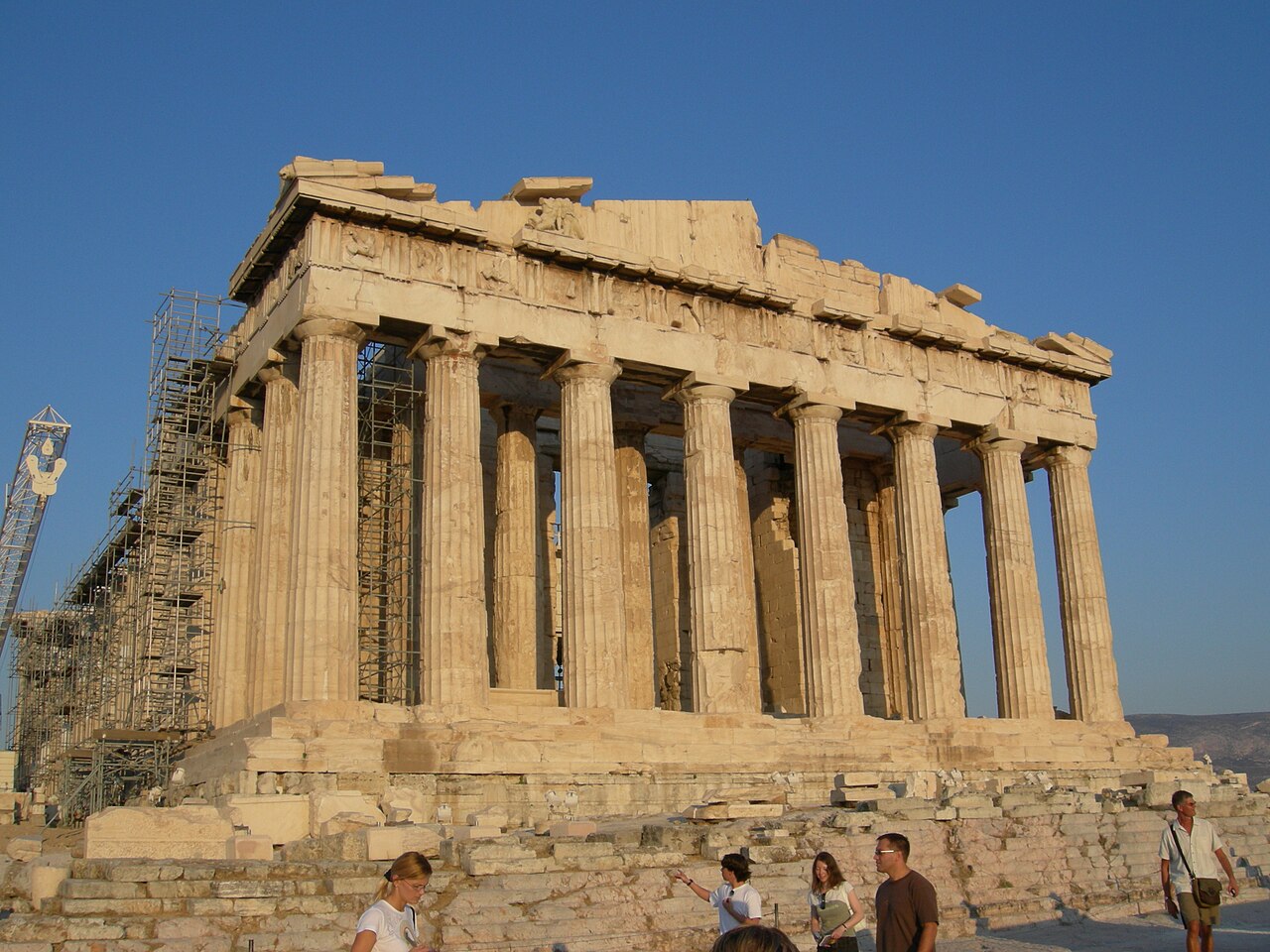
The Parthenon upon the Athenian Acropolis was dedicated primarily to her.
Apollo
Apollo was associated with prophecy, music, healing, archery, poetry and purification.
He was the son of Zeus and Leto and the twin brother of Artemis.
His symbols included the lyre, bow, laurel tree and raven.
Apollo spoke through the oracle at Delphi, one of the most important religious centres in the Greek world.
He could heal disease but could also send plague through his arrows.
Later tradition strongly connected Apollo with the sun, although Helios had originally been the distinct divine personification of the sun.
Artemis
Artemis was the goddess of hunting, wild animals, wilderness and the protection of young girls.
She was the twin sister of Apollo.
Her symbols included the bow, deer, hunting dogs and crescent moon.
Artemis defended her independence and punished those who violated her sacred spaces or insulted her followers.
She was also connected with childbirth, even though she was usually imagined as a virgin goddess.
Her worship varied greatly between regions.
Ares
Ares was the god of violent warfare, bloodshed and battle fury.
He represented the physical terror and chaos of combat.
His symbols included the spear, helmet, shield and vulture.
Ares was less respected in many Greek myths than Athena because he lacked her discipline and wisdom.
However, he was still a powerful god who received worship, especially in places with strong military traditions.
Aphrodite
Aphrodite was the goddess of love, beauty, desire and attraction.
One tradition described her as the daughter of Zeus and Dione.
Another said that she emerged from the sea foam near Cyprus.
Her symbols included the dove, rose, myrtle, shell and apple.
Aphrodite could inspire affection, marriage and fertility, but also uncontrollable passion and rivalry.
Her promise to Paris helped begin the chain of events leading to the Trojan War.
Hermes
Hermes was the messenger of the gods and the protector of travellers, merchants, heralds and thieves.
He was associated with speed, cleverness, communication and boundaries.
His symbols included winged sandals, a traveller’s hat and the herald’s staff known as the caduceus.
Hermes guided the souls of the dead towards the Underworld.
He also appeared as a trickster who could deceive others while remaining useful to gods and mortals.
Hephaestus
Hephaestus was the god of fire, metalworking, craftsmanship and invention.
He created weapons, armour, jewellery and mechanical wonders for the gods.
His forge was often placed beneath a volcanic mountain.
Hephaestus was usually represented as physically disabled or lame.
His myths combined extraordinary skill with experiences of rejection and humiliation.
He created the armour of Achilles and many other divine objects.
Hestia
Hestia was the goddess of the hearth, home and domestic stability.
She was the sister of Zeus, Hera, Poseidon, Demeter and Hades.
The household hearth was a sacred centre where food was prepared and offerings were made.
Public buildings also contained civic hearths representing the unity of the community.
Hestia appeared less frequently in dramatic myths because her power was connected with peace, continuity and the centre of the home.
Dionysus
Dionysus was the god of wine, theatre, ecstasy, transformation and altered states of consciousness.
He was the son of Zeus and the mortal woman Semele.
His symbols included the grapevine, drinking cup, ivy and thyrsus.
Dionysus could bring joy, release and creativity, but also madness and loss of control.
His festivals played a major role in the development of Greek tragedy and comedy.
Hades
Hades was the ruler of the Underworld and the god of the dead.
He was the brother of Zeus and Poseidon.
Hades was stern and unavoidable rather than purely evil.
He maintained the boundary between life and death.
His symbols included the sceptre, cypress tree and helmet of invisibility.
He was sometimes called Plouton, meaning the wealthy one, because valuable metals and crops came from beneath the earth.
Persephone
Persephone was the daughter of Demeter and the queen of the Underworld.
Hades took her into his realm, where she became his wife.
Because she ate pomegranate seeds in the Underworld, she was required to spend part of each year there.
Her annual return to Demeter was associated with growth and fertility.
Persephone represented both youthful life and the mysterious authority of death.
Other Gods and Divine Beings
The Greek religious world contained far more divine beings than the major Olympians.
Rivers, springs, winds, mountains, forests and seas could possess divine personalities.
Minor gods and spirits were honoured according to local needs and traditions.
Helios
Helios was the divine personification of the sun.
He drove a shining chariot across the sky each day.
Because he saw events from above, Helios could reveal secrets hidden from other gods.
His sacred cattle appeared in the Odyssey.
Later religious thought sometimes merged aspects of Helios and Apollo.
Selene
Selene was the goddess and personification of the moon.
She travelled across the night sky in a chariot.
Her best-known myth concerned her love for the beautiful mortal Endymion.
Later traditions sometimes connected or identified Selene with Artemis.
Eos
Eos was the goddess of dawn.
She opened the gates of heaven for the sun and brought light to the world.
She was commonly described with rosy fingers or saffron-coloured robes.
Her myths often concerned relationships with mortal men.
Pan
Pan was the god of shepherds, flocks, wild landscapes and rustic music.
He was represented with the legs and horns of a goat.
Pan played pipes made from reeds.
His sudden appearance could cause overwhelming fear, producing the word panic.
He was especially associated with Arcadia.
Asclepius
Asclepius was the god of healing and medicine.
He was commonly described as a son of Apollo.
His symbol was a staff with a single serpent coiled around it.
People visited sanctuaries of Asclepius seeking cures through prayer, offerings, sleep and medical treatment.
His most famous sanctuary was at Epidaurus.
Nike
Nike was the goddess or personification of victory.
She was often shown as a winged young woman.
Nike could accompany Athena or Zeus and crown successful warriors or athletes.
The Temple of Athena Nike stood upon the Athenian Acropolis.
Nemesis
Nemesis was associated with justice, retribution and the punishment of excessive pride or undeserved good fortune.
She restored balance when individuals became arrogant or ignored proper limits.
Her power reflected the Greek belief that success should not lead to disrespect towards gods or other people.
Tyche
Tyche was the goddess of fortune and the changing fate of cities and individuals.
She became especially important during the Hellenistic period, when political life often appeared uncertain.
Tyche could bring prosperity or sudden disaster without a clear moral explanation.
Eros
Eros was the god or personification of desire and attraction.
In early traditions, he could appear as a primordial force involved in creation.
Later art frequently represented him as a youthful companion or son of Aphrodite.
His arrows caused gods and mortals to fall in love.
Hypnos
Hypnos was the god of sleep.
He was associated with night and was often described as a brother of Thanatos, the personification of death.
Sleep was viewed as a temporary condition resembling death.
Thanatos
Thanatos was the personification of peaceful death.
He differed from violent spirits of destruction and slaughter.
In myth, Heracles wrestled Thanatos to save Alcestis from death.
The Fates
The Fates were powerful goddesses who controlled the destiny of human beings.
They were often imagined as three sisters named Clotho, Lachesis and Atropos.
Clotho spun the thread of life.
Lachesis measured the portion assigned to each person.
Atropos cut the thread at death.
Even the gods sometimes appeared unable or unwilling to overturn fate completely.
The Furies
The Furies were goddesses of vengeance who punished serious crimes, especially murder within the family and violations of sacred law.
They were also known as the Erinyes.
They pursued guilty individuals with madness, fear and suffering.
Later tradition sometimes called them the Eumenides, meaning the kindly ones, in an attempt to avoid provoking their anger.
The Muses
The Muses were goddesses of poetry, music, history, dance and intellectual inspiration.
They were commonly described as nine daughters of Zeus and Mnemosyne, goddess of memory.
Poets invoked them at the beginning of works and asked for divine inspiration.
The word museum developed from the concept of a place dedicated to the Muses.
The Graces
The Graces were goddesses associated with beauty, charm, generosity and celebration.
They frequently accompanied Aphrodite and appeared in art as a group of three.
They represented the pleasures and social gifts that made life harmonious.
The Nymphs
Nymphs were female divine spirits associated with natural places.
Naiads lived near fresh water.
Dryads were connected with trees and forests.
Oreads belonged to mountains.
Nereids were sea nymphs.
Nymphs were long-lived and supernatural but were not always considered fully immortal in the same way as the Olympians.
River Gods
Important rivers were worshipped as male gods.
They were often shown as bearded men, bulls or hybrid figures.
River gods controlled water essential for farming, travel and settlement.
Achelous was one of the most famous river gods and wrestled Heracles for the right to marry Deianira.
The Winds
The major winds were personified as gods.
Boreas was the cold north wind.
Zephyrus was the gentle west wind.
Notus was the south wind.
Eurus was associated with the east or south-east.
Sailors and farmers paid close attention to winds because they affected travel, weather and crops.
Primordial Deities
Greek creation myths began with ancient divine powers existing before the Olympian gods.
These primordial beings represented fundamental parts of the cosmos.
Chaos
Chaos was the first state in one influential Greek creation account.
It was not simply disorder in the modern sense.
It represented a vast gap, emptiness or opening from which other beings emerged.
Gaia
Gaia was the earth itself and one of the first great divine powers.
She produced mountains, seas and the sky god Uranus.
Gaia became the mother or ancestor of many Titans, giants and monsters.
She represented both life-giving fertility and ancient power.
Uranus
Uranus was the personification of the sky.
He was the son and partner of Gaia.
Their children included the Titans, Cyclopes and Hundred-Handed Ones.
Uranus imprisoned some of his children until the Titan Cronus overthrew him.
Nyx
Nyx was the goddess and personification of night.
She was an ancient and powerful figure feared even by Zeus in some myths.
Her children included beings associated with sleep, death, dreams, conflict and fate.
Tartarus
Tartarus was both a primordial deity and a deep region beneath the Underworld.
It became the prison of defeated Titans and other enemies of the gods.
Tartarus represented the most distant and terrifying depth of the cosmos.
Erebus
Erebus personified deep darkness and shadow.
He was associated with the dark region through which souls passed towards the Underworld.
The Titans
The Titans were an older generation of gods born from Gaia and Uranus.
They ruled before Zeus and the Olympians.
Their most famous ruler was Cronus.
Other Titans included Rhea, Oceanus, Tethys, Hyperion, Themis, Mnemosyne, Iapetus and Coeus.
Cronus
Cronus overthrew his father Uranus and became ruler of the cosmos.
He feared that one of his own children would overthrow him.
To prevent this, he swallowed each child born to Rhea.
Rhea saved Zeus by hiding him and giving Cronus a stone wrapped like an infant.
Rhea
Rhea was the mother of Zeus, Hera, Poseidon, Hades, Demeter and Hestia.
She protected Zeus from Cronus and arranged for him to be raised secretly.
Her actions allowed the younger gods to overthrow the Titans.
The Titanomachy
The Titanomachy was the great war between the Titans and the Olympian gods.
Zeus freed his swallowed siblings and released the Cyclopes and Hundred-Handed Ones.
The Cyclopes gave Zeus the thunderbolt, Poseidon the trident and Hades the helmet of invisibility.
After a long struggle, the Olympians won.
Many defeated Titans were imprisoned in Tartarus.
Prometheus
Prometheus was a Titan associated with foresight and the protection of humanity.
He tricked Zeus during the division of sacrificial meat and later stole fire for mortals.
Zeus punished him by chaining him to a mountain where an eagle ate his liver each day.
Heracles eventually killed the eagle and freed Prometheus.
Prometheus became a symbol of intelligence, rebellion and sacrifice for humanity.
Atlas
Atlas was a Titan punished after the Titanomachy.
He was forced to support the heavens at the western edge of the world.
Heracles temporarily carried the burden during the labour involving the golden apples of the Hesperides.
Mythology and Religion
Greek mythology and Greek religion were closely related but were not identical.
Myths explained the origins, relationships and actions of gods and heroes.
Religion involved the actual rituals, prayers, sacrifices and festivals through which people honoured divine powers.
A myth could entertain, educate or explore moral questions without functioning as a fixed statement of religious doctrine.
Different versions of the same myth could exist without creating a single official interpretation.
Homer
The poems traditionally attributed to Homer were central to Greek culture.
The Iliad described events during the Trojan War, while the Odyssey followed the return of Odysseus.
The gods appear throughout both poems, supporting heroes, causing conflict and debating mortal fate.
These works influenced how later Greeks imagined divine personalities and heroic values.
Hesiod
Hesiod was another important early Greek poet.
His Theogony described the origins and generations of the gods.
His Works and Days explored labour, justice, farming and the condition of human life.
Hesiod helped organise diverse traditions into influential accounts of divine genealogy.
The Homeric Hymns
The Homeric Hymns were poems dedicated to individual gods and goddesses.
They praised divine powers, described important myths and explained the origins of cults.
Despite their name, they were composed by different poets over time rather than by Homer alone.
Local Myths
Greek cities preserved myths connecting particular gods and heroes with their landscapes.
A spring, cave, mountain or tree could be linked with a divine birth, transformation or miracle.
Local myths gave communities a sacred history and explained the origin of festivals and rituals.
Heroes
Heroes occupied a position between gods and ordinary mortals.
Many were children of a god and a mortal parent.
Others were exceptional kings, warriors, founders or ancestors.
Heroes died, but they could continue to possess power near their tombs.
Communities honoured them with sacrifices, games and shrines.
Heracles
Heracles was one of the most widely worshipped Greek heroes.
He was the son of Zeus and the mortal Alcmene.
His Twelve Labours demonstrated strength, endurance and service.
After his mortal death, Heracles was believed to have become a god and joined the Olympians.
He could therefore receive worship as both hero and deity.
Theseus
Theseus was the great hero of Athens.
He defeated the Minotaur, cleared dangerous roads and was credited with uniting the communities of Attica.
Athenians honoured him as a founder and protector of the city.
Perseus
Perseus was the son of Zeus and Danae.
He killed the Gorgon Medusa and rescued Andromeda.
Several royal families claimed descent from him.
Achilles
Achilles was the greatest Greek warrior in the Iliad.
He was the son of the mortal Peleus and the sea goddess Thetis.
After his death, he received heroic honours in several parts of the Greek world.
Odysseus
Odysseus was famous for intelligence, endurance and clever speech.
His journey home from Troy formed the subject of the Odyssey.
He survived through a combination of personal skill and divine assistance, especially from Athena.
Hero Cults
A hero cult honoured a dead figure believed to possess continuing power.
Rituals often took place at a tomb or sacred site associated with the hero.
Offerings could include food, drink, animals and athletic contests.
Heroes might protect a city, heal illness or assist soldiers in battle.
Founding Heroes
Greek colonies and cities often honoured legendary founders.
The founder could receive a tomb in a prominent public location.
Annual rituals preserved the memory of the person credited with establishing the community.
Sacred Spaces
Greek worship took place in many different settings.
A sacred space could be a major temple complex, a small rural shrine, a cave, a spring, a grove or a household altar.
The presence of a deity did not depend entirely upon a monumental building.
Sanctuaries
A sanctuary was a sacred area dedicated to one or more deities.
It could contain temples, altars, treasuries, statues, dining rooms and monuments.
The boundary of the sacred area separated it from ordinary land.
Visitors were expected to follow rules concerning cleanliness, behaviour and offerings.
Temples
A Greek temple was considered the house of a god or goddess.
It usually contained a cult statue representing the deity.
The temple protected sacred property and offerings.
Most public worship took place outside rather than inside the building.
The temple’s exterior architecture was designed to honour the deity and impress visitors.
Cult Statues
A cult statue represented the divine presence within a temple.
It could be made from wood, stone, bronze, gold or ivory.
Some statues were ancient and simple, while others were enormous artistic masterpieces.
The statue of Zeus at Olympia and Athena Parthenos in Athens were famous examples.
Worshippers did not necessarily believe that the material object was identical with the god, but it provided a focus for ritual and devotion.
Altars
The altar was the central location for sacrifice.
It usually stood outside the temple beneath the open sky.
Animals, food, wine, incense and other offerings were placed or burned upon it.
The altar allowed worshippers to communicate with the deity through ritual exchange.
Sacred Groves
Some sanctuaries developed around sacred trees or groves.
Cutting trees or hunting animals within such areas could be forbidden.
The natural landscape itself formed part of the sacred experience.
Caves
Caves were associated with divine births, hidden gods, nymphs and entrances to the Underworld.
Zeus was believed to have been raised in a Cretan cave.
Offerings discovered in caves show that many remained active places of worship.
Springs and Fountains
Springs were sacred because fresh water was essential for life.
Nymphs or gods could be associated with particular water sources.
Worshippers used sacred water for drinking, healing and ritual purification.
Household Religion
Religion began within the household as well as in public sanctuaries.
Families honoured gods connected with the home, ancestors and daily life.
The hearth was sacred to Hestia.
Zeus could be worshipped as protector of property and family.
Hermes guarded entrances and boundaries.
The Household Hearth
The hearth was the centre of cooking, warmth and family gathering.
Offerings to Hestia could be made at the beginning and end of meals.
The continuous fire symbolised the survival and unity of the household.
Household Shrines
Small shrines or sacred objects could be placed near doors, courtyards or storerooms.
Families offered incense, cakes, fruit, wine and other items.
Household worship was less visible than public religion but formed a regular part of daily life.
Ancestors
Families remembered dead relatives through funeral rites and visits to tombs.
Food, drink and flowers could be offered.
The dead were believed to require respect and proper burial.
Neglecting burial duties could anger both the deceased and the gods.
Prayer
Greek prayer was usually spoken aloud.
The worshipper often raised the hands towards the sky when addressing Olympian gods.
Hands could be directed towards the ground when speaking to gods of the Underworld or the dead.
A prayer commonly named the deity, recalled earlier offerings and stated the request.
The Structure of Prayer
A worshipper might begin by calling upon a god under a particular title.
The prayer could mention the deity’s birthplace, powers or earlier acts of favour.
The speaker might then remind the god of sacrifices already made.
Finally, the worshipper asked for protection, healing, success or another benefit.
Offerings
Offerings created a relationship of respect and exchange between humans and gods.
People offered what they could afford, ranging from simple food to valuable statues and buildings.
An offering could express gratitude, fulfil a promise or request divine help.
Libations
A libation was a liquid offering poured onto an altar, the ground or a grave.
Wine was common, but water, milk, honey or oil could also be used.
Libations accompanied meals, sacrifices, treaties and funerals.
Incense
Incense and fragrant substances were burned as offerings.
The rising smoke and pleasant smell honoured the gods.
Imported incense could also demonstrate wealth and access to distant trade networks.
Food Offerings
Cakes, grain, fruit, cheese and prepared meals could be offered to deities.
Not every ritual required animal sacrifice.
Simple offerings allowed ordinary people to participate regularly in worship.
Votive Offerings
A votive offering was dedicated to a deity in fulfilment of a promise or in thanks for assistance.
It could be a small figurine, weapon, piece of jewellery, statue, tripod or entire building.
Sanctuaries accumulated large numbers of such gifts.
Inscriptions sometimes recorded the identity of the donor and the reason for the dedication.
Healing Votives
People healed from illness could dedicate models of body parts at a sanctuary.
A clay or stone hand, foot, eye or other organ represented the part that had been cured.
These offerings expressed gratitude and provided visible evidence of divine healing.
Animal Sacrifice
Animal sacrifice was one of the most important public rituals in Greek religion.
Cattle, sheep, goats and pigs were commonly sacrificed.
The type of animal depended upon the deity, occasion and wealth of the community.
The ritual combined worship, public ceremony and communal eating.
Preparing the Sacrifice
The chosen animal was decorated and led in procession towards the altar.
Participants washed their hands and maintained ritual order.
Grain or water could be placed upon the animal, causing it to move its head in a way interpreted as agreement.
Prayers were spoken before the killing.
The Killing of the Animal
The animal’s throat was cut, and its blood was collected or allowed to flow upon the altar.
Musicians and participants could create sound during the act.
The ritual transformed an act of killing into a controlled sacred ceremony.
The Division of Meat
Selected bones wrapped in fat were burned for the gods.
Parts of the animal were examined or offered according to ritual custom.
Much of the meat was cooked and shared among worshippers.
Public sacrifice therefore created a communal feast that strengthened social relationships.
The Myth of Prometheus and Sacrifice
A myth involving Prometheus explained the division of sacrificial meat.
Prometheus arranged an ox into two portions.
One contained edible meat hidden beneath an unattractive covering.
The other contained bones covered with shining fat.
Zeus selected the deceptive portion, establishing the custom of burning bones and fat for the gods while humans consumed the meat.
Burnt Offerings
Some sacrifices were burned completely rather than shared as food.
Such offerings were especially associated with gods of the Underworld, the dead or rituals of purification.
The entire animal could be destroyed so that no living participant consumed it.
Bloodless Sacrifice
Not all religious groups or occasions used animal sacrifice.
Some worshippers preferred grain, fruit, cakes, incense or wine.
Certain philosophical and mystery traditions criticised or avoided the killing of animals.
Purification
Purification removed ritual pollution and prepared a person for contact with the sacred.
Water, smoke, blood, sulphur and other materials could be used.
Purification was required after childbirth, death, murder or other events believed to disturb religious order.
Ritual Pollution
Ritual pollution was not identical with moral guilt.
A person could become polluted through contact with death even without committing a crime.
However, serious acts such as murder created especially dangerous pollution.
Purification restored the person’s ability to approach gods and participate in community worship.
Murder and Pollution
Murder was believed to pollute the killer, household and sometimes the wider community.
The Furies could pursue those guilty of killing relatives.
Purification, exile or legal judgement might be required before the pollution ended.
Festivals
Religious festivals were major events in Greek civic life.
They combined worship with processions, sacrifices, competitions, music, theatre and feasting.
Festivals marked the calendar and reinforced the shared identity of the community.
Processions
A procession carried participants, offerings and sacred objects towards a sanctuary or altar.
Priests, officials, musicians, athletes, citizens and animals could take part.
The order of participants displayed the structure and values of the community.
Public Feasting
Festivals often included large communal meals following sacrifice.
Meat was distributed among participants according to custom and status.
The feast united religious worship with social celebration.
Athletic Competitions
Athletic contests were frequently held in honour of gods or dead heroes.
Victories demonstrated physical excellence and brought honour to athletes and their cities.
Major events included running, wrestling, boxing, chariot racing and the pentathlon.
Musical Competitions
Musicians, singers and poets competed during some festivals.
Music was especially important in the worship of Apollo and Dionysus.
Victors could receive crowns, money or lasting fame.
The Olympic Games
The Olympic Games were held at Olympia in honour of Zeus.
They became one of the most famous religious and athletic festivals in the Greek world.
Competitors and visitors travelled from many cities.
A sacred truce was proclaimed to support safe travel.
Victors received olive wreaths and enormous prestige.
Olympia
Olympia was a sanctuary rather than an ordinary city.
It contained temples, altars, treasuries, athletic facilities and monuments.
The Temple of Zeus housed a colossal statue created by Phidias.
The statue was counted among the Seven Wonders of the Ancient World.
The Pythian Games
The Pythian Games were held at Delphi in honour of Apollo.
They included musical and athletic competitions.
The festival celebrated Apollo’s defeat of the serpent Python and his control of the Delphic oracle.
The Isthmian Games
The Isthmian Games were held near Corinth in honour of Poseidon.
They included athletics, horse racing, music and poetry.
The location near important sea routes reflected the connection with the god of the sea.
The Nemean Games
The Nemean Games were held in honour of Zeus at Nemea.
Their mythology was connected with the death of the infant Opheltes and with Heracles’ defeat of the Nemean Lion.
The Panathenaic Festival
The Panathenaic Festival honoured Athena as patron of Athens.
It included a great procession, sacrifices, music, athletics and other competitions.
A new woven robe was presented to Athena.
The procession became the subject of the famous Parthenon frieze.
The Great Panathenaia
The Great Panathenaia was held every four years on a larger scale.
Competitors came from across the Greek world.
Victors in athletic events could receive decorated jars filled with valuable olive oil.
The City Dionysia
The City Dionysia was a major Athenian festival honouring Dionysus.
It included processions, sacrifices and dramatic competitions.
Playwrights presented tragedies, comedies and satyr plays before large audiences.
The festival contributed to the development of Greek theatre.
Tragedy
Greek tragedy explored myths involving suffering, responsibility, justice and conflict between human and divine law.
Playwrights such as Aeschylus, Sophocles and Euripides competed at religious festivals.
Theatre was both entertainment and a form of civic and religious reflection.
Comedy
Greek comedy used humour, exaggeration and criticism to address politics, society and public figures.
Aristophanes became the most famous surviving writer of Old Comedy.
Comedy was performed in honour of Dionysus alongside other festival events.
The Rural Dionysia
The Rural Dionysia was celebrated in local communities of Attica.
It included processions, drinking, songs and dramatic performances.
The festival connected the worship of Dionysus with vineyards and agricultural life.
The Anthesteria
The Anthesteria was an Athenian festival of Dionysus associated with new wine and the presence of the dead.
Wine jars were opened, drinking contests were held and ancient rituals were performed.
The festival combined celebration with unease about spirits entering the world of the living.
The Thesmophoria
The Thesmophoria was a festival celebrated by women in honour of Demeter and Persephone.
It focused upon fertility, agriculture and the continuation of the community.
Men were excluded from central parts of the ritual.
The festival demonstrates the important religious roles performed by women.
The Eleusinian Mysteries
The Eleusinian Mysteries were secret rites connected with Demeter and Persephone.
They took place at Eleusis near Athens.
Initiates were promised special knowledge, blessings or hope concerning the afterlife.
The exact rituals were kept secret and remain only partly understood.
The Myth Behind Eleusis
The mysteries were based upon Demeter’s search for Persephone.
While grieving, Demeter came to Eleusis in disguise.
She attempted to make a royal child immortal and later revealed her divine identity.
A sanctuary was established in her honour.
Initiation
Men, women, foreigners and enslaved people could be initiated if they met the required conditions and understood Greek.
Initiates underwent purification, fasting, processions and sacred experiences.
The central revelation was not recorded openly.
The Sacred Way
Participants travelled from Athens to Eleusis along a route known as the Sacred Way.
The procession included sacred objects, songs, jokes and ritual stops.
The journey itself formed part of the religious experience.
The Telesterion
The Telesterion was the great initiation hall at Eleusis.
Large numbers of participants gathered inside.
Its architecture supported ceremonies whose details remain uncertain because initiates respected secrecy.
Orphism
Orphism was a group of religious beliefs and practices connected with the mythical poet Orpheus.
It emphasised purification, the soul and the possibility of a better fate after death.
Orphic traditions often presented the body as a temporary prison or burden for the soul.
Orpheus
Orpheus was a legendary musician whose songs could charm animals, trees and even the powers of the Underworld.
He descended into the realm of Hades in an attempt to recover his wife Eurydice.
His connection with death, music and sacred knowledge made him an important figure in mystery traditions.
Orphic Gold Tablets
Small gold tablets have been discovered in graves in parts of the Greek world.
They contain instructions intended to guide the soul after death.
The texts identify the deceased as an initiate and describe routes, guardians or sacred statements.
They provide important evidence for beliefs about personal salvation and the afterlife.
Dionysian Mysteries
Some forms of Dionysian worship involved secret initiation, ecstatic ritual and hopes for blessed existence after death.
These traditions varied greatly and did not form one central organisation.
The Cabeiri
The Cabeiri were mysterious deities worshipped in places including Samothrace and Lemnos.
Initiation into their mysteries was associated with protection, especially for sailors.
The exact identities and rituals of the Cabeiri remain uncertain.
Priests and Priestesses
Greek religion did not have one central priesthood governing all worship.
Individual temples and cults had their own priests or priestesses.
Some positions were hereditary, while others were chosen by election, appointment or lot.
Religious officials performed sacrifices, cared for sacred property and supervised rituals.
The Role of Priests
A priest could speak prayers, kill sacrificial animals and manage temple finances.
Priests did not necessarily preach moral teachings or interpret one sacred scripture.
Many held office for a limited period and remained ordinary citizens outside ritual duties.
The Role of Priestesses
Women held important priestly positions throughout the Greek world.
The priestess of Athena Polias in Athens possessed high social status.
The Pythia at Delphi delivered the words of Apollo.
Priestesses could manage sacred objects, lead processions and receive public honours.
Religious Specialists
Beyond priests and priestesses, Greek communities included seers, interpreters of omens, purification experts and attendants responsible for ritual tasks.
These specialists advised individuals, armies and governments.
Oracles
Oracles were places or persons through which divine guidance was communicated.
People consulted them before wars, colonisation, marriage, travel and major political decisions.
Responses could be clear, symbolic or deliberately ambiguous.
The Oracle at Delphi
The oracle of Apollo at Delphi was the most famous in the Greek world.
The sanctuary stood upon the slopes of Mount Parnassus.
Individuals and city representatives travelled there to ask questions.
The priestess known as the Pythia delivered Apollo’s response.
The Pythia
The Pythia was selected from local women and served as Apollo’s prophetic priestess.
She sat upon a sacred tripod within the temple.
Ancient sources described her entering an inspired state before speaking.
Priests may have helped record or interpret her words.
The Omphalos
Delphi was believed to be the centre of the world.
A sacred stone called the omphalos represented its position as the world’s navel.
A myth said that Zeus released two eagles from opposite ends of the earth and they met at Delphi.
Python
Before Apollo controlled Delphi, the site was associated with a serpent named Python.
Apollo killed Python and established his oracle.
The Pythian Games commemorated this victory.
Famous Delphic Responses
Several famous historical and legendary figures consulted Delphi.
King Croesus received a prediction that if he attacked Persia, he would destroy a great empire.
He assumed the empire would be Persia, but his own kingdom was destroyed.
The story illustrated the danger of interpreting an oracle too confidently.
Dodona
Dodona in north-western Greece was an ancient oracle of Zeus.
Priests and priestesses interpreted the sound of oak leaves, birds or bronze objects.
Visitors wrote questions upon lead tablets, many of which have survived.
The questions concerned marriage, property, travel, health and everyday uncertainty.
The Oracle of Trophonius
The oracle of Trophonius in Boeotia involved a frightening descent into an underground chamber.
Consultants underwent purification and special preparation.
The experience was believed to provide divine knowledge but could leave the visitor deeply shaken.
Dream Oracles
Some sanctuaries provided guidance through dreams.
Worshippers slept in sacred areas and expected a god to appear or send a symbolic message.
This practice was especially important at healing sanctuaries of Asclepius.
Divination
Divination was the interpretation of signs believed to reveal divine will.
Greeks examined dreams, animal behaviour, lightning, birds and sacrificial organs.
Divination did not always predict a fixed future.
It could reveal whether the gods approved of a planned action.
Bird Omens
The direction, species and behaviour of birds could be interpreted as divine signs.
Eagles were particularly associated with Zeus.
Seers observed whether birds appeared from the right or left and how they moved.
Sacrificial Omens
The behaviour of an animal before sacrifice could indicate divine approval or rejection.
After the killing, specialists examined the internal organs.
The liver was considered especially important.
Dreams
Dreams could be sent by gods, the dead or deceptive spirits.
Some dreams offered direct instructions, while others required interpretation.
Greek literature frequently used dreams to warn heroes or create uncertainty.
Lots
Lots could be drawn to seek divine guidance or make decisions.
Random selection was interpreted as allowing the gods to reveal their preference.
Lots also played a role in some political and judicial practices.
Omens Before Battle
Greek armies performed sacrifices before marching or attacking.
If the signs were unfavourable, commanders might delay action.
Military confidence depended partly upon belief that the gods supported the campaign.
Religion and Warfare
Warfare was surrounded by religious ritual.
Soldiers took oaths, carried sacred symbols and offered sacrifices.
Victories could be celebrated through temples, statues and captured weapons dedicated to the gods.
Defeat might be interpreted as evidence of divine anger or failed ritual.
War Gods
Ares represented the violence of battle.
Athena represented strategy, protection and disciplined warfare.
Zeus could grant victory and punish oath-breaking.
Artemis, Apollo and local heroes could also support armies.
Battlefield Sacrifice
Commanders sacrificed animals before combat.
The final sacrifice could occur when the enemy was already close.
Favourable signs encouraged soldiers to advance with confidence.
Trophies
After victory, Greeks erected a trophy upon the battlefield.
Enemy armour and weapons were attached to a tree trunk or wooden structure.
The trophy marked the point where the defeated army turned and fled.
It was dedicated to the gods who granted victory.
Temple Treasures
Weapons captured in war could be dedicated in sanctuaries.
These offerings displayed military success and thanked the deity.
Large victories could fund temples, statues or treasuries.
Religion and Politics
Greek political life was inseparable from religion.
Magistrates performed sacrifices and festivals.
Assemblies opened with purification and prayer.
Treaties were sworn before the gods.
Religious offences could become political crimes.
Patron Deities
Many cities identified themselves closely with a patron deity.
Athena protected Athens.
Apollo was central at Delphi.
Hera held special importance at Argos and Samos.
The patron deity represented the unity and identity of the community.
Civic Cults
Civic cults were supported by the city and involved public officials and resources.
They included festivals, sacrifices, priesthoods and maintenance of sanctuaries.
Participation demonstrated membership within the political community.
Oaths
Oaths called upon the gods as witnesses.
Breaking an oath risked divine punishment as well as social disgrace.
Political agreements, legal testimony and military service could all involve sacred oaths.
Hospitality
Hospitality towards strangers was protected by Zeus Xenios.
Hosts were expected to welcome travellers, provide food and ensure safety.
Guests were expected to respect the household.
Myths repeatedly showed the punishment of people who violated hospitality.
Religion and Law
Greek law and religion overlapped in cases involving murder, temple theft, impiety and broken oaths.
Some crimes offended both the community and the gods.
Courts could consider religious pollution as well as legal responsibility.
Impiety
Impiety involved disrespect towards gods, sacred institutions or religious customs.
The exact meaning depended upon political and historical circumstances.
Accusations of impiety could become powerful tools in public conflict.
The Trial of Socrates
Socrates was accused of failing to recognise the gods of the city, introducing new divine beings and corrupting the young.
He was found guilty and sentenced to death.
The trial demonstrates the close connection between religious identity, education and politics in Athens.
Religion and Women
Women were excluded from many areas of formal political life but played essential roles in religion.
They served as priestesses, led processions, prepared sacred clothing and participated in women-only festivals.
Religious office could provide status and public visibility unavailable through politics.
Marriage Rituals
Marriage involved prayers and offerings to gods associated with transition, fertility and family.
The bride could dedicate childhood objects to Artemis.
Hera protected marriage, while Aphrodite represented desire and attraction.
Torches, processions and shared meals formed part of wedding ceremonies.
Childbirth
Women prayed to Artemis, Hera and Eileithyia during childbirth.
Eileithyia was a goddess specifically associated with labour and delivery.
Successful childbirth could be followed by offerings of thanks.
Coming of Age
Young people marked transitions into adulthood through religious rituals.
Girls could dedicate toys, hair or clothing before marriage.
Boys participated in civic festivals and military training connected with local gods and heroes.
Religion and Children
Children were introduced to family and community religion from birth.
Naming ceremonies, household rituals and festivals connected them with ancestors and gods.
Some sanctuaries specialised in protecting children and young people.
Birth Rituals
Childbirth created ritual pollution requiring purification.
After a period of recovery, the infant was formally introduced into the household.
The child could be carried around the hearth in a ceremony recognising membership within the family.
Religion and Agriculture
Agriculture depended upon rainfall, seasons, soil and successful growth.
Farmers honoured gods controlling these forces.
Demeter, Persephone, Zeus and Dionysus were especially important.
Rituals accompanied planting, harvesting, wine production and the storage of food.
Demeter and Grain
Demeter represented the cultivated grain that supported Greek communities.
Her festivals sought fertility for fields and protection against famine.
The myth of Persephone expressed the cycle of disappearance and return within agriculture.
Dionysus and Wine
Dionysus protected vineyards and wine production.
Wine was used in meals, festivals, sacrifices and social gatherings.
It was normally mixed with water before drinking.
Undiluted wine could symbolise dangerous excess and loss of civilised control.
Zeus and Rain
Zeus controlled storms and rainfall essential for crops.
Communities prayed for rain during drought and for calm weather during harvest.
Titles of Zeus could reflect his connection with clouds and weather.
Religion and the Sea
Sea travel was dangerous and unpredictable.
Sailors honoured Poseidon, sea nymphs, local gods and protective heroes.
Offerings could be made before departure and after safe arrival.
Poseidon’s Anger
Myths demonstrated the danger of offending Poseidon.
He delayed Odysseus’ return because the hero blinded his son Polyphemus.
He punished King Minos for failing to sacrifice the Cretan Bull.
Such stories encouraged respect for the unpredictable sea.
Ship Dedications
Sailors could dedicate models, equipment or parts of ships in sanctuaries.
Victorious naval forces offered captured ships or bronze rams.
These gifts thanked the gods for survival and success.
Religion and Medicine
Healing involved both practical treatment and religious belief.
Physicians examined symptoms and developed natural explanations for disease.
At the same time, people prayed to healing gods and visited sanctuaries.
The two approaches could exist together.
Sanctuaries of Asclepius
Asclepian sanctuaries provided environments for rest, ritual and healing.
Visitors purified themselves, made offerings and slept within a sacred building.
They hoped that Asclepius would appear in a dream and reveal a cure.
Incubation
Incubation was the practice of sleeping within a sanctuary to receive a divine dream.
The god might perform a healing act in the dream or provide instructions.
Priests helped record and interpret successful cures.
Healing Inscriptions
Sanctuaries displayed inscriptions describing remarkable recoveries.
These stories encouraged trust in the god and advertised the power of the sanctuary.
They also preserve information about ancient illnesses and religious expectations.
Snakes and Healing
Snakes were sacred to Asclepius.
They could represent renewal because they shed their skin.
Non-venomous snakes moved freely in some healing sanctuaries.
The staff of Asclepius remains a widely used medical symbol.
Death and Burial
Death required careful ritual attention.
The body had to be prepared, mourned and buried or cremated according to custom.
Proper burial allowed the dead to enter the Underworld and protected the living from pollution.
Preparing the Body
Women of the household commonly washed, anointed and dressed the body.
The deceased was placed upon a bed for viewing.
Relatives and mourners gathered to express grief.
Lamentation
Laments honoured the dead and allowed the community to express sorrow.
Women often led mourning songs and gestures.
Excessive lamentation could be restricted by law because it disrupted public order or displayed aristocratic power.
The Funeral Procession
The body was carried to the burial place in a procession.
Funerals often took place before sunrise.
Family members, musicians and mourners accompanied the dead.
Burial and Cremation
Greeks used both burial and cremation.
Customs varied according to time, place and family preference.
Ashes from cremation could be placed within an urn.
Grave goods might include pottery, jewellery, weapons or personal objects.
Coins for Charon
Later Greek burial customs sometimes placed a coin with the dead.
The coin was believed to pay Charon, the ferryman of the Underworld.
The practice was not universal but became a famous part of later tradition.
Tombs
Tombs could range from simple graves to elaborate family monuments.
Grave markers displayed names, images and messages about the deceased.
Families visited tombs and made offerings during festivals or anniversaries.
The Underworld
The Greek Underworld was ruled by Hades and Persephone.
It was imagined as a shadowy realm beneath the earth.
Most souls continued in a reduced and ghost-like existence.
Different literary and religious traditions described the afterlife in different ways.
Hermes as Guide
Hermes guided the souls of the dead from the living world towards Hades.
This role gave him the title of guide of souls.
Charon
Charon carried souls across an Underworld river.
He was often represented as an old and severe ferryman.
Those denied proper burial could be left waiting upon the shore.
Cerberus
Cerberus guarded the gates of the Underworld.
He allowed the dead to enter but prevented them from leaving.
Heracles captured him during the final labour and later returned him safely.
The Rivers of the Underworld
The Underworld contained several rivers.
The Styx was associated with sacred oaths.
Acheron was linked with sorrow.
Cocytus represented lamentation.
Phlegethon was a river of fire.
Lethe brought forgetfulness.
The Judges of the Dead
Later traditions described Minos, Rhadamanthys and Aeacus judging souls.
They directed the dead towards appropriate regions according to their lives and divine law.
The Asphodel Meadows
The Asphodel Meadows were a region where many ordinary souls existed after death.
It was not a place of great reward or extreme punishment.
The dead remained as shadows of their former selves.
Elysium
Elysium was a blessed region reserved for heroes, favourites of the gods or especially virtuous individuals.
It was imagined as a place without ordinary hardship.
Some traditions placed it at the western edge of the world, while others located it within the Underworld.
The Isles of the Blessed
The Isles of the Blessed were paradise-like islands where selected heroes enjoyed peaceful existence.
Some traditions allowed exceptionally righteous souls to reach them after several lives.
Tartarus
Tartarus was the deepest region of punishment.
The Titans and great offenders against divine order were imprisoned there.
It was located as far beneath the earth as the sky was above it in poetic descriptions.
Sisyphus
Sisyphus was punished for deception and attempts to escape death.
He was forced to push a huge stone uphill.
Whenever it approached the top, the stone rolled back down.
His labour became a symbol of endless and meaningless effort.
Tantalus
Tantalus stood in water beneath fruit branches but could never drink or eat.
The water withdrew when he bent down, and the branches moved beyond reach.
His punishment reflected crimes involving the gods, hospitality and forbidden knowledge.
Ixion
Ixion attempted to violate Hera and betrayed divine hospitality.
He was bound to a fiery wheel that turned endlessly.
The Danaids
The daughters of Danaus were punished for murdering their husbands.
They were forced to carry water in vessels that could never be filled.
Ideas About the Soul
Greek ideas about the soul changed across time and philosophical schools.
Early poetry often described the soul as a shadow leaving the body at death.
Mystery religions and philosophers developed ideas of judgement, purification and rebirth.
Reincarnation
Pythagorean and Orphic traditions taught that the soul could pass through several lives.
Purification and philosophical discipline could eventually free it from the cycle.
Plato and the Afterlife
Plato used myths of judgement and rebirth to explore justice and the soul.
He argued that the soul was immortal and that its choices had consequences beyond one lifetime.
His philosophical accounts influenced later religious thought.
Philosophical Criticism of Myth
Some Greek philosophers criticised traditional stories about the gods.
They questioned whether divine beings could behave dishonestly, violently or immorally.
This criticism did not always reject religion completely.
It often sought a more rational or morally perfect understanding of divinity.
Xenophanes
Xenophanes criticised the human-like gods described by Homer and Hesiod.
He observed that different peoples imagined gods resembling themselves.
He suggested that if animals could create images, they would portray gods in animal form.
His arguments challenged anthropomorphic religion.
Heraclitus
Heraclitus criticised empty ritual and emphasised a deeper cosmic order known as the logos.
He did not simply deny divinity but sought unity beneath the changing world.
Socrates
Socrates spoke of divine signs, moral duty and care for the soul.
His questioning of accepted ideas contributed to accusations of impiety.
He maintained that obedience to divine moral purpose was more important than fear of death.
Plato
Plato criticised myths portraying gods as deceptive or unjust.
He argued that divine beings should be understood as good and orderly.
His philosophy transformed religious questions into investigations of truth, beauty and the immortal soul.
Aristotle
Aristotle developed philosophical ideas about a first cause or unmoved mover.
This divine principle differed from the emotional and human-like gods of traditional myth.
It represented perfect thought and the ultimate source of cosmic motion.
Epicureanism
Epicurus believed that gods existed but lived in perfect tranquillity and did not interfere in human affairs.
People should therefore not fear divine punishment or death.
Religious fear was viewed as an obstacle to peace of mind.
Stoicism
Stoic philosophers understood divinity as a rational force present throughout the cosmos.
They interpreted traditional gods as expressions of natural powers.
Living according to reason meant living in harmony with divine nature.
Scepticism
Sceptical philosophers questioned whether humans could possess certain knowledge about gods and the universe.
Suspending judgement could protect the mind from anxiety and dogmatism.
Foreign Gods
Greek religion changed through contact with other cultures.
Greeks adopted, adapted or identified foreign gods with their own deities.
Trade, migration and conquest encouraged religious exchange.
Interpretation of Foreign Gods
Greeks often identified foreign deities with Greek gods possessing similar powers.
An Egyptian god could be understood as a form of Zeus, Hermes or another familiar deity.
This method allowed different religious systems to be compared and combined.
Cybele
Cybele was a powerful mother goddess from Anatolia.
She became worshipped in parts of the Greek world.
Her cult involved music, drums, mountains and ecstatic ritual.
Greeks connected her with Rhea and other mother goddesses.
Isis
Isis was an Egyptian goddess whose worship spread widely during the Hellenistic and Roman periods.
She was associated with motherhood, protection, healing and the sea.
Her cult offered personal devotion and initiation to worshippers from different backgrounds.
Serapis
Serapis was a Hellenistic deity combining Greek and Egyptian religious elements.
He was promoted by the Ptolemaic rulers of Egypt.
Serapis was associated with kingship, healing, fertility and the afterlife.
Adonis
Adonis was a beautiful youth of Near Eastern origin whose myth became connected with Aphrodite.
His death and mourning were associated with seasonal vegetation and loss.
Women played important roles in festivals honouring him.
Hellenistic Religion
The Hellenistic period followed the conquests of Alexander the Great.
Greek culture spread across Egypt, the Near East and parts of Asia.
Religious life became increasingly diverse and international.
Traditional civic cults continued, but mystery religions, ruler worship and personal devotion became more prominent.
Ruler Cults
Hellenistic kings could receive divine honours during or after their lives.
Cities established festivals, priesthoods and temples in their names.
Ruler cult linked political loyalty with religious ceremony.
Alexander the Great
Alexander encouraged connections between himself and divine figures.
He visited the oracle of Zeus Ammon in Egypt and was recognised as the god’s son in later tradition.
After his death, rulers and cities used divine honours to express his extraordinary status.
Personal Religion
Hellenistic worship increasingly addressed individual fears and hopes.
People sought protection, healing and a favourable afterlife through mystery cults and foreign deities.
Religion remained public, but personal spiritual experience gained greater importance.
Magic
Magic existed alongside recognised religious practices.
People used spells, amulets, curses and ritual objects to seek love, protection, revenge or healing.
The boundary between magic and religion was not always clear.
A practice accepted within one context might be condemned as dangerous or secretive in another.
Curse Tablets
Curse tablets were thin sheets of lead inscribed with requests that supernatural powers bind or punish another person.
They were placed in graves, wells or sacred locations associated with the Underworld.
Targets could include legal opponents, business rivals, athletes or romantic competitors.
Binding Spells
A binding spell attempted to restrict the actions, speech or success of another person.
The spell might call upon Hermes, Hecate, Persephone or restless spirits of the dead.
Amulets
Amulets were objects worn or carried for protection.
They could contain symbols, stones, images or written words.
People used them against illness, the evil eye, danger and harmful spirits.
Hecate
Hecate was a goddess associated with crossroads, night, magic, ghosts and protection.
She could be represented with three bodies or faces looking in different directions.
Offerings were placed at crossroads and household entrances.
Hecate was both feared and honoured as a guardian of dangerous boundaries.
The Evil Eye
The evil eye was the belief that envy or hostile attention could cause harm.
Protective symbols, gestures and amulets were used to defend against it.
The belief remained influential across the Mediterranean world.
Sacred Animals
Many gods were associated with particular animals.
The animal could symbolise the deity’s qualities, appear in myths or live within sanctuaries.
Owls belonged to Athena, eagles to Zeus, dolphins to Apollo and deer to Artemis.
Animals and Divine Signs
The sudden appearance or unusual behaviour of an animal could be interpreted as a divine sign.
Gods also transformed themselves or mortals into animals within myth.
Sacred Plants
Plants and trees could belong to particular gods.
The olive was sacred to Athena.
The laurel belonged to Apollo.
The grapevine represented Dionysus.
Wheat and barley were associated with Demeter.
Myrtle and roses belonged to Aphrodite.
The Olive Tree
Athena gave the olive tree to the people of Attica during her contest with Poseidon.
It provided oil, food, wood and light.
The gift demonstrated the goddess’s connection with useful wisdom and civilisation.
The Laurel Tree
The laurel became sacred to Apollo through the myth of Daphne.
Daphne was transformed into a laurel tree while escaping Apollo’s pursuit.
Victors at the Pythian Games received laurel crowns.
Sacred Time
The Greek calendar was organised through religious festivals as well as seasons and political events.
Different cities used different month names and calendars.
Many months were named after festivals or gods.
Lunar Calendars
Greek months followed the cycles of the moon.
Because lunar months did not fit perfectly within the solar year, extra months were added when necessary.
Religious officials helped maintain the calendar and festival schedule.
Holy Days
Particular days of each month could be sacred to certain gods.
The new moon marked household and civic rituals.
Festivals occurred according to local calendars rather than one universal Greek system.
Sacred Truces
A sacred truce could be announced before major festivals.
It protected athletes and visitors travelling through hostile territories.
The truce did not always end every war, but it gave religious protection to festival participation.
Religious Art
Greek art represented gods, heroes, myths and rituals.
Statues stood within temples and public spaces.
Painted pottery showed sacrifices, festivals and divine stories.
Religious art helped worshippers recognise deities through symbols and appearance.
Identifying the Gods
Artists used attributes to distinguish divine figures.
Zeus carried a thunderbolt.
Poseidon held a trident.
Athena wore a helmet and carried a spear.
Apollo held a lyre or bow.
Hermes carried the caduceus.
Idealised Bodies
Gods were often represented with idealised human bodies.
Physical beauty expressed immortality, power and perfection.
Individual divine identities were communicated through clothing, posture and symbols.
Religious Theatre
Greek drama emerged within festivals honouring Dionysus.
Performances were acts of civic competition and religious celebration.
Myths were reinterpreted before audiences familiar with the stories.
Music and Worship
Music accompanied sacrifices, processions, theatre and festivals.
Instruments included the lyre, kithara, aulos, drums and pipes.
Different forms of music were associated with Apollo, Dionysus and other gods.
Hymns
Hymns praised gods and recalled their powers and myths.
They could be sung by individuals, choruses or professional performers.
Music strengthened communal participation in worship.
Dance
Dance formed part of festivals, initiation and dramatic performance.
Choral dances could represent myths or express collective devotion.
Dionysian worship was especially associated with energetic movement.
Religious Clothing
Priests, participants and sacred statues could wear special clothing during rituals.
White garments, crowns of leaves and decorated robes marked sacred occasions.
The colour and material depended upon the deity and festival.
Sacred Crowns
Participants wore crowns made from leaves, flowers or branches.
Olive, laurel, ivy and celery were associated with different festivals.
Crowns marked purity, honour and connection with the deity.
Religious Economy
Sanctuaries controlled land, animals, money and valuable offerings.
They employed workers, priests, attendants and craftsmen.
Major festivals attracted traders and visitors, creating economic activity.
Temple Treasuries
Temples stored money, precious objects and public wealth.
Because sanctuaries were protected by divine authority, they could function as secure treasuries.
However, cities sometimes borrowed or removed sacred wealth during war.
Land Owned by Gods
Sanctuaries could own farmland, forests and pastures.
Income from sacred land supported rituals and building maintenance.
Stealing or damaging sacred property was a serious offence.
Pilgrimage
People travelled to distant sanctuaries for festivals, healing, prophecy and initiation.
Delphi, Olympia, Eleusis and Epidaurus attracted visitors from across the Greek world.
Pilgrimage created shared religious experiences beyond individual city boundaries.
Panhellenic Religion
Panhellenic sanctuaries served worshippers from many Greek cities.
They created a sense of shared Greek identity despite political conflict.
Athletic games, common myths and worship of major gods linked separate communities.
Competition Between Cities
Cities displayed wealth and power through monuments dedicated at major sanctuaries.
Treasuries, statues and victory monuments stood beside those of rivals.
Religious devotion and political competition often operated together.
Colonisation and Religion
Greek settlers carried religious traditions when founding colonies.
They brought sacred fire from the mother city and consulted oracles before departure.
New settlements established temples to familiar gods while also adopting local influences.
The Founder of a Colony
The leader of a colonial expedition could become a hero after death.
His tomb formed a sacred centre of the new city.
Annual rituals reinforced the community’s connection with its origins.
Religious Diversity
There was no single version of ancient Greek religion followed identically by everyone.
Beliefs differed according to city, family, social group, profession and historical period.
Traditional civic cults existed beside mystery religions, philosophy, magic and foreign worship.
This diversity was a central feature rather than an exception.
Contradictory Myths
Different poets could describe the parentage or actions of a god differently.
One city might preserve a local story unknown elsewhere.
Contradiction did not necessarily create a religious crisis because myth was flexible.
Titles of the Gods
A deity could be worshipped under many titles known as epithets.
Each title identified a particular power, location or function.
Athena Polias protected the city.
Athena Nike brought victory.
Apollo Pythios was associated with Delphi.
Zeus Xenios guarded hospitality.
Local Forms of Deities
The same god could possess a different character in different sanctuaries.
Artemis at Ephesus differed in appearance and emphasis from Artemis in mainland Greek hunting myths.
Aphrodite could protect marriage in one place and sailors in another.
Religious Tolerance
Greek polytheism often allowed new gods and cults to be added without abandoning older ones.
However, communities could still oppose practices considered threatening, secretive or politically disruptive.
Religious flexibility did not mean that every form of worship was accepted without question.
Human Relationships with the Gods
Greeks sought favourable relationships with the gods through honour, offerings and correct ritual.
The gods could protect and reward worshippers, but they were not always predictable.
Religious practice aimed to maintain goodwill rather than guarantee complete control.
Reciprocity
Reciprocity was an important principle in Greek religion.
Worshippers gave honour and offerings in the hope of receiving divine assistance.
A prayer might remind a god of previous sacrifices before making a request.
Piety
Piety involved respect for gods, rituals, family duties and social obligations.
It was demonstrated through action rather than belief alone.
Attending festivals, performing sacrifices and honouring the dead were forms of piety.
Hubris
Hubris was excessive pride, arrogance or insulting behaviour that violated proper limits.
A person guilty of hubris might dishonour gods or other human beings.
Myths frequently showed such arrogance leading to punishment.
Niobe
Niobe boasted that she was superior to the goddess Leto because she had more children.
Apollo and Artemis killed Niobe’s sons and daughters in punishment.
The story warned against comparing mortal success with divine honour.
Arachne
Arachne was a skilled weaver who challenged Athena.
Her work displayed great ability but also insulted the gods.
Athena transformed her into a spider.
The myth explored artistic skill, pride and divine authority.
Marsyas
Marsyas challenged Apollo to a musical contest.
After losing, he suffered a terrible punishment.
The story warned against competing with a god within the deity’s own area of power.
Pentheus
Pentheus refused to recognise the divinity of Dionysus.
He attempted to suppress the god’s worship.
Dionysus drove the women of Thebes into an ecstatic state, and Pentheus was killed by his own mother and relatives.
The myth warned against rejecting divine powers that seemed unfamiliar or disorderly.
Divine Justice
Greek myths often presented divine justice as powerful but difficult for humans to understand.
Punishment could affect descendants as well as the original offender.
Human suffering was not always explained by one simple moral rule.
Fate and Free Will
Greek religion explored the tension between fate and personal choice.
Prophecies could reveal future events, but attempts to avoid them often helped bring them about.
Individuals remained responsible for choices even within a destined pattern.
Oedipus
Oedipus was prophesied to kill his father and marry his mother.
His parents attempted to prevent the prophecy, but their actions contributed to its fulfilment.
The myth raised questions about knowledge, identity, responsibility and fate.
The Limits of Human Knowledge
Mortals could consult oracles and interpret signs, but they rarely possessed complete knowledge.
The gods understood more than humans and could conceal important facts.
Greek tragedy frequently explored the danger of acting with incomplete information.
Religion and Morality
Greek religion supported moral values such as hospitality, respect for oaths, family duty and proper burial.
However, the gods of myth did not always behave according to one consistent moral standard.
Philosophers and playwrights debated the relationship between divine power and human justice.
Justice and Zeus
Zeus was often described as protector of justice and lawful order.
Hesiod warned rulers that Zeus observed corrupt judgement.
At the same time, myths portrayed Zeus acting according to divine desires difficult for mortals to judge.
Family Duty
Respect for parents, children and relatives was reinforced through religion.
Crimes within the family attracted the anger of the Furies.
Funeral obligations were treated as sacred duties.
Antigone
In the tragedy Antigone, the heroine buries her brother despite the king’s prohibition.
She believes divine funeral law is higher than human command.
The play explores conflict between political authority, family loyalty and religious duty.
The End of Independent Greek Religion
Greek religion changed as Greek cities came under Macedonian and Roman rule.
Traditional gods and festivals continued for centuries.
Roman religion adopted many Greek deities under Latin names.
New cults and philosophical ideas became increasingly influential.
Greek and Roman Gods
The Romans identified many of their gods with Greek deities.
Zeus was associated with Jupiter.
Hera became linked with Juno.
Poseidon was identified with Neptune.
Aphrodite was associated with Venus.
Ares was linked with Mars.
The Roman gods retained distinct traditions even as Greek mythology influenced their stories and art.
Religion Under Roman Rule
Greek sanctuaries continued operating under the Roman Empire.
Roman emperors funded temples, festivals and restoration projects.
Greek myths remained central to education and literature.
Imperial cults introduced worship and honours for emperors alongside traditional gods.
The Spread of Christianity
Christianity gradually spread through Greek-speaking regions of the Roman Empire.
Christians rejected sacrifice to the traditional gods and taught belief in one God.
Periods of conflict and persecution occurred, followed by increasing legal acceptance.
During the fourth century CE, Christianity received imperial support.
The Decline of Public Pagan Worship
Late Roman emperors restricted or prohibited many traditional sacrifices and cult practices.
Temples lost state support, closed or were converted to other uses.
Some festivals disappeared, while myths continued through literature, education and art.
Survival of Traditions
Elements of older religious practice survived through local customs, storytelling and adapted festivals.
Greek mythology continued to influence Byzantine scholars even when the gods were no longer publicly worshipped.
Archaeological Evidence
Knowledge of Greek religion comes from temples, altars, inscriptions, votive offerings, graves, pottery and sculpture.
Archaeology reveals practices not fully described in literary texts.
It also shows differences between public ideals and everyday worship.
Inscriptions
Religious inscriptions record dedications, sacred laws, calendars, priesthoods and festival expenses.
They provide direct evidence from worshippers and communities.
Small inscriptions can reveal the names of local gods otherwise unknown from literature.
Sacred Laws
Sacred laws explained rules for entering sanctuaries, selecting sacrifices and maintaining purity.
They could forbid particular clothing, foods or behaviour.
These rules demonstrate how carefully ritual practice was organised.
Pottery
Painted pottery shows sacrifices, processions, gods, heroes and funeral rituals.
Images allow historians to study clothing, equipment and ritual movement.
Artistic scenes must still be interpreted carefully because they could combine reality with myth and symbolism.
Votive Figurines
Small clay or bronze figurines were dedicated in sanctuaries.
They represented worshippers, animals, gods or objects.
Large numbers of inexpensive figurines show that religious participation was not limited to wealthy elites.
Animal Bones
Bones found near altars provide evidence for sacrifice and feasting.
Researchers can identify animal species, age and butchery methods.
This evidence helps reconstruct rituals beyond written descriptions.
Ancient Greek Religion in Art and Literature
Greek religious myths became foundations of European art and literature.
Renaissance painters and sculptors revived images of Olympian gods.
Poets and dramatists repeatedly reinterpreted stories of Prometheus, Orpheus, Oedipus and the Trojan War.
Greek Religion in Modern Culture
The gods and heroes of ancient Greece continue to appear in novels, films, television, games and comics.
Modern stories often change divine personalities or combine several myths.
These adaptations demonstrate the continuing imaginative power of Greek religion.
Modern Worship
Some modern groups practise reconstructed or revived forms of ancient Greek religion.
They honour Greek deities through prayers, offerings and festivals adapted to modern life.
These movements are distinct from the ancient communities but draw inspiration from historical evidence.
Common Misunderstandings
One misunderstanding is that every Greek believed every myth literally and in exactly the same way.
Ancient Greeks debated myths, changed stories and interpreted gods philosophically.
Religious identity depended strongly upon ritual participation and civic tradition.
There Was No Single Greek Church
Ancient Greek religion had no single organisation controlling all temples and beliefs.
Each city maintained its own cults, calendars and priesthoods.
Panhellenic sanctuaries created shared traditions without eliminating local differences.
Myth Was Not One Fixed Scripture
Homer, Hesiod, playwrights and local communities preserved different versions of divine stories.
No central authority selected one official version for every Greek.
This flexibility allowed myths to change according to place and purpose.
The Gods Were Not Simply Symbols
Modern readers sometimes treat the gods only as symbols of natural forces or psychological ideas.
Ancient worshippers could understand them as real divine beings who received offerings and influenced events.
Symbolic meanings existed, but they did not replace religious belief.
Not Every Ritual Was Grand
Much Greek religion involved small and ordinary actions.
A person could pour a little wine, burn incense or leave a cake at a shrine.
Daily worship was often more common than large temple festivals.
The Importance of Correct Ritual
Greek religion placed great emphasis upon performing rituals correctly.
The proper words, movements, offerings and participants mattered.
A mistake could require the ritual to be repeated.
Correct practice demonstrated respect and maintained order between humans and gods.
Belief and Practice
There was no single required statement of faith shared by all Greeks.
Participation in family and civic rituals was often more important than private agreement with every myth.
Belief remained significant, but it was expressed through action, tradition and public honour.
Religion as Community
Festivals brought citizens together and displayed the structure of the city.
Shared sacrifices and meals created unity.
Religious participation helped define who belonged to a household, neighbourhood or polis.
Religion as Identity
A city expressed its identity through patron gods, local myths and sacred monuments.
Athens presented itself as the city of Athena.
Delphi was identified with Apollo’s oracle.
Eleusis was known for the mysteries of Demeter and Persephone.
Religion as Memory
Rituals preserved memories of divine actions, heroic founders and past victories.
Annual repetition connected each generation with ancestors and sacred history.
Temples and monuments made memory visible within the landscape.
Religion as Explanation
Myths explained the origins of seasons, cities, rituals and natural features.
They addressed questions about suffering, death and the limits of human knowledge.
Religious explanation existed beside philosophical and scientific investigation.
Religion as Uncertainty
Greek religion did not promise that the gods would always protect the innocent or punish wrongdoing immediately.
Divine plans could be mysterious.
Prayer, divination and ritual helped people respond to uncertainty without removing it completely.
The Lasting Influence of Greek Religion
Ancient Greek religion influenced Roman worship, philosophy, literature and art.
Its gods became central figures in later European culture.
Greek religious vocabulary shaped discussions of mythology, ritual, sacrifice and divine power.
Influence on Language
Many modern words derive from Greek divine names and myths.
Panic comes from Pan.
Hermetic is connected with Hermes.
Narcissism comes from Narcissus.
Atlas, mentor, nemesis and echo also developed from Greek mythological names.
Influence on Psychology
Modern psychology has used Greek myths to name patterns and concepts.
The Oedipus complex, narcissism and other terms draw upon ancient stories.
These modern interpretations differ from the original religious meanings but demonstrate their continuing influence.
Influence on Astronomy
Planets, moons and constellations bear names from Greek and Roman mythology.
Orion, Andromeda, Perseus, Hercules and Cassiopeia appear in the night sky.
The celestial map preserves ancient religious and mythological imagination.
Influence on Medicine
The staff of Asclepius remains a major symbol of medicine.
Hygieia, daughter of Asclepius, gave her name to the concept of hygiene.
Panacea, another associated figure, became a word for a universal cure.
Influence on Politics
Greek festivals, public monuments and civic cults influenced later ideas about community identity.
Modern societies continue using classical architecture and mythology to represent authority, law and public values.
Influence on Theatre
Greek tragedy and comedy developed within Dionysian festivals.
Modern theatre inherited terms, structures and stories from these religious performances.
Drama remains one of the clearest examples of religion producing a lasting artistic form.
Why Ancient Greek Religion Endures
Ancient Greek religion endures because its myths explore permanent human concerns.
They address love, jealousy, ambition, grief, war, family conflict and death.
The gods possess enormous power but display emotions recognisable to human beings.
This combination makes the stories accessible while preserving their sense of wonder.
Conclusion
Ancient Greek religion was a diverse and deeply rooted system that shaped the lives of individuals, families and cities.
It was not based upon one sacred text, one priesthood or one fixed set of beliefs.
Instead, it developed through rituals, myths, festivals, local traditions and relationships with many divine powers.
The Greeks worshipped a large family of gods led by Zeus.
Major deities included Hera, Poseidon, Demeter, Athena, Apollo, Artemis, Ares, Aphrodite, Hermes, Hephaestus, Hestia and Dionysus.
Hades and Persephone ruled the Underworld, while countless nymphs, river gods, winds, heroes and local spirits filled the sacred landscape.
Religion was present in daily life.
Families honoured Hestia at the hearth, farmers prayed to Demeter, sailors sacrificed to Poseidon and soldiers sought divine approval before battle.
Public life was equally religious.
Assemblies, treaties, military campaigns and festivals began with prayers and sacrifices.
Each city maintained temples, altars, priesthoods and sacred calendars.
Temples housed cult statues and valuable offerings, but most ceremonies took place outside around an altar.
Animal sacrifice formed an important part of public worship.
The gods received burned portions, while the community shared the cooked meat.
This ritual united religious devotion with public feasting and social identity.
Smaller offerings were also common.
People poured libations, burned incense, offered cakes and dedicated figurines or valuable objects.
Greek festivals combined processions, worship, athletics, music, theatre and communal meals.
The Olympic Games honoured Zeus, the Pythian Games honoured Apollo and the Panathenaic Festival celebrated Athena.
Dionysian festivals gave rise to Greek tragedy and comedy.
Women held important positions as priestesses and participants in festivals such as the Thesmophoria.
Mystery cults offered forms of religious experience beyond ordinary civic worship.
The Eleusinian Mysteries centred upon Demeter and Persephone and promised initiates hope concerning death and the afterlife.
Orphic and Dionysian traditions explored purification, rebirth and the fate of the soul.
Oracles and divination helped Greeks seek guidance from the gods.
The oracle at Delphi influenced personal, political and military decisions across the Greek world.
Seers interpreted birds, dreams, lightning and sacrificial organs.
Such practices did not remove uncertainty but helped communities respond to it.
Greek beliefs about death were equally varied.
Most souls travelled to the Underworld ruled by Hades and Persephone.
Charon carried the dead across a river, and Cerberus guarded the gates.
Ordinary souls might enter the Asphodel Meadows, while heroes could reach Elysium and serious offenders suffered in Tartarus.
Philosophers questioned and reinterpreted traditional religion.
Xenophanes criticised gods imagined in human form.
Plato explored the immortality of the soul and demanded morally perfect divinity.
Aristotle described an unmoved mover, while Stoics understood divinity as rational order within nature.
Greek religion remained flexible enough to absorb new ideas and foreign gods.
During the Hellenistic period, the cults of Isis, Serapis and Cybele spread alongside traditional worship.
Ruler cults connected political authority with divine honour.
Magic, curse tablets and amulets existed beside public religion and personal devotion.
Greek religious traditions continued under Roman rule and strongly influenced Roman mythology.
As Christianity spread, public sacrifice and temple worship gradually declined.
However, Greek myths survived through literature, art, philosophy and education.
The influence of ancient Greek religion remains visible in language, theatre, medicine, astronomy and modern storytelling.
The gods and heroes continue to appear because their stories examine human experiences that remain familiar.
Ancient Greek religion was therefore far more than a collection of entertaining myths.
It was a living system through which people understood nature, community, morality, suffering and death.
It provided rituals for important moments, explanations for the unknown and a sacred framework for the organisation of society.
Its diversity, imagination and lasting cultural influence make it one of the most important religious traditions of the ancient world.