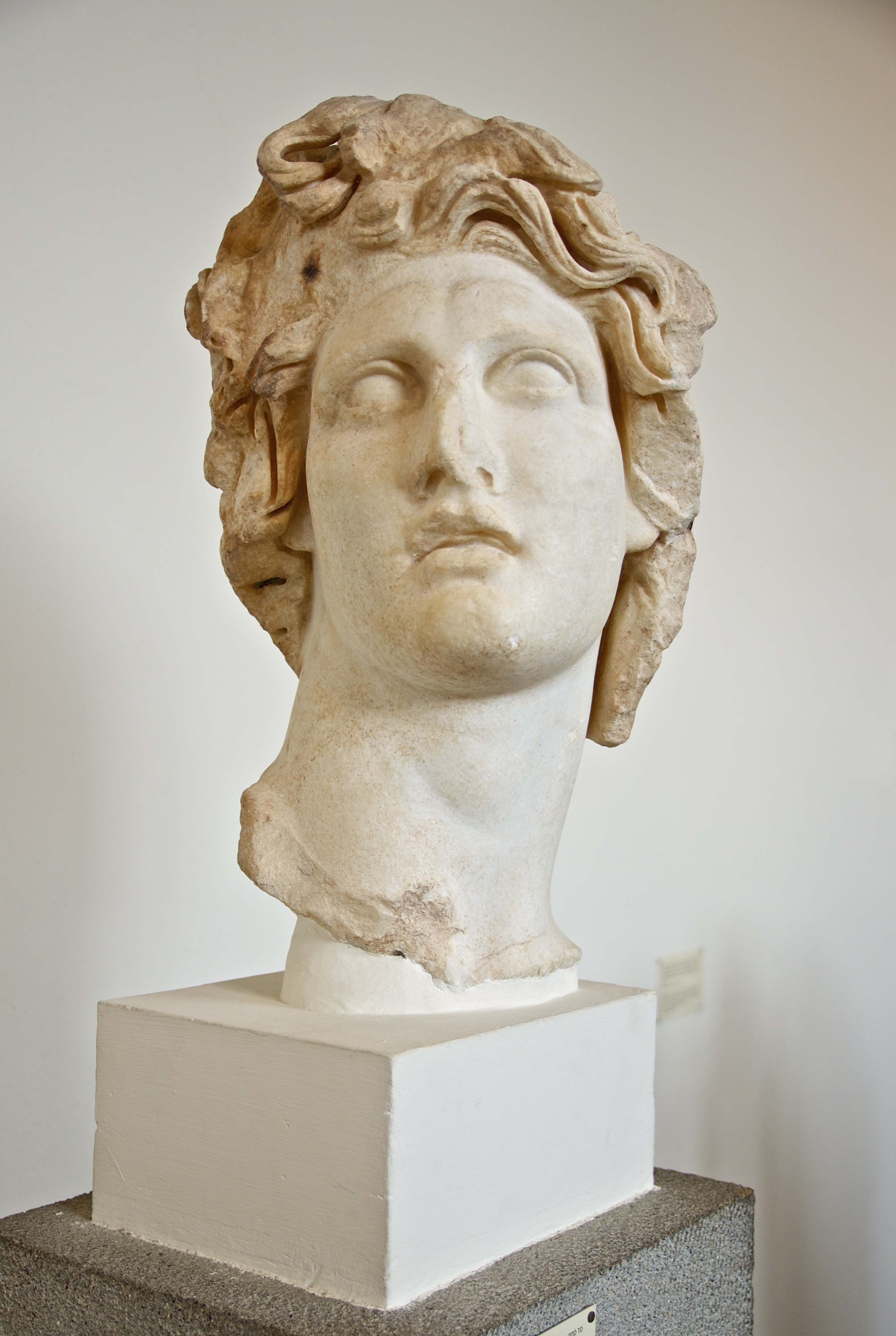
Helios – The Greek God of the Sun
Helios was the ancient Greek god and divine personification of the Sun, one of the most magnificent and powerful celestial deities in Greek mythology. Known for his radiant appearance and his daily journey across the heavens, Helios represented the brilliant solar light that illuminated the Earth, marked the passage of time, and sustained the natural world. Each morning, he emerged from the eastern horizon in a magnificent chariot drawn by fiery horses, travelling across the sky before descending into the west at sunset.
Unlike many Olympian gods, whose powers were associated with particular aspects of human life or nature, Helios was identified directly with the Sun itself. His presence brought daylight to the world, and his departure marked the beginning of night. To the ancient Greeks, his daily journey symbolised the eternal rhythm of the cosmos, the regular movement of the heavens, and the dependable return of light after darkness.
Helios belonged to the older generation of Greek divinities descended from the Titans. He was the son of Hyperion and Theia and the brother of Selene, goddess of the Moon, and Eos, goddess of the Dawn. Together, these three celestial deities represented the principal sources and appearances of heavenly light.
Although Helios was eventually associated with Apollo in some Greek and Roman traditions, the two gods originally possessed distinct identities. Helios was the personification of the Sun, while Apollo was principally associated with prophecy, music, healing, archery, and divine purification. Their identities became increasingly intertwined during later antiquity.
Helios appeared in numerous ancient myths as an all-seeing witness, a divine guardian of sacred herds, a father of powerful and sometimes dangerous children, and a deity whose extraordinary knowledge could influence the affairs of gods and mortals alike.
The Origins of Helios
According to Hesiod's Theogony, Helios was the son of the Titans Hyperion and Theia, also known as Euryphaessa, whose name is commonly interpreted as "Wide-Shining" or "Far-Shining".
Hyperion was one of the twelve original Titans born to Gaia, the primordial goddess of the Earth, and Uranus, the personification of the Sky. His name is often interpreted as "He Who Goes Above", reflecting his association with the celestial realm.
Theia was a Titan goddess connected with heavenly brilliance and radiance. Through her children, she became associated with the shining powers of the Sun, Moon, and Dawn.
Helios had two sisters. Selene personified the Moon and travelled through the night sky, while Eos personified the Dawn and announced the arrival of each new day.
The three siblings formed an important celestial family within Greek mythology. Eos brought the first light of morning, Helios illuminated the world during the day, and Selene shone across the heavens at night.
Helios was therefore a descendant of the primordial generation of Greek gods, belonging to a divine lineage that existed before Zeus and the Olympians established their supremacy.
Helios – The Personification of the Sun
In ancient Greek religion, Helios was not merely a deity who controlled the Sun. He was the divine embodiment of the Sun itself, possessing the power to illuminate the heavens and observe the world below.
His name, Helios, was also the ordinary ancient Greek word for the Sun. This close identification between the deity and the celestial body made him one of the clearest examples of a natural phenomenon represented as a divine being.
Every day, Helios crossed the heavens, bringing light and warmth to the Earth. His appearance marked the beginning of daylight, while his disappearance beyond the western horizon signalled the arrival of darkness.
His regular journey reflected the ancient Greek belief that the universe possessed an underlying order maintained through the activities of divine powers.
The Sun was essential to agriculture, navigation, the measurement of time, and daily life. Through Helios, these natural processes acquired a divine significance.
Ancient poets frequently described him as radiant, brilliant, and golden, emphasising the extraordinary light associated with his celestial presence.
The Chariot of Helios
One of the most famous images in Greek mythology is that of Helios driving his magnificent chariot across the sky.
According to ancient poetic traditions, Helios travelled in a splendid vehicle drawn by powerful horses associated with fire and celestial brilliance. Later accounts commonly described four horses pulling his chariot.
The horses were sometimes given names such as Pyrois, Eous, Aethon, and Phlegon, although the names and details varied among ancient writers.
Each morning, Helios emerged from the eastern reaches of the world, rising above the horizon to begin his journey across the heavens.
As he travelled westward, his radiant light illuminated mountains, seas, cities, and fields. His movement marked the progress of the day and provided a visible measure of passing time.
At evening, Helios descended towards the western horizon, where his daily journey ended.
The image of the solar chariot became one of the most enduring symbols of the Sun in Greek and Roman art. It represented both the majesty of the god and the seemingly unstoppable movement of the heavenly bodies.
The Night Journey of Helios
Ancient Greek mythology also attempted to explain how Helios returned to the east after setting in the west.
In some traditions, the Sun god travelled back across the encircling waters of Oceanus in a magnificent golden vessel or cup.
This mysterious vessel carried Helios through the night, allowing him to return to the eastern horizon before dawn.
The great river Oceanus was imagined as surrounding the inhabited world, providing a mythological setting for the Sun's nightly passage.
Ancient stories associated the golden vessel with the hero Heracles, who borrowed or obtained it during his journey to the distant west in search of the cattle of Geryon.
The tradition of Helios travelling through the night in a golden cup illustrated the imaginative ways in which the Greeks explained the Sun's disappearance and daily return.
Although the details varied between sources, the underlying idea remained consistent: Helios completed a continuous cosmic journey that ensured the renewal of daylight.
Helios and Eos – The Coming of Dawn
Helios's sister Eos was the goddess of the Dawn, responsible for announcing the arrival of morning.
Greek poets frequently described Eos as "rosy-fingered", an expression referring to the beautiful pink and golden colours that spread across the sky before sunrise.
In mythological descriptions, Eos emerged from the eastern horizon and prepared the heavens for the appearance of Helios.
Her arrival marked the transition from night to day, while the rising Sun completed the transformation by filling the world with light.
The relationship between Eos and Helios reflected the natural sequence of dawn and sunrise.
Although both deities were associated with light, they represented different aspects of the daily celestial cycle.
Eos embodied the first appearance of morning, while Helios represented the brilliant Sun that dominated the daylight hours.
Helios and Selene – The Sun and Moon
Selene, the sister of Helios, was the Greek goddess and personification of the Moon.
Like her brother, Selene was frequently imagined travelling across the heavens in a chariot, although her light was gentler and associated with the quiet mystery of night.
Helios and Selene represented two complementary celestial powers. Helios illuminated the world during the day, while Selene brought light to the darkness after sunset.
Their relationship reflected the ancient Greek understanding of the recurring cycles of day and night.
Selene was also associated with the measurement of lunar months, while the movement of Helios helped mark the seasons and the progression of the solar year.
Together with Eos, the siblings formed a divine family whose activities explained some of the most familiar and important patterns in the visible heavens.
Helios – The All-Seeing God
One of the most significant characteristics of Helios was his ability to observe events taking place across the world.
Because the Sun travelled high above the Earth, Helios was believed to witness actions that might otherwise remain hidden from gods and mortals.
He was therefore frequently described as an all-seeing deity whose knowledge could reveal secrets, betrayals, and acts of wrongdoing.
This ability made Helios an important witness in several Greek myths.
His position in the heavens also connected him symbolically with truth, revelation, and the exposure of concealed actions.
In ancient literature, Helios could be invoked as a witness to oaths and solemn declarations, particularly when divine testimony was required.
However, his all-seeing nature did not mean that he controlled every event or possessed unlimited power over the other gods.
Rather, his extraordinary knowledge arose from his celestial position and the belief that very little occurring beneath the daylight Sun could escape his observation.
Helios and the Abduction of Persephone
One of the most important myths involving Helios concerns the abduction of Persephone, daughter of Demeter and Zeus.
According to the Homeric Hymn to Demeter, Persephone was gathering flowers when Hades, ruler of the Underworld, emerged from the Earth and carried her away.
Demeter searched desperately for her missing daughter, wandering across the world in grief.
For nine days, Demeter continued her search without discovering what had happened. On the tenth day, Hecate approached her and explained that she had heard Persephone's cries but had not witnessed the abduction.
Demeter and Hecate then sought information from Helios, whose position above the world allowed him to observe events hidden from others.
Helios revealed that Hades had taken Persephone and that Zeus had permitted the marriage.
This revelation was crucial because it explained the circumstances of Persephone's disappearance and exposed the involvement of the supreme Olympian god.
Demeter's grief and anger eventually caused the Earth to become barren, threatening humanity with famine.
Zeus ultimately arranged for Persephone to return from the Underworld for part of each year, although she remained bound to spend another portion of the year with Hades.
Helios's role in the story illustrates his importance as a divine witness whose knowledge could reveal the truth behind mysterious events.
Helios and Aphrodite – The Discovery of a Secret Affair
Another famous myth demonstrates the extraordinary powers of observation possessed by Helios.
In Homer's Odyssey, the goddess Aphrodite and Ares, the god of war, conduct a secret love affair despite Aphrodite's marriage to Hephaestus.
The lovers believe their relationship is concealed, but Helios witnesses their meetings from his position in the heavens.
He informs Hephaestus of the betrayal, allowing the divine craftsman to devise a plan to expose them.
Hephaestus constructs an almost invisible net of extraordinary strength and places it around the bed where Aphrodite and Ares meet.
When the lovers are caught, Hephaestus summons the other gods to witness their humiliation.
The story became one of the most memorable episodes involving divine jealousy and deception in Greek mythology.
Helios's role was brief but essential. Without his ability to observe events across the world, the affair might have remained hidden.
The myth reinforced his reputation as a god who could uncover secrets and expose actions concealed from ordinary observers.
Helios and the Island of Rhodes
Helios was especially important on the island of Rhodes, where he became the principal patron deity.
According to a myth preserved by Pindar, when the gods divided the world among themselves, Helios was absent because he was performing his celestial duties.
As a result, he received no territory during the original distribution.
Zeus offered to arrange another division, but Helios instead requested a new land that he had seen emerging from the sea.
This land was Rhodes, which became sacred to the Sun god.
Another version of the island's mythology connected its name with Rhodos, a goddess or nymph who became the consort of Helios.
The relationship between Helios and Rhodes became an important part of the island's religious and cultural identity.
Helios received public worship, sacrifices, and celebrations, and his image appeared prominently on Rhodian coinage.
His importance on Rhodes also led to the creation of one of the most celebrated monuments of the ancient world.
The Colossus of Rhodes
The Colossus of Rhodes was an enormous bronze statue representing Helios, constructed during the early third century BC.
It was built to commemorate the successful resistance of Rhodes against the siege conducted by Demetrius Poliorcetes in 305–304 BC.
The statue was created by Chares of Lindos and is traditionally estimated to have stood approximately 30 to 33 metres tall.
Its immense size made it one of the most remarkable achievements of ancient Greek monumental sculpture.
The Colossus became famous throughout the Mediterranean and was later included among the Seven Wonders of the Ancient World.
Although popular modern illustrations often depict it standing with its legs spread across the entrance to the harbour, there is no reliable ancient evidence that the statue occupied this position.
It probably stood on solid ground near the harbour, although its precise original location remains uncertain.
The statue stood for only a few decades before it collapsed during an earthquake, traditionally dated to around 226 BC.
Despite its destruction, the Colossus remained a celebrated symbol of Rhodes and the extraordinary importance of Helios to the island's inhabitants.
Helios and the Cattle of the Sun
One of the most famous myths involving Helios appears in Homer's Odyssey and concerns the sacred cattle of the Sun god.
According to the poem, Helios possessed seven herds of cattle and seven flocks of sheep, each containing fifty animals.
These sacred animals grazed on the island of Thrinacia and were watched over by the nymphs Phaethusa and Lampetia, daughters of Helios.
The cattle were particularly precious because they belonged to the divine Sun and were not to be harmed by mortals.
During his long journey home from the Trojan War, Odysseus reached Thrinacia with his surviving companions.
Both the prophet Tiresias and the enchantress Circe had warned Odysseus that harming the cattle of Helios would bring disaster.
Odysseus instructed his men to leave the sacred animals untouched, but unfavourable winds prevented their departure from the island.
As their food supplies diminished, the crew became increasingly desperate.
While Odysseus slept, his companions slaughtered several of the sacred cattle and prepared a meal.
Their actions violated the property of Helios and triggered a terrible divine punishment.
The Wrath of Helios
When Helios learned that the companions of Odysseus had slaughtered his sacred cattle, he became furious.
He demanded that Zeus punish the offenders and threatened to withdraw his light from the world of the living and shine instead among the dead if justice was denied.
Zeus promised to avenge the violation.
After Odysseus and his crew departed from Thrinacia, Zeus struck their ship with a thunderbolt during a violent storm.
The vessel was destroyed, and every surviving crew member except Odysseus perished.
Odysseus escaped because he had not participated in the slaughter of the sacred animals.
The episode illustrates the seriousness with which Greek mythology treated violations against divine property.
It also demonstrates that Helios possessed considerable authority within the divine order. Although Zeus wielded the thunderbolt, Helios could appeal directly to the ruler of Olympus and demand punishment for wrongdoing.
The destruction of Odysseus's crew became one of the most dramatic examples of divine retribution in ancient Greek epic poetry.
Helios and Phaethon
One of the best-known stories associated with the Sun god concerns Phaethon, a young man who attempted to drive his father's solar chariot.
The story survives in several ancient forms and became particularly famous through the Roman poet Ovid's Metamorphoses, where the solar father is identified as Sol, the Roman counterpart of Helios.
Phaethon wished to prove his divine ancestry and asked his father to grant him a special favour.
The Sun god promised to fulfil his request, but Phaethon demanded permission to drive the solar chariot across the heavens for a single day.
His father attempted to discourage him, explaining that even the greatest gods would struggle to control the fiery horses.
Nevertheless, bound by his promise, the Sun god reluctantly allowed Phaethon to take the reins.
Almost immediately, the young driver lost control of the horses.
The chariot rose dangerously high before plunging towards the Earth, causing terrible disruption to the natural world.
In Ovid's account, mountains burned, rivers dried, and vast regions of the Earth were scorched by the uncontrolled solar fire.
To prevent the destruction of the world, Zeus struck Phaethon with a thunderbolt.
The young man fell from the heavens and died, bringing his disastrous journey to an end.
The myth became a powerful warning about reckless ambition, the dangers of exceeding human limitations, and the responsibilities associated with divine power.
The Children of Helios
Helios was the father of numerous divine and semi-divine figures whose stories became important parts of Greek mythology.
His children were associated with distant kingdoms, magical powers, dangerous adventures, and extraordinary transformations.
Among his most famous descendants were Phaethon, Aeetes, Circe, Pasiphae, and the Heliades.
Ancient sources preserved different genealogies, and the names of their mothers sometimes varied between traditions.
One important consort of Helios was Perseis, an Oceanid daughter of Oceanus and Tethys.
According to Hesiod, Perseis and Helios became the parents of Circe and Aeetes.
Other traditions included Pasiphae and Perses among their children.
Through these descendants, Helios became connected with some of the most famous myths involving magic, monstrous creatures, heroic voyages, and royal families.
Circe – The Enchantress Daughter of Helios
Circe was one of the most famous daughters of Helios and an important figure in Homer's Odyssey.
She was a powerful enchantress who lived on the island of Aeaea, where she possessed extraordinary knowledge of magical herbs and transformations.
When Odysseus and his companions arrived at her island, Circe invited several of the sailors into her dwelling.
She gave them enchanted food and drink before transforming them into pigs with her magical powers.
Odysseus escaped the same fate with the assistance of Hermes, who provided him with a protective herb known as moly.
Unable to overcome Odysseus with her magic, Circe eventually restored his companions to human form.
Odysseus remained on her island for approximately a year before continuing his journey home.
Circe later provided him with valuable advice concerning the dangers he would encounter, including the Sirens, Scylla, Charybdis, and the sacred cattle of Helios.
Her divine ancestry connected her magical abilities with the wider family of powerful beings descended from the Titans.
Aeetes – The King of Colchis
Aeetes was another important son of Helios and became the legendary king of Colchis, a distant kingdom traditionally located near the eastern shores of the Black Sea.
He is best remembered for his role in the myth of Jason and the Argonauts.
Aeetes possessed the Golden Fleece, the extraordinary treasure that Jason was commanded to retrieve.
When Jason arrived in Colchis, Aeetes imposed seemingly impossible tasks upon him.
Jason was required to yoke fire-breathing bulls, plough a field, and sow the teeth of a dragon, from which armed warriors emerged.
Jason succeeded with the assistance of Medea, the daughter of Aeetes and a powerful sorceress.
Medea eventually helped Jason obtain the Golden Fleece and escape from Colchis.
Through Aeetes and Medea, the lineage of Helios became connected with one of the greatest heroic adventures of Greek mythology.
Pasiphae – The Daughter of Helios
Pasiphae was another daughter of Helios and became the wife of King Minos of Crete.
She was associated with extraordinary divine ancestry and with one of the most disturbing myths of ancient Greece.
According to the tradition, Poseidon sent a magnificent bull to Minos as a sign of divine favour.
When Minos refused to sacrifice the animal as expected, divine punishment followed.
In several accounts, Pasiphae developed an unnatural passion for the bull, and with the assistance of the craftsman Daedalus she gave birth to the Minotaur.
The Minotaur possessed the body of a man and the head of a bull and was confined within the famous Labyrinth constructed by Daedalus.
The creature was eventually defeated by the Athenian hero Theseus.
Through Pasiphae, Helios became an ancestor of figures associated with the royal mythology of Crete and the legendary events surrounding the Minotaur.
The Heliades – Daughters of the Sun
The Heliades were daughters of Helios whose mythology became closely associated with grief and transformation.
They are particularly remembered as the sisters of Phaethon.
After Phaethon's death, the Heliades mourned him beside the river where his body had fallen.
According to later poetic traditions, their grief continued until they were transformed into poplar trees.
The tears they shed became drops of amber, creating a mythological explanation for the beautiful golden substance.
This story reflected the ancient Greek tendency to connect natural materials and features of the landscape with divine transformations.
The Heliades also demonstrated that even the children of powerful celestial gods could experience tragedy and suffering.
Helios and the Hero Heracles
Helios also appeared in traditions concerning Heracles, the greatest hero of Greek mythology.
During his tenth labour, Heracles travelled towards the distant west to obtain the cattle of Geryon, a formidable giant who lived near the edge of the known world.
As Heracles crossed a region of intense heat, he became frustrated by the burning rays of the Sun.
In one ancient tradition, he boldly aimed his bow at Helios.
Rather than punishing Heracles, the Sun god admired his extraordinary courage.
Helios allowed the hero to use his golden cup or vessel to cross the waters of Oceanus and reach his destination.
Heracles then continued his adventure, defeated Geryon, and obtained the cattle.
The episode demonstrates the unusual relationship between gods and heroes in Greek mythology, where courage and strength could sometimes earn divine respect even when displayed through defiance.
Helios and the Titanomachy
Helios belonged to the younger generation of divine beings descended from the original Titans.
His father Hyperion was one of the twelve Titans, while his grandfather Uranus represented the primordial Sky.
When Zeus led the Olympian gods against Cronus and the Titans in the Titanomachy, the cosmic order underwent a profound transformation.
The conflict ended with the victory of Zeus and the imprisonment of many defeated Titans in Tartarus.
However, the surviving principal accounts do not describe Helios taking an active role in the fighting.
Unlike several older Titans, Helios continued to fulfil his celestial responsibilities under the rule of Zeus.
His daily journey across the heavens remained essential to the functioning of the universe.
This continuity demonstrates that the triumph of the Olympians did not require the disappearance of every deity associated with the earlier generations.
Helios retained his divine identity and importance throughout the age of Zeus.
Helios and Zeus
Although Zeus became the supreme ruler of the Olympian gods, Helios maintained a distinct and important position within the divine hierarchy.
Zeus controlled the thunderbolt, governed the heavens, and exercised authority over gods and mortals.
Helios, however, personified the Sun and performed a celestial function that was fundamental to the daily order of the world.
The story of the sacred cattle in the Odyssey demonstrates the relationship between the two deities.
When the companions of Odysseus violated the sacred property of Helios, the Sun god appealed to Zeus for justice.
Zeus responded by destroying their ship with a thunderbolt.
The episode shows that Helios possessed recognised divine rights even though Zeus held supreme authority.
His power was not based upon kingship over Olympus but upon his unique identity as the radiant Sun.
Helios and Apollo – Two Gods of Light
One of the most common misunderstandings concerning Greek mythology is the belief that Apollo was always the principal Greek Sun god.
In early Greek mythology, Helios and Apollo were distinct deities with different responsibilities.
Helios was the personification of the Sun and the god who travelled across the heavens in the solar chariot.
Apollo was an Olympian deity associated with prophecy, music, healing, archery, purification, and several other aspects of divine and human life.
Although Apollo possessed associations with brightness and was sometimes called Phoebus, meaning "Bright" or "Pure", he was not originally identical to Helios.
Over time, however, Greek poets and religious traditions increasingly associated Apollo with the Sun.
During the Hellenistic and Roman periods, the identities of Apollo and Helios could overlap, and the two were sometimes treated as equivalent manifestations of solar divinity.
Nevertheless, ancient literature and religious practice continued to preserve Helios as a separate deity.
The distinction is particularly important when examining older Greek myths such as the Odyssey, where Helios clearly possesses his own identity and responsibilities.
The Worship of Helios in Ancient Greece
Helios received religious honours in several parts of the ancient Greek world, although his worship was especially prominent on Rhodes.
As the divine Sun, he was associated with the visibility of all things, the regular passage of time, and the natural conditions necessary for life.
Greek worshippers honoured Helios through prayers, sacrifices, and local religious ceremonies.
Ancient traditions sometimes associated white horses with the Sun god, reflecting the importance of horses in imagery of his celestial chariot.
On Rhodes, Helios held a particularly important place within civic religion. His patronage became central to the island's identity, and religious festivals celebrated his divine power.
The Halieia was an important Rhodian festival dedicated to Helios and included athletic and equestrian competitions.
His image also appeared frequently on Rhodian coins, often showing the radiant head of the god surrounded by rays of sunlight.
Although Helios was not one of the twelve Olympians, his worship demonstrates that divine importance in ancient Greece was not restricted to the principal gods of Mount Olympus.
The Symbols of Helios
Helios was associated with several distinctive symbols that reflected his identity as the radiant Sun.
His most recognisable attribute was the solar chariot, which represented his daily movement across the heavens.
The horses that drew his chariot symbolised the tremendous energy and power of the Sun.
Helios was also frequently depicted with a radiant crown, sometimes called a solar crown, consisting of pointed rays extending outward from his head.
This crown emphasised his divine brilliance and became one of the most enduring visual symbols of solar deities in ancient art.
Other imagery associated with Helios included the golden cup or vessel used in his nightly journey and the sacred cattle that belonged to him.
His symbols expressed different aspects of his divine nature: celestial movement, light, power, sacred ownership, and the regular renewal of day.
Helios in Ancient Greek Art
Helios appeared in Greek sculpture, pottery, reliefs, and other artistic works as a youthful and handsome deity possessing radiant beauty.
He was frequently shown driving his chariot through the heavens, accompanied by powerful horses.
One of the most celebrated representations of Helios appeared in the sculptural decoration of the Parthenon in Athens.
The east pediment of the Parthenon depicted the birth of Athena, with the rising chariot of Helios at one end and a setting celestial figure, generally identified as Selene, at the other.
The composition placed the divine event within a cosmic setting extending from sunrise to moonset.
Helios also appeared in vase paintings and later mosaics, often with a crown of radiating solar rays.
During the Hellenistic period, the monumental Colossus of Rhodes became the most famous artistic representation of the Sun god.
Roman artists continued to develop solar imagery, particularly in depictions of Sol, the Roman Sun deity.
These representations helped establish the radiant crown and solar chariot as enduring symbols of divine sunlight.
Helios in Ancient Greek Literature
Helios appears in several of the most important surviving works of ancient Greek literature.
In Hesiod's Theogony, he is identified as the son of Hyperion and Theia and the brother of Selene and Eos.
The Homeric Hymn to Helios celebrates his radiant appearance and describes his movement through the heavens.
In Homer's Odyssey, Helios plays a crucial role in the destruction of Odysseus's companions after they slaughter his sacred cattle.
The Odyssey also describes his discovery of the affair between Ares and Aphrodite, demonstrating his ability to observe hidden events.
In the Homeric Hymn to Demeter, Helios reveals the truth about Persephone's abduction.
Pindar preserves important traditions concerning the relationship between Helios and the island of Rhodes.
Later Greek and Roman writers expanded the mythology of solar deities, contributing to the development of stories involving Phaethon and other descendants of the Sun.
These works show that Helios was not merely a symbolic representation of daylight but an active divine figure capable of influencing important mythological events.
Helios and the Passage of Time
The daily journey of Helios provided the ancient Greeks with one of the most visible measures of time.
Sunrise marked the beginning of the day, the Sun's changing position indicated the progress of daylight, and sunset announced the approach of night.
The annual movement of the Sun also contributed to the observation of seasonal changes.
These cycles were essential to agriculture, seafaring, religious observances, and the organisation of daily life.
Although ancient Greek astronomy eventually developed mathematical explanations for celestial movements, the mythological image of Helios travelling across the heavens remained culturally influential.
His regular journey symbolised continuity and cosmic order.
No matter what conflicts occurred among gods or mortals, the Sun was expected to return each morning and illuminate the world once again.
Helios therefore represented one of the most dependable rhythms of existence.
Helios and the Natural World
As the personification of the Sun, Helios was intimately connected with the conditions that sustained life.
Sunlight helped crops grow, warmed the land and seas, and influenced the seasonal activities of human communities.
For agricultural societies, the Sun's regular appearance was essential to planting, harvesting, and the successful production of food.
For sailors, the position of the Sun provided an important means of orientation during journeys across the Mediterranean.
Helios also represented the potentially dangerous power of intense solar heat.
The myth of Phaethon vividly illustrated the destructive consequences imagined when the Sun's fiery force escaped its proper celestial course.
This dual nature reflected the ancient understanding that the Sun was both life-giving and capable of causing suffering through drought and extreme heat.
Helios embodied the magnificent but formidable energy of the natural world.
Helios in Roman Mythology
In Roman mythology, Helios was closely identified with Sol, the divine personification of the Sun.
Roman religious and artistic traditions adopted many elements of Greek solar mythology, including the radiant crown and the chariot travelling across the heavens.
Over time, solar worship acquired increasing importance in certain parts of the Roman world.
During the imperial period, the cult of Sol Invictus, meaning the "Unconquered Sun", became especially prominent.
Emperor Aurelian strongly promoted the worship of Sol Invictus in the third century AD, establishing an important state cult of the Sun.
Although Roman solar religion developed through several influences and should not be regarded as simply identical to the Greek worship of Helios, the two traditions shared important symbols and mythological themes.
The radiant solar crown, divine chariot, and imagery of heavenly power remained prominent features of Roman solar representations.
Through this cultural connection, the imagery associated with Helios continued to influence religion and art long after the classical Greek period.
Helios and Ancient Astronomy
The mythology of Helios developed during a period when celestial events were commonly explained through the actions of divine beings.
The Sun's apparent movement across the heavens was imagined as the daily journey of a god travelling in a magnificent chariot.
As Greek intellectual traditions developed, philosophers and astronomers increasingly investigated celestial phenomena through mathematical and natural explanations.
Thinkers such as Anaxagoras proposed that the Sun was a physical body rather than a divine figure travelling through the sky.
Aristarchus of Samos later developed a heliocentric model in which the Earth moved around the Sun, although this view did not become the dominant astronomical system of antiquity.
These developments marked important changes in the understanding of the heavens.
Nevertheless, the mythological figure of Helios remained influential in poetry, art, religion, and cultural imagination.
The coexistence of mythological imagery and scientific investigation illustrates the complexity of ancient Greek thought.
The Symbolism of Helios
Helios represented far more than the physical appearance of the Sun.
His radiant light became associated with visibility, knowledge, truth, and the revelation of hidden events.
As an all-seeing deity, he could expose wrongdoing and provide testimony concerning actions that other gods had not witnessed.
His daily journey symbolised order, reliability, and the continual renewal of the world.
The solar chariot represented the immense power required to maintain the movement of the heavens, while the story of Phaethon demonstrated the dangers of attempting to control forces beyond mortal capability.
Helios's sacred cattle expressed the importance of respecting divine boundaries, and the destruction of Odysseus's companions illustrated the consequences of violating them.
His relationship with Rhodes reflected the role of divine patronage in the identity of ancient Greek cities and communities.
Together, these associations created a complex divine figure who embodied light, observation, cosmic order, and the formidable authority of the Sun.
Helios and the Other Solar Deities
Helios belonged to a wider tradition of solar divinities found throughout the ancient world.
Many civilisations regarded the Sun as a divine or sacred power because of its extraordinary importance to life and the visible environment.
In ancient Egypt, Ra was one of the principal solar gods and was associated with the daily journey of the Sun and the maintenance of cosmic order.
In Mesopotamian religion, Shamash, known as Utu in Sumerian tradition, was a solar deity closely associated with justice and the ability to observe human actions.
The Roman god Sol shared many features with Helios, particularly the solar chariot and radiant crown.
Although these deities belonged to different religious traditions, their mythologies frequently connected sunlight with power, order, truth, and divine observation.
These similarities reveal the widespread importance of solar symbolism in ancient cultures.
The Legacy of Helios
Helios remains one of the most recognisable celestial gods of ancient Greek mythology.
His image as a radiant deity driving a chariot across the heavens has continued to inspire literature, painting, sculpture, and modern interpretations of classical mythology.
The story of Phaethon remains a famous warning against reckless ambition and the misuse of extraordinary power.
The sacred cattle of Helios continue to occupy an important place in the study of Homer's Odyssey, while his role in revealing Persephone's abduction demonstrates his significance in the mythology of Demeter.
The Colossus of Rhodes remains one of the best-known monuments of the ancient world, preserving the memory of the Sun god's importance to the island.
Helios has also influenced scientific terminology. The prefix "helio-", derived from the Greek word for the Sun, appears in terms such as heliocentric, heliosphere, and heliophysics.
Modern astronomy uses the term heliocentric to describe a system centred on the Sun, reflecting the lasting influence of Greek language upon scientific thought.
Although the ancient Greeks eventually developed increasingly sophisticated explanations of celestial phenomena, the mythology of Helios remains a powerful expression of humanity's fascination with the Sun.
Conclusion – Helios, the Eternal Light of the Heavens
Helios was the ancient Greek god and personification of the Sun, a magnificent celestial deity whose daily journey across the heavens brought daylight to the world.
As the son of Hyperion and Theia and the brother of Selene and Eos, he belonged to a powerful family of divine beings associated with heavenly illumination.
His radiant chariot, fiery horses, and all-seeing gaze made him one of the most distinctive figures in Greek mythology.
Helios played important roles in numerous myths, from revealing the abduction of Persephone and exposing the affair between Ares and Aphrodite to demanding punishment for the slaughter of his sacred cattle.
Through his children, including Circe, Aeetes, and Pasiphae, he became connected with some of the most extraordinary stories of heroic adventure, magic, and divine punishment.
His worship reached particular prominence on Rhodes, where the construction of the Colossus demonstrated the extraordinary honour given to the Sun god.
Although later traditions increasingly associated Apollo with the Sun, Helios retained his distinct identity as the ancient personification of solar light.
For the Greeks, Helios represented the brilliant power that illuminated the Earth, revealed hidden truths, and maintained the daily rhythm of the heavens.
His legacy endures as a symbol of light, cosmic order, divine knowledge, and the magnificent energy of the Sun, making him one of the most fascinating and enduring deities of ancient Greek mythology.