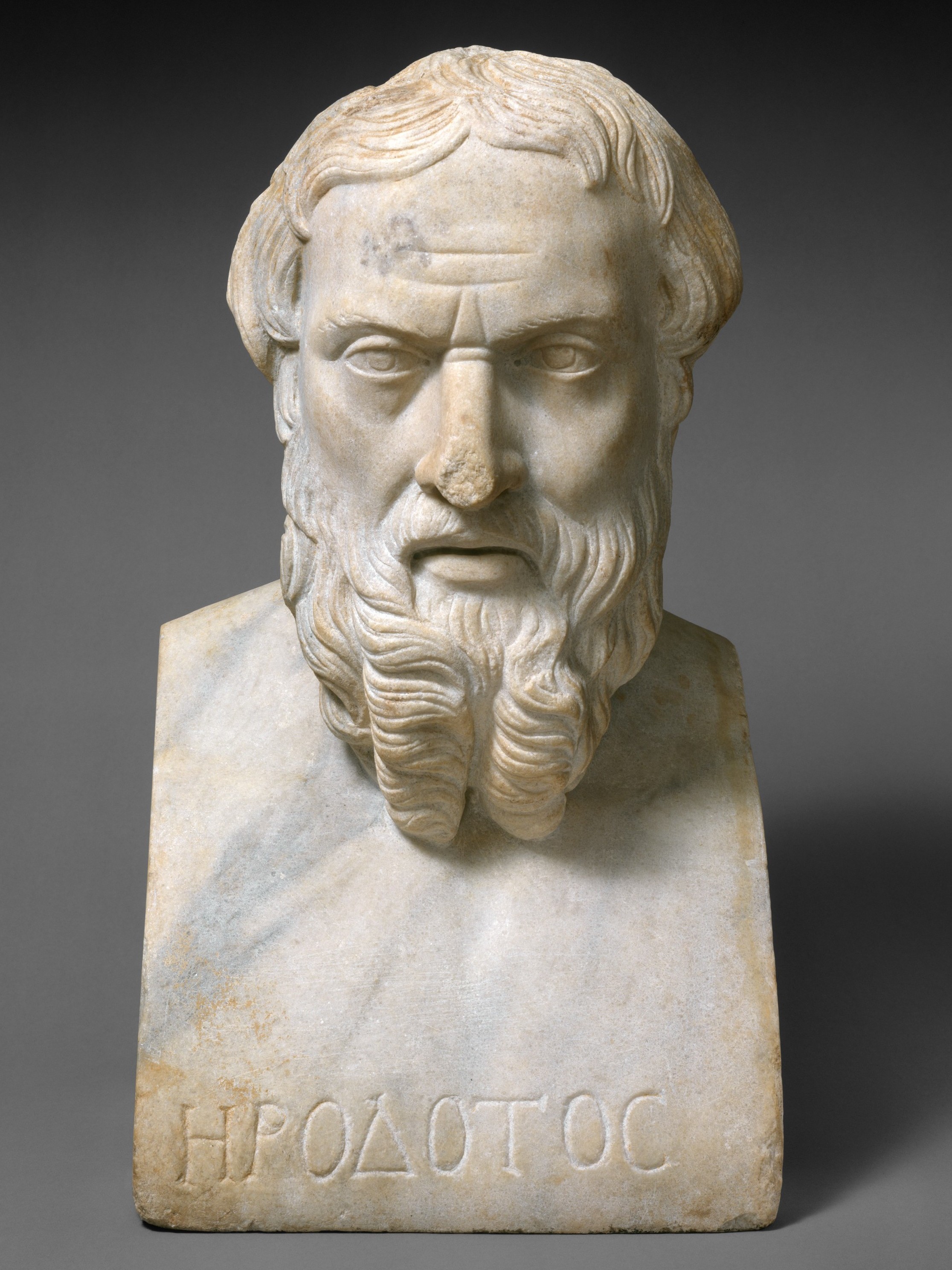
Herodotus of Halicarnassus (c. 484-425 BCE) stands as one of the most influential figures in Western intellectual tradition, earning the enduring title "The Father of History." His groundbreaking work, The Histories, represents humanity's first systematic attempt to record and analyze past events through critical inquiry rather than mythological narrative. More than simply chronicling the Persian Wars, Herodotus pioneered a new approach to understanding human experience that would fundamentally shape historical methodology for millennia to come.
The Father of History
"Great deeds are usually wrought at great risks." - Herodotus
Born in the cosmopolitan city of Halicarnassus (modern-day Bodrum, Turkey) during the height of the Persian Empire, Herodotus lived at the intersection of East and West, Greek and barbarian, tradition and innovation. This unique position allowed him to develop a perspective that was both deeply Greek and remarkably cosmopolitan, enabling him to view cultures and civilizations with an curiosity and relative objectivity that was revolutionary for his time.
Early Life and Background
Herodotus was born into a world of unprecedented cultural exchange and political upheaval. Halicarnassus, his birthplace, was a melting pot of Greek, Persian, Lydian, and Carian influences. The city had been incorporated into the Persian Empire under Cyrus the Great, yet maintained its Greek character and institutions. This multicultural environment profoundly shaped Herodotus's worldview and methodology.
Little is known with certainty about Herodotus's family background, though ancient sources suggest he came from an aristocratic family. His uncle, Panyassis, was a renowned epic poet, indicating that literary and intellectual pursuits were valued in his household. The political situation in Halicarnassus during Herodotus's youth was complex and often volatile, with local tyrants ruling under Persian oversight while Greek cultural identity remained strong.
During his formative years, Herodotus witnessed the aftermath of the great Persian Wars (499-449 BCE), which had ended just decades before his birth. The stories, memories, and consequences of these conflicts permeated the intellectual atmosphere of his time. Veterans of Marathon, Salamis, and Plataea were still alive, providing firsthand accounts that would later inform his historical narrative.
The young Herodotus received an excellent Greek education, studying the works of Homer, Hesiod, and the early philosophers. He was particularly influenced by the intellectual revolution occurring in Ionia, where thinkers like Thales, Anaximander, and Hecataeus were developing new ways of understanding the natural world and human society. Hecataeus of Miletus, in particular, served as an important predecessor, having written geographical and genealogical works that attempted to rationalize mythological traditions.
The Great Journey: Herodotus as Traveler and Ethnographer
What distinguished Herodotus from his predecessors and contemporaries was his commitment to personal investigation and travel. Rather than simply accepting traditional accounts or relying on secondhand information, he embarked on extensive journeys throughout the known world to gather information firsthand. His travels took him from the Black Sea to the First Cataract of the Nile, from the Scythian steppes to the Persian heartland.
In Egypt, Herodotus spent considerable time studying the ancient civilization that had fascinated Greeks since Homer's time. He interviewed priests, observed religious ceremonies, and examined architectural marvels like the pyramids. His account of Egypt in Book II of The Histories represents one of the earliest systematic ethnographic studies, combining geographical description, cultural analysis, and historical narrative. He was particularly struck by Egyptian antiquity and the way their customs often reversed Greek practices - a observation that led him to profound insights about cultural relativism.
His journeys to Babylon brought him into contact with another ancient civilization that predated Greek culture by millennia. Herodotus described the city's magnificent architecture, including the Hanging Gardens, and documented Babylonian customs and religious practices. His account of Babylonian marriage markets and funeral customs provides valuable insights into daily life in the Persian Empire's richest province.
Perhaps most remarkably, Herodotus traveled to the northern shores of the Black Sea, venturing into Scythian territory. His descriptions of nomadic life, Scythian customs, and the vast steppes opened up an entirely new world to Greek readers. His account of Scythian military tactics, social organization, and religious beliefs demonstrates his ability to appreciate and understand cultures radically different from his own.
These travels were not mere sightseeing expeditions but systematic research projects. Herodotus developed what we might recognize today as anthropological methods: participant observation, cultural comparison, and the critical evaluation of sources. He consistently sought multiple perspectives on events and customs, comparing local traditions with accounts from other regions.
Historical Methodology and Innovation
Herodotus's approach to historical investigation was revolutionary for its time and remains influential today. He established several fundamental principles that continue to guide historical scholarship: the importance of eyewitness testimony, the critical evaluation of sources, and the necessity of acknowledging uncertainty when evidence is incomplete or contradictory.
One of his most important innovations was the concept of historia itself - a word meaning "inquiry" or "investigation." Unlike earlier chroniclers who simply recorded events or poets who celebrated heroic deeds, Herodotus sought to understand the causes and consequences of human actions. He was particularly interested in the question of causation: why do events happen as they do? This analytical approach marked the beginning of historical thinking as we understand it.
Herodotus developed sophisticated methods for evaluating conflicting accounts. He often presented multiple versions of events, indicating which he considered most credible and explaining his reasoning. For example, when describing the death of Cyrus the Great, he presents several different accounts before stating his preference for the version he considers most reliable. This transparency about sources and methodology was unprecedented.
His treatment of divine intervention in human affairs represents another methodological innovation. While Herodotus lived in an age that accepted divine causation as natural, he distinguished between immediate human causes and ultimate divine purposes. He rarely rejected religious explanations outright but focused primarily on human motivations and actions that could be observed and verified.
The concept of cultural relativism, though not explicitly articulated as such, permeates Herodotus's work. He consistently demonstrated that customs that seem strange or barbarous to Greeks might be perfectly rational within their own cultural context. His famous observation that "custom is king of all" reflects his understanding that cultural practices should be judged within their own framework rather than by external standards.
The Histories: Structure and Content
The Histories, Herodotus's masterwork, is structured around the central narrative of the Persian Wars but encompasses far more than military history. The work is traditionally divided into nine books, each named after one of the nine Muses, though this division was likely made by later editors rather than Herodotus himself.
Books I-III: The Rise of Persia. The opening books trace the expansion of Persian power from its origins under Cyrus the Great through the reign of Cambyses and into the early years of Darius I. Herodotus masterfully weaves together the stories of Lydia's fall under Croesus, the Persian conquest of Babylon, and Cambyses' invasion of Egypt. These books establish the Persian Empire as a world power while introducing the cultural and geographical diversity that would characterize Herodotus's entire work.
Books IV-V: Expanding Horizons. These books focus on Persian expeditions to the periphery of the known world: Scythia and Libya. Book IV contains Herodotus's famous ethnographic account of the Scythians, while Book V begins the narrative of Persian involvement in Greek affairs through the Ionian Revolt. The geographical scope continues to expand as Herodotus describes the vast reaches of the Persian Empire.
Books VI-IX: The Persian Wars. The final books contain the central narrative for which Herodotus is best known: the Persian Wars themselves. From Marathon through Salamis to Plataea, these books chronicle the greatest military conflict of the ancient world with unprecedented detail and psychological insight. Yet even here, Herodotus maintains his ethnographic interest, describing Persian customs, Greek political developments, and the cultural dimensions of the conflict.
What makes The Histories unique is not just its factual content but its literary artistry. Herodotus was a master storyteller who understood that historical truth could be conveyed through compelling narrative. His work contains hundreds of individual stories, each carefully crafted to illuminate larger themes about human nature, divine justice, and the rise and fall of civilizations.
Major Themes and Philosophical Insights
Throughout The Histories, several recurring themes demonstrate Herodotus's sophisticated understanding of human nature and historical causation. These themes transcend the specific events he describes and offer timeless insights into the human condition.
The Wheel of Fortune. One of Herodotus's most persistent themes is the instability of human fortune and the cyclical nature of power. He repeatedly demonstrates how the mighty fall and the humble rise, often through their own actions. The stories of Croesus, Polycrates, and Xerxes all illustrate this pattern. This theme reflects both Greek tragic sensibility and Herodotus's observation of historical patterns across different cultures.
Hubris and Nemesis. Closely related to the theme of fortune's wheel is the Greek concept of hubris (excessive pride or ambition) followed by nemesis (divine retribution). Herodotus shows how leaders who overstep appropriate bounds - whether geographical, cultural, or moral - inevitably face downfall. Xerxes' invasion of Greece serves as the paradigmatic example, but the theme appears throughout the work.
Cultural Relativism and Tolerance. Herodotus's extensive travels made him acutely aware of cultural diversity and the relativity of customs. Unlike many of his contemporaries, he rarely dismissed foreign practices as simply barbarous but sought to understand them within their own context. This perspective made him remarkably tolerant for his time and contributed to his ability to present non-Greek cultures sympathetically.
The Limits of Power. Throughout The Histories, Herodotus explores the limitations that constrain even the most powerful rulers. Geography, climate, cultural resistance, and human nature all serve as checks on imperial ambition. His portrayal of Persian imperial expansion demonstrates both the remarkable achievements of organized power and its ultimate limitations.
Free Will versus Fate. Herodotus grapples with the tension between human agency and divine predetermination. While he acknowledges the role of fate and divine will, he consistently emphasizes human choice and responsibility. Characters in his narrative face genuine decisions that have real consequences, even when operating within broader patterns of divine justice.
The Persian Wars: Herodotus's Central Narrative
The Persian Wars form the dramatic climax of The Histories and represent Herodotus's attempt to explain the most significant conflict of his age. His account goes far beyond military history to explore the cultural, political, and psychological dimensions of the struggle between East and West.
The Ionian Revolt (499-494 BCE). Herodotus traces the origins of the conflict to the Ionian Revolt, when Greek cities in Asia Minor rebelled against Persian rule. He provides detailed accounts of the political maneuvering that led to the revolt, the military campaigns that followed, and the ultimate failure of the Greek resistance. His portrayal of figures like Aristagoras of Miletus and Histiaeus reveals the complex motivations that drove individuals to risk everything for freedom.
Marathon (490 BCE). The Battle of Marathon receives careful treatment as both military engagement and symbolic confrontation. Herodotus emphasizes the courage of the Athenians and Plataeans who faced the Persian force without Spartan support. His account of the battle itself is relatively brief, but he provides rich context about Persian preparations, Athenian politics, and the broader significance of Greek victory.
Thermopylae and Salamis (480 BCE). Herodotus's account of Xerxes' massive invasion reaches its dramatic peak with the battles of Thermopylae and Salamis. His portrayal of Leonidas and the 300 Spartans has become legendary, but equally important is his analysis of Greek strategy and Persian logistics. The naval battle at Salamis receives particularly detailed treatment, with Herodotus providing insights into naval tactics, leadership, and the role of Themistocles in Greek victory.
Plataea and Mycale (479 BCE). The final Persian defeat on land and sea completes Herodotus's narrative arc. His account of Plataea emphasizes Greek unity and Persian disarray, while the simultaneous victory at Mycale demonstrates the liberation of the Aegean. These battles mark not just military victory but the preservation of Greek independence and culture.
Throughout his account of the Persian Wars, Herodotus maintains remarkable balance and objectivity. While clearly sympathetic to the Greek cause, he presents Persian leaders like Cyrus and Darius as complex figures worthy of respect. He acknowledges Persian achievements and criticizes Greek failures, maintaining the analytical approach that distinguishes his work from mere patriotic propaganda.
Herodotus as Ethnographer: Understanding the Ancient World
Beyond his role as historian, Herodotus serves as our primary source for understanding the cultural diversity of the ancient Mediterranean and Near East. His ethnographic descriptions provide invaluable insights into societies that left few written records of their own perspectives.
Egyptian Civilization. Herodotus's second book contains the most extensive ancient Greek account of Egyptian civilization. He describes religious practices, architectural marvels, social customs, and historical traditions with remarkable detail. His account of mummification, though not entirely accurate by modern standards, provides insights into Egyptian beliefs about death and afterlife. He was particularly impressed by Egyptian antiquity and the stability of their institutions.
Scythian Culture. His description of Scythian nomads in Book IV represents one of the earliest systematic accounts of pastoral nomadism. Herodotus describes their political organization, military tactics, religious beliefs, and daily life with an appreciation for their adaptation to the steppe environment. His account of Scythian resistance to Darius's invasion demonstrates his understanding of how nomadic societies could effectively oppose settled agricultural empires.
Persian Society. Throughout The Histories, Herodotus provides glimpses of Persian culture and society that complement his political and military narrative. He describes Persian education, religious practices, court ceremonies, and social organization. His portrayal of Persian tolerance for local customs within their empire shows sophisticated understanding of imperial administration.
Comparative Method. Herodotus consistently employs comparative analysis to illuminate cultural differences and similarities. He notes, for example, how different societies approach marriage, burial practices, religious observance, and political organization. This comparative approach allows him to identify both universal human patterns and unique cultural adaptations.
His ethnographic work demonstrates remarkable open-mindedness for his era. While he occasionally expresses skepticism about particular claims, he generally approaches foreign cultures with curiosity rather than prejudice. This attitude made possible his insights into cultural relativism and the diversity of human social organization.
Literary Achievement and Narrative Techniques
Herodotus was not only a pioneering historian but also a masterful storyteller whose literary techniques enhanced rather than compromised his analytical purposes. His ability to combine factual investigation with compelling narrative makes The Histories one of the great works of world literature.
Narrative Structure. The overall structure of The Histories follows a carefully planned design that moves from the periphery to the center, from the rise of Persian power to its confrontation with Greece. Within this larger framework, Herodotus employs ring composition, a technique borrowed from epic poetry, where themes and motifs introduced early in the work return at crucial moments to create unity and emphasis.
Character Development. Herodotus excels at character portrayal, creating memorable figures who embody larger historical forces while remaining recognizably human. His Croesus is both a symbol of the dangers of wealth and power and a sympathetic individual facing genuine moral choices. Cyrus represents Persian imperial energy but also demonstrates wisdom and restraint. These characterizations make abstract historical processes concrete and accessible.
Dialogue and Speech. Following the convention established by Homer, Herodotus frequently employs direct speech to reveal character and advance his analysis. The conversations between Croesus and Solon, Xerxes and Artabanus, or Demaratus and Xerxes serve multiple functions: they provide psychological insight, articulate competing worldviews, and allow Herodotus to present complex ideas through dramatic interaction rather than abstract exposition.
Irony and Foreshadowing. Herodotus employs dramatic irony with considerable skill, allowing readers to perceive outcomes and patterns that characters cannot see. His use of oracles and prophecies creates a framework for exploring the relationship between human planning and divine will. The ironic gap between expectation and result serves both literary and analytical purposes, highlighting the unpredictability of human affairs.
Episodic Structure. Within his larger narrative framework, Herodotus employs an episodic structure that allows him to explore themes from multiple angles. Individual stories illuminate broader patterns while maintaining their own dramatic integrity. This technique enables him to present complex historical developments through accessible, memorable narratives.
Influence on Later Historians and Thinkers
Herodotus's influence on subsequent historical writing and thought extends far beyond the ancient world. His methodological innovations, thematic concerns, and literary techniques established patterns that continue to influence historians, anthropologists, and writers today.
Immediate Successors. Thucydides, often considered Herodotus's successor as a Greek historian, defined his own approach partly in reaction to Herodotus's methods. While Thucydides emphasized political and military analysis over cultural description, he adopted Herodotus's commitment to critical inquiry and eyewitness testimony. The tension between these two approaches - Herodotus's broad cultural perspective and Thucydides' focused political analysis - has continued to influence historical writing.
Roman Historians. Roman historians like Livy and Tacitus drew heavily on Herodotean techniques, particularly his use of character analysis and moral themes to illuminate political developments. The Roman conception of history as moral instruction owes much to Herodotus's example, though Roman historians generally focused more narrowly on political and military affairs.
Medieval and Renaissance Reception. During the medieval period, Herodotus's work was less known in Western Europe than that of later Roman historians, but his influence persisted through Byzantine scholars and Arabic translations. The Renaissance rediscovery of Greek texts brought renewed interest in Herodotus's methods and perspectives. Humanist historians admired his attention to cultural diversity and his literary skill.
Modern Historical Scholarship. Modern historians have increasingly appreciated Herodotus's sophisticated approach to cultural analysis and source criticism. His recognition of the importance of economic, social, and cultural factors in historical development anticipated many concerns of modern social history. Anthropologists and ethnographers particularly value his attention to cultural description and his comparative methodology.
Contemporary Relevance. In our globalized world, Herodotus's interest in cultural encounter and conflict has gained new relevance. His exploration of East-West tensions, imperial overreach, and cultural identity resonates with contemporary concerns. His methodological commitment to multiple perspectives and source criticism provides a model for navigating information abundance and conflicting interpretations.
Modern Scholarly Assessment and Criticisms
While Herodotus's pioneering contributions to historical methodology are universally acknowledged, modern scholarship has also identified significant limitations and problems in his work. Understanding these criticisms helps clarify both his achievements and the evolution of historical scholarship since his time.
Source Criticism and Reliability. Modern historians question some of Herodotus's sources and his ability to evaluate them critically. His reliance on oral tradition, particularly for events that occurred generations before his birth, sometimes led him to accept legendary material as factual. Archaeological evidence has contradicted some of his claims, particularly regarding numbers of troops, casualty figures, and specific details of battles.
Cultural Bias and Stereotyping. Despite his remarkable open-mindedness for his time, Herodotus occasionally reveals Greek cultural assumptions and biases. His portrayal of Persian despotism versus Greek freedom, while influential, sometimes oversimplifies complex political realities. Some of his descriptions of foreign customs reflect Greek stereotypes rather than accurate observation.
Chronological Problems. Herodotus lacked precise chronological frameworks and sometimes confused the sequence of events or compressed timeframes. His understanding of Egyptian chronology, for example, was distorted by incomplete information and methodological limitations. These problems reflect the absence of standardized dating systems in the ancient world rather than personal failing.
Religious and Supernatural Elements. His inclusion of oracles, dreams, and divine interventions troubles modern readers who prefer purely naturalistic explanations. However, this criticism may miss the sophisticated way Herodotus used religious material to explore questions of causation and meaning that remain relevant today. His religious elements often serve analytical rather than simply credulous purposes.
Methodological Inconsistencies. Herodotus did not always apply his critical methods consistently. He sometimes accepted implausible stories while rejecting others that may have been more reliable. This inconsistency reflects the experimental nature of his enterprise and the absence of established historical conventions to guide his work.
Despite these limitations, modern scholarship increasingly appreciates Herodotus's achievements. His pioneering methodology, sophisticated cultural analysis, and literary artistry established foundations for historical scholarship that remain relevant today. His limitations reflect the challenges facing any pioneer working without established traditions or institutional support.
Legacy and Enduring Significance
More than two millennia after his death, Herodotus continues to influence how we understand the past and our place within it. His legacy extends beyond professional historical scholarship to encompass literature, anthropology, political science, and popular culture.
Historical Methodology. Herodotus established fundamental principles of historical investigation that remain central to modern scholarship: the importance of primary sources, the need for critical evaluation of evidence, the value of multiple perspectives, and the obligation to acknowledge uncertainty. While specific techniques have evolved, these basic principles continue to guide historical research.
Cultural Understanding. His approach to cultural diversity and comparative analysis anticipated modern anthropological methods. His recognition that different societies develop different solutions to universal human problems remains a foundational insight for understanding cultural variation. His work demonstrates that rigorous investigation can coexist with sympathetic appreciation of human diversity.
Literary Achievement. The Histories stands as one of the great works of world literature, demonstrating that analytical rigor and narrative artistry can enhance rather than compromise each other. His influence on subsequent writers extends far beyond historians to include novelists, dramatists, and poets who have drawn inspiration from his themes and techniques.
Political Thought. Herodotus's exploration of political systems, imperial dynamics, and cultural conflict has influenced political thinkers from ancient times to the present. His analysis of Persian despotism and Greek freedom, though sometimes oversimplified, raised questions about political organization that remain relevant. His treatment of imperial overreach and cultural resistance speaks to contemporary concerns about globalization and cultural identity.
Popular Culture. References to Herodotus appear throughout Western culture, from classical literature to modern films and novels. His stories of Thermopylae, Marathon, and Salamis have become part of the common cultural inheritance, though often in simplified or romanticized forms. His work continues to provide raw material for artists and writers exploring themes of cultural encounter, heroism, and historical change.
Educational Value. The Histories remains a valuable educational text for students of history, literature, and cultural studies. Its combination of factual information, analytical insight, and literary artistry makes it uniquely suited for demonstrating how serious scholarship can also be engaging and accessible. Students reading Herodotus encounter not just information about the ancient world but a model for thoughtful inquiry into human experience.
Conclusion: The Eternal Relevance of Inquiry
Herodotus of Halicarnassus deserves his title as "The Father of History" not merely because he was chronologically first, but because he established an approach to understanding the past that remains fundamentally sound. His commitment to investigation over assumption, his appreciation for cultural complexity, and his recognition that human affairs follow discernible patterns while remaining unpredictable in their details created a framework for historical thinking that has proven remarkably durable.
What makes Herodotus eternally relevant is not his specific conclusions about the Persian Wars or ancient cultures, but his demonstration that careful inquiry can yield genuine understanding. In an age overwhelmed by information but often lacking wisdom, his example of thoughtful investigation, cultural empathy, and narrative skill provides a model for making sense of our complex world.
His work reminds us that history is not simply a collection of facts but an ongoing conversation between past and present, an attempt to understand how we became who we are and where we might be going. The questions he raised about power and justice, cultural identity and human nature, freedom and necessity, remain as urgent today as they were in the fifth century BCE.
Perhaps most importantly, Herodotus demonstrated that the pursuit of understanding need not be dry or abstract but can be as engaging and dramatic as any fictional narrative. His legacy suggests that the highest forms of inquiry combine rigorous analysis with imaginative sympathy, careful research with compelling storytelling, scholarly precision with human wisdom.
In our globalized, interconnected world, Herodotus's vision of inquiry that crosses cultural boundaries while respecting cultural differences offers particularly valuable guidance. His example suggests that we can maintain our commitments to truth and accuracy while remaining open to perspectives that challenge our assumptions and expand our understanding.
The title "Father of History" thus represents not just historical priority but ongoing relevance. Herodotus created not just a work of history but a way of approaching the world that combines curiosity, skepticism, empathy, and wonder. In a world that desperately needs such an approach, his legacy continues to inspire and guide those who seek to understand the complexities of human experience across time and culture.