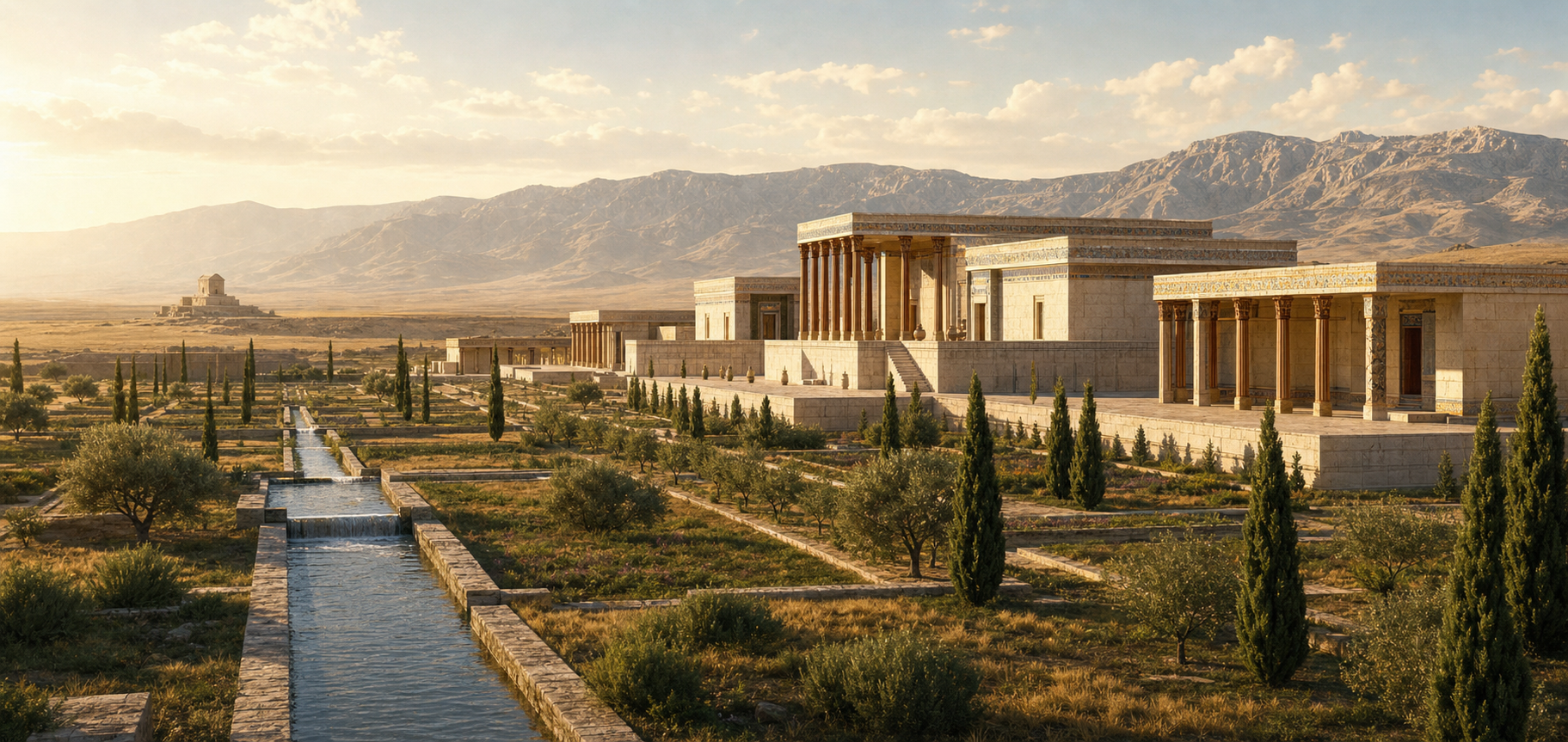
Corinth was one of the wealthiest and most strategically important city-states of ancient Greece. Situated on the narrow Isthmus of Corinth, the strip of land connecting the Peloponnese to mainland Greece, Corinth controlled vital trade routes between northern and southern Greece as well as maritime routes between the Aegean and Ionian seas. Its geographic position made it a commercial powerhouse, a naval force, and a significant political actor throughout the Archaic and Classical periods.
Unlike Sparta, which focused on military discipline, or Athens, which became synonymous with democracy and philosophy, Corinth was best known for commerce, craftsmanship, naval enterprise, and strategic diplomacy. Its influence extended across the Mediterranean through colonisation, trade networks, and political alliances.
Geographic Importance and Strategic Position
Corinth’s location defined its destiny. The city lay at the junction of two harbours: Lechaeum on the Corinthian Gulf to the west and Cenchreae on the Saronic Gulf to the east. This unique position allowed Corinth to control maritime traffic between the western Mediterranean and the Aegean.
The Isthmus of Corinth also enabled goods to be transported overland across a short distance rather than sailing around the dangerous southern Peloponnese. In antiquity, ships were hauled across the isthmus via a paved track known as the Diolkos. This innovation significantly enhanced Corinth’s commercial advantage.
Towering above the city stood the Acrocorinth, a massive limestone hill serving as a natural fortress. Whoever controlled Corinth commanded one of the most defensible and strategically significant positions in Greece.
Early History and Political Development
Corinth was inhabited during the Mycenaean period and appears in early Greek legend. In the Archaic period, it rose to prominence under aristocratic leadership. The ruling clan known as the Bacchiadae controlled the city until they were overthrown in the seventh century BCE.
Subsequently, Corinth experienced a period of tyranny under Cypselus and his son Periander. Unlike the modern negative connotation of the term, tyrants in archaic Greece were often strong rulers who centralised authority and promoted economic development. Under Periander, Corinth expanded its commercial networks, strengthened its fleet, and undertook public works.
Later, Corinth transitioned to an oligarchic system dominated by wealthy elites. Political power generally rested with influential families and commercial interests rather than with a broad citizen assembly such as that found in Athens.
Economic Power and Trade Networks
Corinth’s prosperity rested upon trade and manufacturing. The city was renowned for its fine pottery, particularly during the seventh and sixth centuries BCE, when Corinthian ceramics were widely exported across the Mediterranean. Corinthian goods have been discovered as far away as Italy and North Africa.
Corinth also became a major centre for shipbuilding and maritime commerce. Its fleets transported goods, established colonies, and projected influence abroad. Colonies such as Corcyra and Syracuse were founded under Corinthian leadership, extending its economic reach.
The city’s wealth derived not only from trade but also from its control of transit routes across the isthmus. Taxes and harbour fees provided substantial revenue, reinforcing Corinth’s position as one of the richest Greek poleis.
Colonisation and Overseas Influence
Corinth was among the most active colonising states of the Archaic period. It established settlements throughout the western Mediterranean, particularly in Sicily and southern Italy. The foundation of Syracuse proved especially significant, as it grew into a powerful city in its own right.
These colonies strengthened Corinth’s trading networks and increased access to resources such as grain, metals, and timber. They also enhanced Corinth’s cultural influence, spreading artistic styles and political models abroad.
Unlike purely territorial expansion, colonisation allowed Corinth to extend its power without overburdening its domestic population.
Military and Naval Strength
Although not as singularly focused on warfare as Sparta, Corinth maintained a capable military force. Its navy was particularly important, reflecting its maritime orientation.
Corinthian ships were among the most advanced of their time, and the city played a crucial role in naval developments. Its fleet allowed it to defend trade routes and intervene in regional conflicts.
In land warfare, Corinth participated in alliances and coalitions, adapting its military policy to suit its commercial and strategic interests.
Religion and the Isthmian Games
Corinth was a major religious centre. The city was closely associated with the worship of Aphrodite, whose sanctuary stood atop the Acrocorinth. This cult contributed to Corinth’s distinctive cultural identity.
Corinth also hosted the Isthmian Games, one of the four major Panhellenic festivals alongside the Olympic Games. Held near the isthmus, these athletic competitions attracted participants from across the Greek world and enhanced Corinth’s prestige.
Religious festivals reinforced civic identity whilst simultaneously strengthening inter-polis connections.
Corinth in the Persian and Peloponnesian Wars
During the Persian Wars, Corinth joined other Greek states in resisting Persian invasion. Its navy contributed to the allied fleet at the Battle of Salamis.
In the fifth century BCE, Corinth became increasingly concerned about Athenian expansion. Its colony Corcyra entered into conflict with Corinth, and this dispute contributed to the outbreak of the Peloponnesian War.
Corinth sided with Sparta against Athens. Although Sparta led the Peloponnesian League, Corinth was a driving force behind anti-Athenian sentiment. The war devastated much of Greece and altered the balance of power permanently.
The Corinthian War and Later History
After the Peloponnesian War, Corinth’s relationship with Sparta deteriorated. The city eventually joined Athens, Thebes, and Persia in opposing Spartan dominance during the Corinthian War.
In the fourth century BCE, Corinth became involved in shifting alliances as Macedon rose to prominence under Philip II and Alexander the Great. The League of Corinth, established by Philip, symbolised Macedonian hegemony over Greece.
Under Roman rule, Corinth suffered destruction in 146 BCE but was later rebuilt as a Roman colony. It flourished again under Roman administration and became an important urban centre.
Culture and Society
Corinthian society reflected its commercial character. Wealth, craftsmanship, and maritime enterprise were central to civic life. Unlike Sparta’s austere militarism, Corinth embraced prosperity and urban sophistication.
Its artistic contributions, especially in pottery and architecture, were influential in shaping early Greek visual culture. The Corinthian order of columns became a defining element of later classical architectural design.
The city’s cosmopolitan environment fostered interaction between Greeks and other Mediterranean peoples, contributing to cultural exchange.
Legacy
Corinth’s history demonstrates the importance of geography, commerce, and strategic positioning in shaping political power. Its wealth and naval strength allowed it to exert influence far beyond its territorial boundaries.
Though it did not produce the democratic institutions of Athens or the militarised discipline of Sparta, Corinth embodied a third model of Greek civilisation: commercially driven, strategically astute, and culturally dynamic.
Today, the ruins of ancient Corinth, including the Temple of Apollo and the Acrocorinth fortress, stand as reminders of a city that once controlled the crossroads of Greece and played a decisive role in shaping Mediterranean history.