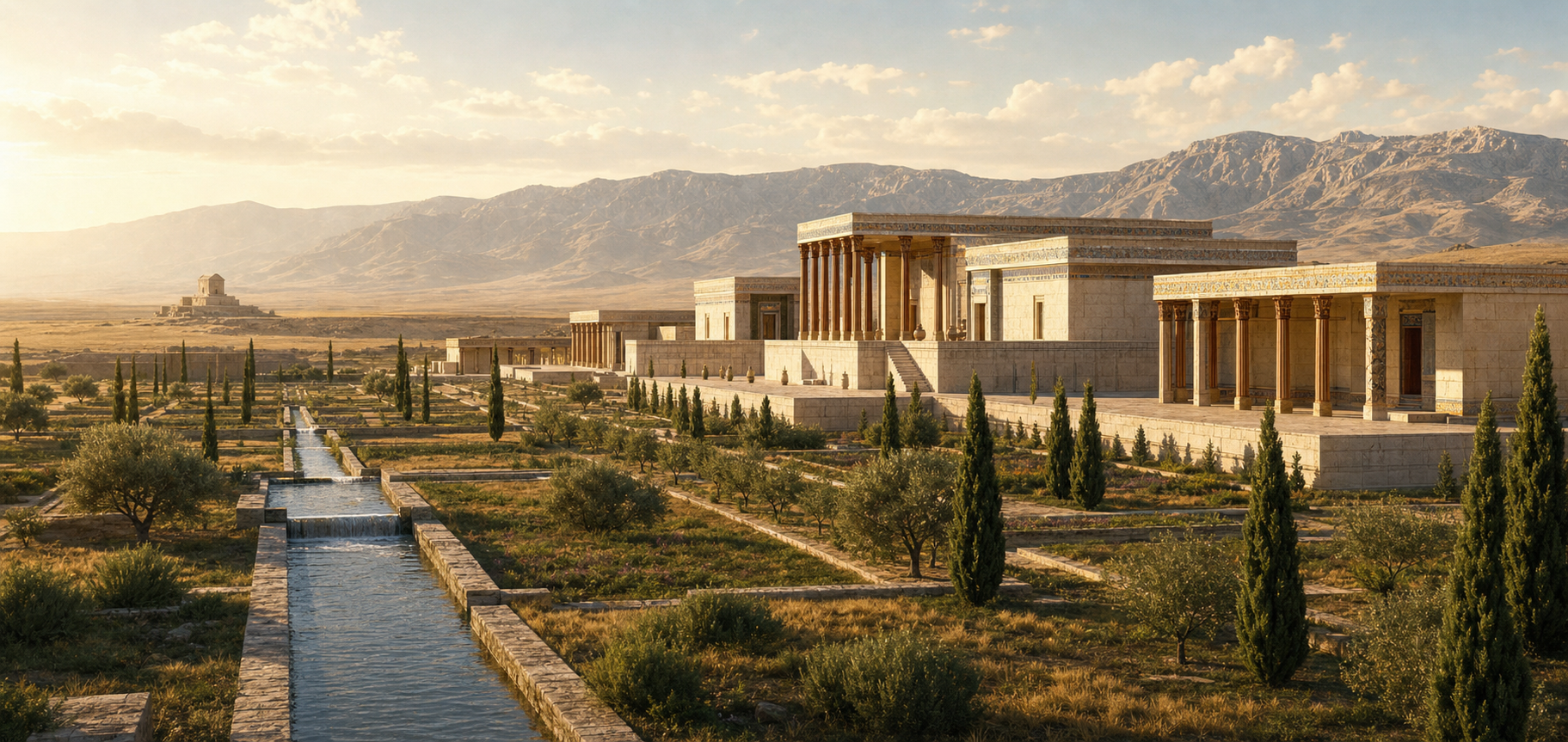
Between approximately 550 and 323 BCE, the ancient Mediterranean and Near Eastern worlds experienced one of the most influential periods in human history. Powerful empires expanded across vast territories, Greek city-states developed new political systems, philosophers questioned the nature of knowledge and morality, artists transformed architecture and sculpture, and armies fought conflicts that reshaped the political map of the ancient world.
This broad era is often associated particularly with Classical Greece, but the world of the Classical Age extended far beyond Athens and Sparta. The Achaemenid Persian Empire became the largest empire yet created. Phoenician cities remained major centres of maritime commerce. Egypt passed through periods of Persian and native rule. Carthage expanded throughout the western Mediterranean, while Greek communities stretched from the Black Sea to Sicily and southern Italy.
The period began as Cyrus the Great established Persian supremacy over the Medes and expanded his kingdom into an empire. It ended with the death of Alexander the Great in 323 BCE after his conquest of Persia and campaigns extending as far as northwestern India. Between those events, the political and cultural foundations of the later Hellenistic and Roman worlds were created.
A Changing Ancient World
Around 550 BCE, the political world of western Asia was undergoing profound change.
Assyria had collapsed several decades earlier, leaving Babylonia and the Medes as major powers.
Lydia controlled much of western Anatolia.
Egypt remained independent under the Twenty-Sixth Dynasty.
Greek communities were divided into hundreds of independent city-states, while Phoenician merchants maintained trading networks throughout the Mediterranean.
The rise of Persia would soon connect many of these regions within one enormous imperial system.
The Rise of Persia
The Persians were an Iranian-speaking people established in southwestern Iran.
During the sixth century BCE, a ruler named Cyrus II transformed their regional kingdom into a major power.
Cyrus defeated the Median king Astyages around 550 BCE and took control of the Median political network.
Instead of simply destroying the existing system, Cyrus incorporated Median nobles and soldiers into his new kingdom.
This ability to absorb conquered peoples became an important characteristic of Persian imperial expansion.
Cyrus the Great
Cyrus II became known to later generations as Cyrus the Great.
His military campaigns created the foundations of the Achaemenid Persian Empire.
After defeating the Medes, he expanded westward into Anatolia and eventually conquered the wealthy kingdom of Lydia.
He later entered Mesopotamia and captured Babylon in 539 BCE.
By his death, Cyrus controlled territories stretching from Central Asia to the Mediterranean.
The Achaemenid Dynasty
The Persian royal house is commonly known as the Achaemenid dynasty.
Later Persian kings traced their ancestry to a figure named Achaemenes.
The dynasty produced rulers including Cyrus the Great, Cambyses II, Darius I, Xerxes I and Artaxerxes III.
Under these kings, Persia developed administrative systems capable of governing millions of people across three continents.
The Conquest of Media
Cyrus's victory over Astyages marked the end of independent Median kingship.
However, the Medes did not disappear as a people.
Median nobles continued to hold important positions within the Persian Empire.
Greek writers frequently referred to Persians and Medes together, demonstrating their close association within imperial government.
Lydia
The kingdom of Lydia controlled much of western Anatolia during the early sixth century BCE.
Its capital at Sardis was famous for wealth.
Lydian kings benefited from fertile territory, trade routes and access to precious metals.
The kingdom was also associated with the early development of minted coinage.
Croesus
Croesus was the final independent king of Lydia.
Ancient traditions remembered him as a symbol of extraordinary wealth.
He controlled Greek cities along the western Anatolian coast and maintained relationships with sanctuaries such as Delphi.
When Persian power expanded westward, Croesus confronted Cyrus.
The resulting war ended with Lydia's defeat and the capture of Sardis.
The Fall of Sardis
After defeating Croesus, Cyrus incorporated Lydia into his empire.
Persian authority now reached the Aegean coast.
The Greek cities of Ionia that had previously lived under Lydian influence were brought into the Persian political system.
This expansion would eventually help create the conditions for conflict between Persia and mainland Greece.
The Conquest of Babylon
In 539 BCE, Cyrus turned against the Neo-Babylonian Empire.
Babylon was one of the largest and most prestigious cities in the ancient world.
Persian forces defeated the Babylonian army and entered the city.
Cyrus presented himself as a legitimate ruler rather than simply a foreign conqueror.
Babylon became one of the major centres of the expanding Persian Empire.
The Cyrus Cylinder
A famous clay cylinder discovered at Babylon contains an inscription issued in the name of Cyrus.
The text describes his conquest and presents him as chosen by the Babylonian god Marduk.
It states that temples and religious traditions were restored after the previous king had supposedly neglected them.
The inscription reflects traditional Mesopotamian royal propaganda and demonstrates Cyrus's willingness to adopt local political customs.
Religious Policy
Persian kings generally allowed conquered peoples to continue worshipping their traditional gods.
Local temples often remained active, and regional religious elites could continue exercising influence.
This policy reduced the need to impose cultural uniformity across an enormous empire.
The Persians demanded political loyalty and taxation but frequently permitted substantial cultural diversity.
The Return from Babylonian Exile
After Cyrus conquered Babylon, some Judean exiles were permitted to return to Jerusalem.
The Babylonian Empire had destroyed Jerusalem and its temple decades earlier.
Under Persian rule, the temple was eventually rebuilt.
Jewish traditions therefore remembered Cyrus unusually positively as a ruler who allowed restoration of their religious community.
Cambyses II
Cyrus was succeeded by his son Cambyses II.
Cambyses continued Persian expansion and conquered Egypt in 525 BCE.
The Egyptian pharaoh Psamtik III was defeated, and Egypt became part of the Achaemenid Empire.
The conquest gave Persia control of another ancient and wealthy civilisation.
Persian Egypt
The Persians governed Egypt as an imperial territory while retaining many existing administrative and religious traditions.
Persian rulers could be represented using Egyptian pharaonic imagery.
Local temples remained important.
However, Persian rule was periodically challenged by Egyptian revolts, demonstrating that imperial control was not always secure.
Darius I
After a period of political instability following Cambyses's death, Darius I became king in 522 BCE.
Darius transformed the administration of the empire and became one of its most important rulers.
He reorganised provinces, developed taxation systems, constructed roads and commissioned monumental architecture.
Under Darius, the Achaemenid Empire reached a highly organised imperial form.
The Behistun Inscription
Darius recorded the story of his rise to power in a monumental inscription at Behistun in western Iran.
The text was written in Old Persian, Elamite and Babylonian.
It describes rebellions throughout the empire and Darius's victories over rival claimants.
The accompanying relief depicts defeated enemies standing before the Persian king.
The inscription became one of the most important sources for understanding early Achaemenid history.
Satrapies
The Persian Empire was divided into administrative regions commonly called satrapies.
A governor known as a satrap represented royal authority in each region.
Satraps supervised taxation, security and administration.
Some came from Persian aristocratic families, while local elites could also play important roles.
The system allowed the king to govern enormous territories without directly controlling every local decision.
The Great King
Achaemenid rulers presented themselves as kings over many peoples and lands.
The royal title King of Kings emphasised authority above subordinate rulers.
Persian inscriptions portrayed the empire as an ordered collection of different nations united beneath the monarch.
Royal legitimacy was closely associated with the god Ahura Mazda.
Ahura Mazda
Persian royal inscriptions frequently invoke Ahura Mazda as the great god who granted kingship to the ruler.
Darius stated that he ruled by the favour of Ahura Mazda.
The exact relationship between Achaemenid royal religion and later forms of Zoroastrianism remains debated.
Nevertheless, concepts of truth, divine order and legitimate kingship were central to Persian political ideology.
The Royal Road
Darius developed a road system connecting the major centres of the empire.
The most famous route later became known as the Royal Road.
It linked Sardis in western Anatolia with regions deep inside the empire, including the royal centre at Susa.
Stations along the route supported official messengers.
This communication network allowed orders and information to travel across enormous distances.
Royal Couriers
Persian messengers were famous for their speed.
Relay stations supplied fresh horses and provisions.
Officials could therefore carry royal messages much faster than ordinary travellers.
Efficient communication was essential to the administration of an empire stretching thousands of kilometres.
Susa
Susa was one of the great royal cities of the Persian Empire.
Located in southwestern Iran, it had been an important centre long before the rise of Persia.
Darius constructed a major palace there.
Building materials and craftspeople were brought from many regions of the empire.
The palace therefore became a physical representation of imperial diversity.
Persepolis
Darius also began constructing the ceremonial complex at Persepolis.
Later kings expanded the site.
Massive terraces supported palaces, audience halls and monumental stairways.
Stone reliefs depicted representatives of many peoples bringing gifts or tribute to the king.
The imagery emphasised cooperation, hierarchy and imperial order.
The Apadana
The Apadana was a vast audience hall at Persepolis.
Its roof was supported by enormous columns.
Reliefs along its stairways portray delegations from different regions of the empire.
Their distinctive clothing and gifts represented the enormous geographical range of Persian rule.
Persian Art
Achaemenid art combined influences from many cultures.
Persian architects and artists drew upon traditions from Mesopotamia, Egypt, Anatolia and Iran.
Foreign craftspeople worked on imperial monuments.
The result was a distinctive royal style that expressed the multicultural character of the empire.
Persian Taxation
The empire required enormous resources to support its government and armies.
Satrapies provided taxes in silver, agricultural products or valuable goods.
Different regions contributed according to their resources.
Egypt supplied grain, while other territories provided horses, metals or luxury materials.
Persian Coinage
Darius introduced important royal coinage traditions.
Gold coins commonly known as darics became symbols of Persian royal authority.
Silver sigloi were also used in parts of the empire.
Coinage was particularly important in western territories where monetary economies were becoming increasingly developed.
The Persian Army
The Persian military reflected the diversity of the empire.
Soldiers were recruited from numerous peoples.
Persian and Median troops formed important components, but armies could also include Egyptians, Babylonians, Phoenicians, Greeks and others.
Different groups brought specialised weapons and fighting traditions.
The Immortals
Greek writers described an elite Persian infantry force known as the Immortals.
The name came from the claim that their number was constantly maintained because any casualty was immediately replaced.
They formed a prestigious royal guard and battlefield force.
The exact details of their organisation are primarily known from Greek sources.
Persian Cavalry
Cavalry was particularly important in Persian warfare.
Iranian military traditions placed great value on horsemanship.
Mounted archers and spear-armed cavalry provided speed and flexibility.
Persian armies often attempted to use open terrain where cavalry could operate effectively.
The Persian Navy
Persia also controlled powerful naval forces, particularly through subject maritime peoples.
Phoenician cities supplied some of the finest ships and sailors.
Egyptians, Cypriots and Ionian Greeks also contributed naval forces.
This allowed Persian kings to conduct major campaigns throughout the eastern Mediterranean.
The Greek World
While Persia developed into a vast empire, the Greek world remained politically divided.
Hundreds of independent city-states occupied mainland Greece, the Aegean islands, western Anatolia and colonies throughout the Mediterranean and Black Sea.
They shared language, religious traditions and cultural practices but frequently fought one another.
Two city-states eventually became particularly influential: Athens and Sparta.
The Polis
The polis was the central political institution of Classical Greece.
It included an urban centre and the surrounding territory controlled by its citizens.
Each polis possessed its own laws, political institutions and religious traditions.
Citizens identified strongly with their individual city-state.
This local loyalty often mattered more politically than the broader cultural identity of being Greek.
Athens
Athens developed in Attica in central Greece.
Its urban centre was dominated by the Acropolis.
During the sixth century BCE, Athens experienced political struggles involving aristocrats, reformers and tyrants.
These conflicts eventually produced the democratic institutions for which the city became famous.
Solon
Solon introduced important reforms at Athens during the early sixth century BCE.
He attempted to address social tensions caused by debt, inequality and political exclusion.
His reforms cancelled certain debt obligations and altered political participation according to wealth.
Solon did not create full democracy, but his reforms became an important step toward later political development.
Peisistratus
Peisistratus became tyrant of Athens during the sixth century BCE.
In ancient Greek politics, a tyrant was a ruler who gained supreme power outside traditional constitutional arrangements.
Peisistratus maintained many existing institutions while strengthening his personal authority.
His rule was associated with public works, religious festivals and economic development.
Hippias
After Peisistratus's death, his sons Hippias and Hipparchus inherited influence.
Hipparchus was assassinated, and Hippias's rule became increasingly harsh.
Hippias was eventually expelled from Athens in 510 BCE.
The political crisis that followed led directly to major constitutional changes.
Cleisthenes
Cleisthenes introduced reforms at Athens around 508 and 507 BCE.
He reorganised citizens into new political units that weakened the traditional power of aristocratic families.
A larger council was created, and broader citizen participation developed.
These reforms are commonly regarded as the foundation of Athenian democracy.
Athenian Democracy
Athenian democracy developed into a system in which male citizens could participate directly in major political decisions.
The Assembly debated war, diplomacy, laws and public policy.
Many offices were selected by lot.
Citizens also served on large juries.
The system was unusually participatory by ancient standards but excluded women, enslaved people and resident foreigners.
The Assembly
The Athenian Assembly was open to adult male citizens.
Meetings allowed citizens to vote directly on important policies.
Speakers attempted to persuade the audience through public debate.
Political success therefore depended heavily upon rhetorical ability.
The Council of Five Hundred
The Council of Five Hundred prepared business for the Assembly and supervised many aspects of administration.
Members were selected from different political divisions of Attica.
Service rotated regularly, allowing large numbers of citizens to participate in government over time.
Ostracism
Athenians developed a political procedure known as ostracism.
Citizens could vote to exile a prominent individual for ten years.
The votes were written on pottery fragments known as ostraka.
The system was intended partly to prevent dangerous concentrations of political power.
Limits of Democracy
Athenian democracy was radical in allowing many citizens direct political power, but citizenship itself was limited.
Women could not vote or hold political office.
Enslaved people had no political rights.
Foreign residents known as metics contributed substantially to the economy but were excluded from citizenship.
The democratic system therefore existed within a society containing significant inequality.
Sparta
Sparta developed in Laconia in the southern Peloponnese.
Its political and social system differed dramatically from that of Athens.
Spartan society emphasised military discipline, collective identity and stability.
A relatively small class of full Spartan citizens controlled a much larger population of dependent workers.
The Spartan Kings
Sparta possessed two hereditary kings ruling simultaneously.
The kings performed religious and military functions.
Their power was limited by other institutions, including a council of elders and annually elected officials called ephors.
This mixed system made Sparta unusual among Greek city-states.
The Gerousia
The Gerousia was Sparta's council of elders.
It contained twenty-eight men over the age of sixty along with the two kings.
The council prepared proposals and served important judicial functions.
Membership was held for life.
The Ephors
Five ephors were elected each year.
They exercised substantial authority and supervised aspects of Spartan government and education.
The ephors could even challenge the kings under certain circumstances.
The office helped prevent the monarchy from becoming completely dominant.
The Spartiates
Full Spartan male citizens were commonly known as Spartiates or Homoioi.
They formed an elite warrior class.
To maintain full status, a citizen was expected to complete the Spartan educational system and participate in communal dining groups.
Their lifestyle depended heavily upon agricultural labour performed by the helots.
The Helots
The helots were a dependent population controlled by the Spartan state.
They worked agricultural land and supplied produce to Spartan citizens.
Helots greatly outnumbered the full Spartan citizen population.
Fear of revolt profoundly shaped Spartan military and political institutions.
The Perioikoi
The Perioikoi were free inhabitants of communities around Sparta who did not possess full Spartan citizenship.
They participated in commerce and craft production and served in the military.
Their communities possessed some local autonomy but remained subordinate to the Spartan state.
The Agoge
Spartan boys entered a state-supervised educational system commonly called the agoge.
Training emphasised discipline, endurance, obedience and military skills.
Young men learned to operate as part of a collective rather than pursuing individual luxury.
The agoge became central to Sparta's later reputation as a warrior society.
The Hoplite
Greek warfare relied heavily upon heavily armed infantry known as hoplites.
A hoplite typically carried a large round shield, spear and secondary weapon.
Helmets and body armour provided additional protection depending upon wealth and period.
Hoplites fought in close formations known as phalanxes.
The Phalanx
The phalanx depended upon disciplined cooperation.
Soldiers stood close together with overlapping shields.
Rows of spears faced the enemy.
Maintaining formation was essential because an individual soldier's protection depended partly upon the men beside him.
The system reflected the collective nature of Greek citizen warfare.
Greek Colonies
Greek settlement extended far beyond mainland Greece.
Colonies had been established throughout the Mediterranean and Black Sea since the eighth century BCE.
By the Classical Age, Greek cities existed in Sicily, southern Italy, North Africa, Anatolia and around the Black Sea.
These communities maintained cultural connections while remaining politically independent.
Magna Graecia
Southern Italy and Sicily contained numerous prosperous Greek cities.
The region became known as Magna Graecia, or Greater Greece.
Cities such as Syracuse, Tarentum and Croton developed into major political and cultural centres.
Some became richer and more powerful than many mainland Greek states.
Syracuse
Syracuse in Sicily became one of the greatest Greek cities of the western Mediterranean.
Its rulers controlled extensive territory and maintained powerful armies and fleets.
Syracuse frequently fought Carthage for influence over Sicily.
The island therefore became a major frontier between Greek and Phoenician-descended powers.
Carthage
Carthage had been founded by Phoenician settlers on the North African coast.
By the Classical Age, it had developed into the leading power of the western Mediterranean.
Carthaginian merchants operated extensive maritime networks.
The city controlled or influenced territories in North Africa, Sardinia, western Sicily and parts of Iberia.
Carthaginian Trade
Carthage's wealth depended heavily upon maritime commerce.
Merchants traded metals, agricultural products, textiles and luxury goods.
Access to Iberian mineral resources was particularly valuable.
Carthaginian ships travelled through both the western Mediterranean and Atlantic coastal routes.
Hanno the Navigator
An ancient account describes a Carthaginian expedition associated with Hanno the Navigator.
Hanno travelled beyond the Strait of Gibraltar along the Atlantic coast of Africa.
The precise distance reached remains debated.
The account nevertheless demonstrates the maritime ambitions of Carthaginian explorers and merchants.
The Ionian Greeks
Greek cities along the western coast of Anatolia were collectively associated with Ionia.
Important centres included Miletus, Ephesus and others.
These cities became centres of commerce, philosophy and cultural exchange.
After the Persian conquest of Lydia, they fell under Persian authority.
Miletus
Miletus was one of the most influential Ionian cities.
Its merchants established colonies around the Black Sea and Mediterranean.
The city also became famous for early philosophers who attempted to explain nature through rational principles rather than purely mythological narratives.
Thales
Thales of Miletus was remembered as one of the earliest Greek philosophers.
Later traditions credited him with interests in mathematics, astronomy and natural philosophy.
He proposed that underlying principles of nature could be investigated through reason.
Although details of his thought are known primarily through later writers, he became an important symbol of early Greek scientific inquiry.
Anaximander
Anaximander, another Milesian thinker, explored questions concerning the origins and structure of the cosmos.
He proposed explanations that did not rely entirely upon traditional stories of the gods.
Early Ionian philosophy helped create a tradition of questioning the natural world through argument and observation.
The Ionian Revolt
In 499 BCE, several Ionian Greek cities rebelled against Persian rule.
Miletus became a major centre of the uprising.
Athens and Eretria provided limited support to the rebels.
Persian forces eventually suppressed the revolt.
The conflict helped trigger direct confrontation between Persia and mainland Greece.
The Burning of Sardis
During the Ionian Revolt, rebel forces and their allies attacked Sardis.
Part of the city was burned.
The attack demonstrated that mainland Greek involvement could threaten Persian territory.
Later Greek traditions connected Darius's desire to punish Athens with its participation in the revolt.
The Battle of Lade
The Ionian Revolt was effectively decided at the naval Battle of Lade in 494 BCE.
The Persian fleet defeated the Greek rebels.
Miletus was captured soon afterward.
Persian control of the Anatolian Greek cities was restored.
The Persian Wars
The Persian Wars became one of the defining conflicts of the Classical Age.
Persian kings attempted to extend their authority into the Aegean world, while several mainland Greek states resisted.
The conflict produced famous battles including Marathon, Thermopylae, Salamis and Plataea.
Later Greek writers presented the wars as struggles between freedom and imperial rule, although the political reality was more complicated.
Darius Invades Greece
Darius launched a major expedition against mainland Greece in 490 BCE.
The force targeted Athens and Eretria, which had supported the Ionian Revolt.
Eretria was captured.
The Persian army then landed in Attica near Marathon.
The Battle of Marathon
At Marathon, an Athenian army supported by troops from Plataea confronted the Persian forces.
The Athenians fought as hoplites in close formation.
They achieved a remarkable victory and forced the Persian army back toward its ships.
The battle became one of the most celebrated events in Athenian history.
Miltiades
The Athenian general Miltiades became strongly associated with the victory at Marathon.
His experience with Persian warfare may have influenced Athenian tactics.
Later tradition celebrated him as one of the principal architects of the victory.
The Marathon Legend
A later tradition told of a runner carrying news of victory from Marathon to Athens.
Modern marathon races ultimately took their name from this legend.
The ancient evidence for the familiar version is much later and differs from earlier accounts.
The story nevertheless became one of the most famous traditions associated with the battle.
Xerxes I
Darius died before launching another major campaign against Greece.
His son Xerxes I succeeded him and prepared a far larger invasion.
In 480 BCE, a massive Persian force entered Greece by land and sea.
Numerous Greek states submitted, while others formed an alliance to resist.
The Hellespont
Xerxes's forces crossed from Asia into Europe using temporary bridges built across the Hellespont.
Ships were connected to support the crossing.
The operation demonstrated the logistical capabilities of the Persian Empire.
The army then advanced through northern Greece.
Thermopylae
A Greek force attempted to block the Persian advance at the narrow pass of Thermopylae.
The defenders included Spartans led by King Leonidas as well as soldiers from several other Greek states.
The narrow terrain limited the Persian advantage in numbers.
After several days, the Persians found a route around the Greek position.
Leonidas
Leonidas was one of Sparta's two kings.
He became famous for remaining at Thermopylae with a smaller force after the Greek position had been outflanked.
Leonidas and the remaining defenders were killed.
The battle became an enduring symbol of military sacrifice.
The Three Hundred Spartans
Later tradition emphasised the three hundred Spartan citizens who fought with Leonidas.
However, they were not the only Greeks who remained during the final phase of the battle.
Thespians and others also fought and died.
The focus on the Spartans reflects their later military reputation rather than the full composition of the defending force.
Persian Victory at Thermopylae
Thermopylae was ultimately a Persian victory.
Xerxes's army broke through the defensive position and advanced into central Greece.
Athens was evacuated.
Persian troops captured and burned parts of the city, including structures on the Acropolis.
Artemisium
At the same time as Thermopylae, Greek and Persian fleets fought near Artemisium.
The naval engagements were indecisive.
When news arrived that Thermopylae had fallen, the Greek fleet withdrew southward.
The next major confrontation would take place near Salamis.
Themistocles
The Athenian politician Themistocles played a crucial role in preparing Athens for naval warfare.
He persuaded Athenians to invest substantial resources in a large fleet of triremes.
This decision proved decisive during the Persian invasion.
Athenian naval strength became the foundation of the city's later maritime empire.
The Trireme
The trireme was a fast warship powered by large numbers of rowers arranged in three levels.
Its principal offensive weapon was a reinforced ram at the bow.
Naval battles required skilled crews capable of complex manoeuvres.
Athens eventually maintained hundreds of such vessels.
The Battle of Salamis
In 480 BCE, the Greek and Persian fleets fought in the narrow waters near Salamis.
The confined space reduced the ability of the larger Persian fleet to manoeuvre effectively.
Greek ships attacked in coordinated formations.
The Persian fleet suffered a major defeat.
Salamis prevented Xerxes from securing complete control of Greece.
Xerxes Withdraws
After Salamis, Xerxes withdrew much of his force from Greece.
A substantial Persian army remained under the command of Mardonius.
The following year, the remaining Persian forces attempted to defeat the Greek alliance on land.
The Battle of Plataea
In 479 BCE, a large Greek army confronted Persian forces at Plataea.
Spartans, Athenians and troops from many other city-states participated.
The Greeks defeated the Persian army, and Mardonius was killed.
The victory effectively ended the major Persian attempt to conquer mainland Greece.
The Battle of Mycale
Greek forces also defeated Persian troops near Mycale on the Anatolian coast in 479 BCE.
The victory weakened Persian naval control in the Aegean.
Several Ionian Greek communities again challenged Persian authority.
The initiative in the conflict gradually shifted toward the Greeks.
The Meaning of the Persian Wars
Later Greeks regarded the Persian Wars as defining moments in their history.
They celebrated the defence of independent city-states against a vast empire.
However, not all Greeks fought Persia.
Some Greek states remained neutral or submitted to Xerxes.
Greek mercenaries also served in Persian armies throughout the Classical Age.
Herodotus
The historian Herodotus wrote the most famous surviving narrative of the Persian Wars.
Born in Halicarnassus in western Anatolia, he travelled widely and collected stories from many regions.
His Histories examined the rise of Persia and the conflicts with Greece.
Herodotus is often called the Father of History because he attempted to investigate causes and compare different accounts.
Historical Inquiry
Herodotus did not simply list events.
He discussed geography, customs, religion and political systems.
He sometimes presented several explanations and allowed readers to judge between them.
Although some stories are difficult to verify, his work represents a major development in historical writing.
The Delian League
After the Persian Wars, Athens led an alliance of Greek states commonly known as the Delian League.
Its original purpose was to continue fighting Persia and protect Greek communities around the Aegean.
Members contributed ships or money.
The alliance treasury was initially located on the sacred island of Delos.
Athenian Empire
Over time, the Delian League increasingly became an Athenian empire.
Some allied states attempted to leave but were forced back into the organisation.
Athens controlled league finances and used tribute to support its fleet.
The treasury was eventually moved from Delos to Athens.
Athenian democracy at home therefore existed alongside imperial domination abroad.
Athenian Naval Power
Athens became the greatest naval power in the Greek world.
Its fleet protected trade routes and enforced imperial authority.
Thousands of poorer Athenian citizens worked as rowers.
Naval service therefore strengthened their political importance within the democracy.
Piraeus
Piraeus served as Athens's principal harbour.
The port contained naval bases, warehouses and commercial facilities.
Ships arriving from throughout the Mediterranean brought grain, timber, metals and luxury goods.
Piraeus became one of the busiest commercial centres in the Greek world.
The Long Walls
Athens constructed fortified walls connecting the city with Piraeus.
These Long Walls ensured access to the sea even if enemy armies occupied the surrounding countryside.
As long as Athens controlled maritime routes, the population could receive imported supplies.
The walls became central to Athenian military strategy.
Sparta After the Persian Wars
Sparta remained the dominant land power of Greece.
Its alliances in the Peloponnese formed what modern historians call the Peloponnesian League.
Spartan leaders increasingly viewed the growth of Athenian power with concern.
The rivalry between the two states eventually produced decades of conflict.
The Peloponnesian League
Sparta maintained alliances with several city-states in the Peloponnese and beyond.
Members retained substantial independence but were expected to provide military support.
Corinth was one of the most important allied states.
The league gave Sparta considerable influence over southern Greece.
Pericles
Pericles became one of the most influential Athenian political leaders of the fifth century BCE.
He repeatedly held the elected military office of strategos.
Under his influence, Athens expanded democratic participation and carried out enormous building projects.
The period is often associated with the cultural height of Classical Athens.
The Age of Pericles
The decades associated with Pericles witnessed remarkable developments in architecture, theatre, philosophy and art.
Athens used resources from its empire to finance monumental construction.
The city became a centre attracting thinkers, artists and craftspeople from across the Greek world.
The Acropolis
The Acropolis rose above Athens as the city's sacred centre.
Persian forces had destroyed earlier buildings there during the invasion of 480 BCE.
During the fifth century BCE, Athenians transformed the hill with an extraordinary programme of monumental construction.
The Parthenon
The Parthenon was constructed during the fifth century BCE and dedicated primarily to Athena, patron goddess of Athens.
The architects Iktinos and Kallikrates were associated with its design.
The sculptor Pheidias supervised major aspects of its decoration.
The temple became one of the defining masterpieces of Classical Greek architecture.
Athena Parthenos
Inside the Parthenon stood an enormous statue of Athena created under the direction of Pheidias.
The statue was made using gold and ivory over an internal framework.
Athena appeared armed and majestic, symbolising both the religious identity and political power of Athens.
The Propylaea
The monumental entrance to the Acropolis was known as the Propylaea.
Its imposing architecture controlled access to the sacred precinct.
The building programme transformed movement through the Acropolis into a carefully designed ceremonial experience.
The Erechtheion
The Erechtheion was another important temple on the Acropolis.
Its complex design responded to several sacred locations and religious traditions.
The building is especially famous for the Porch of the Caryatids, where sculpted female figures serve as architectural supports.
The Temple of Athena Nike
A small Ionic temple dedicated to Athena Nike stood near the entrance of the Acropolis.
Nike represented victory.
The temple celebrated Athenian military success while contributing to the monumental appearance of the sacred hill.
Classical Architecture
Greek architecture developed highly influential systems of proportion and decoration.
The Doric and Ionic orders were particularly important during the Classical period.
Later the Corinthian order became increasingly popular.
These architectural traditions deeply influenced Roman and much later European building design.
The Doric Order
Doric columns are generally sturdy in appearance and traditionally lack separate bases.
Their capitals are relatively simple.
The Parthenon is primarily a Doric temple, although it incorporates Ionic features.
The Ionic Order
Ionic columns tend to be more slender and stand on bases.
The capitals contain distinctive spiral forms known as volutes.
The style was particularly associated with Greek communities of the eastern Aegean but became widespread.
The Corinthian Order
The Corinthian order developed during the Classical period and became more common later.
Its capitals are decorated with elaborate leaves, traditionally associated with the acanthus plant.
Roman architects later adopted the Corinthian style extensively.
Greek Sculpture
Classical Greek sculptors transformed the representation of the human body.
Earlier Archaic figures had often appeared rigid and symmetrical.
Classical artists increasingly represented natural movement, balance and anatomical detail.
The ideal human form became a central subject of Greek art.
Contrapposto
One important development was contrapposto, a pose in which the body's weight rests primarily on one leg.
The hips and shoulders respond naturally to the shift in weight.
This created a more relaxed and lifelike appearance.
The technique profoundly influenced later Western sculpture.
Polykleitos
The sculptor Polykleitos developed theories concerning ideal bodily proportion.
His famous work traditionally called the Doryphoros, or Spear Bearer, embodied principles of balance and mathematical harmony.
Although the original bronze is lost, later Roman copies preserve aspects of its design.
Pheidias
Pheidias became one of the most celebrated sculptors of Classical Greece.
He was associated with the sculptural programme of the Parthenon.
He also created the enormous statue of Zeus at Olympia, later counted among the Seven Wonders of the Ancient World.
Theatre
Classical Athens became the birthplace of some of the most influential dramatic literature in history.
Plays were performed during religious festivals, particularly those honouring Dionysus.
Large audiences gathered in open-air theatres.
Drama became a medium for exploring politics, morality, religion and human suffering.
Dionysus
Dionysus was the god associated with wine, ecstasy and theatre.
Major dramatic festivals at Athens were held in his honour.
Religious ritual and theatrical performance were therefore closely connected.
Greek Tragedy
Tragedy focused on serious stories involving gods, heroes and human suffering.
Characters faced difficult moral choices and destructive consequences.
The surviving works of Aeschylus, Sophocles and Euripides remain central to the history of drama.
Aeschylus
Aeschylus was one of the earliest great Athenian tragedians.
He had lived through the Persian Wars and reportedly fought at Marathon.
His plays often explore divine justice, political order and cycles of violence.
The Oresteia is his most famous surviving trilogy.
Sophocles
Sophocles wrote plays including Antigone and Oedipus Rex.
His tragedies explore conflicts between personal duty, political authority and divine law.
His characters often possess admirable qualities yet face consequences they cannot escape.
Euripides
Euripides frequently portrayed traditional myths from unusual or critical perspectives.
His surviving plays include Medea, The Bacchae and The Trojan Women.
He explored themes involving war, gender, power and religious uncertainty.
Comedy
Athenian comedy used humour to criticise politicians, intellectuals and social behaviour.
Comic plays could contain extremely direct political commentary.
Aristophanes is the best-known surviving playwright of Old Comedy.
Aristophanes
Aristophanes wrote during the Peloponnesian War.
His plays include Lysistrata, The Clouds and The Birds.
He mocked political leaders, philosophers and the absurdities of prolonged warfare.
His works provide valuable evidence for public debate and popular culture in Classical Athens.
Philosophy
The Classical Age witnessed extraordinary developments in Greek philosophy.
Thinkers asked questions concerning knowledge, morality, politics, nature and the best way to live.
Athens became a particularly important centre of philosophical discussion.
Socrates, Plato and Aristotle became three of the most influential thinkers in world history.
The Sophists
Sophists were professional teachers who travelled through Greek cities offering instruction, especially in rhetoric.
The ability to speak persuasively was valuable in democratic politics and courts.
Some Sophists challenged conventional assumptions about morality and truth.
Their critics accused them of teaching persuasion without sufficient concern for justice.
Socrates
Socrates lived in Athens during the fifth century BCE.
He left no writings of his own.
Most knowledge of him comes from authors including Plato and Xenophon.
Socrates became famous for questioning people about concepts such as justice, courage and virtue.
The Socratic Method
Socrates often examined claims through a sequence of questions.
By asking speakers to define their terms and consider contradictions, he exposed weaknesses in apparently confident arguments.
This style of critical inquiry became strongly associated with his name.
The Trial of Socrates
In 399 BCE, Socrates was brought to trial at Athens.
He was accused of impiety and corrupting the young.
A citizen jury found him guilty.
Socrates was sentenced to death and drank hemlock.
His execution became one of the most famous episodes in the history of philosophy.
Plato
Plato was a student of Socrates.
He wrote philosophical works primarily in the form of dialogues.
His writings explore ethics, politics, knowledge, education, mathematics and the nature of reality.
Plato became one of the foundational figures of Western philosophy.
The Academy
Plato established a philosophical school at Athens known as the Academy.
Students and thinkers gathered there to investigate philosophy and mathematics.
The Academy continued in different forms for centuries.
Its name eventually became associated with institutions of learning more generally.
The Republic
Plato's Republic explores the nature of justice and the ideal political community.
The dialogue examines education, leadership and the relationship between individual character and political order.
Plato famously imagined philosopher-rulers whose education would prepare them to govern wisely.
The Allegory of the Cave
One of Plato's most famous philosophical images is the Allegory of the Cave.
It describes people who mistake shadows for reality because they have never seen the world outside their cave.
The story represents the difficult movement from ignorance toward genuine knowledge.
Aristotle
Aristotle studied at Plato's Academy before developing his own philosophical system.
His interests included logic, ethics, politics, biology, poetry and natural philosophy.
He emphasised observation and systematic classification alongside philosophical reasoning.
His writings influenced scholarship for more than two thousand years.
The Lyceum
Aristotle later established his own school in Athens known as the Lyceum.
Research there covered a wide range of subjects.
Aristotle and his associates collected information about political constitutions, animals and natural phenomena.
Aristotle and Politics
Aristotle studied different forms of government and examined how political systems changed.
He distinguished among monarchy, aristocracy and constitutional government along with their corrupted forms.
Rather than designing one purely ideal state, he often compared actual political communities.
Greek Medicine
The Classical Age also saw important developments in medicine.
Greek physicians increasingly attempted to explain disease through natural causes rather than only divine punishment.
This did not eliminate religious healing, but it encouraged systematic observation of symptoms.
Hippocrates
Hippocrates of Cos became the most famous physician associated with Classical Greece.
A large collection of medical writings known as the Hippocratic Corpus was later associated with his name.
The works were written by multiple authors but share an emphasis on observation and medical reasoning.
The Hippocratic Tradition
Hippocratic medicine examined diet, environment, symptoms and bodily processes.
Physicians attempted to predict the course of illnesses.
Although many ancient medical theories were incorrect by modern standards, the tradition represented an important movement toward systematic clinical observation.
Greek Mathematics
Mathematics developed significantly throughout the Greek world.
Greek thinkers combined knowledge inherited from earlier Egyptian and Mesopotamian traditions with new approaches to proof and abstract reasoning.
Geometry became particularly important.
Pythagoras
Pythagoras lived before the height of the Classical period but profoundly influenced later Greek thought.
His followers connected mathematics with philosophy, music and the structure of the cosmos.
The mathematical theorem bearing his name was known in various forms before him, but the Pythagorean tradition became strongly associated with mathematical proof.
Democritus
Democritus proposed that matter was composed of extremely small indivisible particles known as atoms.
His theory differed greatly from modern atomic science but represented a remarkable attempt to explain physical reality through underlying natural components.
He belonged to a broader tradition of Greek thinkers seeking non-mythological explanations for nature.
Greek Science
Classical Greek inquiry did not resemble modern science in every respect.
Philosophy, mathematics, medicine and natural observation overlapped closely.
Nevertheless, the period encouraged systematic argument about how the natural world worked.
This intellectual tradition became enormously influential during later Hellenistic and Roman periods.
The Peloponnesian War
The growing rivalry between Athens and Sparta eventually produced the Peloponnesian War.
The conflict began in 431 BCE and lasted, with interruptions, until 404 BCE.
It involved much of the Greek world.
Athens relied heavily upon naval power, while Sparta possessed the strongest land army.
Causes of the Peloponnesian War
The war resulted from numerous political disputes and long-term tensions.
Athenian imperial expansion alarmed Sparta and several of its allies.
Conflicts involving Corinth, Corcyra and Potidaea increased hostility.
The historian Thucydides famously emphasised the growth of Athenian power and the fear it created in Sparta.
Thucydides
Thucydides was an Athenian historian who wrote about the Peloponnesian War.
He had served as a military commander before being exiled after failing to prevent the loss of Amphipolis.
His historical method focused heavily on political decisions, military strategy and human motivations.
He attempted to distinguish reliable evidence from rumour.
The History of the Peloponnesian War
Thucydides's work became one of the most influential texts in political and military history.
He examined the effects of fear, ambition and power.
His speeches reconstruct arguments presented by historical actors, although they are not exact transcripts.
The work remains central to discussions of international relations and political realism.
The Archidamian War
The first major phase of the Peloponnesian War began with Spartan invasions of Attica.
Athens avoided direct land battles with the Spartan army.
Instead, its population sheltered behind the city walls while the fleet attacked enemy territory.
Pericles believed Athens could survive as long as it maintained naval superiority.
The Plague of Athens
Soon after the war began, a devastating epidemic struck Athens.
The crowded population inside the walls helped disease spread rapidly.
Thousands died.
Pericles himself eventually became one of the victims.
The epidemic severely weakened Athenian society and morale.
Thucydides and the Plague
Thucydides survived the epidemic and provided a detailed account of its symptoms and social effects.
He described people abandoning customs and laws when they believed death was imminent.
The exact disease responsible remains debated.
Mytilene
During the war, the city of Mytilene rebelled against Athenian authority.
The Athenian Assembly initially voted to execute much of the male population.
The following day, citizens reconsidered and sent another ship with less extreme orders.
The episode demonstrates both the harshness of imperial warfare and the direct nature of Athenian democratic decision-making.
Pylos and Sphacteria
In 425 BCE, Athens achieved an important victory at Pylos and Sphacteria.
A group of Spartan soldiers became trapped and eventually surrendered.
The capture shocked the Greek world because Spartans possessed a reputation for fighting to the death rather than surrendering.
The Peace of Nicias
After years of inconclusive warfare, Athens and Sparta agreed to the Peace of Nicias in 421 BCE.
The treaty was intended to create a long period of peace.
In practice, tensions continued, and several allies rejected or undermined the agreement.
The war soon entered another major phase.
Alcibiades
Alcibiades was one of the most controversial political figures of Classical Athens.
He was wealthy, ambitious and associated with Socrates.
He supported an enormous Athenian expedition against Sicily.
His career later involved shifting allegiance between Athens, Sparta and Persia.
The Sicilian Expedition
In 415 BCE, Athens launched a massive expedition against Syracuse in Sicily.
The campaign aimed to expand Athenian influence and potentially gain access to substantial resources.
It became one of the greatest disasters in Athenian history.
The Siege of Syracuse
Athenian forces attempted to surround Syracuse with siege walls.
The defenders resisted and received Spartan assistance.
Athenian naval superiority gradually disappeared inside the confined harbour.
The expedition became trapped.
The Destruction of the Athenian Expedition
In 413 BCE, the Athenians attempted to retreat.
Their fleet was defeated, and the surviving army was forced to surrender.
Thousands of prisoners were captured.
The destruction of the expedition severely weakened Athens financially and militarily.
Persia Returns to Greek Politics
During the final years of the Peloponnesian War, Persia played an important role in Greek affairs.
Persian satraps provided financial support to Sparta.
This money allowed Sparta to construct and maintain a fleet capable of challenging Athens at sea.
The former enemy of the Greek city-states now influenced the outcome of their internal war.
Lysander
The Spartan commander Lysander developed strong relationships with Persian supporters.
He became the principal architect of Sparta's final naval victories.
His forces defeated the Athenian fleet at Aegospotami in 405 BCE.
Aegospotami
The Battle of Aegospotami effectively destroyed Athenian naval power.
Most of the fleet was captured.
Without control of the sea, Athens could no longer import sufficient food or maintain its empire.
The city surrendered in 404 BCE.
The Fall of Athens
After surrender, Athens was forced to dismantle the Long Walls and abandon its empire.
Sparta became the leading military power in Greece.
The defeat ended one of the most extraordinary periods of Athenian imperial and cultural influence.
The Thirty Tyrants
Sparta supported an oligarchic government in Athens known as the Thirty.
The regime executed and exiled political opponents.
Its brutality quickly created resistance.
Democratic exiles eventually returned and restored democracy in 403 BCE.
Spartan Hegemony
After defeating Athens, Sparta attempted to dominate Greek politics.
However, maintaining supremacy proved difficult.
Former allies became suspicious of Spartan power.
Spartan intervention throughout Greece and Anatolia generated opposition.
The Ten Thousand
In 401 BCE, thousands of Greek mercenaries joined Cyrus the Younger in an attempt to seize the Persian throne from his brother Artaxerxes II.
Cyrus was killed at the Battle of Cunaxa.
The Greek soldiers found themselves deep inside Persian territory without their employer.
Their difficult journey home became famous through Xenophon's Anabasis.
Xenophon
Xenophon was an Athenian soldier, historian and writer.
His Anabasis describes the retreat of the Ten Thousand through hostile territory.
He also wrote about Socrates, Spartan society and Greek history.
His works provide valuable evidence for warfare and society during the fourth century BCE.
The Corinthian War
Spartan dominance soon produced another coalition of enemies.
Athens, Thebes, Corinth and Argos fought Sparta during the Corinthian War.
Persia supported Sparta's enemies for part of the conflict.
Greek politics became increasingly shaped by shifting alliances.
The King's Peace
In 387 or 386 BCE, a settlement commonly called the King's Peace ended the Corinthian War.
The Persian king Artaxerxes II played the decisive role in imposing the terms.
Greek cities of Asia Minor were recognised as belonging to Persia.
The treaty demonstrated that Persia remained a major influence in Greek politics despite the earlier Greek victories of the Persian Wars.
Thebes
During the fourth century BCE, Thebes emerged as a major Greek power.
The city had long been important in central Greece.
Under leaders including Epaminondas and Pelopidas, Thebes challenged Spartan dominance.
Epaminondas
Epaminondas was a Theban statesman and general renowned for military innovation.
He reorganised battlefield tactics to concentrate strength on one section of the enemy line.
His victories transformed the balance of power in Greece.
The Battle of Leuctra
In 371 BCE, Thebes defeated Sparta at Leuctra.
The victory shattered the belief that Spartan hoplites were nearly unbeatable.
Theban forces used a deep formation concentrated against the strongest part of the Spartan line.
Sparta's political and military prestige declined sharply.
The Sacred Band
The Sacred Band of Thebes was an elite military unit.
Ancient sources describe it as composed of pairs of male companions whose personal bonds strengthened battlefield courage.
The unit became famous for its role in Theban military successes.
The Liberation of Messenia
Theban forces invaded the Peloponnese after Leuctra.
They helped free Messenia from Spartan control.
This deprived Sparta of much of the land and helot labour that had supported its citizen military system.
Spartan power never fully recovered.
The Battle of Mantinea
In 362 BCE, Thebes fought another major battle at Mantinea.
The Thebans won tactically, but Epaminondas was killed.
Without his leadership, Theban supremacy weakened.
No Greek city-state was able to establish lasting dominance.
A Fragmented Greece
By the middle of the fourth century BCE, Athens, Sparta and Thebes had all experienced periods of supremacy followed by decline.
Decades of warfare exhausted many Greek states.
This political fragmentation created opportunities for a rising kingdom to the north: Macedon.
Macedon
Macedon occupied territory north of the traditional centres of the Greek city-states.
Its population spoke a form of Greek or a closely related language and shared many aspects of Greek religion and culture.
Southern Greeks often regarded Macedonian political institutions as different from their own city-state traditions.
The kingdom was ruled by hereditary monarchs.
Philip II
Philip II became king of Macedon in 359 BCE.
He transformed the kingdom militarily, diplomatically and economically.
Philip reorganised the army, strengthened the monarchy and expanded Macedonian territory.
Within little more than two decades, Macedon became the dominant power in Greece.
The Macedonian Phalanx
Philip developed a powerful infantry system built around the sarissa, an extremely long spear.
Macedonian infantry fought in dense formations with rows of spear points projecting toward the enemy.
The phalanx was formidable from the front but depended upon supporting troops for flexibility and protection.
The Sarissa
The sarissa was considerably longer than the traditional Greek hoplite spear.
Soldiers used both hands to control it.
Several ranks could project their weapons beyond the front of the formation.
This created a dense wall of spear points difficult for opponents to approach.
Companion Cavalry
Macedonia also developed elite cavalry known as the Companions.
These mounted warriors included members of the Macedonian aristocracy.
They could deliver powerful charges against weakened sections of an enemy line.
The combination of phalanx and cavalry became central to Macedonian battlefield success.
Combined Arms
Philip's army succeeded because different troop types worked together.
The phalanx fixed the enemy in place.
Cavalry attacked vulnerable positions.
Light infantry, archers and specialist troops supported the main formations.
This integrated system later became the foundation of Alexander's conquests.
Siege Engineering
Macedonian military power also depended upon increasingly sophisticated siege technology.
Engineers constructed torsion artillery and advanced siege machines.
Fortified cities that might once have resisted traditional Greek armies became increasingly vulnerable.
Philip and Greek Politics
Philip combined military force with diplomacy.
He intervened in disputes between Greek states and built alliances through negotiation and marriage.
Some Greek politicians viewed him as a potential leader against Persia.
Others saw Macedonian expansion as a threat to Greek independence.
Demosthenes
The Athenian orator Demosthenes became one of Philip's most famous opponents.
His speeches known as the Philippics warned Athenians about Macedonian power.
He urged Greek states to resist Philip before Macedon became too strong.
The Battle of Chaeronea
In 338 BCE, Philip defeated an alliance led by Athens and Thebes at Chaeronea.
The battle established Macedonian supremacy over most of mainland Greece.
The Sacred Band of Thebes was destroyed.
Philip's young son Alexander participated in the campaign.
The League of Corinth
After Chaeronea, Philip organised most Greek states into an alliance commonly known as the League of Corinth.
Sparta notably remained outside.
Philip presented himself as leader of a planned campaign against the Persian Empire.
He was assassinated before he could begin the invasion.
The Assassination of Philip II
Philip was assassinated in 336 BCE during celebrations at Aegae.
The killer was a member of his bodyguard named Pausanias.
The exact motives and possible wider conspiracy remain debated.
Philip's death placed his twenty-year-old son Alexander on the Macedonian throne.
Alexander the Great
Alexander III of Macedon became one of history's most famous conquerors.
He inherited Philip's powerful army and plans for war against Persia.
Within little more than a decade, Alexander destroyed the Achaemenid Empire and created a kingdom extending from Greece to Egypt and northwestern India.
Alexander's Education
According to ancient tradition, Aristotle was among Alexander's teachers.
The prince received education in literature, philosophy and Greek culture alongside military training.
Alexander developed a particular admiration for the Iliad and the heroic traditions surrounding Achilles.
Securing Macedonia
Alexander first had to secure his throne.
He eliminated political rivals and campaigned against rebellious peoples around Macedonia.
When Thebes rebelled in 335 BCE, Alexander responded with overwhelming force.
The Destruction of Thebes
Alexander's army captured Thebes and destroyed much of the city.
Many inhabitants were killed or enslaved.
Only selected buildings and individuals were spared according to later traditions.
The destruction sent a powerful warning to other Greek states not to rebel during Alexander's Persian campaign.
Alexander Invades Persia
In 334 BCE, Alexander crossed the Hellespont into Asia Minor.
His army included Macedonian infantry, cavalry and troops supplied by allied Greek states.
The campaign was officially presented partly as revenge for earlier Persian invasions of Greece.
Alexander also sought conquest, wealth and personal glory.
The Granicus
Alexander's first major battle against Persian forces occurred at the Granicus River in 334 BCE.
Persian satraps attempted to stop the Macedonian advance.
Alexander's cavalry crossed the river and defeated the defenders.
The victory opened western Anatolia to Macedonian conquest.
Greek Cities of Asia Minor
Alexander presented himself as liberating Greek cities from Persian rule.
Some welcomed him, while others resisted.
Macedonian victory nevertheless brought the cities into Alexander's expanding political system.
Halicarnassus
The fortified city of Halicarnassus resisted Alexander.
A difficult siege followed.
Macedonian engineering and assault tactics eventually forced the defenders to withdraw.
The campaign demonstrated the importance of siege warfare in Alexander's conquests.
The Battle of Issus
In 333 BCE, Alexander confronted the Persian king Darius III near Issus.
The battlefield limited the Persian advantage in numbers.
Alexander led a powerful attack toward the Persian centre.
Darius fled, and the Macedonians captured members of the Persian royal family.
Darius III
Darius III was the final Achaemenid king.
He faced the enormous challenge of defending a vast empire against Alexander's highly mobile army.
After Issus, Darius attempted to negotiate.
Alexander refused settlements that would have left substantial Persian territories under Darius's control.
The Siege of Tyre
The Phoenician city of Tyre resisted Alexander in 332 BCE.
The main city stood on an island protected by powerful walls.
Alexander ordered construction of a causeway from the mainland and assembled naval forces.
After a siege lasting several months, the Macedonians captured the city.
The Causeway to Tyre
Engineers dumped stone and timber into the water to create a route toward the island.
Siege towers and artillery protected workers from attack.
Although later coastal changes altered the landscape, the causeway permanently transformed the geography around ancient Tyre.
Gaza
After Tyre, Alexander continued southward and encountered resistance at Gaza.
The fortified city stood on elevated ground.
Macedonian forces constructed siege works and eventually captured it.
The victory opened the route into Egypt.
Alexander in Egypt
Egypt had returned to Persian control shortly before Alexander's arrival.
Alexander entered the country in 332 BCE and encountered limited major military resistance.
He presented himself as a legitimate Egyptian ruler and honoured local religious traditions.
Pharaoh Alexander
Alexander was recognised within Egyptian political tradition as pharaoh.
He participated in rituals and made offerings to Egyptian gods.
Like earlier Persian kings, he adapted his public image to local traditions.
Alexandria
Alexander founded a new city on the Mediterranean coast of Egypt.
Named Alexandria, it was positioned to connect Egypt with the wider Mediterranean world.
The city later became one of the greatest centres of commerce and scholarship in antiquity.
The Oracle of Siwa
Alexander travelled to the oasis sanctuary of Zeus-Ammon at Siwa.
Ancient accounts differ concerning exactly what the oracle told him.
The visit strengthened Alexander's association with divine favour and may have encouraged claims concerning his exceptional status.
The Battle of Gaugamela
In 331 BCE, Alexander and Darius fought their decisive battle near Gaugamela in northern Mesopotamia.
Darius assembled a large army and chose open terrain suited to cavalry and chariots.
Alexander's disciplined formations created an opening in the Persian line.
A Macedonian attack toward Darius forced the Persian king to flee.
The Collapse of Persian Resistance
After Gaugamela, the principal centres of the Persian Empire lay open to Alexander.
Babylon surrendered.
Susa followed.
Alexander then advanced toward the Persian heartland.
Alexander Enters Babylon
Babylon welcomed Alexander without a prolonged siege.
He respected important religious traditions and ordered restoration work at temples.
The city later became one of the principal centres of his empire.
Susa
Alexander captured the royal treasury at Susa.
Enormous quantities of precious metal accumulated by the Achaemenid monarchy came under Macedonian control.
This wealth helped finance further campaigns and transformed the economy of the eastern Mediterranean.
The Persian Gates
Alexander faced strong resistance while crossing into the Persian heartland.
At the Persian Gates, defenders used mountainous terrain to block his army.
The Macedonians eventually found a route around the position and defeated them.
Persepolis
Alexander entered Persepolis, the great ceremonial centre of Achaemenid kingship.
The royal complex contained palaces and monumental reliefs built by generations of Persian rulers.
Macedonian forces seized enormous wealth from the site.
The Burning of Persepolis
Part of the palace complex at Persepolis was burned during Alexander's occupation.
Ancient writers offered different explanations.
Some described the fire as revenge for the Persian destruction of Greek temples.
Others portrayed it as the result of a drunken celebration.
The precise circumstances remain debated.
The Death of Darius III
Darius fled eastward after Gaugamela.
He was eventually seized by members of his own entourage.
In 330 BCE, he was killed while Alexander pursued him.
Alexander reportedly treated Darius's body with royal respect and increasingly presented himself as successor to the Achaemenid kings.
Alexander as Persian King
After Darius's death, Alexander did not simply dismantle all Persian institutions.
He retained aspects of the existing provincial system.
Persian nobles were appointed to important positions.
Alexander adopted elements of Persian royal dress and ceremony.
These policies created tensions among some Macedonian followers.
Proskynesis
One controversial court practice involved proskynesis, a gesture of respect traditionally performed before Persian kings.
For Persians, the action could represent proper court etiquette.
Many Greeks and Macedonians associated such gestures with worship and considered them inappropriate toward a human ruler.
Alexander's attempt to incorporate Persian court customs therefore generated resistance.
The Campaign in Central Asia
Alexander's conquest did not end with the fall of the main Persian capitals.
He pursued resistance into Bactria and Sogdiana in Central Asia.
These campaigns were among the most difficult of his career.
Local leaders used mobility and difficult terrain to resist Macedonian control.
Bactria
Bactria occupied regions corresponding broadly to parts of modern Afghanistan and neighbouring areas.
It had been an important Achaemenid satrapy.
Alexander established garrisons and founded settlements throughout the region.
Greek and Macedonian communities would remain influential there long after his death.
Sogdiana
Sogdiana lay farther north in Central Asia.
Alexander faced determined resistance there.
Campaigns involved fortresses, cavalry warfare and attempts to control local elites.
Roxana
Alexander married Roxana, the daughter of a Bactrian or Sogdian nobleman.
The marriage helped strengthen political ties with local aristocracy.
It also symbolised Alexander's increasing attempt to integrate Macedonian and Asian elites.
Alexander Invades India
Alexander eventually crossed into the northwestern regions of the Indian subcontinent.
His forces moved through territories corresponding broadly to parts of modern Pakistan.
He encountered new political systems, armies and war elephants.
The Battle of the Hydaspes
In 326 BCE, Alexander fought King Porus near the Hydaspes River.
Porus commanded infantry, cavalry and war elephants.
Alexander secretly moved part of his army across the river and attacked.
After a hard-fought battle, Porus was defeated.
King Porus
Ancient traditions describe Alexander admiring Porus's courage.
Rather than removing him completely, Alexander allowed him to continue ruling under Macedonian authority and expanded his territory.
The arrangement reflected Alexander's willingness to govern through cooperative local rulers when useful.
War Elephants
Indian war elephants made a powerful impression on Macedonian soldiers.
The animals could disrupt infantry and frighten horses.
However, they were also difficult to control once wounded or surrounded.
War elephants became increasingly important in Hellenistic armies after Alexander's campaigns.
The Army Refuses to Continue
After years of campaigning, Alexander wanted to push farther east.
At the Hyphasis River, his exhausted soldiers refused to continue.
They had marched and fought for thousands of kilometres.
Faced with determined opposition from his own army, Alexander agreed to turn back.
The Return Journey
Alexander's forces returned through several routes.
Part of the army travelled by sea under the commander Nearchus.
Alexander led another force through the difficult Gedrosian Desert.
The desert march caused severe losses from heat, thirst and exhaustion.
Nearchus
Nearchus commanded a fleet exploring the route from the Indus toward the Persian Gulf.
The voyage provided valuable geographical information.
It also demonstrated Alexander's interest in connecting newly conquered territories by sea.
The Susa Weddings
In 324 BCE, Alexander organised mass marriages at Susa between Macedonian officers and Persian noblewomen.
Alexander himself married daughters of the Persian royal house in addition to Roxana.
The event symbolised his attempt to unite Macedonian and Persian ruling elites.
Many Macedonians, however, remained suspicious of such policies.
Persians in the Army
Alexander trained thousands of Persian youths in Macedonian military methods.
He also incorporated Persian cavalry and other soldiers into his forces.
Some Macedonian veterans feared they were being replaced.
This tension contributed to disputes between Alexander and his army.
The Mutiny at Opis
In 324 BCE, Macedonian soldiers protested Alexander's policies at Opis.
The king responded angrily and dismissed some veterans.
Eventually reconciliation occurred.
The incident revealed the difficulty of merging Macedonian and Persian political traditions.
Hephaestion
Hephaestion was one of Alexander's closest companions and senior commanders.
His death in 324 BCE deeply affected the king.
Alexander ordered elaborate mourning and commemorative ceremonies.
The episode reveals the intense personal relationships within the Macedonian royal court.
Alexander Returns to Babylon
Alexander returned to Babylon in 323 BCE.
He planned additional campaigns and administrative projects.
Arabia may have been among his intended future targets.
However, he became seriously ill before these plans could be carried out.
The Death of Alexander
Alexander died in Babylon in June 323 BCE at the age of thirty-two.
The precise cause of death remains uncertain.
Ancient accounts describe fever developing over several days.
Modern theories include infectious disease and other medical possibilities, but no explanation can be proven conclusively.
No Clear Heir
Alexander's death created an immediate political crisis.
He had no adult son capable of taking control.
His half-brother Philip III Arrhidaeus had limited ability to govern independently, while Roxana was pregnant with Alexander's child.
The enormous empire lacked a universally recognised ruler capable of controlling its generals.
The Diadochi
Alexander's senior commanders eventually fought one another for control of the empire.
They became known as the Diadochi, meaning successors.
The wars between them fragmented Alexander's conquests into several major kingdoms.
This marks the beginning of the Hellenistic Age.
The End of the Classical Age
The year 323 BCE therefore provides a convenient boundary between the Classical and Hellenistic periods.
Greek culture had already spread throughout the eastern Mediterranean before Alexander.
His conquests carried Greek-speaking soldiers, administrators and settlers deep into Egypt and Asia.
After his death, new kingdoms would combine Greek and local traditions across enormous territories.
Classical Greek Religion
Religion remained central to Greek life throughout the Classical Age.
Communities worshipped gods including Zeus, Athena, Apollo, Artemis, Poseidon, Hera, Aphrodite and Dionysus.
Temples housed sacred images and received offerings.
Festivals combined religion with athletics, theatre and political identity.
Zeus
Zeus was regarded as ruler of the Olympian gods.
He was associated with the sky, thunder, kingship and justice.
Major sanctuaries dedicated to Zeus existed at Olympia and elsewhere.
Athena
Athena was associated with wisdom, warfare and crafts.
She was the patron goddess of Athens.
The Acropolis contained major sanctuaries dedicated to her.
Athenians connected their civic identity closely with Athena's protection.
Apollo
Apollo was associated with prophecy, music, healing and other spheres.
His oracle at Delphi became one of the most prestigious religious institutions in the Greek world.
Individuals and governments consulted Delphi before important decisions.
Delphi
Delphi stood on the slopes of Mount Parnassus.
The sanctuary attracted visitors from throughout the Greek world and beyond.
City-states constructed treasuries there to display wealth and commemorate victories.
Religion and interstate competition therefore existed side by side.
The Pythia
The priestess who delivered Apollo's oracle was known as the Pythia.
Questions were presented to the sanctuary, and her responses were interpreted and recorded.
Ancient rulers frequently sought divine guidance through the oracle.
Olympia
Olympia was the sanctuary of Zeus associated with the Olympic Games.
Competitors from different Greek communities participated in athletic contests.
The festival reinforced a shared Greek cultural identity despite constant political division.
The Olympic Games
The ancient Olympic Games were traditionally dated from 776 BCE and continued throughout the Classical Age.
Events included running, wrestling, boxing, chariot racing and the pentathlon.
Victors received enormous prestige even though official prizes at Olympia were symbolic wreaths rather than financial rewards.
Panhellenism
Shared sanctuaries and festivals encouraged the idea of a wider Greek identity.
Greeks could distinguish themselves culturally from non-Greek peoples while continuing to fight among themselves politically.
The Persian Wars strengthened some expressions of this broader identity.
Greek Slavery
Slavery was widespread throughout the Greek world.
Enslaved people worked in households, agriculture, mines and workshops.
They could come from many regions and were often acquired through warfare or trade.
The cultural achievements of Classical Greece therefore existed within societies heavily dependent upon unfree labour.
The Laurion Mines
Silver mines at Laurion in Attica became extremely important to the Athenian economy.
Large numbers of enslaved labourers worked in dangerous underground conditions.
Revenue from the mines helped finance the fleet that played a crucial role in the Persian Wars.
Women in Classical Greece
The position of women varied between Greek communities.
In Athens, citizen women had no formal role in democratic politics.
They managed households and participated actively in religious life.
In Sparta, women possessed greater control over property and received physical education, though they also lacked political citizenship.
Athenian Women
Marriage and household management shaped much of the expected life of citizen women at Athens.
Wealthier women were often expected to limit public activity outside religious and family obligations.
Poorer women frequently had to work outside the household.
Women played essential roles in religious festivals and priesthoods.
Spartan Women
Spartan women were famous among other Greeks for possessing unusual economic and social freedom.
They could inherit substantial property.
Girls received physical training.
Their role was connected partly with the Spartan emphasis on producing and managing households of citizen warriors.
Metics
Athens contained a substantial population of resident foreigners known as metics.
They worked as merchants, craftspeople and professionals.
Metics paid taxes and could serve militarily but lacked full political rights.
The commercial success of Athens depended heavily upon their activity.
Citizenship
Citizenship was central to Greek political identity.
Citizens could possess rights unavailable to outsiders.
In Athens, citizenship allowed participation in the Assembly and courts.
In Sparta, full citizenship required participation in a demanding military and communal system.
Greek Education
Education varied among city-states and social classes.
Athenian boys from wealthy families might study reading, music, athletics and rhetoric.
Spartan education focused much more heavily on discipline and military preparation.
Higher education became increasingly associated with philosophers and Sophists.
Rhetoric
Public speaking was extremely important in democratic Athens.
Citizens argued cases in courts and debated policies in the Assembly.
Professional teachers therefore offered training in persuasive speech.
Rhetoric became one of the central arts of Classical Greek education.
Greek Law Courts
Athenian courts used large citizen juries.
Litigants generally presented their own cases, although professional speechwriters could prepare arguments for them.
There were no judges performing exactly the same role as in modern legal systems.
Juries voted directly on guilt and other legal questions.
Commerce
The Classical Mediterranean contained extensive trading networks.
Ships carried grain, wine, olive oil, timber, pottery, metals and luxury goods.
Greek cities depended upon maritime trade, particularly those with large urban populations and limited agricultural land.
Grain Trade
Athens imported large amounts of grain.
The Black Sea region became an especially important source.
Maintaining access to shipping routes was therefore a matter of national security.
Athenian naval policy was closely connected with food supply.
Olive Oil
Olive oil was one of the major products of the Mediterranean economy.
It was used for cooking, lighting, religious rituals and personal care.
Greek communities exported oil in large ceramic containers known as amphorae.
Wine
Wine was produced throughout many parts of the Greek world.
It was normally mixed with water before consumption at social gatherings.
Wine was exported widely and carried in amphorae that can often be traced archaeologically to their regions of origin.
The Symposium
The symposium was a social drinking gathering among Greek men of particular social groups.
Participants drank wine, listened to music and discussed politics, poetry or philosophy.
Such gatherings became important spaces for elite social interaction.
Greek Pottery
Painted pottery provides some of the richest visual evidence for Classical Greek life.
Artists decorated vessels with mythological scenes, athletics, warfare and everyday activities.
Athenian workshops became particularly famous for black-figure and red-figure pottery.
Black-Figure Pottery
Black-figure pottery used dark figures painted against the natural red colour of the clay.
Details were cut into the black surface.
The technique flourished during the Archaic period and continued into the early Classical era.
Red-Figure Pottery
The red-figure technique reversed the earlier method.
Figures remained the natural colour of the clay while the surrounding background was painted dark.
This allowed artists to create more flexible internal details with brushes.
Red-figure pottery became dominant in many Athenian workshops.
Greek Warfare
Warfare was a constant feature of Classical Greek life.
City-states fought over borders, alliances, trade and political influence.
Citizen hoplites remained important, but military systems became increasingly diverse.
Cavalry, light infantry, mercenaries and naval forces played growing roles.
Peltasts
Peltasts were lightly armed troops often carrying javelins and smaller shields.
Their mobility allowed them to harass heavier infantry.
During the fourth century BCE, skilled light troops demonstrated that traditional hoplite formations could be vulnerable under the right circumstances.
Mercenaries
Greek mercenary soldiers became increasingly common during the Classical Age.
They served Persian satraps, Greek rulers and other employers.
Long periods of warfare produced experienced soldiers willing to fight for pay.
Mercenary service helped spread Greek military techniques across the eastern Mediterranean.
Iphicrates
The Athenian commander Iphicrates became famous for developing effective light infantry tactics.
He demonstrated that mobile troops could defeat heavier Spartan formations under favourable conditions.
Such developments reflected the increasing complexity of fourth-century warfare.
Naval Warfare
Control of the sea became critical for cities such as Athens.
Trireme fleets required enormous numbers of trained rowers.
Naval battles depended upon manoeuvre, discipline and coordination rather than simply boarding enemy vessels.
The Economics of Naval Power
Maintaining a fleet was expensive.
Ships required timber, sails, equipment and constant maintenance.
Thousands of rowers had to be paid or otherwise supported.
Athens could sustain this system partly through imperial tribute and commercial wealth.
Persian-Greek Cultural Exchange
Despite warfare, Greeks and Persians interacted extensively.
Greek artisans worked within Persian territories.
Greek mercenaries served Persian rulers.
Persian luxury goods influenced Greek tastes.
Cultural exchange continued even during periods of military hostility.
Greek Mercenaries in Persia
Persian satraps frequently hired Greek soldiers.
The Ten Thousand provide the most famous example, but they were not unique.
Greek military service within the empire demonstrates that Persian-Greek relations were far more complex than a simple division between permanent enemies.
Persian Influence in Anatolia
Western Anatolia became a region where Persian, Greek and local traditions interacted continuously.
Local rulers adopted elements from multiple artistic and political traditions.
Monumental tombs sometimes combined Greek architectural forms with Persian elite imagery.
The Mausoleum at Halicarnassus
One of the most famous monuments of the fourth century BCE was the tomb of Mausolus at Halicarnassus.
Mausolus ruled Caria under Persian authority.
His monumental tomb combined Greek and Anatolian elements.
Later writers counted it among the Seven Wonders of the Ancient World.
The modern word mausoleum ultimately derives from Mausolus's name.
Artemisia II
Artemisia II was both the sister and wife of Mausolus and succeeded him as ruler of Caria.
Ancient tradition associated her strongly with the completion or commemoration of the Mausoleum.
Her rule demonstrates the important political roles occasionally held by elite women within the Persian imperial world.
The Temple of Artemis at Ephesus
Ephesus contained a monumental temple dedicated to Artemis.
The sanctuary had deep religious importance and attracted visitors from a wide region.
A later version of the temple became one of the Seven Wonders of the Ancient World.
The Seven Wonders
Several monuments associated with the Classical and early Hellenistic worlds later appeared on lists of the Seven Wonders of the Ancient World.
These included the Temple of Artemis, the Mausoleum at Halicarnassus and the Statue of Zeus at Olympia.
The Great Pyramid of Giza was already more than two thousand years old during the Classical Age.
Greek Historical Writing
The Classical Age transformed the writing of history.
Herodotus investigated the conflicts between Greece and Persia.
Thucydides analysed the Peloponnesian War.
Xenophon later continued parts of the narrative of Greek political conflict.
These writers developed different approaches to evidence, causation and political explanation.
Biography and Memory
Greek societies commemorated leaders through inscriptions, monuments and oral traditions.
Later authors turned figures such as Themistocles, Pericles and Alexander into subjects of historical and moral reflection.
The Classical Age therefore supplied later generations with a vast collection of political examples and heroic personalities.
Political Thought
Constant experimentation with monarchy, oligarchy, democracy and tyranny encouraged Greek thinkers to compare political systems.
Plato and Aristotle examined questions about justice, citizenship and leadership.
Historical writers studied why states rose and fell.
Political theory emerged directly from the experience of competing city-states.
Democracy and Empire
Athens presents one of the great contradictions of the Classical Age.
Its male citizens possessed extraordinary political participation at home.
At the same time, Athens forced many allied communities to remain within its empire.
Tribute collected from subordinate states helped support the democratic city's naval and cultural power.
Freedom and Slavery
Greek political thinkers frequently discussed freedom.
Yet Greek societies depended heavily upon slavery.
This contradiction demonstrates that ancient ideas of political freedom applied primarily to recognised citizens rather than humanity as a whole.
Persian Imperial Diversity
The Persian Empire offered a different political model.
Instead of independent citizen city-states, it united many peoples under one hereditary monarchy.
Local languages, religions and customs often continued.
Imperial administration linked these diverse communities through taxation, roads and royal authority.
Two Political Traditions
Greek city-state politics and Persian imperial monarchy are sometimes presented as complete opposites.
In reality, both worlds contained substantial internal diversity.
Greek states could be monarchies, oligarchies or democracies.
Persian provinces often retained local institutions.
The Classical Age was therefore characterised by many different approaches to political organisation.
Egypt in the Classical Age
Egypt experienced repeated changes of rule between 550 and 323 BCE.
The Persians conquered the country under Cambyses II.
Egypt later regained independence during periods of Persian weakness.
Native dynasties ruled for several decades before Artaxerxes III reconquered Egypt in the fourth century BCE.
Alexander eventually ended Persian rule there.
Late Period Egypt
Despite political instability, Egyptian cultural traditions remained remarkably resilient.
Temples continued operating.
Hieroglyphic writing remained in use.
Pharaohs continued presenting themselves according to traditions thousands of years old.
Foreign rulers often adopted Egyptian royal imagery when governing the country.
Nectanebo II
Nectanebo II was the final native Egyptian pharaoh before the conquests of Persia and Alexander.
He ruled during the fourth century BCE.
His reign included substantial temple construction.
Persian forces under Artaxerxes III eventually drove him from power.
Artaxerxes III
Artaxerxes III restored Persian control over Egypt during the fourth century BCE.
His reign demonstrated that the Achaemenid Empire remained a formidable military power only decades before Alexander's invasion.
The empire was not simply collapsing naturally when Macedon attacked.
The Phoenicians
Phoenician cities continued to play major economic and military roles under Persian rule.
Tyre, Sidon and other centres supplied ships to the Persian navy.
Their merchants maintained extensive Mediterranean networks.
Local rulers retained varying degrees of autonomy under imperial authority.
Sidonian Revolt
Sidon rebelled against Persian authority during the fourth century BCE.
The rebellion was ultimately crushed by Artaxerxes III.
The destruction demonstrated both the persistence of local resistance and the ability of Persia to respond forcefully.
Cyprus
Cyprus remained strategically important because of its position and copper resources.
The island contained several kingdoms influenced by Greek, Phoenician and local traditions.
Cypriot rulers navigated between independence and submission to larger powers, particularly Persia.
The Western Mediterranean
While Greece and Persia dominated much of the eastern Mediterranean story, powerful developments were occurring farther west.
Carthage expanded its commercial influence.
Greek colonies developed throughout Sicily and southern Italy.
Etruscan city-states remained important in central Italy.
Rome was gradually increasing its influence within Latium.
Rome During the Classical Age
Rome entered the Classical Age as a growing central Italian city.
According to Roman tradition, the monarchy ended in 509 BCE and was replaced by a republic.
During the fifth and fourth centuries BCE, Rome fought neighbouring Latin, Etruscan, Aequi, Volscian and Samnite communities.
Its expansion remained regional compared with Persia or Macedon.
The Roman Republic
The Republic replaced the king with annually elected magistrates.
Two consuls eventually became the principal executive officials.
The Senate exercised enormous influence, while citizen assemblies elected magistrates and passed laws.
The system developed gradually rather than appearing fully formed in 509 BCE.
Patricians and Plebeians
Early Republican politics were shaped by struggles between aristocratic patrician families and the broader plebeian population.
Plebeians gradually gained greater political and legal rights.
This long process is traditionally known as the Conflict of the Orders.
The Twelve Tables
During the fifth century BCE, Roman legal traditions were famously recorded on the Twelve Tables.
The original tablets have not survived, but later Roman writers preserved parts of their content.
The laws addressed property, family relationships, debt and legal procedures.
Their publication became an important symbol of Roman legal development.
The Gauls Sack Rome
Around 390 or 387 BCE, a Gallic force defeated a Roman army and entered Rome.
Much of the city was occupied and damaged.
The event became one of the most traumatic memories in Roman history.
Rome nevertheless recovered and resumed expansion.
The Samnite Wars
During the fourth century BCE, Rome became involved in major wars against the Samnites of the central Apennines.
These conflicts continued beyond Alexander's death.
They helped transform Roman military organisation and contributed to Rome's eventual domination of Italy.
Etruscan Decline
Etruscan cities remained important during the early Classical period but gradually lost territory to Rome, Celts and other powers.
Rome captured the nearby Etruscan city of Veii in the early fourth century BCE.
This victory significantly expanded Roman territory.
Veii Falls
Roman tradition described a long struggle against Veii ending with its capture in 396 BCE.
The conquest provided Rome with substantial new land north of the Tiber.
It marked an important stage in Rome's transformation from a local city-state into a larger territorial power.
Classical Art Beyond Greece
Greek artistic styles influenced societies throughout the Mediterranean.
Etruscan artists adopted and adapted Greek pottery and sculpture.
Persian monuments incorporated Greek craftsmen while maintaining distinct imperial traditions.
Carians, Lycians and other Anatolian peoples combined local and Greek forms.
The Classical world was therefore characterised by continuous artistic exchange.
Lycia
Lycia in southwestern Anatolia developed distinctive monumental tomb architecture.
Local elites participated in the Persian imperial system while adopting some Greek artistic forms.
The resulting monuments demonstrate how cultures could combine without losing regional identity.
Classical Idealism
Greek Classical art often attempted to balance realistic observation with idealised perfection.
Sculptors represented bodies that looked anatomically convincing yet more harmonious than ordinary human beings.
This search for proportion and balance became enormously influential in later European artistic traditions.
Classical Literature
Alongside history and philosophy, the Classical Age produced major works of poetry, drama and rhetoric.
Literature became closely connected with public festivals and political life.
Many texts written during these centuries continue to be read more than two thousand years later.
Public Speaking
Political systems in cities such as Athens gave extraordinary importance to spoken argument.
Citizens listened to debates over war, taxation and law.
Successful politicians had to persuade large audiences.
Orators such as Demosthenes elevated rhetoric into a highly sophisticated art.
Isocrates
Isocrates was an influential Athenian teacher and rhetorician.
He argued for political cooperation among Greeks and at times promoted the idea of a common campaign against Persia.
His educational programme emphasised rhetoric as preparation for public life.
Panhellenic Campaign Against Persia
The idea of uniting Greeks in a war against Persia circulated before Philip and Alexander.
Some writers believed such a campaign could reduce internal Greek warfare.
Philip II eventually adopted this idea as part of his political programme after Chaeronea.
Alexander inherited and dramatically expanded the campaign.
Persia Was Not Weak
Alexander's victory has sometimes created the impression that the Persian Empire was already doomed.
In reality, the empire remained enormous, wealthy and capable of raising major armies.
Persian rulers continued suppressing rebellions and controlling vast resources.
Alexander's conquest was therefore an extraordinary military achievement rather than the simple occupation of a collapsed state.
Alexander's Strategy
Alexander repeatedly combined speed with aggressive battlefield manoeuvre.
He often led Companion cavalry personally.
The Macedonian phalanx maintained pressure on the enemy centre while cavalry searched for decisive openings.
Siege engineering allowed him to capture fortified cities that refused submission.
Leadership in Battle
Alexander regularly fought near the front of his army.
This inspired soldiers but exposed him to serious danger.
Ancient sources record several injuries during his campaigns.
His personal bravery became central to his reputation among both contemporaries and later historians.
Alexander and Achilles
Alexander admired the heroic traditions surrounding Achilles.
Ancient accounts describe him visiting sites associated with Troy at the beginning of his Asian campaign.
He appears to have interpreted his own conquests partly through the heroic ideals of Greek epic.
Alexander's Cities
Alexander founded or renamed numerous settlements during his campaigns.
Many were called Alexandria.
Some served as military colonies or administrative centres.
Greek and Macedonian settlers helped spread language and cultural traditions into newly conquered regions.
Cultural Fusion
Alexander increasingly attempted to rule his empire through both Macedonian and Persian elites.
He adopted aspects of Persian court ceremony and encouraged intermarriage.
His policies were controversial among his followers.
Nevertheless, they anticipated the mixed political cultures of the later Hellenistic kingdoms.
The Classical Age and Warfare
The period between 550 and 323 BCE witnessed major transformations in military organisation.
Greek hoplite warfare remained important early in the period.
Naval warfare became increasingly sophisticated.
Light infantry and mercenaries gained importance.
Philip and Alexander eventually created integrated armies combining phalanxes, cavalry, artillery and specialised troops.
The Classical Age and Government
The era produced radically different political systems.
The Persian Empire represented highly organised hereditary monarchy across enormous territories.
Athens developed direct democracy among male citizens.
Sparta maintained a mixed constitution centred on military elites.
Macedon relied upon royal authority supported by aristocratic companions and a powerful army.
The Classical Age and Citizenship
Greek political thought increasingly connected citizenship with participation in public life.
Citizens fought in armies, served on juries and debated political decisions.
Yet citizenship remained exclusive.
The distinction between citizen and non-citizen shaped law, social status and political identity.
The Classical Age and Empire
Empire was another defining feature of the period.
Persia ruled dozens of peoples across three continents.
Athens created a maritime empire from an alliance against Persia.
Sparta attempted a shorter period of Greek supremacy.
Macedon ultimately imposed political control over Greece and then conquered Persia itself.
The Classical Age and Knowledge
The period transformed approaches to knowledge.
Philosophers asked how truth could be established.
Historians examined human causes behind political events.
Physicians studied symptoms and environmental conditions.
Mathematicians developed increasingly rigorous forms of reasoning.
The Classical Age and Humanism
Greek art and philosophy placed great emphasis on human abilities and experience.
Artists studied the human body.
Dramatists examined moral choices.
Political thinkers debated how citizens should govern themselves.
This emphasis did not eliminate religion but created new ways of considering human responsibility.
Religion Remained Central
It would be incorrect to portray Classical Greece as a modern secular society.
Religious festivals shaped calendars.
Armies sacrificed before battle.
Oracles influenced political decisions.
Temples stood at the centres of cities.
Philosophical inquiry existed alongside deeply rooted religious traditions.
The Persian Legacy
The Achaemenid Empire demonstrated how a multicultural territorial empire could be administered across enormous distances.
Its roads, provincial government and diplomatic systems influenced later rulers.
Alexander preserved important elements of Persian administration.
Later empires would similarly govern through regional officials and extensive communication networks.
The Greek Legacy
Classical Greek culture profoundly influenced later Mediterranean civilisation.
Greek philosophy shaped Roman and later European thought.
Architecture inspired public buildings for thousands of years.
Drama established literary forms still used today.
Historical writing, rhetoric and political theory remained central to education throughout antiquity and beyond.
The Macedonian Legacy
Philip II and Alexander transformed Greek warfare and politics.
Macedon's armies ended the era in which Athens, Sparta and Thebes competed as independent great powers.
Alexander's conquests expanded the geographical reach of Greek language and culture on an unprecedented scale.
The Persian-Greek Encounter
The relationship between Persia and Greece shaped the entire Classical Age.
They fought major wars but also traded, negotiated and influenced one another.
Persian money supported Greek armies.
Greek soldiers served Persian governors.
Artists and craftsmen moved between cultural worlds.
Their interaction was therefore continuous rather than defined solely by conflict.
From Cyrus to Alexander
The Classical Age can be framed by two extraordinary conquerors.
Cyrus the Great created the Persian Empire that transformed western Asia around 550 BCE.
More than two centuries later, Alexander destroyed that empire and absorbed its territories into a new Macedonian monarchy.
Between them lay the Persian Wars, Athenian democracy, the Peloponnesian War and the rise of Macedon.
Two Centuries of Transformation
The world of 323 BCE was dramatically different from that of 550 BCE.
At the beginning of the period, Persia was only beginning its imperial rise.
Rome remained a regional Italian community.
Athens had not yet developed its mature democracy.
Macedon remained on the margins of southern Greek politics.
By the end, Alexander had conquered territories stretching from Egypt to India.
The End of the City-State Age
Greek city-states did not disappear after Alexander, but their political environment changed permanently.
Independent cities now operated within a world dominated increasingly by enormous territorial kingdoms.
Military power depended on resources far beyond those normally available to individual poleis.
The Classical balance between competing city-states gave way to Hellenistic monarchies.
The Beginning of the Hellenistic World
After Alexander's death, his generals divided his territories through decades of warfare.
Major kingdoms emerged in Egypt, Macedonia and Asia.
Greek-speaking elites ruled large non-Greek populations.
New cities became centres of learning, commerce and political power.
The Hellenistic Age developed directly from the conquests that ended the Classical era.
Why the Classical Age Matters
The Classical Age matters because many political, artistic and intellectual traditions that shaped later history reached formative stages during these centuries.
Athenian democracy became an enduring reference point for political thought.
Persian administration demonstrated the possibilities of multicultural empire.
Greek philosophers transformed approaches to ethics, logic and knowledge.
Architects and sculptors created forms repeatedly revived by later civilisations.
A World of Contradictions
The achievements of the Classical Age existed alongside warfare, slavery and political inequality.
Athens celebrated democratic freedom while ruling an empire and relying on enslaved labour.
Persia permitted substantial cultural diversity while demanding obedience to an absolute monarchy.
Greek philosophers discussed justice while their cities repeatedly destroyed one another in war.
Understanding these contradictions is essential to understanding the period itself.
The Classical Age Beyond Athens
Athens occupies a prominent place in surviving histories because so much literature and archaeology survives from the city.
Yet the Classical Age was much larger.
Persians, Egyptians, Phoenicians, Carthaginians, Macedonians, Thracians, Scythians, Italians and many other peoples shaped the political and cultural landscape.
The period was fundamentally interconnected.
A Mediterranean World
Merchants crossed seas connecting Greece, Italy, Egypt, Phoenicia and North Africa.
Mercenaries travelled between kingdoms.
Artists adopted foreign styles.
Diplomats carried messages between courts.
Political events in one region could affect communities thousands of kilometres away.
An Age of Great Cities
The Classical Age contained some of antiquity's greatest urban centres.
Babylon remained a major Mesopotamian city.
Persepolis represented Persian royal power.
Athens became a cultural centre.
Carthage dominated western Mediterranean commerce.
Syracuse became a major Sicilian power.
Alexandria was founded near the end of the period and would soon rival all of them.
An Age of Great Battles
Marathon, Thermopylae, Salamis, Plataea, Leuctra, Chaeronea, Issus and Gaugamela became some of the most famous battles in ancient history.
Each changed political relationships far beyond the battlefield.
Military innovation repeatedly overturned assumptions about which states were dominant.
An Age of Great Thinkers
Socrates questioned conventional wisdom.
Plato explored ideal government and the nature of reality.
Aristotle attempted to organise knowledge across an extraordinary range of subjects.
Herodotus and Thucydides transformed historical writing.
Hippocratic medicine encouraged systematic observation of disease.
The intellectual legacy of these figures continued for millennia.
An Age of Great Builders
Darius and Xerxes constructed monumental Persian palaces.
Periclean Athens rebuilt the Acropolis.
Greek cities erected temples throughout the Mediterranean.
Local rulers in Anatolia combined Greek and Persian artistic traditions.
Architecture became a powerful expression of civic, religious and imperial identity.
An Age of Political Experiment
No single political model dominated the Classical world.
Monarchy, democracy, oligarchy and tyranny all existed.
Some states combined several forms of government.
Political competition encouraged intense debate over what made a government legitimate and effective.
From Democracy to Monarchy
The political story of the Greek world during this period moved from the rise of democratic Athens toward Macedonian royal supremacy.
This did not mean democracy disappeared.
Greek cities continued maintaining civic institutions under later monarchies.
However, the power to shape the wider Mediterranean increasingly belonged to large kingdoms rather than citizen armies alone.
From Persia to Macedon
The Achaemenid Empire dominated western Asia for more than two centuries.
Its fall to Alexander represented one of the most dramatic political reversals of ancient history.
A kingdom once threatened by Persian expansion had produced the army that conquered Persia itself.
The Legacy of 550–323 BCE
The centuries between 550 and 323 BCE created a political and cultural inheritance that reached far beyond the ancient world.
Persian imperial traditions influenced later Asian and Mediterranean monarchies.
Greek language and culture spread through Alexander's conquests.
The city-states of Greece produced ideas about citizenship, constitutional government and political debate that continued to inspire later thinkers.
Classical architecture became a model repeatedly revived by Roman, Renaissance and modern builders.
The Classical Age in World History
The Classical Age should not be understood simply as an isolated golden age of Greece.
It was a period of interaction between empires, kingdoms and city-states across a vast geographical area.
Persian wealth helped shape Greek politics.
Phoenician naval traditions supported Persian fleets.
Egyptian resources became part of successive empires.
Macedonian conquest eventually connected these worlds within one enormous political system.
The Classical Age Ends
When Alexander died in Babylon in 323 BCE, the political structures of the eastern Mediterranean had been transformed.
The Achaemenid Empire was gone.
Macedon dominated Greece.
Greek-speaking soldiers and settlers were scattered across Egypt and Asia.
New kingdoms were about to emerge from Alexander's conquests.
From Cyrus to Alexander
The period had begun with Cyrus defeating the Medes and creating the foundations of Persian imperial rule.
It ended when another brilliant conqueror controlled the same Persian capitals and planned campaigns from Babylon.
Between those two rulers stretched more than two centuries of war, political innovation, philosophy, art and cultural exchange.
A Turning Point in Ancient History
The Classical Age stands between the older kingdoms of the Iron Age and the international monarchies of the Hellenistic world.
It witnessed the height of independent Greek city-state politics and the greatest extent of Achaemenid Persian power.
It produced the intellectual traditions of Socrates, Plato and Aristotle while also creating new military systems that made the traditional city-state increasingly vulnerable to larger monarchies.
An Enduring Classical Legacy
More than two thousand years later, the Classical Age continues to shape ideas about politics, philosophy, history, art and architecture.
Terms such as democracy, philosophy, history and politics themselves entered later languages through Greek intellectual traditions.
Persian achievements in administration and communication demonstrated how enormous multicultural states could function.
Alexander's conquests carried these cultural worlds into a new era of interaction.
The World After 323 BCE
Alexander's death did not end the cultural forces created during the Classical Age.
Instead, they expanded.
Greek became an international language across much of the eastern Mediterranean and Near East.
Persian administrative practices survived within successor kingdoms.
Egypt, Mesopotamia and Greek culture interacted more intensely than ever before.
The Hellenistic Age was therefore both a new beginning and a continuation of Classical developments.
The Significance of the Classical Age
Between 550 and 323 BCE, the ancient world experienced an extraordinary concentration of political and cultural change.
Cyrus the Great created an empire spanning continents. Darius organised it into one of antiquity's most sophisticated states. Greek city-states resisted Persian conquest and then turned against one another. Athens developed democracy and became a centre of art and philosophy. Sparta rose and declined, Thebes briefly transformed Greek warfare, and Philip II brought the city-states under Macedonian supremacy.
Alexander then carried Macedonian armies across the Persian Empire, conquered Egypt and advanced into India before dying unexpectedly at Babylon.
An Age That Changed the Ancient World
The Classical Age was an era of remarkable creativity and relentless conflict.
Its temples and sculptures expressed ideals of beauty and proportion. Its philosophers questioned knowledge and morality. Its historians attempted to explain why states fought and why empires rose and fell. Its politicians experimented with democracy, oligarchy and monarchy, while its generals transformed warfare on land and sea.
By 323 BCE, the world created around 550 BCE had vanished. Persia's empire had fallen, the independence of the great Greek city-states had been weakened and Macedonian armies had carried Greek culture farther east than ever before.
The death of Alexander the Great therefore closed one of the defining chapters of ancient history. The Classical Age had transformed politics, warfare, philosophy, literature and art, leaving foundations that would shape the Hellenistic kingdoms, the Roman world and cultures far beyond the Mediterranean for centuries to come.