Around 550 BCE, Cyrus II of Persia defeated the Median king Astyages and transformed a regional Persian kingdom into the foundation of the Achaemenid Persian Empire. Over the following two decades, Cyrus conquered Lydia, expanded across the Iranian plateau and Central Asia, captured Babylon and created the largest empire the ancient Near East had yet seen.
Known to later generations as Cyrus the Great, he became one of the most celebrated rulers of antiquity. His success depended not only upon military conquest but also upon his ability to incorporate defeated peoples, cooperate with local elites and present himself as a legitimate ruler within many different cultural traditions.
The empire Cyrus created would eventually stretch from the Aegean Sea and Egypt to Central Asia and the Indus Valley under his successors. It brought dozens of peoples, languages and religions beneath the authority of one dynasty. The administrative and political traditions developed by the Achaemenids influenced later rulers including Alexander the Great and the Hellenistic kingdoms that followed.
The year 550 BCE therefore represents one of the great turning points of ancient history. The defeat of the Medes did not simply replace one Iranian ruler with another. It began the rise of a new imperial power that would dominate western Asia for more than two centuries.
The World Before Cyrus
The ancient Near East of the sixth century BCE contained several powerful kingdoms.
The Neo-Assyrian Empire had collapsed near the end of the seventh century BCE after dominating the region for generations.
Its former territories had been divided principally between the Neo-Babylonian kingdom and the Medes.
Lydia controlled much of western Anatolia, while Egypt remained independent under the Twenty-Sixth Dynasty.
Between these great powers lived numerous smaller kingdoms, tribal communities and city-states.
The Fall of Assyria
The destruction of the Neo-Assyrian Empire created the political world into which Cyrus was born.
Babylonians and Medes had cooperated in attacks against Assyria during the late seventh century BCE.
Nineveh fell in 612 BCE, and remaining Assyrian resistance was eventually eliminated.
No single power immediately replaced Assyria across all of its former territories.
This fragmentation created opportunities for new states to emerge.
The Medes
The Medes were an Iranian-speaking people who lived primarily in western Iran.
Assyrian inscriptions had mentioned Median communities for centuries.
By the late seventh and early sixth centuries BCE, Median rulers had become powerful enough to participate in the destruction of Assyria and exercise influence across large parts of the Iranian plateau.
Greek traditions later described a substantial Median kingdom centred on Ecbatana.
Ecbatana
Ecbatana was remembered as the principal royal centre of the Medes.
The city is generally associated with modern Hamadan in western Iran.
Its location provided access to important routes connecting Mesopotamia, the Iranian plateau and Central Asia.
Later Greek writers described Ecbatana as a wealthy royal capital, although the archaeological reconstruction of Median political organisation remains incomplete.
The Persians
The Persians were another Iranian-speaking people closely related culturally and linguistically to the Medes.
They were established in southwestern Iran in a region known as Parsa, later called Persis by the Greeks.
Before Cyrus, Persian rulers controlled a comparatively modest kingdom and existed within a political landscape dominated by more powerful neighbours.
The Achaemenid dynasty would completely transform that situation.
Parsa
Parsa lay in the region corresponding broadly with modern Fars in southwestern Iran.
The landscape contained valleys suitable for agriculture surrounded by mountains that provided natural defensive advantages.
This region became the ancestral homeland of the Achaemenid Persians.
Later Persian kings would construct the ceremonial centre of Persepolis there.
Anshan
Early Persian kings were associated with the ancient region and city of Anshan.
Anshan had previously belonged to the cultural world of Elam in southwestern Iran.
Cyrus himself used the title king of Anshan in early traditions and inscriptions associated with his dynasty.
This connection illustrates how Persian power developed within a region possessing much older political and cultural traditions.
The Elamite Heritage
Southwestern Iran had been home to Elamite civilisation for thousands of years before the rise of Persia.
Elamite language and administrative traditions continued to influence the Achaemenid Empire.
Later records from Persepolis were frequently written in Elamite.
The Persians therefore did not build their imperial system in an empty political landscape. They inherited and adapted institutions from older societies.
The Achaemenid Family
Cyrus belonged to the royal dynasty later known as the Achaemenids.
The dynasty took its name from Achaemenes, an ancestral figure claimed by later Persian rulers.
The precise genealogy connecting Cyrus with all later members of the dynasty remains debated.
Nevertheless, Achaemenid royal ideology presented the ruling family as possessing an ancient and legitimate Persian lineage.
Cyrus II
Cyrus II probably became ruler of the Persian kingdom around 559 BCE.
At this stage, he was not yet ruler of a vast empire.
His authority was centred primarily in southwestern Iran.
Within approximately a decade, however, he challenged the most powerful Iranian monarchy of the period and emerged victorious.
Cyrus the Great
Later historians called Cyrus the Great because of the extraordinary scale of his conquests.
He combined military success with unusual political adaptability.
After defeating rival kingdoms, Cyrus often preserved local administrative traditions and incorporated former enemies into his own system.
This flexibility helped him govern territories containing many different peoples.
Astyages
Astyages was the final Median king according to Greek historical tradition.
He ruled from Ecbatana and inherited a kingdom that had become one of the major powers of western Asia.
The relationship between Astyages and Cyrus became the subject of elaborate stories recorded by later Greek writers.
Separating historical fact from legend is difficult because contemporary Persian accounts provide much less narrative detail.
Herodotus and Cyrus
The Greek historian Herodotus wrote one of the most famous accounts of Cyrus's early life.
Herodotus lived approximately a century after Cyrus and collected traditions circulating among different peoples.
His narrative contains dreams, attempted infanticide, secret identities and dramatic reversals of fortune.
These stories reveal how Cyrus was remembered but cannot automatically be treated as literal biography.
The Dream of Astyages
According to Herodotus, Astyages experienced dreams suggesting that the child of his daughter Mandane would eventually overthrow him.
Alarmed by the prophecy, he arranged her marriage in a way he believed would reduce the threat.
When Cyrus was born, Astyages supposedly ordered the infant to be killed.
The child survived and eventually fulfilled the prophecy.
The story resembles other ancient legends in which a ruler unsuccessfully attempts to prevent a predicted successor from rising.
Mandane
Herodotus identified Cyrus's mother as Mandane, daughter of Astyages.
This would have made Cyrus the grandson of the Median king.
Other ancient traditions differ, and modern historians cannot confidently confirm every element of this genealogy.
The story nevertheless provided later writers with an explanation for Cyrus's connection to both Persian and Median royal traditions.
Cambyses I
Cyrus's father was traditionally identified as Cambyses I, a Persian king associated with Anshan.
His kingdom was considerably smaller than the empire his son would create.
Later Achaemenid rulers reused the name Cambyses within the royal family.
Cyrus's own son Cambyses II would eventually conquer Egypt.
The Childhood Legend
According to Herodotus, the official ordered to kill the infant Cyrus instead gave him to a herdsman.
The child was raised away from the royal court.
His natural leadership supposedly became evident during childhood games in which other boys treated him as a king.
Eventually his true identity was discovered.
The story reinforced the idea that Cyrus was destined to rule despite attempts to prevent it.
Legend and Historical Memory
The miraculous childhood of Cyrus resembles foundation legends associated with other ancient rulers.
Sargon of Akkad and Romulus and Remus were also said to have survived dangerous childhood circumstances before becoming great leaders.
Such stories expressed the belief that extraordinary rulers possessed a destiny protected by forces beyond ordinary human control.
Cyrus Rebels Against Media
Around the middle of the sixth century BCE, Cyrus challenged Median authority.
The exact reasons remain uncertain.
The conflict may have involved a Persian rebellion against Median supremacy, dynastic rivalry or broader dissatisfaction among Median elites.
Whatever the cause, Cyrus's victory dramatically altered the political balance of western Asia.
Harpagus
Herodotus gave an important role to a Median nobleman named Harpagus.
According to his narrative, Harpagus had been severely punished by Astyages and later secretly encouraged Cyrus to rebel.
During the decisive conflict, Harpagus and other Median troops supposedly defected to Cyrus.
The historical details remain uncertain, but internal disloyalty within the Median kingdom may indeed have contributed to Cyrus's success.
The Defeat of Astyages
Around 550 BCE, Cyrus defeated Astyages and captured Ecbatana.
The Median monarchy came to an end.
Cyrus now possessed the military resources and political networks formerly controlled by the Medes.
This victory transformed him from a regional Persian ruler into one of the most powerful monarchs of the ancient Near East.
The Foundation of the Persian Empire
The conquest of Media is commonly treated as the beginning of the Achaemenid Persian Empire.
Cyrus did not create every later Persian institution immediately in 550 BCE.
Instead, the victory gave him control over a large territory and provided the foundations for additional expansion.
The empire developed progressively through further conquests and administrative adaptation.
Persians and Medes Together
Cyrus did not simply eliminate the Median elite.
Medes continued to occupy important military and administrative positions under Persian rule.
Later Greek writers frequently paired the terms Medes and Persians.
This suggests substantial integration rather than total replacement of one ruling class by another.
Why Integration Mattered
Incorporating defeated elites gave Cyrus access to experienced administrators, soldiers and regional political networks.
It also reduced the possibility that every conquest would require a completely new governing structure.
The Persian Empire repeatedly benefited from this ability to absorb existing systems rather than destroy them unnecessarily.
A New Iranian Power
After the conquest of Media, Cyrus controlled much of western Iran and territories extending toward northern Mesopotamia and Anatolia.
His kingdom now bordered several major powers.
To the west lay Lydia.
To the southwest stood Babylonia.
Central Asian regions to the east and northeast also became areas of Persian military activity.
The Kingdom of Lydia
Lydia was one of the wealthiest kingdoms of the sixth century BCE.
It controlled western Anatolia and exercised authority over many Greek cities along the Aegean coast.
Its capital at Sardis stood near important trade routes and mineral resources.
King Croesus became famous throughout the Greek world for his wealth.
Croesus of Lydia
Croesus inherited a powerful kingdom and continued Lydian expansion.
He maintained diplomatic relationships with Greek sanctuaries and rulers.
After Cyrus defeated the Medes, Lydia suddenly faced a new and expanding power on its eastern frontier.
Croesus eventually chose war.
The Oracle of Delphi
Greek tradition claimed that Croesus consulted the oracle at Delphi before attacking Persia.
The oracle supposedly told him that if he crossed a particular river, he would destroy a great empire.
Croesus interpreted the statement as promising Persian defeat.
Instead, according to the famous story, the empire destroyed was his own.
Historical Caution
The oracle story comes from later Greek literary tradition.
It illustrates Herodotus's interest in fate, human misunderstanding and the dangers of excessive confidence.
Whether Croesus actually received such an oracle cannot be established.
The broader historical fact remains that Lydia and Persia entered into war shortly after Cyrus's victory over the Medes.
The Battle of Pteria
Croesus advanced eastward into Anatolia and confronted Cyrus near Pteria.
The resulting battle appears to have been indecisive.
Croesus withdrew toward Sardis, apparently expecting to gather additional allies before renewing the war.
Cyrus refused to give him time.
Cyrus Pursues Croesus
Instead of waiting for another campaigning season, Cyrus advanced rapidly into Lydia.
This aggressive decision caught Croesus before his wider coalition could fully assemble.
The Persian king demonstrated a characteristic willingness to exploit strategic opportunities with speed.
The Battle Near Sardis
Herodotus described a decisive battle on the plain near Sardis.
Lydian cavalry was considered particularly dangerous.
Cyrus supposedly placed camels in front of his forces because horses were disturbed by their unfamiliar smell and appearance.
The exact tactical details remain uncertain, but Persian victory forced Croesus behind the walls of Sardis.
The Fall of Sardis
Persian forces captured Sardis after a short siege around the middle of the 540s BCE.
The conquest ended Lydia's independence.
Cyrus now controlled western Anatolia and gained access to the Aegean world.
The defeat of one of the wealthiest kingdoms of the ancient Near East greatly increased Persian prestige.
The Fate of Croesus
Ancient sources disagree about what happened to Croesus after the Persian victory.
Herodotus tells a dramatic story in which Cyrus ordered him burned but later spared him after recognising the uncertainty of human fortune.
Other evidence suggests different possibilities.
The exact fate of Croesus remains uncertain.
The Wealth of Lydia
Lydia's conquest brought significant economic resources under Persian authority.
The region possessed productive agricultural land, established trade networks and access to precious metals.
Sardis continued to be an important administrative centre under Persian rule.
The city eventually became the western terminus of the famous Persian Royal Road.
Lydian Coinage
Lydia played a major role in the development of early coinage.
Coins made from electrum and later gold and silver circulated in western Anatolia.
The Persian administration inherited this monetary environment.
Later Achaemenid kings would issue their own important gold and silver coinage.
The Ionian Greek Cities
The conquest of Lydia brought Cyrus into direct contact with Greek communities along the western Anatolian coast.
Cities such as Miletus, Ephesus and others had previously lived under varying degrees of Lydian control.
They now faced Persian authority.
This marked the beginning of a long and complicated relationship between Persia and the Greek world.
Ionia
Ionia contained prosperous Greek cities connected with maritime trade throughout the Aegean and Mediterranean.
These communities shared Greek language and religious traditions but were politically independent from one another.
Persian rulers generally governed them through local elites or appointed rulers who acknowledged imperial authority.
Resistance in Western Anatolia
Not every Anatolian community accepted Persian control immediately.
Cyrus delegated campaigns in the west to commanders including Harpagus.
Persian forces gradually brought rebellious Greek and Anatolian cities under imperial authority.
Some inhabitants chose migration rather than submission.
Harpagus in Anatolia
Harpagus became one of Cyrus's important commanders according to Greek sources.
He campaigned against several peoples of western Anatolia.
His forces conquered regions including parts of Caria and Lycia.
These campaigns expanded Persian authority toward the Mediterranean coast.
The Lycians
Lycia lay in southwestern Anatolia and possessed a distinctive local culture.
Greek sources described strong resistance to Persian conquest.
After defeat, Lycia became part of the broader imperial system while retaining important elements of local identity.
Later Lycian art would combine indigenous, Greek and Persian influences.
Caria
Caria occupied another part of southwestern Anatolia.
Its inhabitants had long interacted with Greek coastal communities.
Under Persian rule, local dynasts could retain substantial authority while acknowledging the Great King.
This model of local rule within a larger imperial framework became common throughout Achaemenid territory.
Persia Reaches the Aegean
By conquering Lydia and western Anatolia, Cyrus extended Persian influence to the shores of the Aegean Sea.
The empire now stretched across an enormous geographical range from Iran to the Greek world.
Its western frontier would eventually become one of the most politically active regions of the Achaemenid state.
Cyrus Turns East
Cyrus also campaigned eastward into regions of Central Asia.
The chronology and details of these campaigns are much less certain than those involving Lydia and Babylon.
Persian authority eventually extended across large parts of eastern Iran and into territories inhabited by Iranian-speaking peoples of Central Asia.
Bactria
Bactria became one of the important eastern regions of the Persian Empire.
It occupied territory corresponding broadly to parts of modern Afghanistan and neighbouring Central Asia.
The region possessed fertile river valleys and controlled routes connecting Iran with lands farther east.
Later Bactria would become strategically important during the campaigns of Alexander the Great.
Sogdiana
Sogdiana lay beyond Bactria in Central Asia.
Persian authority eventually extended into this region as well.
Its cities and trade routes connected western Asia with the wider Central Asian world.
Sogdian communities later became famous for long-distance commerce, though their greatest commercial influence came centuries after Cyrus.
The Eastern Frontier
Controlling the eastern frontier required Persia to interact with mobile pastoral and nomadic peoples.
These groups were skilled horse riders and archers.
They could be formidable military opponents because they were difficult to force into conventional battles.
Cyrus's final campaign would eventually take place in this wider frontier world.
Babylonia
The greatest remaining Near Eastern kingdom west of Persia was the Neo-Babylonian Empire.
Its rulers controlled Mesopotamia and territories extending through much of the Levant.
Babylon itself was one of the largest, richest and most prestigious cities in the ancient world.
Conquering it would transform Cyrus from a regional conqueror into the ruler of the traditional heartland of Mesopotamian civilisation.
The Neo-Babylonian Empire
The Neo-Babylonian kingdom had emerged after the destruction of Assyria.
Nabopolassar founded the dynasty, and his son Nebuchadnezzar II expanded its territory and transformed Babylon through monumental construction.
After Nebuchadnezzar's death, a series of rulers occupied the throne before Nabonidus became king.
Nabonidus
Nabonidus was the final king of the Neo-Babylonian Empire.
His religious policies differed in important ways from those of some predecessors.
He showed particular devotion to the moon god Sin and spent several years away from Babylon at the Arabian oasis of Tayma.
His relationship with sections of Babylon's priestly elite may have become strained.
Belshazzar
During Nabonidus's long absence from Babylon, his son Belshazzar exercised substantial authority in the kingdom.
Belshazzar appears in later biblical tradition, although he was not technically the final king of Babylon.
Cuneiform evidence confirms his historical position as an important royal figure serving beneath Nabonidus.
Why Cyrus Attacked Babylon
The exact motivations behind Cyrus's Babylonian campaign are not fully documented.
Control of Mesopotamia would provide enormous agricultural wealth and strategic advantages.
Babylon also dominated routes connecting Iran with the Levant.
A successful conquest would give Cyrus control over one of the most prestigious royal traditions in the ancient world.
The Battle of Opis
In 539 BCE, Persian and Babylonian forces fought near Opis on the Tigris.
The Babylonian army was defeated.
Persian forces then advanced deeper into Mesopotamia.
The victory effectively opened the way toward Babylon itself.
Sippar
The city of Sippar fell to Persian forces shortly before Babylon.
According to the Babylonian Chronicle, Sippar was taken without major fighting.
Nabonidus fled.
Only a short time later, Persian troops entered Babylon.
The Capture of Babylon
Babylon fell to Cyrus in October 539 BCE.
Contemporary Babylonian evidence indicates that the city was captured with relatively little destruction.
A Persian commander named Ugbaru or Gobryas played an important role in the occupation.
Cyrus himself entered Babylon later and formally assumed royal authority.
The Euphrates Legend
Later Greek writers told a dramatic story in which Persian forces diverted the Euphrates River and entered Babylon along the riverbed.
The story became famous, but contemporary Babylonian documents do not clearly confirm this account.
The city appears instead to have passed into Persian hands with comparatively limited fighting.
Cyrus Enters Babylon
Cyrus did not present himself as the destroyer of Babylon.
He adopted traditional Mesopotamian royal titles and represented his conquest as a restoration of proper order.
This political strategy allowed him to claim legitimacy within Babylonian culture rather than ruling solely as an external Persian conqueror.
Marduk
Marduk was the patron god of Babylon and one of the most important deities in Mesopotamian religion.
Persian propaganda associated with Cyrus claimed that Marduk had rejected Nabonidus and chosen Cyrus to restore proper rule.
This was a traditional form of Mesopotamian political language.
A successful conqueror could legitimise himself by claiming the approval of the city's god.
The Cyrus Cylinder
The Cyrus Cylinder is one of the most famous surviving documents from Cyrus's reign.
Written in Babylonian cuneiform, it describes the Persian conquest of Babylon and presents Cyrus as a ruler favoured by Marduk.
It records restoration of temples and the return of divine images and displaced communities to various cities.
The text was written within established Babylonian traditions of royal proclamation.
Not a Modern Human Rights Charter
The Cyrus Cylinder is sometimes described in modern popular culture as the world's first declaration of human rights.
This description is historically misleading.
The document does not present universal individual rights in the modern sense.
It is better understood as a royal inscription explaining and legitimising Cyrus's conquest through traditional Mesopotamian political and religious concepts.
A Policy of Restoration
The cylinder nevertheless provides important evidence for Cyrus's political methods.
He portrayed himself as restoring sanctuaries and returning sacred images that had previously been removed.
Such actions could strengthen relations with local priesthoods and communities.
Political legitimacy depended heavily upon respect for established religious institutions.
Local Religions
The Persian Empire contained hundreds of religious traditions.
Cyrus generally did not attempt to impose one uniform religion on his subjects.
Local temples and priesthoods frequently continued operating.
This practical flexibility reduced unnecessary opposition across culturally diverse territories.
The Judean Exiles
The Babylonian conquest of Judah had resulted in the deportation of sections of the Judean population to Mesopotamia.
After Cyrus conquered Babylon, Persian policy permitted some exiled communities to return to their homelands.
Judean traditions connected Cyrus with permission to rebuild the temple at Jerusalem.
Cyrus in Jewish Tradition
Cyrus holds an unusually positive position in biblical texts.
The Book of Isaiah famously refers to him with language normally associated with a divinely appointed ruler.
He is remembered as the foreign king through whom the restoration of Jerusalem became possible.
This demonstrates how differently the same conqueror could be remembered by different peoples.
Jerusalem Under Persian Rule
Judah became part of the Persian imperial system.
The province centred on Jerusalem is commonly known from later sources as Yehud.
The temple was rebuilt during the Persian period.
Local religious and administrative institutions developed beneath imperial authority.
Babylon Remains Important
The Persian conquest did not cause Babylon to disappear.
The city remained one of the great administrative and cultural centres of the empire.
Persian kings used Babylon as a royal residence.
Its scribes continued producing cuneiform documents and preserving ancient Mesopotamian scholarship.
The Persian King of Babylon
Cyrus incorporated Babylonian royal traditions into his imperial identity.
He could rule simultaneously as Persian king and as legitimate monarch within Mesopotamian political culture.
This ability to adopt multiple forms of kingship became important within the multicultural Achaemenid Empire.
The Size of Cyrus's Empire
By the end of Cyrus's reign, his territories stretched across a vast part of western and Central Asia.
He controlled Persia, Media, Mesopotamia and much of Anatolia.
His authority reached into Central Asian regions and extended westward to the Aegean coast.
No ruler of his time governed a comparable range of territories.
A Multicultural Empire
The empire contained Persians, Medes, Babylonians, Elamites, Lydians, Greeks, Phoenicians, Judeans and many other peoples.
Subjects spoke numerous languages and worshipped different gods.
A successful imperial government therefore could not depend upon complete cultural uniformity.
Persian rulers instead developed systems that allowed substantial regional diversity beneath central royal authority.
Language
No single spoken language replaced all others within Cyrus's empire.
Babylonian remained important in Mesopotamia.
Elamite continued to be used in southwestern Iran.
Aramaic was increasingly important for communication across western Asia.
Greek remained widely spoken in the Aegean regions.
Aramaic
Aramaic had already spread widely under the Assyrian and Babylonian empires.
Its alphabetic writing system made it useful for communication and administration.
Under later Achaemenid rulers, Imperial Aramaic became especially important across many western provinces.
The Persians therefore benefited from linguistic networks created by earlier empires.
Old Persian
Old Persian was the language of the Persian ruling people and later appeared in monumental royal inscriptions.
The distinctive Old Persian cuneiform writing system is primarily associated with Darius I and his successors rather than the earliest years of Cyrus.
Imperial administration continued to rely heavily upon older regional writing traditions.
Cuneiform
Cuneiform writing remained essential in Babylonia and other parts of the empire.
By Cyrus's time, the writing tradition was already more than two thousand years old.
Persian conquest did not end it.
Babylonian scholars continued producing astronomical, legal and economic documents for centuries.
Administration Under Cyrus
The detailed administrative structure of Cyrus's empire is less clearly documented than the later system of Darius I.
Cyrus appears to have retained many existing regional institutions.
Local governors and elites could continue exercising authority as long as they accepted Persian supremacy.
This avoided the enormous difficulty of replacing every administrative system after conquest.
Satrapies
Later Persian provinces are commonly called satrapies, governed by officials known as satraps.
Some forms of provincial rule existed before Darius, but he is particularly associated with organising and regularising the imperial system.
The foundations of this approach nevertheless developed from the need created by Cyrus's rapid expansion.
Local Elites
Cyrus frequently relied upon local elites to help govern conquered territories.
These people understood regional languages, traditions and economic systems.
Allowing them to retain status encouraged cooperation.
The imperial monarchy stood above these local structures rather than attempting to eliminate all of them.
Tribute and Taxation
Conquered regions contributed resources to the Persian state.
Payments could include silver, grain, livestock, horses and other goods.
Later rulers developed more systematic taxation structures.
Imperial wealth supported armies, royal courts and large building programmes.
The Persian Army
Cyrus's conquests depended upon a highly effective military.
Persian and Median warriors formed important elements of his forces.
As territory expanded, soldiers from conquered peoples could also serve within the imperial army.
This created increasingly diverse military forces.
Persian Cavalry
Horse warfare was particularly important among Iranian peoples.
Persian and Median cavalry provided speed and mobility on campaign.
Mounted warriors could scout, pursue defeated enemies and attack vulnerable formations.
Control of horse-producing regions remained strategically important throughout Achaemenid history.
Archery
Archery had a long tradition within Iranian warfare.
Persian soldiers used bows both on foot and from horseback.
Missile fire could weaken enemy formations before close combat.
Later Persian armies became famous among Greek writers for their large numbers of archers.
Spears and Swords
Persian infantry also used spears and short swords or daggers.
Equipment varied according to troop type and cultural background.
The empire's ability to draw soldiers from many regions eventually produced armies containing a wide variety of weapons and fighting traditions.
Military Flexibility
Cyrus fought enemies with very different military systems.
He confronted Median forces, Lydian cavalry, fortified Anatolian cities, Babylonian armies and mobile Central Asian peoples.
Success required adaptability rather than reliance upon one battlefield method.
This flexibility became one of the strengths of the early Persian military system.
Siege Warfare
Many important cities were protected by walls.
Persian forces therefore needed the ability to conduct sieges.
The capture of Sardis and other fortified settlements demonstrated that Cyrus could combine battlefield victories with attacks against urban defences.
Logistics
Conquering territories across thousands of kilometres required enormous logistical organisation.
Armies needed grain, water, animals and replacement equipment.
Routes had to be secured and local supplies organised.
Cyrus's rapid expansion would have been impossible without administrative systems capable of supporting campaigning armies.
Roads
The Persians inherited existing routes developed by earlier kingdoms.
These roads connected Mesopotamia, Iran and Anatolia.
Later Darius would develop the imperial road network more systematically.
Cyrus's conquests created the territorial framework within which those routes could be unified under a single political authority.
Communication
Rapid communication was essential for a large empire.
Royal orders had to reach distant governors.
Reports concerning rebellions, taxation and military threats had to return to the king.
Later Persian rulers developed famous courier systems, building upon the administrative requirements created by the empire's expansion.
Persian Kingship
Cyrus ruled as a hereditary monarch, but the way kingship was expressed varied across different regions.
In Persia he belonged to the Achaemenid royal family.
In Babylon he adopted traditional Mesopotamian royal language.
Local cultures could understand the same ruler through their own political traditions.
King of Kings
Later Achaemenid rulers famously used the title King of Kings.
The expression communicated authority over numerous subordinate rulers and peoples.
Cyrus's conquests created precisely this kind of political structure, in which one monarch stood above many local authorities.
Royal Legitimacy
Conquest alone was not enough to guarantee stable rule.
A foreign ruler needed ways to persuade local communities that his authority was legitimate or at least acceptable.
Cyrus repeatedly used existing political and religious traditions to reinforce his position.
This became one of the most important features of his reputation.
Cyrus and Religion
Cyrus's personal religious beliefs are difficult to reconstruct in detail.
Later Achaemenid kings invoked Ahura Mazda prominently in royal inscriptions.
Cyrus's surviving Babylonian inscription instead uses the religious language of Marduk because it was composed for a Babylonian audience.
This illustrates the adaptability of imperial representation.
Ahura Mazda
Ahura Mazda later became central to Achaemenid royal inscriptions.
Darius I described himself as king through the favour of Ahura Mazda.
The extent to which Cyrus expressed his kingship using the same theological language is less certain because comparable Old Persian inscriptions from his reign are limited.
Zoroastrianism
The relationship between Cyrus and Zoroastrianism remains debated.
Zoroastrian traditions centred on the teachings associated with Zarathustra, or Zoroaster.
The exact date of Zarathustra is uncertain, and scholars continue debating how closely early Achaemenid royal religion should be identified with later formal Zoroastrianism.
It is therefore safest not to describe Cyrus simply as a documented Zoroastrian king.
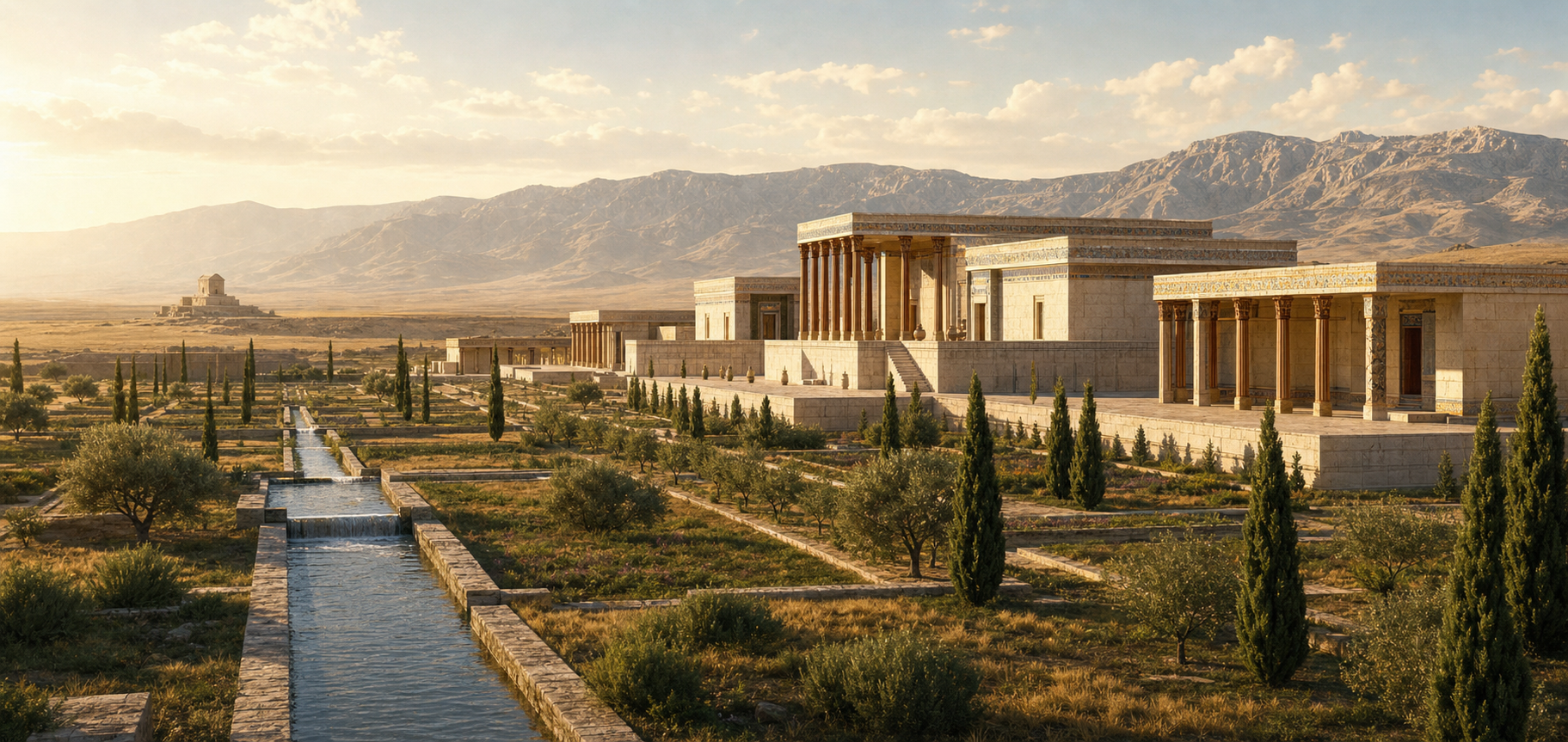
Pasargadae
Cyrus established an important royal centre at Pasargadae in southwestern Iran.
The site became closely associated with his dynasty and victories.
Its palaces, gardens and monumental architecture represented an early form of Achaemenid royal design.
Pasargadae remained sacred to later Persian kings even after newer capitals were established.
The Architecture of Pasargadae
Pasargadae combined architectural influences from several regions.
Stone construction, columned halls and decorative elements reflected the increasingly international character of Cyrus's kingdom.
Craft traditions from Iran, Anatolia and Mesopotamia may all have contributed to the emerging Achaemenid style.
Royal Gardens
Pasargadae included carefully organised garden spaces supplied with water channels.
Royal gardens became important features of Persian court culture.
Later Greek writers used a term from Iranian languages that eventually produced the modern word paradise.
Gardens symbolised abundance, order and royal control over the landscape.
The Tomb of Cyrus
A monumental stone tomb at Pasargadae is traditionally identified as the burial place of Cyrus the Great.
The structure stands on a stepped stone base with a small chamber above.
Its simple but imposing design differs from the later rock-cut royal tombs associated with other Achaemenid kings.
Alexander at Cyrus's Tomb
More than two centuries later, Alexander the Great visited the tomb of Cyrus after conquering the Persian Empire.
Ancient writers state that Alexander respected Cyrus and ordered repairs after discovering that the tomb had been disturbed.
The episode demonstrates the enduring prestige of Cyrus even among the conqueror who ended Achaemenid rule.
Cyrus's Reputation
Cyrus developed a remarkably positive reputation in several different historical traditions.
Persian memory celebrated him as founder of the empire.
Babylonian propaganda presented him as a legitimate ruler favoured by Marduk.
Jewish texts remembered him as the monarch who permitted restoration after exile.
Greek writers sometimes portrayed him as an example of effective kingship.
Xenophon's Cyrus
The Greek writer Xenophon composed a work known as the Cyropaedia, or Education of Cyrus.
Written long after Cyrus's lifetime, it presents an idealised portrait of the Persian king.
Xenophon used Cyrus to explore leadership, education and political authority.
The work is philosophical and literary rather than a straightforward biography.
Cyrus as an Ideal Ruler
Xenophon's Cyrus wins loyalty through discipline, generosity and understanding of human motivation.
This image had an enormous influence on later political thought.
Readers across centuries encountered Cyrus not merely as a conqueror but as a model of successful leadership.
Greek Respect for Cyrus
Greek attitudes toward Persia were often hostile, particularly after the Persian Wars.
Yet Cyrus could still receive admiration from Greek writers.
His achievements were too extraordinary to dismiss simply as those of a foreign enemy.
The distinction between Cyrus and later Persian kings became an important theme in some Greek literature.
Cyrus and Mercy
Ancient traditions frequently contrast Cyrus with rulers known primarily for brutality.
He could be portrayed as sparing defeated kings, respecting religions and allowing local customs to continue.
Some of these stories may be idealised.
Nevertheless, the consistency of the reputation reflects the political effectiveness of his approach to conquered peoples.
Conquest Was Still Violent
Cyrus should not be romanticised as a purely peaceful ruler.
His empire was created through warfare.
Armies were defeated, cities were besieged and political independence was removed from conquered kingdoms.
His reputation for tolerance existed within the realities of ancient imperial conquest.
A Different Imperial Strategy
Cyrus's importance lies partly in how he managed conquest afterward.
He often preserved useful institutions and cultivated local elites rather than destroying entire administrative systems.
This approach could make imperial rule less costly and more stable.
It also helped transform rapid military conquest into a lasting political structure.
Comparison With Assyria
The Neo-Assyrian kings had also governed a diverse territorial empire and sometimes preserved local rulers.
They were particularly famous, however, for royal propaganda emphasising violent punishment and mass deportation.
Cyrus's surviving propaganda emphasised restoration and legitimacy much more strongly.
The difference partly reflects political presentation as well as genuine variations in policy.
Assyrian Imperial Influence
Persian rulers inherited a Near East already shaped by Assyrian innovations.
Provincial government, long-distance roads, royal communications and population administration had all been developed extensively under Assyria.
The Achaemenids adapted this imperial inheritance to their own purposes.
Babylonian Influence
Babylon contributed sophisticated systems of writing, taxation, law and temple administration.
Cyrus preserved much of this bureaucratic structure after conquest.
The empire therefore combined Persian political leadership with administrative traditions developed over thousands of years in Mesopotamia.
Median Influence
The Medes also contributed important political and military traditions.
Median nobles served within the Persian state.
Greek writers sometimes had difficulty distinguishing Median and Persian court customs.
The new empire represented a fusion of Iranian elites rather than simply a wholly new Persian creation.
Elamite Influence
Elamite traditions remained especially important in southwestern Iran.
Later administrative tablets from Persepolis reveal extensive use of the Elamite language.
Persian royal culture developed in a landscape shaped by centuries of interaction with Elam.
An Empire of Inherited Systems
Cyrus's genius was therefore not that he invented every element of imperial rule.
He brought many existing political worlds beneath one monarchy.
He preserved useful institutions and linked them through Achaemenid authority.
His empire was innovative partly because it successfully combined older traditions on a much larger scale.
Trade Under Persian Rule
Bringing vast territories beneath one political system created opportunities for long-distance commerce.
Merchants could travel between Mesopotamia, Iran and Anatolia through lands subject to the same monarch.
Local taxes and political conditions still varied, but imperial stability could make major routes safer.
Metals
The empire controlled regions rich in metals.
Anatolia contained significant mineral resources.
Iran provided access to additional deposits and trade routes leading toward Central Asia.
Precious metals supported royal treasuries and later Persian coinage.
Agriculture
Most people within Cyrus's empire were farmers.
Mesopotamia produced grain through extensive irrigation systems.
Anatolian valleys supported cereals, livestock and vineyards.
Iranian regions produced crops through both rainfall agriculture and irrigation.
The agricultural productivity of these territories supported imperial armies and cities.
Irrigation
Water management was essential in many regions of the empire.
Mesopotamia possessed ancient canal systems.
Iranian communities developed methods suited to local environments.
Later Persian rule became particularly associated with supporting irrigation and agricultural development across arid landscapes.
Qanats
Underground water channels commonly known as qanats became important in Iran and other dry regions.
They transported groundwater over long distances while reducing evaporation.
The exact chronology of their earliest development remains debated, but the technology became strongly associated with Iranian societies and later spread widely.
Imperial Wealth
Cyrus's conquests gave his dynasty access to the treasuries of several wealthy kingdoms.
Lydian and Babylonian resources became part of the new imperial economy.
Later Persian kings accumulated enormous royal treasuries at cities such as Susa and Persepolis.
This wealth funded armies, construction projects and royal courts.
Royal Gifts
Gift exchange played an important role in Persian political relationships.
Local rulers and elites could present valuable goods to the king.
The king in return distributed honours and rewards.
These exchanges reinforced personal loyalty within the imperial hierarchy.
Tribute and Loyalty
Paying tribute acknowledged the supremacy of the Persian monarch.
Some regions retained local rulers while providing regular resources.
Failure to remain loyal could result in military intervention.
The empire combined cooperation with the constant possibility of force.
Imperial Diversity
Cyrus ruled peoples whose customs differed enormously.
Babylonian priests followed traditions developed over millennia.
Ionian Greeks lived within independent urban traditions.
Iranian pastoral communities possessed different social systems.
The imperial monarchy had to function across all of these environments.
No Policy of Cultural Uniformity
The Persians generally did not require subjects to become culturally Persian.
Local clothing, languages and religious traditions continued.
Later reliefs at Persepolis deliberately represented imperial peoples in distinctive dress.
Diversity itself became part of the visual language of empire.
Future Persepolis Reliefs
Although Persepolis was constructed after Cyrus's death, its reliefs express the political system he created.
Delegations from across the empire appear approaching the king with distinctive gifts.
The scenes do not simply show defeated enemies.
They portray many peoples participating within an ordered imperial hierarchy.
The Great King and Local Kings
Cyrus could allow subordinate monarchs or dynasts to continue ruling under Persian supremacy.
This reduced the administrative burden on the central government.
The relationship depended upon loyalty and tribute.
If local rulers rebelled, they could be removed.
Imperial Hostages
Ancient empires sometimes secured loyalty by keeping members of important families at royal courts.
Such arrangements created personal connections between local elites and the imperial centre.
They also provided leverage against rebellion.
The Achaemenid court developed complex relationships with elite families from many regions.
Marriage and Alliance
Royal marriage could strengthen political relationships among Iranian elites.
Later Achaemenid rulers married within powerful aristocratic networks.
Family ties helped connect leading houses with the monarchy.
The empire depended not only upon formal institutions but also upon personal relationships among elites.
The Persian Court
The royal court travelled between several major centres rather than remaining permanently in one capital.
This mobile pattern allowed the king to maintain relationships with different regions.
Later Persian royal residences included Susa, Babylon, Ecbatana and Persepolis.
Cyrus's Pasargadae became the dynastic heart of this wider royal landscape.
No Single Capital
The Persian Empire did not function around one permanent capital in the modern sense.
Different cities served administrative, ceremonial and seasonal purposes.
Babylon had immense economic importance.
Ecbatana remained strategically significant.
Susa later became a major administrative residence.
The Royal Household
Achaemenid kings travelled with substantial households containing officials, guards, servants and family members.
The court itself became a centre of government.
Decisions concerning distant territories could be issued wherever the monarch was residing.
Royal Guards
The security of the king was essential to the stability of the empire.
Elite guards protected the monarch and royal family.
Later Greek sources described prestigious Persian formations connected with royal protection.
The development of such forces reflected the increasing scale and importance of the Achaemenid court.
Persian Nobility
Powerful Persian families formed the core of the imperial elite.
Nobles could command armies, govern territories and hold important court positions.
The king depended upon these families but also needed to prevent any single noble from becoming strong enough to challenge him.
The King's Authority
The Achaemenid monarchy was powerful, but government still depended upon cooperation.
Satraps, generals, priests and local rulers all possessed influence within their own spheres.
A successful Great King maintained loyalty through rewards, family connections, reputation and military strength.
Rebellion
Large empires inevitably faced rebellions.
Distance made provincial control difficult.
Local rulers might take advantage of succession disputes.
High taxation or political resentment could also produce resistance.
Cyrus's successors would repeatedly confront such challenges.
The Importance of Succession
The survival of the new empire depended upon a stable transfer of power after Cyrus's death.
Many ancient empires fragmented when a successful conqueror died.
Cyrus therefore needed a dynasty capable of continuing his political system.
Cambyses II
Cyrus's son Cambyses II succeeded him as Great King.
The succession appears to have occurred without immediate destruction of the empire.
Cambyses later conquered Egypt, extending Achaemenid rule into northeast Africa.
This demonstrated that Cyrus had created more than a temporary personal kingdom.
Bardiya
Another son of Cyrus was Bardiya, known in Greek tradition as Smerdis.
Events surrounding his death and a later claimant to the throne became central to the succession crisis following Cambyses.
Darius I later presented his own rise as the defeat of an impostor pretending to be Bardiya.
The exact sequence remains debated.
Darius I
Darius I became king in 522 BCE after the succession crisis.
He was not a son of Cyrus, though he belonged to the broader Achaemenid royal family according to his own inscriptions.
Darius reorganised the empire Cyrus had created and developed its administrative institutions more systematically.
Cyrus Creates, Darius Organises
A useful distinction can be made between the achievements of Cyrus and Darius.
Cyrus created the empire through extraordinary conquest and political integration.
Darius later regularised provincial administration, taxation and royal ideology on a much larger documentary scale.
Both were essential to the success of Achaemenid rule.
The Royal Road Under Darius
Darius developed communication routes across the empire, including the road connecting Sardis with Susa.
These routes were possible because Cyrus had already brought Anatolia, Mesopotamia and Iran under one dynasty.
The conquest of 550 BCE therefore eventually produced administrative integration across thousands of kilometres.
Persian Coinage Under Darius
Darius introduced famous royal gold coins known as darics.
The coins often depicted an armed royal figure.
They circulated especially in western areas of the empire.
Persian monetary systems built partly upon traditions inherited after Cyrus conquered Lydia.
Persepolis Under Darius
Darius began constructing Persepolis in the Persian homeland.
The complex represented the mature imperial system descended from Cyrus's conquests.
Delegations from the empire's many peoples were depicted in stone.
The architecture turned political diversity into a monumental statement of royal order.
The Empire Reaches Egypt
Cambyses's conquest of Egypt in 525 BCE brought another ancient civilisation beneath Achaemenid rule.
The Persian king adopted aspects of pharaonic tradition.
Egypt became an important imperial province supplying grain, taxes and military resources.
The Empire Reaches the Indus
Under Darius, Persian authority expanded farther east toward the Indus Valley.
Parts of the northwestern Indian subcontinent entered the imperial system.
The empire now stretched across an extraordinary geographical range from the Aegean to South Asia.
The Largest Empire Yet Seen
At its height, the Achaemenid Empire ruled a larger territory than any previous empire known in the ancient Near East.
Its population may have represented a substantial proportion of the world's inhabitants at the time.
The precise population cannot be calculated confidently, but the scale was extraordinary by ancient standards.
Cyrus's Foundations
None of this later expansion would have been possible without Cyrus's victories.
The conquest of Media supplied the first enormous territorial foundation.
Lydia provided access to Anatolia and the Aegean.
Babylon added Mesopotamia and western imperial territories.
Eastern campaigns extended Persian authority into Central Asia.
Cyrus's Final Campaign
Cyrus died while campaigning on the northeastern frontier of his empire around 530 BCE.
The exact circumstances are uncertain.
Herodotus claimed that he fought the Massagetae, a powerful nomadic people beyond the empire's settled eastern regions.
Other ancient sources provide different accounts.
The Massagetae
The Massagetae were described by Greek writers as a mobile people of Central Asia.
They relied heavily upon horses and possessed effective warrior traditions.
Their precise relationship with other Iranian-speaking steppe groups remains debated.
According to Herodotus, Cyrus attempted to bring them under his authority during his final campaign.
Queen Tomyris
Herodotus identified Tomyris as queen of the Massagetae.
He described her as resisting Cyrus after rejecting his political approaches.
In the famous story, Cyrus's forces initially gained an advantage through a trap involving food and wine.
Tomyris's son was captured and later died.
The Death of Cyrus
Herodotus claimed that Tomyris later defeated the Persian army and that Cyrus was killed in battle.
He added a dramatic story in which the queen placed Cyrus's head into a container of blood.
The account is memorable but cannot be independently confirmed.
The secure historical conclusion is simply that Cyrus died around 530 BCE during or near the period of eastern campaigning.
Cyrus Is Buried at Pasargadae
Cyrus's body was eventually associated with the tomb at Pasargadae.
The monument became an important dynastic site.
Later Achaemenid kings respected the founder's memory even after establishing their own royal centres elsewhere.
An Empire Survives Its Founder
The most important test of Cyrus's achievement came after his death.
The empire did not immediately fragment.
Cambyses succeeded him and continued expansion.
Despite later succession crises, Achaemenid rule survived for more than two additional centuries.
This durability demonstrates that Cyrus had created institutions and political relationships stronger than his personal military authority alone.
Cyrus and Alexander
Alexander the Great conquered the Achaemenid Empire more than two hundred years after Cyrus.
Yet Alexander appears to have admired the Persian founder.
He visited Cyrus's tomb and adopted many aspects of Persian administration and royal ceremony.
The conqueror of Persia therefore became, in important ways, an inheritor of the imperial system Cyrus had established.
Alexander Preserves Persian Administration
Alexander retained satrapal government in many regions.
Persian officials sometimes continued serving under Macedonian authority.
Existing taxation systems and communication networks remained useful.
The political structures of the Achaemenids therefore survived their dynasty in modified form.
The Hellenistic Kingdoms
After Alexander's death, his generals divided the conquered territories into competing kingdoms.
The Seleucid Empire controlled much of the former Persian heartland and Mesopotamia.
The Ptolemies ruled Egypt.
These kingdoms inherited administrative practices and urban networks developed under earlier empires.
Later Iranian Empires
The memory of Achaemenid imperial greatness remained important within Iranian history.
Later Parthian and Sasanian rulers again created powerful Iranian empires competing with Mediterranean states.
Although their political systems differed from that of Cyrus, they operated within a long tradition of Iranian imperial kingship.
Cyrus in Modern Iranian Memory
Cyrus remains one of the most famous figures in Iranian history.
Pasargadae and his traditionally identified tomb have become powerful symbols of the country's ancient past.
Modern interpretations of Cyrus vary considerably, but his position as founder of the Achaemenid Empire is central to his enduring importance.
Cyrus in Religious Memory
Few ancient conquerors are remembered positively in so many different cultural traditions.
Jewish texts associate Cyrus with restoration.
Babylonian sources portray him through traditional local royal ideology.
Greek writers admired aspects of his leadership.
These different memories contributed to an unusually broad historical reputation.
The Meaning of Tolerance
Cyrus is frequently described as tolerant because he often allowed local religious and cultural traditions to continue.
The term should be understood within an ancient imperial context.
His policies were not based on modern concepts of equal citizenship or freedom of religion.
They were practical and politically effective methods of ruling diverse populations.
Pragmatic Kingship
Cyrus appears to have understood that unnecessary cultural confrontation could create resistance.
If local elites remained loyal, preserving their institutions could strengthen imperial stability.
This pragmatic approach reduced the administrative cost of conquest.
It also helped explain why his rule could be represented positively within several conquered societies.
Cyrus and Propaganda
Like other ancient rulers, Cyrus used political messaging.
The Cyrus Cylinder does not offer an objective account of the Babylonian conquest.
It criticises Nabonidus while presenting Cyrus as the divinely chosen restorer of order.
This was propaganda designed to justify a new dynasty.
Propaganda and Effective Rule
Propaganda does not mean the claims were politically unimportant.
By communicating in familiar Babylonian terms, Cyrus demonstrated an understanding of local expectations.
A ruler who could present conquest as restoration gained a powerful tool for stabilising newly acquired territory.
The Image of the Restorer
Cyrus repeatedly became associated with restoring what previous rulers had disrupted.
Temples were respected.
Divine statues could be returned.
Some displaced communities received permission to return home.
This image distinguished his political presentation from that of a purely destructive conqueror.
Empire and Identity
The Persian Empire did not erase local identities.
A person could remain Babylonian, Lydian, Egyptian or Judean while also being subject to the Great King.
This layered political identity became one of the defining characteristics of Achaemenid rule.
The Persian Elite
At the centre of the system remained a distinctly Persian monarchy and aristocracy.
Persian nobles enjoyed privileged access to the king and military command.
Imperial diversity therefore existed within a clear political hierarchy.
The empire was multicultural, but it was not politically egalitarian.
Royal Authority and Rebellion
Communities that accepted Persian supremacy could enjoy considerable local continuity.
Those that rebelled could face military punishment.
Persian tolerance therefore had firm limits defined by political loyalty.
The monarchy expected obedience throughout its territories.
The Persian Vision of Order
Later Achaemenid inscriptions presented the empire as a world brought into proper order by the king.
Different peoples were expected to fulfil their obligations beneath royal authority.
Rebellion represented disorder and falsehood.
This ideological structure may have developed more fully under Darius but rested on the imperial world Cyrus created.
A Bridge Between Civilisations
The Persian Empire connected several ancient cultural zones.
Greek cities in Anatolia became politically connected with Mesopotamia and Iran.
Egypt later belonged to the same imperial structure as Bactria.
Royal roads and administrative networks moved people and information across unprecedented distances.
Movement Across the Empire
Soldiers could serve far from their homelands.
Officials travelled between provinces.
Merchants moved along international routes.
Craftspeople from different regions worked on royal projects.
Imperial integration therefore increased cultural contact.
Artistic Exchange
Achaemenid royal art blended traditions from across the empire.
Mesopotamian guardian figures influenced palace design.
Egyptian, Ionian and Anatolian craftsmen contributed technical skills.
Iranian themes provided the political framework.
The resulting style was distinctly Persian while deliberately international.
Craftspeople and Empire
Royal building projects required specialist labour.
Stone masons, metalworkers, carpenters and sculptors came from different regions.
Later inscriptions from Darius's buildings explicitly mention materials and workers drawn from across the empire.
This international labour system was possible because Cyrus had first united those territories politically.
Imperial Gardens and Architecture
Persian royal architecture often incorporated gardens, water and monumental halls.
These carefully ordered environments symbolised royal prosperity and control.
Pasargadae provides some of the earliest surviving evidence for this distinctive imperial landscape.
The Persian Legacy in Architecture
Later Achaemenid architecture reached its height at Susa and Persepolis.
Columned halls, monumental staircases and animal-headed capitals became defining features.
The architectural tradition began after Cyrus created the political and economic foundation capable of supporting such enormous projects.
Cyrus and the Idea of Empire
Cyrus did not invent empire.
Akkadian, Egyptian, Hittite, Assyrian and Babylonian rulers had governed large territories long before him.
His achievement was to create an empire of unprecedented geographical scale while successfully integrating several older imperial centres.
From Assur to Babylon to Persia
The ancient Near East had experienced repeated cycles of imperial expansion.
Assyria dominated much of western Asia during the Iron Age.
Babylon succeeded Assyria in many regions.
Cyrus then conquered Babylon while already controlling Media and Lydia.
Persia combined territories that earlier empires had often controlled separately.
The First Truly Transcontinental Empire
The Achaemenid Empire eventually governed significant territories in Asia, Africa and Europe.
Under Cyrus, the empire already extended from Central Asia to the Aegean.
His successors added Egypt, southeastern Europe and regions toward the Indus.
The scale of this political system was unprecedented.
The Aegean Frontier
Cyrus's conquest of Lydia created a lasting Persian presence beside the Greek world.
Decades later, dissatisfaction among Ionian Greek cities would contribute to the Ionian Revolt.
That revolt would eventually help trigger the famous Persian Wars between the Achaemenid kings and mainland Greek states.
Cyrus and the Persian Wars
Cyrus himself never invaded mainland Greece.
The conflicts at Marathon, Thermopylae and Salamis occurred during the reigns of his later successors Darius I and Xerxes I.
However, Cyrus's conquest of western Anatolia created the political circumstances from which those wars eventually developed.
Athens in Cyrus's Time
When Cyrus founded the Persian Empire, Athens had not yet developed the mature democracy associated with the fifth century BCE.
The city was still undergoing political struggles between aristocratic families and powerful leaders.
Cleisthenes's democratic reforms would come several decades later.
Sparta in Cyrus's Time
Sparta was already developing into one of the most powerful Greek land states.
Its distinctive social and military system had taken shape over preceding centuries.
The Persians and Spartans would eventually confront one another dramatically during Xerxes's invasion of Greece.
Rome in Cyrus's Time
Rome was still a relatively small but growing city in central Italy.
According to Roman tradition, it remained under kings during much of Cyrus's lifetime.
The Roman Republic would not traditionally begin until 509 BCE.
Few contemporaries could have imagined that Rome would one day become a power comparable in scale to Persia.
Egypt in Cyrus's Time
Egypt remained independent under the Twenty-Sixth Dynasty during Cyrus's reign.
The pharaohs ruled from Sais in the Nile Delta.
Egypt maintained Mediterranean trade connections and employed Greek mercenaries.
Cyrus did not conquer Egypt, but his son Cambyses II would do so only a few years after his death.
Babylon in Cyrus's Time
Babylon remained one of the greatest cities on earth.
Its monumental walls, temples and ceremonial architecture had been expanded dramatically under Nebuchadnezzar II.
Its conquest in 539 BCE therefore became one of the defining achievements of Cyrus's reign.
The Ancient City Meets the New Empire
Babylon represented a civilisation whose written traditions stretched back thousands of years.
Persian political power was comparatively new.
By preserving Babylonian institutions, Cyrus connected an emerging Iranian empire with the ancient administrative traditions of Mesopotamia.
The Importance of Writing
Administering a large empire required enormous quantities of written records.
Taxation, military supplies, property and correspondence all depended upon scribes.
The Persians therefore relied upon multiple writing systems already established throughout conquered territories.
Babylonian Scribes
Babylonian scribes continued writing cuneiform after the Persian conquest.
Business documents, contracts and astronomical records survive from the Achaemenid period.
The persistence of these traditions demonstrates the considerable continuity beneath political change.
Imperial Records
Later Persian archives reveal highly developed bureaucratic systems.
The Persepolis Fortification Tablets record movements of food, workers and travellers.
Although they belong to a later reign, they illustrate the administrative world that grew from the empire Cyrus founded.
The Persepolis Fortification Tablets
Thousands of clay tablets discovered at Persepolis preserve everyday records from the reign of Darius I.
Most are written in Elamite.
They record grain, wine, livestock, workers and official journeys.
The tablets reveal that Persian imperial administration relied on detailed accounting rather than royal proclamations alone.
Women in Persian Administration
The Persepolis records show that women could supervise work groups and receive substantial rations according to status.
Elite royal women controlled estates and economic resources.
This evidence provides a more complex picture of Achaemenid society than surviving Greek political narratives alone.
Royal Women
Women of the Achaemenid royal household could possess extensive property and influence.
Marriage connected powerful Persian families.
Royal mothers and wives could become important figures within succession politics.
The broader imperial system therefore depended upon dynastic relationships as well as formal government.
Persian Society
Persian society contained kings, aristocrats, soldiers, farmers, herders, craftspeople and servants.
The imperial elite benefited from land and royal favour.
Most inhabitants of the empire, however, continued living within local communities largely shaped by regional traditions.
Farmers
Agriculture supported the entire imperial structure.
Farmers produced grain, fruit and livestock.
Taxes and rents transferred part of this production to temples, landowners and the state.
Without agricultural surpluses, Cyrus could not have maintained armies or royal institutions.
Pastoral Communities
Herding remained important throughout Iran and Central Asia.
Sheep, goats, cattle and horses provided food, wool, transport and military resources.
Some Iranian populations combined agriculture with seasonal pastoral movement.
Horses and Persian Power
Horses were central to Iranian elite culture and warfare.
Strong cavalry contributed significantly to Persian military effectiveness.
Later Achaemenid reliefs and records demonstrate the prestige associated with horses and mounted warriors.
Royal Hunting
Hunting was an important activity among Persian elites.
It trained skills useful in warfare and demonstrated courage.
Royal hunts also carried symbolic meaning, presenting the king as a master of both the natural and political worlds.
Persian Clothing
Greek art and Persian reliefs depict Persian and Median elites wearing distinctive garments including trousers, tunics and soft caps or headgear.
Such clothing was well suited to riding and the climates of the Iranian plateau.
Later Persepolis reliefs carefully distinguish the dress of different peoples within the empire.
The Medes at Court
Median clothing and court customs remained prestigious after Cyrus's conquest.
Persian elites adopted or shared several traditions associated with the Median aristocracy.
This again demonstrates that the new empire incorporated the culture of its defeated Iranian rival.
Persian Identity Expands
Before Cyrus, Persian political identity centred on a regional kingdom.
After his conquests, Persia became the ruling identity of a vast imperial state.
The name of a relatively small homeland eventually became associated with an empire stretching across much of the known world.
The Name Persia
The Greek word Persis derived from the Persian homeland Parsa.
Western languages later used Persia as a broader name for Iran.
The modern state officially promoted the international use of Iran in the twentieth century, though both names have deep historical associations.
Cyrus and Iranian Identity
Cyrus became one of the foundational figures of Iranian historical memory because he transformed Persian kingship into imperial power.
His reign connected Iranian political traditions with Mesopotamian, Anatolian and Central Asian worlds.
The Achaemenid Empire established Iran as the centre of one of antiquity's great imperial traditions.
A New Imperial Centre
Earlier dominant empires had often been centred in Mesopotamia.
With Cyrus, political leadership shifted decisively toward the Iranian plateau.
Babylon remained important, but it now formed part of an empire whose dynasty originated farther east.
This change represented a major geopolitical transformation.
The Iranian Plateau
The Iranian plateau contains mountains, deserts and fertile valleys.
Its geography creates strong regional diversity.
Controlling such territory required flexible political systems and effective communication.
The Achaemenids eventually succeeded in linking its regions with territories far beyond Iran itself.
Mountains and Defence
Mountain ranges protected parts of the Persian homeland while also making transportation difficult.
Strategic passes connected the plateau with Mesopotamia and Anatolia.
Control of these routes became essential to military campaigns and trade.
From Regional King to Great King
Cyrus's career illustrates the extraordinary speed with which political power could change in the ancient world.
He began as ruler of a comparatively modest Persian kingdom.
Within decades he had defeated the Medes, Lydians and Babylonians.
Three major royal traditions had fallen beneath his authority.
The Importance of Speed
Cyrus repeatedly demonstrated strategic speed.
He pursued Croesus rather than allowing Lydia time to rebuild its alliances.
He moved rapidly after major victories.
This ability to exploit political weakness helped prevent enemies from coordinating effectively against him.
Diplomacy Before Battle
Military force was only one part of Cyrus's strategy.
Political defections and cooperation from local elites could make conquest easier.
The fall of Media may have involved support from dissatisfied nobles.
Babylonian opposition to Nabonidus may likewise have reduced resistance to Persian rule.
The Value of Reputation
Every victory increased Cyrus's reputation.
Neighbouring rulers knew that he had defeated some of the strongest kingdoms in Asia.
Fear of Persian military power could encourage submission without prolonged resistance.
Prestige therefore became another weapon of empire.
The Value of Generosity
Rewarding loyal elites encouraged cooperation.
Ancient rulers distributed land, titles and valuable gifts to supporters.
Cyrus's reputation for generosity may reflect the practical importance of maintaining loyalty among nobles and conquered rulers.
Persian Imperial Ideology
The mature Achaemenid Empire represented the king as ruler of many peoples because of divine favour.
Different nations contributed to the strength and prosperity of the monarchy.
The king stood at the centre of an ordered hierarchy extending across the empire.
Cyrus's conquests created the political reality from which this ideology developed.
Truth and Rebellion
Under Darius, Persian royal inscriptions strongly contrasted truth with the lie.
Rebels were portrayed as followers of falsehood, while legitimate royal authority represented proper order.
Although this terminology is most clearly documented after Cyrus, it became central to the ideology of the dynasty he founded.
The King's Justice
Ancient rulers were expected to maintain justice and order.
Local legal systems continued operating throughout the Persian Empire.
Babylonian contracts followed Mesopotamian traditions.
Egyptian and Jewish communities maintained their own legal practices in various forms.
The empire did not rely upon one universal law code imposed everywhere.
Legal Diversity
Allowing regional legal customs reduced disruption.
The Persian government intervened when imperial interests were involved but frequently preserved established traditions.
This legal pluralism reflected the broader strategy of governing diverse peoples without forcing complete cultural uniformity.
The King as Protector
Royal propaganda portrayed the Persian monarch as protector of order and prosperity.
This image was especially important after conquest.
A ruler who had defeated a city needed to convince its inhabitants that imperial rule could provide stability.
Cyrus's Babylonian proclamation used exactly this kind of political language.
Peace After Conquest
Successful imperial expansion could create periods of relative stability after warfare ended.
Trade routes could operate beneath one larger political system.
Local elites had incentives to cooperate with the monarchy.
However, stability always depended upon the ability of the empire to suppress rebellion and maintain succession.
Pax Persica
Modern historians sometimes use expressions such as Persian Peace to describe the relative integration created by Achaemenid rule.
The phrase should not imply an absence of warfare.
The empire fought frequent campaigns and suppressed revolts.
It nevertheless created a political framework connecting regions that had previously belonged to competing kingdoms.
Long-Distance Travel
Imperial roads and political stability made long-distance official travel increasingly practical.
Envoys, soldiers and administrators moved between provincial centres.
The empire therefore intensified connections between the Mediterranean, Mesopotamia and Central Asia.
Trade With India
Persian expansion eventually connected western Asia more directly with regions near the Indus.
Goods, ideas and people could move through routes crossing Iran and Central Asia.
Darius's later eastern expansion strengthened these connections further.
Trade With the Mediterranean
Control of Lydia and the Ionian cities connected Persia with Mediterranean maritime commerce.
Phoenician cities added even greater naval resources after Babylonian territories came under Persian control.
Later Persian kings would use these maritime networks to create enormous fleets.
The Phoenicians
Phoenician cities such as Tyre and Sidon became part of the Persian imperial sphere following the conquest of Babylonian territories.
These cities possessed some of the Mediterranean's finest sailors and merchants.
Under later Achaemenid kings, Phoenician naval forces became essential to Persian campaigns against Greece.
Cyrus and Phoenicia
The precise process by which individual Phoenician cities accepted Persian authority is not documented in equal detail.
They had belonged broadly within the Neo-Babylonian political sphere before Persian conquest.
Under Achaemenid rule, many retained local kings while recognising Persian supremacy.
Local Kings Under Persia
Phoenician kings illustrate the flexible character of Persian imperial administration.
They could continue ruling their cities, issuing local coinage in later periods and commanding fleets.
The Great King did not need to replace every regional monarchy with a Persian official.
The Empire as a Network
The Persian Empire functioned less like a culturally uniform nation-state and more like a hierarchy of connected regions.
Royal authority, taxation, military obligation and communication linked territories together.
Local societies continued many of their own traditions beneath this imperial framework.
The Strength of Flexibility
This flexible structure made rapid expansion easier.
A conquered city did not necessarily need to replace its language, religion or entire government.
It primarily had to acknowledge the Persian king and meet imperial obligations.
This adaptability allowed Cyrus to govern territory far larger than the original Persian homeland.
The Risk of Flexibility
Local autonomy could also create dangers.
Powerful satraps or subordinate kings might rebel.
Distant provinces could exploit periods of royal weakness.
Later Achaemenid history repeatedly demonstrates the challenge of balancing regional autonomy with central authority.
Cyrus's Personal Leadership
The rapid rise of Persia depended heavily upon Cyrus himself.
His military victories created confidence among supporters.
His reputation encouraged alliances and defections.
His political adaptability helped hold together territories with very different traditions.
These abilities explain why later generations remembered him as more than an ordinary conqueror.
The Limits of Our Knowledge
Despite Cyrus's importance, many details of his life remain uncertain.
Contemporary sources are limited and often administrative or propagandistic.
Greek narratives were written later and contain legendary material.
Modern historians therefore reconstruct Cyrus's career by comparing Persian, Babylonian, Greek and biblical evidence.
Babylonian Sources
The Babylonian Chronicle provides important chronological information concerning the fall of Babylon.
The Cyrus Cylinder provides royal propaganda issued after the conquest.
Other cuneiform texts preserve administrative and economic evidence from the transition to Persian rule.
Together they offer contemporary perspectives unavailable for some other parts of Cyrus's career.
Greek Sources
Herodotus, Xenophon and Ctesias preserve major Greek traditions about Cyrus.
They often disagree.
Herodotus emphasises dramatic storytelling and the instability of human fortune.
Xenophon presents an idealised political ruler.
Ctesias offered yet another version based partly on claims of Persian court knowledge.
Biblical Sources
Biblical traditions focus primarily on Cyrus's relationship with the Judean community.
They interpret his victories through a theological framework concerning the restoration of Jerusalem.
These texts provide an important example of how Persian imperial policy could be remembered by a subject population.
Archaeology
Archaeological evidence from Pasargadae, Babylon, Sardis and other sites adds material context to the written sources.
Architecture, destruction levels, inscriptions and administrative records help historians test literary accounts.
No single source provides a complete picture.
Pasargadae as Evidence
Pasargadae demonstrates that Cyrus invested in a monumental Persian royal landscape.
The site reflects both Iranian traditions and influences from conquered regions.
It provides physical evidence for the emergence of a new imperial art and architecture during Cyrus's reign.
The Tomb as Evidence
The tomb traditionally associated with Cyrus survived long after the empire's fall.
Its continued identification by ancient visitors supports the strength of the site's connection with the dynasty's founder.
The monument remains one of the most recognisable surviving structures from early Achaemenid Persia.
Cyrus and the Concept of a Founder
Cyrus is properly described as founder of the Persian Empire because his conquests created the territorial and dynastic system later expanded by his successors.
He did not invent every institution associated with mature Achaemenid government.
Many were developed further after his death.
His achievement was establishing the political foundation upon which those institutions could operate.
From Kingdom to Empire
Before Cyrus defeated Astyages, Persia was one kingdom among several Iranian powers.
After the Median victory, it inherited a large political network.
After Lydia, it reached the Aegean.
After Babylon, it controlled Mesopotamia and much of the Levant.
Each conquest transformed the scale of Persian kingship.
Why 550 BCE Matters
The date around 550 BCE marks the decisive transition from Persian regional monarchy to imperial rule.
The defeat of Astyages provided Cyrus with territory, troops and prestige.
Within a generation, Persia would replace the Medes, Lydians and Babylonians as the dominant power of western Asia.
A Political Revolution
Cyrus's victory fundamentally changed the balance of power.
A new dynasty from southwestern Iran now controlled the political inheritance of the Median kingdom.
The centre of imperial authority shifted eastward from the traditional Mesopotamian powers toward Persia.
This transformation would shape Near Eastern history for centuries.
A Military Revolution
Cyrus's armies demonstrated the effectiveness of combining Iranian military traditions with the resources of conquered peoples.
As the empire expanded, its military became increasingly multinational.
Future Persian armies would draw soldiers, sailors and cavalry from across a vast territory.
An Administrative Revolution
Military victories alone could not preserve such a large empire.
Cyrus's willingness to work through existing institutions established a pattern of flexible imperial administration.
Later rulers refined this approach through satrapies, taxation and royal roads.
A Cultural Transformation
Persian political leadership brought previously separate cultural worlds into sustained contact.
Iranian, Mesopotamian, Anatolian, Levantine and later Egyptian traditions interacted within one imperial structure.
Achaemenid art and administration emerged from this extraordinary cultural mixture.
A New Imperial Model
The empire Cyrus founded demonstrated that enormous diversity could be governed without requiring every subject to adopt one language or religion.
Central authority was combined with regional continuity.
This approach became one of the defining features of Achaemenid rule.
The Great King's World
Under Cyrus and his successors, the Persian king stood at the centre of an enormous hierarchy.
Provincial officials governed distant territories.
Local rulers administered communities.
Soldiers defended frontiers.
Merchants and messengers travelled along routes linking the empire together.
The Legacy of Cyrus's Conquests
Cyrus's victories changed the histories of every region he conquered.
The Medes became partners within Persian imperial culture.
Lydia became a crucial western province.
The Ionian Greek cities entered a political relationship with Persia that eventually contributed to the Persian Wars.
Babylon became a great royal centre within the new empire.
The Legacy in Greece
Persian control of Anatolian Greek cities eventually contributed to the Ionian Revolt.
The revolt led Darius I to campaign against mainland Greece.
Later Xerxes launched the enormous invasion associated with Thermopylae and Salamis.
The political consequences of Cyrus's western expansion therefore continued long after his death.
The Legacy in Mesopotamia
Persian rule ended the independent Neo-Babylonian monarchy but preserved much of Mesopotamian urban and scholarly life.
Cuneiform remained in use.
Temples continued functioning.
Babylon remained politically and economically significant.
Imperial conquest therefore changed sovereignty without erasing civilisation.
The Legacy in Judah
Cyrus's conquest of Babylon transformed the history of the Judean exiles.
Persian policy allowed restoration of the Jerusalem temple community.
The Persian period became an important phase in the development of Jewish religious institutions and literature.
The Legacy in Iran
Cyrus established the first great Persian imperial dynasty.
The Achaemenids transformed Iran from one region among the kingdoms of western Asia into the political centre of an enormous empire.
This achievement gave Cyrus an enduring place in Iranian history.
The Legacy of Pasargadae
Pasargadae remained a sacred dynastic centre even after later kings built Persepolis.
Achaemenid monarchs were reportedly invested with royal authority there.
The site preserved the memory of Cyrus and the beginnings of the empire.
The Legacy of the Cyrus Cylinder
The Cyrus Cylinder remains one of the best-known objects associated with ancient Persia.
Its importance lies in the insight it provides into how Cyrus presented himself to Babylonian subjects.
It demonstrates the political value of respecting local religious traditions and adopting established forms of kingship.
The Legacy of Imperial Diversity
The Achaemenid Empire became one of history's most striking examples of multicultural imperial rule.
Persians governed Egyptians, Greeks, Babylonians, Phoenicians, Iranians and Central Asian peoples within one political system.
Later empires repeatedly faced the same challenge of balancing central authority with local identity.
The Legacy of Royal Roads
Although the most famous road system was developed under Darius, it grew from the territories unified by Cyrus.
The ability to move messages quickly across an empire became fundamental to later imperial administration.
Persian communication systems influenced how later rulers understood the management of enormous territories.
The Legacy of Satrapal Government
Provincial government became one of the most influential features of the Achaemenid system.
Alexander preserved satrapies after conquering Persia.
Hellenistic monarchies continued using regional governors in various forms.
The concept of organising vast territory into manageable provinces remained central to imperial government.
The Legacy of Cyrus as King
Cyrus's reputation extended beyond the boundaries of Persia.
Greek philosophers used him as an example of leadership.
Jewish tradition remembered him as a liberator and restorer.
Modern discussions continue to examine his policies and legacy.
Few rulers of the sixth century BCE remain as widely recognised.
More Than a Conqueror
Cyrus's military victories were extraordinary, but conquest alone does not explain his importance.
Many ancient conquerors created kingdoms that disappeared immediately after their deaths.
Cyrus established a dynasty and political system capable of surviving him.
His successors expanded and reorganised his territories rather than rebuilding from nothing.
The Importance of Political Adaptability
Cyrus ruled different peoples in different ways.
Babylonians encountered a king using Mesopotamian royal traditions.
Median nobles remained integrated within the elite.
Anatolian regions retained local political structures where useful.
This adaptability made Persian imperial rule unusually resilient.
The Limits of Cyrus's Empire
Cyrus did not conquer the entire known world.
Egypt remained independent during his lifetime.
Mainland Greece was outside Persian rule.
Arabian, Indian and steppe regions remained only partly incorporated or beyond imperial authority.
His successors would extend the empire farther.
An Unfinished Imperial Project
When Cyrus died around 530 BCE, the Persian Empire was still evolving.
Its borders were expanding.
Administrative systems were developing.
Relations between local elites and the central monarchy were still being defined.
The empire would reach its mature form under later rulers.
Cambyses Continues the Expansion
Cambyses II inherited Cyrus's imperial ambitions.
His conquest of Egypt brought the Nile Valley under Persian authority.
This made the empire even more geographically diverse.
Cyrus's dynasty now ruled ancient centres from Memphis and Babylon to Sardis and Ecbatana.
Darius Consolidates the Empire
Darius survived widespread rebellions and reorganised imperial government.
He established a clearer taxation structure, monumental royal ideology and administrative networks.
He also expanded into regions of Europe and South Asia.
The empire Cyrus founded became one of antiquity's most sophisticated states.
Xerxes
Xerxes I inherited the mature imperial system.
His reign became famous for the invasion of Greece in 480 BCE.
The enormous multinational army and navy he assembled demonstrated the resources of the empire first created by Cyrus several generations earlier.
Persian Power at Its Height
By the fifth century BCE, the Achaemenid monarchy controlled an extraordinary range of territories.
Royal authority extended from the Mediterranean toward Central Asia and the Indus.
Egypt, Mesopotamia and Anatolia belonged to the same imperial structure.
The scale of Persian power reshaped the political imagination of the ancient world.
The Empire Lasts Two Centuries
Achaemenid rule survived from Cyrus's rise in the sixth century BCE until Alexander's conquest in the late fourth century BCE.
The dynasty endured rebellions, succession disputes and major wars.
Its longevity demonstrates the strength of the imperial foundations established during Cyrus's reign.
Alexander Conquers Persia
Beginning in 334 BCE, Alexander of Macedon invaded the Persian Empire.
He defeated Darius III at major battles including Issus and Gaugamela.
Babylon, Susa and Persepolis fell to Macedonian forces.
By 330 BCE, Achaemenid royal rule had effectively ended.
Yet Cyrus's Empire Survives in Another Form
Alexander adopted many aspects of Persian government.
He retained satrapies, employed Persian officials and increasingly used elements of Achaemenid court ceremony.
The conqueror recognised that the Persian administrative system was too useful simply to destroy.
Cyrus and World Empire
Cyrus demonstrated that a ruler could govern territories vastly larger than the traditional city-state or regional kingdom.
His empire linked numerous civilisations beneath one monarchy.
This concept of world empire influenced later Persian, Macedonian, Roman and other imperial traditions.
A New Scale of Government
The challenge of governing Cyrus's territories demanded new levels of organisation.
Information had to travel thousands of kilometres.
Provincial officials had to act without constant direct supervision.
Military resources had to be coordinated across different cultural regions.
This scale of government became one of the defining characteristics of Achaemenid history.
A New Scale of Identity
Subjects of the empire lived simultaneously within local and imperial worlds.
A Babylonian could remain part of Babylonian society while recognising the Persian monarch.
A Phoenician city could preserve its own king while contributing ships to imperial campaigns.
A Greek city in Anatolia could maintain Greek culture while existing under Persian authority.
The Empire as a Political Framework
The Persian Empire did not eliminate the societies it conquered.
It provided an overarching political structure within which many older cultures continued.
This helped create remarkable cultural continuity across a period of enormous political change.
The Great Achievement of Cyrus
Cyrus's greatest achievement was therefore not merely winning battles.
He transformed victory into durable rule.
He successfully incorporated the political inheritance of the Medes, conquered one of Anatolia's richest kingdoms and absorbed the ancient civilisation of Babylonia.
His dynasty inherited a functioning empire rather than a collection of temporary conquests.
The Founder of Achaemenid Power
Later Achaemenid rulers built magnificent capitals and developed sophisticated bureaucratic systems, but they always ruled within the political world Cyrus had created.
His victories gave the dynasty its territory, legitimacy and imperial identity.
For this reason, Cyrus stands as the true founder of Persian imperial power.
The Significance of c. 550 BCE
Around 550 BCE, Cyrus's defeat of Astyages ended the independent Median monarchy and placed Persian leadership at the centre of Iranian politics.
This event began a sequence of conquests that would overturn the balance of power across the Near East.
Within little more than a decade, Lydia would fall.
Within another decade, Babylon would surrender.
From Parsa to the Mediterranean
The kingdom Cyrus inherited was centred in southwestern Iran.
The empire he created reached the Mediterranean and deep into Central Asia.
Its expansion was one of the fastest political transformations of the ancient world.
The name Persia became associated not with one small homeland but with one of history's greatest empires.
A Turning Point in Ancient History
The rise of Cyrus marked the beginning of a new era.
The political system created after the Bronze Age Collapse had been dominated by numerous competing kingdoms.
Assyria had briefly united much of the region before collapsing.
Cyrus now brought an even larger collection of territories beneath a new imperial monarchy.
The Beginning of the Classical Age
The rise of Persia also formed the political background to the Classical Age.
Persian rule over the Ionian Greeks eventually contributed to conflict with Athens and Sparta.
The Persian Wars helped shape Athenian democracy and imperial expansion.
More than two centuries later, Macedon would unite much of Greece and turn eastward against the empire Cyrus founded.
From Cyrus to Alexander
The Classical history of the eastern Mediterranean can therefore be framed partly by Cyrus and Alexander.
Cyrus built the Achaemenid Empire beginning around 550 BCE.
Alexander destroyed Achaemenid political rule in the 330s BCE.
Between them, Persia remained the largest and most influential state of western Asia.
Cyrus's Enduring Reputation
Many ancient rulers were remembered primarily by the peoples who belonged to their own kingdoms.
Cyrus became unusual because several different cultures remembered him favourably.
His political reputation survived the empire itself.
Persian history, Greek political thought and biblical tradition all preserved distinct images of the same king.
The Founder Remembered
Later rulers could claim descent from Cyrus's imperial achievement, but none could repeat the circumstances of his rise.
He had transformed a relatively modest Persian monarchy into the dominant state of western Asia within a single reign.
His name therefore became inseparable from the origins of Persian greatness.
The Legacy of c. 550 BCE
The defeat of the Medes around 550 BCE began one of the most important political transformations in ancient history.
Cyrus gained control of a powerful Iranian kingdom and used its resources to launch further conquests.
Lydia fell, bringing Persia to the Aegean. Babylon fell, bringing Mesopotamia and much of the Levant beneath Persian rule. Eastern campaigns extended imperial authority toward Central Asia.
Within one lifetime, Cyrus created a state spanning regions that had previously belonged to several competing great powers.
Cyrus Changes the Ancient World
The empire Cyrus founded reshaped relationships between Greece, Egypt, Mesopotamia, Anatolia and Iran.
Royal roads and administrative systems later connected territories across thousands of kilometres.
Local religions and languages survived beneath imperial authority.
The monarchy drew soldiers, resources and officials from an extraordinary variety of peoples.
More Than Military Conquest
Cyrus's armies made the empire possible, but his political methods helped make it durable.
He incorporated Median elites, preserved Babylonian institutions and generally avoided imposing a single culture upon conquered populations.
His rule combined overwhelming military power with pragmatic accommodation.
This balance became a defining characteristic of the Achaemenid imperial tradition.
The Birth of the Persian Empire
Around 550 BCE, Persia ceased to be merely a regional kingdom of southwestern Iran.
With the defeat of Astyages, Cyrus inherited the political resources of Media and began building an empire that would eventually govern peoples from the Aegean Sea to the Indus Valley.
The Achaemenid monarchy became the dominant power of the Classical Near East and remained so for more than two centuries.
Its roads, provincial systems, royal ideology and multicultural administration influenced later empires long after the dynasty itself disappeared.
Cyrus the Great
Cyrus died before seeing the greatest geographical extent of the empire he founded, but his achievement was already extraordinary.
He had defeated kings who commanded older and wealthier states, captured some of antiquity's most prestigious cities and created a political system capable of surviving beyond his lifetime.
His successors would expand Persia into Egypt, southeastern Europe and the Indus region, but they did so from the foundation established by Cyrus.
For this reason, the rise of Cyrus around 550 BCE stands among the defining events of ancient history. From a Persian homeland on the Iranian plateau emerged an empire that united much of the known world and transformed the political landscape of the Classical Age.