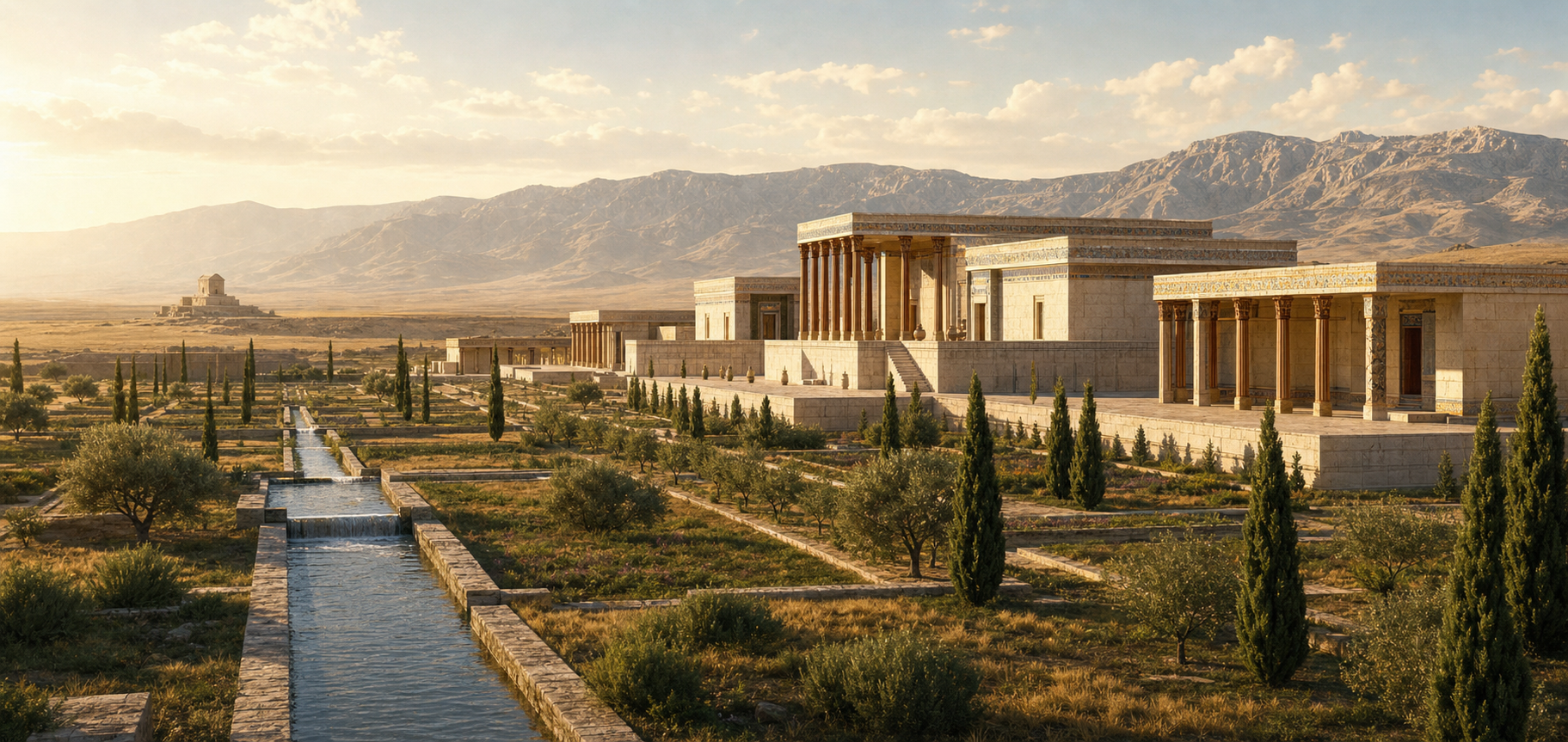
In 480 BCE, the Achaemenid Persian king Xerxes I launched one of the largest and most famous military campaigns of the ancient world. His objective was to bring mainland Greece under Persian control and complete a struggle that had begun during the reign of his father, Darius I.
The Persian Empire was already the greatest territorial power of its age. It stretched from Central Asia and the Indus region to Egypt, Anatolia and the eastern Mediterranean. Its armies could draw soldiers from numerous peoples, while its navy included experienced Phoenician, Egyptian, Cypriot and Greek sailors.
Against this vast imperial force stood a politically divided collection of Greek city-states. Some submitted to Xerxes, some remained neutral and others formed an alliance to resist. Athens and Sparta became the leading members of this coalition.
The invasion produced some of the most famous battles in ancient history, including Thermopylae, Artemisium, Salamis and, in the following year, Plataea. Although the Persians initially advanced deep into Greece and captured Athens, the campaign ultimately failed to bring the principal resisting Greek states under permanent Persian control.
The Achaemenid Persian Empire
By 480 BCE, the Persian Empire had existed for roughly seventy years.
It had been founded by Cyrus the Great, who defeated the Medes around 550 BCE and subsequently conquered Lydia and Babylon.
His successors expanded Persian authority even farther.
Under Darius I, the empire developed sophisticated systems of provincial administration, taxation, roads and royal communication.
Xerxes inherited one of the most powerful states the ancient world had yet seen.
Xerxes I
Xerxes I became Great King after the death of Darius I in 486 BCE.
He belonged to the Achaemenid royal family and ruled an empire containing dozens of peoples and languages.
Before turning his attention toward Greece, Xerxes had to secure his authority within the empire.
He faced unrest in regions including Egypt and Babylonia.
Once major internal challenges had been addressed, preparations for the Greek campaign intensified.
Darius and Greece
The Persian conflict with mainland Greece had begun before Xerxes came to power.
Darius I had already attempted to extend Persian authority into the Aegean.
Persia controlled the Greek cities of western Anatolia, and rebellion there eventually brought Athens into conflict with the empire.
The events of the Ionian Revolt created the immediate background to the Persian invasions of mainland Greece.
The Ionian Revolt
In 499 BCE, several Greek cities in Ionia rebelled against Persian authority.
Athens and Eretria provided limited military assistance to the rebels.
The uprising spread through parts of western Anatolia before Persian forces gradually regained control.
By 494 BCE, the revolt had largely been defeated.
The Burning of Sardis
During the Ionian Revolt, Greek forces attacked Sardis, an important Persian administrative centre in western Anatolia.
Part of the city was burned.
The attack demonstrated that mainland Greek intervention could threaten Persian interests directly.
Later Greek tradition emphasised Darius's determination to punish Athens and Eretria for their involvement.
Darius Invades Greece
In 490 BCE, Darius sent a major expedition across the Aegean.
The Persians captured Eretria and then landed in Attica near Marathon.
An Athenian army, supported by troops from Plataea, confronted them.
The Battle of Marathon ended in an unexpected Greek victory.
The Battle of Marathon
At Marathon, Athenian hoplites advanced against the Persian army and defeated it.
The victory became one of the defining events in Athenian history.
Persia remained overwhelmingly more powerful than Athens, however, and the defeat did not end Persian interest in Greece.
Darius began preparations for another expedition but died before it could take place.
Xerxes Inherits the War
Xerxes inherited both the Persian throne and his father's unfinished plans regarding Greece.
The new king prepared a campaign much larger than the expedition defeated at Marathon.
Rather than sending a force directly across the Aegean toward Attica, Xerxes planned a combined land and naval invasion through northern Greece.
Why Persia Invaded
The invasion had several possible objectives.
Punishing Athens for its role in the Ionian Revolt was part of the traditional explanation.
Persian kings also sought to secure their western frontier and extend imperial authority over regions that resisted them.
Conquest of mainland Greece would reduce the possibility that independent Greek states could support future rebellions among Persian subjects in the Aegean.
Imperial Expansion
Persian kings regularly expanded or defended the boundaries of their empire.
From the Achaemenid perspective, the Greek campaign was part of a much broader tradition of imperial warfare.
Greek city-states were not confronting an unfamiliar regional kingdom but a state accustomed to governing immense territories and mobilising multinational armies.
Preparing the Invasion
The invasion required years of preparation.
Troops had to be gathered from regions across the empire.
Ships needed to be assembled and supplied.
Roads, bridges, food depots and communications had to support the movement of a huge expeditionary force.
The scale of these preparations demonstrates the organisational capabilities of Achaemenid government.
A Multinational Army
Xerxes's army included contingents from many regions of the Persian Empire.
Persians and Medes fought alongside soldiers from Central Asia, Mesopotamia, Anatolia and other territories.
Different groups carried distinctive weapons and wore different styles of clothing.
Greek sources emphasised the extraordinary diversity of the imperial force.
The Size of Xerxes's Army
Ancient writers gave enormous numbers for the Persian invasion force.
Herodotus described an army numbering in the millions when attendants and naval personnel were included.
Modern historians generally consider these figures far too high.
The exact size remains uncertain, but the force was undoubtedly very large by the standards of ancient warfare.
Problems With Ancient Numbers
Ancient historians sometimes used enormous troop numbers to emphasise the scale of great wars.
Logistical realities make several traditional figures difficult to accept literally.
An army of millions would have faced almost impossible challenges finding sufficient food and water along the invasion route.
Modern estimates vary considerably, and no universally accepted number exists.
The Persian Navy
The naval component of the invasion was essential.
The fleet protected coastal supply lines and operated alongside the advancing land army.
Many of the ships and crews came from maritime peoples already subject to Persia.
Phoenician sailors were particularly important.
The Phoenicians
Phoenician cities such as Tyre and Sidon possessed centuries of maritime experience.
Under Persian rule, their fleets became major components of Achaemenid naval power.
Phoenician ships and sailors participated extensively in Xerxes's invasion.
Their expertise helped make Persia a formidable Mediterranean naval power.
Egyptian Ships
Egypt also supplied ships and sailors to Xerxes.
Egypt had been conquered by Cambyses II in 525 BCE and formed an important part of the empire.
Its long maritime and riverine traditions contributed experienced crews to Persian naval operations.
Ionian Greeks in Persian Service
Not all Greeks fought against Persia.
Greek cities in western Anatolia were subjects of Xerxes and contributed ships and soldiers to the imperial campaign.
This fact is important because the invasion cannot accurately be described as a simple conflict between all Greeks and all Persians.
Greeks fought on both sides.
The Hellespont
To reach Europe from Asia, Xerxes's army needed to cross the Hellespont, the narrow waterway now known as the Dardanelles.
Persian engineers constructed remarkable temporary bridges across it.
Ships were arranged and connected to support roadways capable of carrying troops, animals and equipment.
The Pontoon Bridges
The bridges across the Hellespont became one of the most famous engineering achievements associated with the campaign.
They allowed the Persian army to march directly from Asia into Europe.
The operation required careful coordination on a massive scale.
It also symbolised Xerxes's ability to unite territories on both sides of the strait.
The Storm at the Hellespont
Herodotus tells a dramatic story in which an initial bridge was destroyed by a storm.
According to his account, Xerxes became furious and ordered the water symbolically punished.
The story has become famous as an illustration of royal arrogance.
Its literary character means it should be treated cautiously, although the bridges themselves were real achievements.
The Second Bridges
After the failure of the first attempt, Persian engineers constructed new bridges.
These successfully carried the invasion army into Europe.
The army crossed into Thrace and began its long march toward Greece.
The Athos Canal
Xerxes also ordered construction of a canal through the peninsula of Mount Athos.
A previous Persian fleet had suffered severe losses in storms near the dangerous coastline during an earlier campaign.
The canal allowed ships to avoid sailing around the exposed cape.
Archaeological and geological evidence confirms that the canal was a genuine engineering project.
Persian Engineering
The Hellespont bridges and Athos canal demonstrate that the invasion depended upon far more than battlefield strength.
Engineers, labourers, surveyors and administrators prepared routes across difficult terrain.
Successful ancient warfare required logistics and infrastructure on an enormous scale.
Supply Depots
Food and other supplies were prepared along the invasion route before the army arrived.
Local communities were required to contribute resources.
Ships also transported supplies along the coast.
Without these preparations, maintaining a large army so far from the Persian heartland would have been impossible.
Water
Water was one of the greatest logistical concerns.
Large numbers of soldiers and animals could rapidly exhaust local sources.
Herodotus repeatedly mentions rivers and springs being consumed by the advancing forces.
Even if his numbers were exaggerated, water supply remained a serious problem.
Food
Grain and other food had to be gathered continuously.
The empire could command resources from many subject territories, but transporting sufficient provisions remained difficult.
Persia therefore benefited from keeping its army close to coastal supply routes whenever possible.
The March Through Thrace
After crossing the Hellespont, the Persian army moved westward through Thrace and Macedonia.
Several northern regions already recognised Persian authority or submitted as the army approached.
Xerxes continued south toward central Greece.
Macedonia
The kingdom of Macedonia had already experienced Persian influence before 480 BCE.
Its rulers attempted to survive between Persian power and the independent Greek states farther south.
During Xerxes's invasion, Macedonia was not one of the principal members of the anti-Persian Greek alliance.
Submission to Persia
Persian kings traditionally demanded symbolic submission from states expected to recognise their authority.
Greek writers often represented this through the demand for earth and water.
Several Greek communities accepted Persian terms.
Others refused.
Earth and Water
The offering of earth and water symbolised acceptance of Persian supremacy according to Greek accounts.
For resisting Greeks, surrendering these symbols came to represent the loss of political independence.
The phrase became one of the most memorable expressions associated with Persian diplomacy in Greece.
Greece Was Divided
There was no unified Greek nation-state capable of responding automatically to invasion.
Each polis made its own political decisions.
Some states feared Persia.
Others had rivalries with neighbouring Greeks that mattered more than resistance to Xerxes.
Only part of the Greek world joined the coalition that fought the invasion.
Medism
Greeks used terms related to the Medes to describe cooperation with Persia.
States or individuals who supported Xerxes could be accused of medism.
The label later carried strong negative political associations among those who celebrated resistance.
However, communities facing the largest empire in the world often had practical reasons for choosing submission.
Thessaly
Thessaly in northern Greece became particularly important during the Persian advance.
Some Thessalian elites eventually cooperated with Xerxes.
The region's open plains were well suited to Persian cavalry.
Greek attempts to establish an early defensive line there were abandoned.
The Greek Alliance
In response to the invasion, a number of Greek city-states formed an alliance generally led by Sparta.
Representatives met to coordinate military strategy.
Athens contributed the most important naval force, while Sparta possessed enormous prestige in land warfare.
This cooperation was remarkable because many members had longstanding rivalries.
The Hellenic League
Modern historians often refer to the anti-Persian coalition as the Hellenic League.
It included Sparta, Athens, Corinth and numerous other states.
The alliance attempted to resolve internal disputes temporarily and coordinate defence.
Many Greek communities nevertheless remained outside it.
Sparta
Sparta was widely regarded as the strongest Greek land power.
Its citizen soldiers had a formidable military reputation.
Other Greek states therefore accepted significant Spartan leadership during the crisis.
The Spartan king Leonidas would become the most famous individual associated with the land defence of 480 BCE.
Athens
Athens had emerged from the victory at Marathon with considerable prestige.
During the following decade, the city invested heavily in naval power.
This decision proved critical when Xerxes invaded.
Without the Athenian fleet, resistance to the Persian navy would have been far more difficult.
Themistocles
Themistocles was one of the most influential Athenian politicians of the period.
He recognised the importance of naval power and encouraged Athens to construct a large fleet of triremes.
Revenue from the silver mines at Laurion helped finance the programme.
These ships became central to Greek strategy in 480 BCE.
The Laurion Silver Mines
The mines of Laurion in southern Attica produced significant quantities of silver.
Large numbers of enslaved workers laboured in difficult conditions there.
The wealth generated by the mines helped Athens fund its naval expansion.
An economic resource from Attica therefore had enormous consequences for the outcome of the Persian invasion.
Athens Builds a Fleet
Athens constructed hundreds of warships during the years before Xerxes's arrival.
These vessels transformed Athens from primarily a land-based polis into a great naval power.
Many poorer citizens served as rowers.
The expansion of naval service also had important consequences for Athenian politics in later decades.
The Trireme
The principal Greek warship was the trireme.
It was propelled primarily by large crews of rowers arranged across three levels.
The ship was designed for speed and manoeuvrability.
A bronze-sheathed ram at the bow could strike enemy vessels below or near the waterline.
Naval Skill
A trireme was only effective if its crew worked together precisely.
Rowers had to maintain rhythm.
Helmsmen needed to manoeuvre rapidly during battle.
Experienced crews could turn, accelerate and ram enemy ships more effectively than inexperienced ones.
The First Greek Defensive Plan
The Greek coalition initially considered defending northern routes into Greece.
A force moved toward the Vale of Tempe in Thessaly.
The position was abandoned after commanders realised that alternative routes could allow the Persians to outflank them.
The alliance then chose a defensive line farther south.
Thermopylae and Artemisium
The Greeks selected two connected positions.
A land force would block the narrow pass at Thermopylae.
At the same time, the Greek fleet would operate near Artemisium off the northern coast of Euboea.
The strategy aimed to prevent Persian forces from simply bypassing either defence by land or sea.
Thermopylae
Thermopylae was a narrow coastal passage between mountains and the sea.
In antiquity, the pass was considerably narrower in places than the modern landscape suggests because later sediment has extended the coastline.
The restricted terrain reduced the advantage of a larger army.
This made it an attractive defensive position for the Greeks.
The Hot Gates
The name Thermopylae means Hot Gates and refers to thermal springs in the area.
The pass had strategic importance because major routes from northern into central Greece crossed through it.
Blocking Thermopylae could delay Xerxes's southward advance.
Leonidas
King Leonidas of Sparta commanded the Greek force at Thermopylae.
He belonged to the Agiad royal house, one of Sparta's two hereditary dynasties.
His decision to remain during the final stage of the battle transformed him into one of antiquity's most famous military figures.
The Three Hundred Spartans
Leonidas brought three hundred selected Spartan citizens with him.
Ancient tradition states that these men were chosen in part because they had living sons who could continue their families.
The number three hundred later became central to popular memory of Thermopylae.
However, the Spartan contingent formed only part of the Greek army.
The Other Defenders
Several thousand troops from other Greek communities fought at Thermopylae.
Contingents came from places including Thespiae, Thebes, Phocis and several Peloponnesian states.
The popular focus on the three hundred Spartans can obscure the contribution of these other defenders.
The Thespians
The soldiers of Thespiae played a particularly important role during the final stand.
Hundreds of Thespians remained with Leonidas after the Greek position had been outflanked.
They fought and died alongside the Spartans.
Their contribution deserves equal recognition within the history of the battle.
The Thebans
A Theban contingent was also present during the final phase.
Ancient accounts differ concerning their willingness to remain and their relationship with Leonidas.
Thebes later cooperated with Persia during the invasion, making the political interpretation of this contingent particularly complicated.
Xerxes Reaches Thermopylae
The Persian army arrived before the pass and found the Greek defenders waiting.
Herodotus describes Xerxes initially expecting the Greeks to retreat when they recognised the size of his army.
Instead, they remained in position.
The Demand to Surrender
Later traditions preserved dramatic exchanges between Persian representatives and the Spartan defenders.
One famous story claims that the Greeks were ordered to surrender their weapons.
Leonidas supposedly replied with a phrase meaning come and take them.
The exact wording belongs to later literary tradition but became deeply associated with Spartan resistance.
Spartan Discipline
Spartan soldiers had undergone extensive military training.
They were experienced in maintaining formation under pressure.
At Thermopylae, the restricted battlefield suited heavily armed hoplites capable of coordinated close combat.
Persian numerical superiority could not be fully deployed in the narrow pass.
The Hoplite Shield
Greek hoplites carried large round shields.
These protected much of the body and helped maintain a close defensive formation.
Combined with long spears and body armour, the equipment made hoplites formidable in confined terrain.
Persian Infantry
The Persian army contained numerous infantry types.
Some troops were heavily experienced, particularly Persian and Median units.
However, many carried lighter equipment than Greek hoplites.
In the confined pass, Greek armour and spear formations offered significant advantages.
The Immortals
Herodotus describes an elite Persian infantry force known to Greeks as the Immortals.
They supposedly maintained a constant strength because casualties were immediately replaced.
The Immortals were among the prestigious troops sent against the Greek defenders.
At Thermopylae, even they struggled to break the position initially.
The First Assaults
Persian attacks failed to destroy the Greek defensive line during the early stages of the battle.
The narrow terrain prevented large numbers of troops from fighting simultaneously.
Greek soldiers rotated units and maintained formation.
The defenders inflicted substantial losses.
Feigned Retreats
Herodotus credits the Spartans with using controlled tactical withdrawals.
They would supposedly retreat and then suddenly turn against Persian troops pursuing them.
Whether every detail occurred exactly as described, the account emphasises Greek discipline and experience.
Ephialtes
The Greek defensive position was eventually compromised by knowledge of a mountain path around Thermopylae.
Herodotus identified a local man named Ephialtes as the person who informed the Persians about the route.
His name later became associated with betrayal in Greek historical memory.
The Mountain Path
The path allowed Persian troops to bypass the main Greek position.
A Phocian force had been assigned to guard the route.
When Persian troops approached, the Phocians withdrew to defensive ground, allowing the Persians to continue toward the rear of Leonidas's position.
Leonidas Learns of the Encirclement
Once news arrived that Persian forces were approaching from behind, the Greek position was no longer sustainable.
Many contingents withdrew.
Leonidas remained with the Spartans and several other groups.
Historians debate the precise reasons for the final stand.
Why Leonidas Stayed
Several explanations are possible.
The remaining force may have intended to delay the Persians while allies escaped.
Spartan military values and religious expectations may also have influenced the decision.
Herodotus connects the stand with an oracle predicting that Sparta or one of its kings would perish.
The Final Stand
The remaining Greeks moved into more exposed ground and fought until their formations collapsed.
Leonidas was killed.
The Greeks struggled over possession of his body.
Eventually Persian forces surrounded the survivors and overwhelmed them.
The Death of Leonidas
Leonidas's death transformed Thermopylae from a military defeat into a powerful story of sacrifice.
The Spartans had failed to stop the Persian army permanently.
Yet their resistance became celebrated as an example of discipline and willingness to die for the defence of the polis.
Persian Victory
Thermopylae was unquestionably a Persian battlefield victory.
Xerxes broke through the pass and opened the route into central Greece.
The Greek defenders had delayed rather than stopped the invasion.
Later romantic interpretations sometimes obscure this fundamental military outcome.
The Significance of Thermopylae
Although defeated, the defenders may have bought valuable time for the wider Greek coalition.
The battle also became psychologically important.
Stories of the resistance circulated widely and strengthened the image of committed opposition to Persia.
The Thermopylae Epitaph
A famous ancient epitaph commemorated the Spartans who died at Thermopylae.
Its message emphasised that they had obeyed the laws and expectations of their community.
The memorial helped turn the battlefield into a sacred place of Greek memory.
Artemisium
While Leonidas defended Thermopylae, the Greek fleet confronted Persian naval forces near Artemisium.
The battles there occurred over several days.
Neither side achieved a decisive strategic victory during the early engagements.
Persian Naval Losses to Storms
Before and during the campaign, storms caused significant losses among Persian ships.
The dangerous Aegean coastline could destroy vessels without enemy action.
These losses reduced the numerical advantage of Xerxes's fleet.
The Greek Fleet at Artemisium
Athens supplied a large proportion of the Greek ships.
Other states, including Corinth and Aegina, also contributed vessels.
The fleet needed to prevent Persian ships from sailing behind the Thermopylae position.
Naval Engagements
The Greeks attempted to use confined waters and coordinated tactics against the larger Persian fleet.
Fighting was intense, and both sides suffered losses.
When Thermopylae fell, however, the strategic purpose of remaining at Artemisium disappeared.
The Greek Fleet Withdraws
News of Leonidas's defeat forced the Greek fleet to sail south.
The Persian army could now continue into central Greece.
The next stage of the campaign would place Athens directly in the path of Xerxes.
Boeotia
After Thermopylae, Persian forces moved into Boeotia.
Some communities in the region had already chosen cooperation with Persia.
Others faced destruction because they supported the Greek alliance.
Thespiae
The city of Thespiae had supplied soldiers who died at Thermopylae.
Persian forces later destroyed the abandoned city as they advanced.
Its population had largely withdrawn before the enemy arrived.
Plataea
Plataea also supported the anti-Persian coalition.
The city had fought alongside Athens at Marathon.
Persian forces destroyed it during the advance through central Greece.
It would later become the location of the decisive land battle of 479 BCE.
The Road to Athens
After breaking through Thermopylae, Xerxes's army moved toward Attica.
Athens now faced a direct threat.
The city could not realistically defeat the Persian army in open land battle.
The Athenians therefore relied upon evacuation and naval strategy.
The Oracle at Delphi
Athenian tradition preserved accounts of consultations with the oracle at Delphi before the invasion.
One famous response referred to a wooden wall that would provide safety.
The meaning became the subject of intense debate.
The Wooden Wall
Some Athenians interpreted the wooden wall as a literal defensive barrier around the Acropolis.
Themistocles argued that it referred instead to the city's ships.
This interpretation supported the evacuation of Athens and concentration on naval resistance.
The Evacuation of Athens
Much of the population of Athens was evacuated before Xerxes arrived.
Civilians were transported to places including Salamis and Troezen.
The decision required Athenians to abandon homes, farms and temples temporarily.
It demonstrated the extraordinary stakes of the invasion.
Troezen
Ancient tradition states that many Athenian families found refuge at Troezen in the Peloponnese.
Other evacuees went to nearby islands.
The displacement of an entire civic population was one of the most dramatic consequences of Xerxes's advance.
The Acropolis Defenders
A small number of Athenians remained on the Acropolis.
Some believed the wooden wall prophecy referred to physical defences.
They attempted to resist the Persian attack.
The position was eventually captured.
The Capture of Athens
Persian forces entered Athens in 480 BCE.
The city had largely been abandoned.
Buildings on the Acropolis were burned or destroyed.
For Athens, the occupation represented a profound religious and political catastrophe.
The Burning of the Acropolis
Temples and sacred structures suffered destruction during the Persian occupation.
Later Athenians preserved physical reminders of this devastation.
The rebuilding of the Acropolis during the fifth century BCE became closely connected with the memory of the Persian Wars.
Persian Revenge
Greek writers sometimes interpreted the destruction of Athens as Persian revenge for the burning of Sardis during the Ionian Revolt.
Whether Xerxes understood the act specifically in these terms cannot be known with certainty.
Destruction of resisting political and religious centres was a common feature of ancient warfare.
Xerxes Achieves a Major Objective
By capturing Athens, Xerxes had achieved a significant military success.
The city that had defeated his father's forces at Marathon now lay under Persian control.
However, the Athenian population and fleet remained intact.
The war was therefore far from over.
The Greek Fleet at Salamis
The allied Greek fleet gathered near the island of Salamis.
From there, Greek commanders debated their next move.
Some wanted to withdraw toward the Peloponnese.
Themistocles argued strongly for battle in the narrow waters around Salamis.
The Strategic Debate
Many Peloponnesian commanders feared remaining so close to the Persian army.
They preferred to defend the Isthmus of Corinth.
Themistocles believed that abandoning Salamis would sacrifice the best opportunity to defeat the Persian fleet.
He also knew that open waters would favour Persian numerical strength.
Why Salamis Mattered
If the Persian navy remained dominant, Xerxes could support operations around the Greek coast and threaten defensive positions from the sea.
A Greek naval defeat might also leave evacuated populations without protection.
Naval victory was therefore essential to the wider survival of the alliance.
The Isthmus of Corinth
Greek forces constructed defences across the narrow Isthmus of Corinth.
The position protected the Peloponnese from invasion by land.
However, a powerful Persian fleet might simply transport troops around the defensive line.
This made naval control crucial.
Themistocles's Strategy
Themistocles wanted to draw the Persian fleet into narrow waters where its larger numbers would be difficult to use.
The confined straits around Salamis restricted manoeuvre.
Greek crews operating close to familiar shores could exploit the terrain.
The Message to Xerxes
Herodotus tells a famous story in which Themistocles secretly sent a messenger to Xerxes.
The message supposedly claimed that the Greeks were divided and preparing to escape.
Xerxes therefore ordered his fleet to block the routes of withdrawal.
If the story is accurate, it helped force the battle under conditions favourable to the Greeks.
Historical Debate
The exact details of Themistocles's deception are difficult to verify.
Greek sources admired clever strategy and may have emphasised individual brilliance.
Nevertheless, it is clear that the Persian fleet entered the confined waters around Salamis expecting a decisive confrontation.
The Battle of Salamis
The Battle of Salamis took place in 480 BCE, probably in September.
The Persian fleet entered the narrow straits between Salamis and the mainland.
The Greek fleet formed a defensive line.
As the battle developed, the restricted space became a major disadvantage for the more numerous Persian ships.
Xerxes Watches the Battle
Ancient tradition states that Xerxes observed the naval battle from a position on the mainland.
Scribes were said to record notable acts of courage or failure.
The image of the Great King watching his fleet struggle below became one of the most memorable scenes in Greek historical writing.
Greek Formation
The Greek ships fought in relatively confined waters.
The limited space reduced opportunities for Persian vessels to surround them.
Greek crews could concentrate their efforts against ships forced into increasingly congested positions.
Persian Congestion
As Persian ships entered the straits, their formation became difficult to maintain.
Ships could interfere with one another's movement.
Those farther behind had little room to manoeuvre when vessels ahead turned or retreated.
The larger fleet increasingly became a disadvantage.
Ramming
Triremes attempted to strike enemy vessels with their reinforced bows.
A successful ram could damage the hull or disable oars.
Crews could also board enemy ships and fight at close quarters.
Naval combat was chaotic, dangerous and physically demanding.
Aeginetan Ships
The island state of Aegina contributed important ships to the Greek fleet.
Ancient sources credited Aeginetan sailors with significant achievements during the battle.
The victory at Salamis was therefore not an Athenian achievement alone, despite the enormous importance of the Athenian fleet.
Corinthian Ships
Corinth also possessed considerable naval strength.
Ancient accounts disagree over aspects of Corinthian conduct during the battle.
Later rivalries between Greek cities influenced the way individual contributions were remembered.
Artemisia of Caria
One of the most famous commanders on the Persian side was Artemisia I, ruler of Halicarnassus and neighbouring territories.
She personally commanded ships in Xerxes's fleet.
Herodotus, who was himself from Halicarnassus, portrayed her as an intelligent and courageous commander.
A Woman Commander
Artemisia's presence is particularly striking because female commanders were unusual in the surviving accounts of ancient Mediterranean warfare.
She fought as a loyal subject ruler within the Persian imperial system.
Her participation demonstrates the political diversity of Xerxes's forces.
Artemisia at Salamis
Herodotus tells a dramatic story in which Artemisia escaped pursuit by ramming another vessel from the Persian fleet.
The pursuing Greek supposedly assumed that her ship must therefore belong to the Greek side and broke off the chase.
The precise episode cannot be independently verified but became part of her legendary reputation.
The Persian Defeat
The battle ended with major Persian naval losses.
The Greek fleet retained control of the battlefield.
The victory changed the strategic situation dramatically.
Xerxes could no longer rely upon unquestioned naval superiority in Greek waters.
Why Persia Lost at Salamis
The Persian defeat resulted from several factors.
The narrow waters limited the advantages of a larger fleet.
Greek crews fought in terrain selected deliberately for defence.
Congestion disrupted Persian manoeuvres.
The Persian fleet also contained contingents with different levels of experience and motivation.
Not a Destruction of the Entire Persian Navy
Salamis was a major defeat, but the Persian navy was not completely annihilated.
Substantial naval forces remained.
The empire still possessed enormous resources.
The importance of the victory lay in forcing a major strategic change rather than destroying every Persian ship.
Xerxes's Strategic Problem
Without reliable naval dominance, maintaining the entire Persian army in Greece became more difficult.
Supply routes were more vulnerable.
The possibility that Greek ships might threaten the bridges at the Hellespont also created concern.
Xerxes therefore reconsidered how much of his army should remain in Greece.
Xerxes Withdraws
After Salamis, Xerxes returned toward Asia with a substantial portion of his forces.
This did not mean Persia had abandoned the campaign entirely.
A powerful land army remained in Greece under the command of Mardonius.
The final decision would come the following year.
Mardonius
Mardonius was an experienced Persian commander related to the royal family.
He had participated in earlier campaigns in the Aegean world.
Xerxes entrusted him with continuing operations in Greece after the main royal force withdrew.
The Winter of 480–479 BCE
Mardonius withdrew into northern Greece for the winter.
The resisting Greek states now had time to reorganise.
Diplomatic manoeuvring became increasingly important.
Persia attempted to exploit divisions within the Greek alliance.
Persian Diplomacy With Athens
Mardonius attempted to persuade Athens to abandon the coalition.
Persia could offer favourable terms, including restoration and political security.
Athenian cooperation would have severely weakened the Greek alliance.
The Athenians refused.
Athens Is Evacuated Again
When Persian operations resumed in 479 BCE, the Athenians again evacuated their city.
Mardonius reoccupied Athens.
Parts of the city suffered further destruction.
The conflict now moved toward a decisive land confrontation.
The Greek Army Mobilises
Sparta and its allies eventually sent a major force north from the Peloponnese.
Athenians and other coalition members joined them.
The resulting Greek army was among the largest combined land forces assembled by the city-states during the war.
Pausanias
The Greek army was led by Pausanias, a Spartan commander and regent.
He commanded the coalition during the decisive Battle of Plataea.
His later political career became controversial, but his role in defeating the Persian army was significant.
The Battle of Plataea
In 479 BCE, Greek and Persian forces confronted one another near Plataea in Boeotia.
The battle occurred after days of manoeuvring, supply difficulties and cavalry harassment.
The Greek line included Spartans, Athenians and numerous other allied contingents.
Persian Cavalry
Persian cavalry posed a serious threat before the main battle.
Mounted troops attacked Greek supply routes and harassed positions.
The open terrain offered cavalry more opportunities than the narrow pass at Thermopylae.
Masistius
Herodotus describes a prominent Persian cavalry commander named Masistius who was killed during preliminary fighting.
His death reportedly damaged Persian morale.
The episode illustrates the important role cavalry played in Mardonius's strategy.
Greek Supply Problems
The Persians used cavalry to interfere with Greek access to food and water.
This forced the coalition to consider changing position.
Night movements then created confusion among different Greek contingents.
Mardonius interpreted the situation as an opportunity to attack.
The Main Battle
Persian forces advanced against the Greeks.
Heavy fighting developed, particularly against the Spartan-led section of the coalition.
Persian infantry used missile fire and close combat, while Greek hoplites attempted to exploit their heavier equipment and longer spears.
The Death of Mardonius
Mardonius was killed during the battle.
His death contributed to the collapse of Persian resistance.
Many troops withdrew toward their fortified camp.
Greek forces pursued and eventually broke into the position.
Greek Victory at Plataea
Plataea ended in a major Greek victory.
The principal Persian land army remaining in Greece was defeated.
The battle effectively ended the immediate threat of Persian conquest of mainland Greece.
The Persian Camp
After the battle, Greek troops captured the Persian camp and substantial quantities of wealth.
The victory became one of the great shared memories of the anti-Persian coalition.
Dedications were made at major sanctuaries to commemorate the success.
The Serpent Column
A famous monument known as the Serpent Column commemorated the victory over Persia.
It listed Greek states that participated in the struggle.
The monument originally stood at Delphi.
Part of it survives today in Istanbul after being moved there in antiquity.
Mycale
At roughly the same period as Plataea, Greek naval forces crossed the Aegean and confronted Persian forces near Mycale on the coast of Anatolia.
The Persian ships had been drawn onto shore and protected by a fortified camp.
Greek forces attacked and won another important victory.
The Battle of Mycale
Mycale further weakened Persian control of the Aegean.
Ionian Greeks serving under Persian authority increasingly shifted toward rebellion.
The defeat marked the movement of the conflict away from the defence of mainland Greece and toward offensive Greek operations in Persian-controlled territory.
The End of the Invasion
With Persian defeat at Plataea and Mycale in 479 BCE, Xerxes's attempt to conquer mainland Greece had failed.
Persia remained an enormous and powerful empire.
The Greeks had not conquered Persia.
They had successfully preserved the independence of the principal states that resisted the invasion.
The War Continued
The Persian Wars did not end immediately in 479 BCE.
Greek forces continued operations around the Aegean and eastern Mediterranean.
Athens gradually assumed a leading role in these campaigns.
This development eventually produced the Delian League.
The Delian League
Several Greek states formed a new alliance under Athenian leadership.
Its treasury was initially located on the island of Delos.
The alliance aimed to continue the struggle against Persia and protect Greek communities around the Aegean.
Over time, however, it increasingly became an Athenian empire.
Athens After the War
Athens emerged from the invasion physically damaged but politically strengthened.
Its fleet had played a decisive role at Salamis.
Naval power gave the city growing influence throughout the Aegean.
Within decades, Athens would become the centre of a maritime empire.
Rebuilding Athens
The city required substantial reconstruction after Persian destruction.
Walls were rebuilt.
Public buildings and temples eventually rose again.
The rebuilding programme reached its most spectacular stage during the age of Pericles later in the fifth century BCE.
The Acropolis After Persia
The destruction of the Acropolis remained a powerful memory for Athenians.
Later monuments such as the Parthenon were constructed within a sacred landscape marked by the earlier Persian attack.
The magnificent Classical Acropolis therefore developed partly from the experience of destruction in 480 BCE.
The Parthenon
The Parthenon was constructed several decades after the invasion.
It celebrated Athena and the power of the Athenian community.
Its sculptural programme included mythological conflicts that could symbolically evoke struggles between order and chaos.
The memory of the Persian Wars formed part of the political environment in which it was created.
Sparta After the War
Sparta emerged with immense prestige from the Persian Wars.
The sacrifice of Leonidas at Thermopylae became legendary.
Spartan leadership at Plataea reinforced the city's reputation as Greece's strongest land power.
However, relations between Sparta and Athens soon became increasingly tense.
Athens and Sparta
The anti-Persian alliance had forced two very different states to cooperate.
Once the immediate threat declined, their competing interests resurfaced.
Athens expanded its naval empire.
Sparta remained leader of a powerful alliance in the Peloponnese.
The rivalry would eventually contribute to the Peloponnesian War.
Persia After 479 BCE
The failed invasion did not destroy Persian power.
Xerxes continued ruling the Achaemenid Empire for years afterward.
Persia still controlled Egypt, Mesopotamia, Anatolia and vast territories extending eastward.
The empire remained the greatest state of the eastern Mediterranean and western Asia.
No Collapse of the Persian Empire
Greek victory is sometimes presented as though it caused the immediate decline of Persia.
This is inaccurate.
The Achaemenid Empire survived for roughly another century and a half.
Persian kings continued to intervene successfully in Greek politics and maintain control over enormous territories.
Persia and Greek Politics
Persian influence over Greece did not disappear after the invasion.
During later Greek conflicts, Persian money and diplomacy repeatedly affected alliances.
Persia eventually supported Sparta against Athens during the Peloponnesian War.
The empire could often achieve through diplomacy what invasion had failed to accomplish.
The King's Peace
In the fourth century BCE, the Persian king played a decisive role in imposing a peace settlement among Greek states.
The so-called King's Peace recognised Persian control of Greek cities in Asia Minor.
This demonstrates that Persia remained deeply influential in the Greek world long after Salamis and Plataea.
Greek Memory of the Invasion
The victories of 480 and 479 BCE became central to Greek historical memory.
They inspired monuments, poetry and historical writing.
Different city-states competed over who had contributed most to the victory.
Stories of courage and sacrifice became part of political identity.
Herodotus
The most important surviving narrative of the invasion comes from Herodotus.
His Histories examine the rise of Persian power and the conflicts between Persia and the Greek states.
Herodotus collected oral traditions, inscriptions and stories from many regions.
His work preserves invaluable information but must be read critically.
The Father of History
Herodotus is often called the Father of History.
He attempted to explain why the Greeks and Persians came into conflict.
He described geography, religion, customs and political institutions as well as battles.
His work represented an ambitious effort to investigate the causes of major historical events.
Herodotus and Persia
Although writing from a Greek perspective, Herodotus did not portray Persians simply as villains.
He admired Persian courage and described aspects of their customs respectfully.
Several Persian individuals receive favourable treatment in his narrative.
His account is more complicated than a simple story of good Greeks against evil Persians.
Aeschylus
The Athenian playwright Aeschylus had personal experience of the Persian Wars.
He probably fought at Marathon and may have participated in later battles.
His tragedy The Persians was performed in 472 BCE.
It is one of the earliest surviving Greek plays.
The Persians
Aeschylus's The Persians presents the defeat at Salamis from the perspective of the Persian royal court.
The drama focuses on grief, loss and the consequences of Xerxes's expedition.
Rather than simply mocking defeated enemies, it gives substantial emotional dignity to Persian suffering.
Historical Drama
The Persians is unusual because it deals with a recent historical event rather than a distant mythological story.
Its audience included people who had experienced the invasion directly.
The play demonstrates how rapidly Salamis became part of Athenian cultural memory.
The Theme of Hubris
Later Greek interpretations often presented Xerxes's invasion as an example of excessive ambition or hubris.
The king had attempted to conquer free Greek states and even bridged the sea itself.
Greek literature could therefore portray his defeat as the restoration of proper limits.
This moral interpretation should be distinguished from the practical geopolitical reasons behind the Persian campaign.
Freedom and Empire
Greek writers frequently contrasted their political freedom with Persian monarchy.
This became one of the defining ideological themes of the wars.
The contrast contained important truths but also simplifications.
Not all Greek states were democracies, and some willingly supported Persia.
Greek Freedom
For many resisting states, freedom meant political independence of the polis.
It did not mean universal individual liberty in the modern sense.
Greek societies contained slavery, social inequality and restricted citizenship.
The freedom celebrated after the Persian Wars was primarily freedom from foreign political domination.
Persian Monarchy
The Persian Empire was governed by a hereditary Great King.
Subjects owed loyalty and taxation to imperial authority.
However, local institutions, religions and languages frequently continued beneath Persian rule.
The political contrast with Greece was therefore significant but not absolute.
Propaganda After Victory
Greek states used victory over Persia to strengthen their own political prestige.
Athens emphasised Marathon and Salamis.
Sparta celebrated Thermopylae and Plataea.
Different communities competed for recognition as defenders of Greece.
Monuments of Victory
Captured Persian weapons and treasure were dedicated at sanctuaries.
Public monuments commemorated victories.
These objects turned military success into permanent religious and political memory.
Delphi
The sanctuary of Apollo at Delphi received important dedications after the wars.
Because Greeks from many city-states visited Delphi, monuments there communicated victory to a broad audience.
The sanctuary became one of the principal places where the collective memory of resistance was displayed.
Olympia
Olympia likewise served as a Panhellenic sanctuary where Greek states could commemorate military achievements.
Victory monuments placed at shared religious centres linked local political glory with broader Greek identity.
The Rise of Panhellenism
The Persian Wars strengthened the idea that Greeks shared a common cultural identity.
They spoke related dialects, worshipped many of the same gods and participated in shared festivals.
Yet this sense of common identity did not eliminate political rivalry.
Greek states returned to fighting one another soon after the common Persian threat diminished.
Greek Unity Was Temporary
The coalition of 480 BCE was an extraordinary achievement precisely because Greek politics were so divided.
Athens and Sparta had different governments and strategic interests.
Many allies had fought one another previously.
The Persian invasion created a temporary reason for cooperation.
Thebes and Persia
Thebes became one of the most controversial Greek states because its leadership cooperated with Persia during much of the invasion.
Later Greek narratives often condemned this choice.
The episode demonstrates again that political decisions varied considerably between communities.
Argos
Argos did not join the principal Greek coalition against Xerxes.
Its longstanding rivalry with Sparta shaped its calculations.
The decision illustrates how internal Greek conflicts continued to influence strategy even during the Persian invasion.
Corcyra
Corcyra possessed a large fleet but its participation in the resistance was limited and controversial.
Ancient sources accused the Corcyraeans of waiting to see which side would win.
Whether this judgment is entirely fair, it reveals the uncertainty faced by states trying to survive between competing powers.
Sicilian Greeks
The Greek cities of Sicily were largely unable or unwilling to provide major support to the mainland coalition.
They faced their own political and military conflicts in the western Mediterranean.
Events in Sicily therefore unfolded separately from Xerxes's invasion.
Carthage and Sicily
Greek tradition associated the period of the Persian invasion with major conflict between Carthage and Greek cities in Sicily.
The Battle of Himera traditionally occurred in 480 BCE.
Ancient sources sometimes suggested coordination between Persia and Carthage, but firm evidence for a planned joint strategy is lacking.
The Battle of Himera
At Himera, Greek forces in Sicily defeated a Carthaginian army.
The victory became part of western Greek historical memory.
Its approximate coincidence with Salamis later encouraged Greeks to imagine a wider struggle against powerful eastern and western enemies.
War Across the Mediterranean
The year 480 BCE therefore witnessed major conflicts in both the eastern and western Mediterranean.
Greek communities faced imperial powers in very different political settings.
These wars illustrate the increasingly interconnected and competitive nature of the Classical Mediterranean.
Weapons of the Greek Hoplite
A Greek hoplite normally carried a spear as his primary weapon.
A short sword could serve as a secondary weapon.
A large round shield protected the body and contributed to formation fighting.
Helmets and armour varied according to period and individual wealth.
The Corinthian Helmet
The Corinthian helmet became one of the most recognisable forms of Greek armour.
It provided substantial protection to the head and face.
However, its restrictive design could limit hearing and peripheral vision.
Other helmet types were also widely used.
Bronze Armour
Some hoplites wore bronze breastplates and greaves.
Others used lighter forms of body protection.
Heavy equipment provided an advantage in close combat but could be tiring during long marches and hot weather.
The Persian Bow
Persian and other imperial troops made extensive use of bows.
Massed archery could disrupt enemy formations and weaken defenders before close combat.
The difference between Greek heavy infantry and Persian missile-oriented tactics became especially important in battles such as Thermopylae and Plataea.
Persian Shields
Some Persian infantry used lightweight shields made from materials such as wicker.
These offered useful protection against missiles but were less substantial than the heavy Greek hoplite shield during close spear combat.
Persian armies compensated through mobility, archery and combined troop types.
Persian Cavalry
Cavalry was one of Persia's greatest battlefield strengths.
Mounted troops could scout, harass enemy infantry and attack supply routes.
The mountainous and confined terrain of some Greek battlefields limited cavalry's usefulness, but at Plataea it played an important role.
Greek Cavalry
Most Greek states relied less heavily on cavalry than Persia.
Regions such as Thessaly possessed strong cavalry traditions, but many southern Greek armies centred primarily on hoplite infantry.
This difference shaped the tactical choices of both sides.
Military Logistics
The invasion demonstrates the fundamental importance of logistics in ancient warfare.
Xerxes could win battles and occupy cities, yet sustaining a huge army far from the Persian heartland remained difficult.
Control of sea routes, food supplies and water could be as important as battlefield success.
Why Salamis Was Strategically Decisive
Salamis mattered because Persian naval power supported the entire invasion system.
Once the fleet suffered a major defeat, the security of coastal supply operations became less certain.
The Greek alliance could continue resisting from fortified southern positions.
The campaign therefore became much more difficult to complete.
Geography and the War
Greek geography strongly influenced the campaign.
Mountains created narrow passes.
Island-filled seas produced confined naval routes.
These landscapes allowed smaller Greek forces to reduce some of Persia's numerical advantages.
Thermopylae and Geography
The narrow pass at Thermopylae allowed a relatively small army to resist a far larger one temporarily.
Once the Persians found a route around it, however, the same position became untenable.
The battle demonstrates both the advantages and limitations of defensive terrain.
Salamis and Geography
The narrow waters at Salamis reduced Persian manoeuvrability.
Greek commanders deliberately exploited this geographical advantage.
The battle remains a classic example of a smaller force choosing terrain that limits the strengths of a larger opponent.
Persian Adaptability
Persia should not be imagined as a rigid army incapable of adaptation.
The empire successfully crossed major waterways, built canals and campaigned across highly varied environments.
Its failure in Greece resulted from a combination of strategic, geographical and military factors rather than simple incompetence.
Greek Advantages
The resisting Greeks benefited from fighting close to home.
They understood local terrain and could operate from nearby bases.
Their heavy infantry was effective in certain confined environments.
Athenian naval preparation gave them a powerful fleet at exactly the moment it was needed.
Persian Advantages
Persia possessed vastly greater territorial resources.
It could raise multinational armies and fleets.
Its engineering and logistical capabilities were extraordinary.
The early campaign demonstrated these strengths when Xerxes crossed into Europe, defeated the defenders at Thermopylae and captured Athens.
Why the Invasion Failed
No single reason explains the Persian failure.
Greek naval victory at Salamis was critical.
Logistical difficulties made maintaining the full invasion army challenging.
Greek resistance remained strong despite major defeats.
At Plataea, the remaining Persian army suffered a decisive battlefield loss.
Leadership
Individual leaders influenced the campaign substantially.
Xerxes coordinated an extraordinary imperial mobilisation.
Leonidas became central to the defence at Thermopylae.
Themistocles shaped Athenian naval policy and strategy at Salamis.
Mardonius commanded the final Persian land effort.
Pausanias led the allied Greeks at Plataea.
The Role of Chance
Weather and chance also affected the campaign.
Storms damaged Persian fleets.
Information concerning mountain paths changed the outcome at Thermopylae.
Confusion during troop movements influenced Plataea.
Ancient warfare was never controlled completely by commanders.
Religion and War
Both Persians and Greeks interpreted warfare through religious frameworks.
Greek armies performed sacrifices before battle.
Oracles influenced political decisions.
Persian kings likewise understood royal authority and military success through relationships with the divine.
Greek Sacrifices
Greek commanders sought favourable signs from sacrifices before engaging the enemy.
Waiting for acceptable omens could affect the timing of battlefield action.
Religion was therefore integrated directly into military decision-making.
Delphic Prophecy
The oracle at Delphi played an important role in later stories about the invasion.
Prophecies concerning Sparta and Athens became part of the explanation for major strategic decisions.
These accounts reveal how Greeks understood the conflict as both political and religious.
Persian Religion
Achaemenid royal inscriptions associated legitimate kingship with divine favour, particularly that of Ahura Mazda under rulers such as Darius and Xerxes.
Persian rulers nevertheless governed an empire containing many religions and generally allowed local cults to continue.
Xerxes and Greek Temples
The destruction of sanctuaries during the invasion became a central grievance in Greek memory.
Later Greek attacks against Persian territory could be presented partly as revenge for these acts.
Alexander the Great would later invoke the Persian destruction of Greek temples when presenting his own campaign against the Achaemenid Empire.
From Xerxes to Alexander
Roughly a century and a half after Xerxes invaded Greece, the balance of power was reversed dramatically.
Alexander of Macedon crossed from Europe into Asia in 334 BCE.
He defeated the Persian king Darius III and eventually destroyed Achaemenid political rule.
The memory of the Persian Wars remained an important part of the ideological background to Alexander's campaign.
Alexander at Persepolis
When Alexander occupied Persepolis, part of the royal complex was burned.
Some ancient traditions interpreted the act as revenge for Persian destruction in Greece during Xerxes's invasion.
The historical circumstances of the fire remain debated.
The Persian Wars and Athenian Democracy
The invasion had important consequences for Athenian political development.
Thousands of poorer citizens served as naval rowers.
Their military importance strengthened the position of ordinary male citizens within the democratic system.
Athens's naval empire later depended on the same social groups.
The Naval Citizen
Hoplite warfare had traditionally emphasised citizens wealthy enough to purchase substantial equipment.
Naval warfare required vast numbers of rowers who did not need expensive armour.
This broadened military participation and contributed to the political confidence of poorer Athenian citizens.
The Rise of Athens
Victory over Persia helped transform Athens into a major Mediterranean power.
The city's fleet remained mobilised after the invasion.
Athens used its naval strength to lead operations against Persian positions and eventually dominate many former allies.
The Athenian Empire
The Delian League gradually evolved from a voluntary anti-Persian alliance into an empire dominated by Athens.
Allied states paid tribute.
Attempts to leave the alliance could be suppressed by force.
Athens therefore became an imperial power while continuing to celebrate its defence of Greek freedom.
The Irony of Athenian Freedom
Athenians remembered themselves as defenders of liberty against Persian monarchy.
Yet within decades they imposed political control over other Greek communities.
This contradiction became one of the central tensions of fifth-century Greek history.
The Road to the Peloponnesian War
Athenian expansion increasingly alarmed Sparta and its allies.
Competition between the two great powers intensified.
In 431 BCE, the Peloponnesian War began.
The alliance created to resist Persia had given way to a destructive war among the victorious Greeks themselves.
Persia During the Peloponnesian War
Persia eventually exploited divisions among the Greek states.
Persian satraps provided financial support that helped Sparta build a fleet capable of defeating Athens.
Thus the empire defeated at Salamis later contributed to the downfall of Athenian naval supremacy.
The Long-Term Persian Strategy
Persia discovered that influencing divided Greek states through money and diplomacy could be more effective than launching another enormous invasion.
By supporting whichever Greek power best served Persian interests, the Great King could prevent any single state from becoming too dominant.
Persia Regains the Ionian Cities
During the fourth century BCE, Persian diplomacy eventually restored formal control over many Greek cities of western Anatolia.
This reversal demonstrates that the victories of 480 and 479 BCE did not permanently remove Persian influence from the Aegean world.
The King's Peace
The peace settlement of 387 or 386 BCE recognised Persian authority over the Greek cities of Asia Minor.
The Great King effectively guaranteed the political arrangement among mainland Greek states.
Persia had regained through diplomacy much of the influence that military invasion had failed to secure.
Thermopylae in Later Memory
Thermopylae became one of history's most famous last stands.
Later generations celebrated Leonidas and the defenders as symbols of resistance against overwhelming odds.
The story has been retold repeatedly in literature, art and popular culture.
Mythologising Thermopylae
Popular retellings often simplify the battle dramatically.
The conflict was not fought by three hundred Spartans alone.
Thousands of Greeks participated during the earlier stages, and Thespian and Theban troops were among those present during the final stand.
Historical accuracy requires recognising the contributions of these other defenders.
Salamis in Later Memory
Salamis became the great symbol of Athenian naval achievement.
The victory confirmed Themistocles's argument that Athens needed a powerful fleet.
It also allowed Athenians to claim that their naval sacrifice had saved Greece.
Plataea in Later Memory
Plataea represented the collective land victory of the Greek alliance.
Unlike Thermopylae, it ended with a decisive Greek battlefield success.
Spartans, Athenians and many other allied troops participated.
The victory helped create a shared narrative of Panhellenic resistance.
The Importance of Mycale
Mycale demonstrated that Greek forces were now capable of carrying the war back toward Persian-controlled territory.
The defensive struggle of 480 BCE had shifted into a more offensive phase.
This transition eventually supported the rise of Athenian leadership in the Aegean.
The Persian View
Far fewer surviving narrative sources describe the invasion from a Persian perspective.
Most detailed accounts were written by Greeks.
This imbalance inevitably shapes modern understanding of Xerxes's campaign.
The Persian state itself did not leave a surviving narrative history comparable to Herodotus.
Persian Inscriptions
Royal inscriptions from Xerxes's reign describe his authority, construction projects and relationship with Ahura Mazda.
They do not provide a detailed narrative of the defeat in Greece.
Ancient royal inscriptions generally emphasised victories and legitimate rule rather than military setbacks.
The Problem of Greek Sources
Greek sources are extraordinarily valuable but were shaped by Greek political and literary concerns.
They sometimes exaggerate Persian numbers or use the invasion to discuss themes such as freedom, tyranny and divine punishment.
Modern historians therefore compare literary accounts with archaeology, geography and Persian evidence.
Archaeological Evidence
Archaeology contributes important information about the Persian destruction of Athens and other sites.
Military objects, burned structures and monuments help reconstruct events.
Landscape studies also clarify ancient coastlines and battlefields.
The Changing Coast at Thermopylae
The modern landscape at Thermopylae differs significantly from that of 480 BCE.
Sediment has gradually pushed the coastline outward.
The ancient pass was therefore much narrower than it appears today.
This geological change is essential for understanding why the position was defensible.
Underwater Archaeology and Salamis
The waters around Salamis remain important to researchers studying the ancient battle.
Reconstructing ancient coastlines and harbour conditions helps historians understand how fleets could manoeuvre.
Because wooden ships rarely survive intact, much of the battle must still be reconstructed from texts and geography.
Persian Arrowheads
Archaeological discoveries of arrowheads and other military objects at sites associated with the invasion can provide physical evidence of fighting.
Such finds must be dated and interpreted carefully because many ancient battlefields were used repeatedly.
The Acropolis Destruction Layer
Archaeological evidence from Athens confirms major destruction associated with the Persian occupation.
Damaged sculptures and architectural fragments were later incorporated into rebuilding or buried ceremonially.
These remains provide direct physical testimony to the events of 480 BCE.
The Persian Invasion and Art
The experience of invasion influenced Greek artistic themes.
Mythological scenes showing Greeks or gods defeating exotic enemies could carry contemporary political associations.
Conflict between order and disorder became a powerful visual metaphor.
Centauromachy
Scenes of Greeks fighting centaurs appeared prominently in Classical art.
These mythological battles could symbolise civilisation confronting disorder.
In the cultural environment after the Persian Wars, viewers could also connect such imagery with recent historical conflict.
Amazonomachy
Battles between Greek heroes and Amazons were another popular artistic theme.
These scenes had much older mythological roots.
Classical audiences could nevertheless interpret them within contemporary ideas about Greek identity and foreign enemies.
Architecture After Victory
The rebuilding of Greek sanctuaries after the Persian Wars produced some of the greatest architecture of antiquity.
Athens in particular transformed military victory into monumental cultural expression.
The Acropolis building programme became a symbol of renewed confidence and imperial wealth.
The War and Literature
The Persian invasion inspired historical writing, drama and poetry.
Writers attempted to explain how relatively small Greek states had resisted such an enormous empire.
The answer often combined courage, strategy, geography, divine favour and political freedom.
Persian Courage
Greek writers did not deny the courage of Persian troops.
Herodotus describes numerous individuals fighting bravely.
The Persian army had conquered much of the known world for good reason.
The Greek victory therefore appeared more impressive precisely because Persia was a formidable opponent.
A War of Empires and City-States
The conflict brought together two very different scales of political organisation.
Persia governed vast territories through a central monarchy and provincial administration.
Greek political life was fragmented among independent poleis.
The war demonstrated advantages and weaknesses within both systems.
The Strength of Empire
The Persian Empire could mobilise resources no individual Greek city could match.
It assembled ships and troops from multiple continents.
It constructed infrastructure on a scale beyond the capacity of most poleis.
These strengths brought Xerxes all the way to Athens.
The Strength of the Polis
Greek city-states possessed strong local identities.
Citizens defending their own communities could show intense commitment.
Political decentralisation also meant that the defeat of one city did not automatically bring all Greece under control.
Persia had to overcome multiple independent centres of resistance.
Athens Without Athens
The evacuation of Athens illustrates this resilience.
The Persians captured the physical city, but the Athenian state continued through its citizens and fleet.
Athens could therefore lose its buildings without immediately losing its political existence.
The Sea as Athenian Territory
Themistocles's strategy effectively moved Athenian power from land to sea.
The fleet became the principal instrument through which the evacuated community continued the war.
This experience strengthened Athens's future identity as a maritime power.
Spartan Military Culture
Thermopylae reinforced Sparta's reputation for military discipline.
Later Greeks remembered Leonidas's force as embodying obedience to law and willingness to sacrifice for the community.
The battle became inseparable from the mythology surrounding Spartan society.
Reality Behind the Spartan Legend
Spartan military power was supported by a highly unequal social system.
Full Spartan citizens relied upon agricultural labour performed by helots.
This allowed citizens to devote substantial time to military training.
The famous battlefield discipline of Sparta therefore rested upon a broader economic and social structure.
The Helots
Helots were a dependent population controlled by the Spartan state.
They farmed land and supplied produce to Spartan citizens.
They greatly outnumbered the citizen population.
Fear of helot rebellion shaped Spartan strategic decisions, including the number of troops that could safely be sent far from home.
Why Only Three Hundred Spartans?
The famous Spartan contingent at Thermopylae was relatively small.
Religious festivals and domestic security concerns may have limited immediate mobilisation.
A larger Peloponnesian army was expected to assemble later.
The three hundred should therefore be understood as an advance royal force rather than the entire military strength of Sparta.
The Carneia
A Spartan religious festival known as the Carneia took place around the period of the invasion.
Religious obligations may have affected military mobilisation.
Greek states did not necessarily suspend sacred calendars even during extreme political danger.
The Olympic Games
Ancient traditions also place the Olympic festival around the period of the Persian advance.
This has often surprised modern readers.
For the Greeks, religious obligations remained fundamental even during warfare.
Religion and Political Identity
Shared sanctuaries such as Delphi and Olympia helped create a broader sense of Greek cultural connection.
The Persian invasion strengthened this identity among resisting states.
Victory could be interpreted as protection granted by the gods of Greece.
Divine Dedications
After the war, Greeks dedicated captured weapons and portions of war booty to the gods.
Such offerings thanked divine powers for victory.
They also advertised military achievements to visitors from other states.
Victory and Wealth
Captured Persian equipment and treasure contributed to the prestige of victorious communities.
Yet the greatest economic consequences came from the political changes that followed.
Athens's naval leadership produced tribute from the Delian League and funded an unprecedented period of building and cultural activity.
The Birth of Classical Athens
The Athens celebrated for the Parthenon, drama and philosophy emerged in the decades following the Persian Wars.
The invasion destroyed parts of the old city but helped create the political circumstances for its extraordinary fifth-century rise.
The Persian Wars therefore stand at the threshold of the Classical Athenian golden age.
Pericles
Pericles became a leading Athenian statesman several decades after the invasion.
Under his influence, Athens developed its democratic institutions and monumental building programme.
The empire created from the anti-Persian alliance provided resources that helped finance this transformation.
From Salamis to the Parthenon
The fleet built before the invasion became the foundation of Athenian imperial power.
Imperial tribute later supported construction on the Acropolis.
In this sense, the naval strategy that saved Athens in 480 BCE also helped shape the city's cultural achievements later in the century.
The Persian Wars and Philosophy
The invasion itself did not directly create Greek philosophy, which had older roots.
However, the political confidence and prosperity of post-war Athens created an environment in which intellectual life flourished.
Socrates, the Sophists and later Plato lived within a city transformed by the consequences of the Persian Wars.
Herodotus and Historical Causation
The scale of the conflict encouraged profound questions about why empires rise, why rulers invade and why smaller states sometimes defeat larger ones.
Herodotus's attempt to answer such questions helped establish historical inquiry as a major literary and intellectual tradition.
The Persian Invasion as World History
The campaign mattered far beyond the battlefields themselves.
Had Xerxes permanently conquered the principal resisting Greek states, the later political development of Athens and Sparta would certainly have been different.
It is impossible to know exactly how history would have unfolded, and claims that the battle alone saved all later Western civilisation go far beyond what evidence can support.
Avoiding Historical Myths
The Persian Wars are sometimes portrayed as a simple struggle between freedom and tyranny, Europe and Asia, or civilisation and barbarism.
These interpretations oversimplify the ancient world.
Greek states themselves practised slavery and authoritarian government, while the Persian Empire often preserved local religions and institutions.
Greeks and Persians also traded, intermarried and fought alongside one another in other contexts.
Not East Against West
The invasion should not be projected onto modern ideas of permanent conflict between Europe and Asia.
The ancient political world was far more fluid.
Greek communities existed inside the Persian Empire, and Persian rulers regularly employed Greek soldiers.
Political alliances crossed cultural boundaries.
Greeks Serving Persia
Greek mercenaries served Persian commanders both before and after the invasion.
Ionian Greeks fought within Xerxes's fleet.
In later centuries, thousands of Greek soldiers would travel deep into the Persian Empire in search of military employment.
Persian Influence on Greece
Persian artistic objects, luxury goods and political practices influenced Greek culture.
Greek elites admired aspects of Persian wealth and court life even while criticising Persian monarchy.
Cultural exchange continued despite military conflict.
Greek Influence in Persia
Greek artisans and specialists also worked within Persian territories.
Achaemenid architecture incorporated craftsmen and influences from numerous regions, including the Greek world.
The two civilisations were therefore deeply connected.
The Long Shadow of Xerxes
Xerxes became one of the most famous Persian rulers primarily because Greek authors wrote extensively about his invasion.
This has sometimes overshadowed other aspects of his reign.
He also continued major construction programmes and governed the empire for years after returning from Greece.
Xerxes at Persepolis
Xerxes contributed significantly to construction at Persepolis.
He completed and expanded monuments begun by Darius.
These buildings represented the wealth and ordered diversity of the Achaemenid Empire.
His reign cannot therefore be understood solely through the failed Greek campaign.
The Gate of All Nations
Xerxes built the monumental Gate of All Nations at Persepolis.
Visitors entering the complex passed through an impressive gateway guarded by colossal figures.
The name reflects the imperial ideology of a monarch ruling many peoples.
Persia's Imperial Achievement
The very ability to launch the invasion demonstrates the extraordinary strength of Achaemenid Persia.
Troops and ships from distant territories were coordinated under one government.
Engineering projects reshaped landscapes.
An army marched from Asia deep into Greece while supplied across immense distances.
Failure Does Not Erase Achievement
Because Greek sources focus on the final failure, Persian logistical achievements can be overlooked.
Xerxes successfully crossed the Hellespont, moved a vast army through the Balkans, defeated the Greek defence at Thermopylae and captured Athens.
The invasion failed strategically, but it was not a sequence of uninterrupted Persian incompetence.
The Turning Point at Salamis
The decisive change came when Persian naval superiority was challenged successfully at Salamis.
The Greek victory prevented Xerxes from consolidating his gains easily.
The Persian army could occupy territory, but sustaining and protecting that occupation became increasingly difficult.
The Final Decision at Plataea
Plataea transformed a difficult Persian strategic position into outright failure.
The death of Mardonius and destruction of his army ended the realistic prospect of conquering the major resisting Greek states through the existing campaign.
The Importance of 480 BCE
The year 480 BCE stands among the most famous dates in ancient history because it witnessed both the greatest extent of Xerxes's advance and the beginning of its reversal.
Thermopylae opened central Greece to Persia.
Athens fell.
Yet Salamis prevented the Persian navy from securing total control.
A Year of Extremes
For the Greeks, 480 BCE contained catastrophic defeat and extraordinary victory.
Leonidas died and Athens burned.
At the same time, the allied fleet defeated Xerxes at Salamis.
The survival of resistance after such losses became a central theme of later Greek memory.
The Political Consequences
The war accelerated the rise of Athens as a naval power.
It strengthened Sparta's military prestige.
It encouraged a stronger sense of shared Greek identity.
It also created the alliance structures that later contributed to competition between Athens and Sparta.
The Military Consequences
The invasion demonstrated the importance of combining land and naval strategy.
It showed how geography could allow smaller forces to offset numerical disadvantages.
It also revealed how logistical pressure could shape campaigns involving enormous armies.
The Cultural Consequences
The Persian Wars became central subjects in Greek drama, history and art.
They influenced how Greeks thought about themselves and their political systems.
Victory narratives became part of the cultural identity of Classical Greece.
The Persian Legacy
For Persia, the invasion was a major setback but not a fatal one.
The empire remained intact and prosperous.
Future Persian kings continued exercising influence across the eastern Mediterranean.
The Achaemenid state remained one of the greatest powers of antiquity until Alexander's conquests.
The Greek Legacy
For the resisting Greek states, victory preserved political independence.
This allowed Athens, Sparta and other poleis to continue developing according to their own institutions.
The decades that followed produced the cultural achievements most strongly associated with Classical Greece.
Thermopylae, Salamis and Plataea
Three battles came to symbolise different aspects of the struggle.
Thermopylae represented sacrifice in defeat.
Salamis represented strategic brilliance and naval power.
Plataea represented decisive collective victory on land.
Together they formed the central military narrative of the invasion.
The War Was Larger Than Three Battles
The Persian invasion involved far more than these famous encounters.
Engineering works, diplomatic negotiations, evacuations, naval storms, supply operations and smaller engagements all shaped the outcome.
Thousands of people who never appear by name in surviving histories contributed to both armies and fleets.
The Human Cost
The campaign caused extensive suffering.
Cities were destroyed.
Populations fled their homes.
Thousands of soldiers and sailors died in battle, storms and disease.
The heroic language of later memorials should not obscure the human destruction caused by the war.
Civilians
Athenian families abandoned their homes before the Persian advance.
Communities such as Thespiae and Plataea suffered destruction.
Local populations along the invasion route were required to supply the enormous Persian army.
War affected civilians as profoundly as soldiers.
Soldiers of the Persian Empire
Many Persian soldiers were themselves subjects drawn from distant regions.
They fought because their communities belonged to the imperial system.
Thousands died far from their homes in a campaign directed by the Great King.
Greek Soldiers
Greek soldiers likewise fought for different political reasons.
Some defended their home cities.
Others served allied obligations.
Still others fought on the Persian side.
The human experience of the war was therefore far more varied than later patriotic narratives suggest.
The Meaning of Victory
Greek victory did not mean the destruction of Persia.
It meant that the principal resisting city-states avoided incorporation into the Achaemenid Empire.
This distinction is essential for understanding the historical significance of the campaign accurately.
The Failure of Conquest
Xerxes had advanced farther into Greece than his father's forces ever had.
He had captured Athens and broken the defence at Thermopylae.
Yet the survival of the Greek fleet and the defeat of Mardonius meant that these victories could not be converted into permanent political control.
Persia Remains a Superpower
After 479 BCE, Persia still governed an enormous empire from the Aegean frontier to Central Asia and beyond.
Its royal treasuries, armies and administrative systems remained formidable.
For generations, Greek states continued to treat Persian intervention as a major factor in their politics.
Athens Becomes a Great Power
The most immediate long-term beneficiary of the victory was Athens.
Its fleet gave it leadership over numerous Aegean states.
Tribute and commerce transformed the city's wealth.
The political and cultural dominance of Classical Athens grew directly from the naval system developed before and during the Persian invasion.
Sparta Remains a Great Power
Sparta also emerged victorious, but its strengths remained primarily land-based.
It retained leadership over much of the Peloponnese.
The differing strategic foundations of Athenian and Spartan power contributed to their later rivalry.
The Persian Wars Become History
Within a generation, the invasion was already being transformed from lived experience into historical memory.
Veterans, poets and historians told stories of Marathon, Thermopylae and Salamis.
Monuments fixed particular interpretations of events into the public landscape.
Memory and Competition
Greek states competed over credit for victory.
Athenians emphasised their fleet.
Spartans celebrated the sacrifice of Leonidas.
Other states pointed to their own troops and ships.
Collective victory did not eliminate competition over historical memory.
The Birth of a Heroic Narrative
Thermopylae especially became a story larger than the military event itself.
The choice to remain against overwhelming odds provided later generations with a powerful model of courage.
The historical reality of coalition warfare became condensed into the image of Leonidas and his final stand.
Themistocles as Hero
Salamis similarly became associated strongly with Themistocles.
His advocacy of naval expansion and his tactical decisions made him central to the victory narrative.
Yet his later political career ended in exile, demonstrating the instability of fame in democratic Athens.
The Exile of Themistocles
Years after the Persian invasion, Themistocles was ostracised and eventually left Greece.
In a remarkable reversal, he later entered Persian territory and received protection from the Achaemenid king.
The hero of Salamis thus ended his life under the authority of the empire he had helped defeat.
A Complex Ancient World
The fate of Themistocles illustrates why simple stories of permanent Greek-Persian hostility are misleading.
Individuals crossed political boundaries.
Enemies became employers or allies.
Persian and Greek interests shifted constantly over time.
Leonidas as Symbol
Leonidas did not survive to experience the later political consequences of the war.
His death fixed his image permanently at the moment of sacrifice.
This made him particularly suitable for heroic commemoration.
Xerxes as Symbol
Greek literature often transformed Xerxes into a symbol of imperial overreach.
His vast army, bridge across the Hellespont and invasion of Greece became elements in a narrative about the limits of human ambition.
The historical king was more complex than this literary role.
Xerxes the Administrator
Outside Greek histories, Xerxes appears as an Achaemenid ruler maintaining the traditions of his dynasty.
He commissioned monumental architecture, issued royal inscriptions and governed a diverse empire.
The failed invasion represented only one part of his reign.
The Persian Empire's Resilience
The empire's survival after such an expensive campaign demonstrates its underlying strength.
A weaker state might have collapsed after losing so many ships and soldiers.
Persia continued functioning effectively and remained capable of major military and diplomatic action.
Why the Greeks Survived
The resisting Greeks survived because several factors came together.
Their states cooperated sufficiently despite deep rivalries.
They exploited favourable terrain.
Athens had prepared a powerful navy.
Persian naval defeat complicated imperial logistics.
The final land victory at Plataea removed the remaining invasion force.
No Inevitable Victory
Greek success was not inevitable.
If the alliance had collapsed politically, Persia could have defeated its members separately.
If the Greek fleet had withdrawn from Salamis or suffered a major defeat, the defensive strategy of the Peloponnese would have been much more difficult.
The outcome depended upon decisions made under extreme uncertainty.
The Persian Invasion as a Turning Point
The invasion of 480 BCE marks one of the decisive turning points of the Classical Age.
Persian conquest of mainland Greece was halted.
Athens emerged as a major naval and imperial power.
Sparta retained enormous prestige.
The balance between these states shaped Greek history for the rest of the fifth century BCE.
From Invasion to Classical Greece
The destruction caused by Xerxes's campaign was followed by an extraordinary period of rebuilding and cultural production.
Athens produced monumental architecture, drama, philosophy and historical writing.
These achievements did not occur because Persia was culturally inferior, but because the political independence of Athens allowed its own institutions to develop in distinctive ways.
The Wider Classical World
While Greece celebrated victory, Persia continued ruling one of history's greatest empires.
Egypt remained part of the Achaemenid system for much of the following period.
Phoenician cities continued thriving as commercial centres.
Carthage expanded in the western Mediterranean.
The Classical Age was therefore far larger than the Greek world alone.
The Legacy of 480 BCE
The Persian invasion became one of the foundational stories of Classical Greek identity.
Thermopylae represented resistance, Salamis demonstrated the importance of naval strategy and Plataea confirmed that the invasion could be defeated on land.
The victories encouraged the Greeks who had resisted Xerxes to see themselves as defenders of independent political communities.
The Legacy for Persia
For the Persian Empire, the campaign demonstrated both the possibilities and limits of imperial power.
The Achaemenids could mobilise resources across continents and project military force deep into Europe.
Yet geography, logistics and determined local resistance made permanent conquest of mainland Greece difficult.
The Legacy for Athens
Athens's decision to invest in naval power changed its history permanently.
The fleet built to confront Persia became the instrument through which Athens created an empire.
The same naval system also strengthened the political influence of ordinary male citizens serving as rowers.
The Legacy for Sparta
Sparta's reputation became inseparable from Thermopylae.
The death of Leonidas reinforced the ideal of Spartan discipline and obedience.
Yet Sparta's later political history would show that military prestige alone could not guarantee lasting dominance over Greece.
The Legacy for Greek Historical Writing
The wars inspired Herodotus to investigate how the conflict began and why it ended as it did.
His work preserved stories from Greeks, Persians, Egyptians and many other peoples.
The invasion therefore contributed indirectly to the development of one of the world's most influential traditions of historical writing.
The Legacy of Thermopylae
Thermopylae continues to fascinate because it combines defeat with extraordinary resistance.
Historically, it was a delaying action lost by the Greek defenders.
Culturally, it became a symbol of sacrifice against overwhelming force.
Both realities are necessary for understanding its importance.
The Legacy of Salamis
Salamis stands among the most strategically significant naval battles of antiquity.
It did not end the war immediately, but it changed the conditions under which Persia could continue the invasion.
The battle showed how naval warfare could determine the fate of entire land campaigns.
The Legacy of Plataea
Plataea completed the military reversal begun at Salamis.
The defeat of Mardonius removed the principal Persian field army from mainland Greece.
It allowed the coalition to move from defensive survival toward offensive operations in the Aegean.
From 480 to 479 BCE
The Persian invasion should therefore be understood as a campaign extending beyond one calendar year.
The dramatic events of 480 BCE included Thermopylae, Artemisium, the fall of Athens and Salamis.
The decisive land conclusion came at Plataea in 479 BCE, accompanied by victory at Mycale.
The Great Invasion
Xerxes's expedition was one of the most ambitious military operations attempted before the modern era.
It brought together soldiers and sailors from across the Achaemenid Empire.
Bridges crossed the Hellespont, a canal cut through Athos and supply systems supported forces marching through southeastern Europe.
The scale alone makes the invasion a remarkable achievement of ancient organisation.
The Great Resistance
The Greek response was equally remarkable because politically independent and often hostile city-states managed to cooperate long enough to survive.
Spartan soldiers delayed the Persians at Thermopylae.
Athenian ships formed the largest component of the fleet at Salamis.
Numerous smaller states provided soldiers and ships throughout the campaign.
More Than Athens and Sparta
The traditional focus on Athens and Sparta can obscure the contribution of other communities.
Corinth, Aegina, Thespiae, Plataea and many other states played important roles.
The Persian Wars were won by a coalition rather than by one polis alone.
More Than Persians
Likewise, Xerxes's army was not composed only of ethnic Persians.
It was an imperial force drawing upon numerous subject peoples.
Phoenicians, Egyptians, Medes, Anatolians and Greeks themselves participated.
The invasion therefore reflected the multicultural structure of the Achaemenid Empire.
A Clash of Political Systems
The war brought a vast territorial monarchy into conflict with a coalition of independent city-states.
Neither system represented a simple model of good or evil.
Each reflected different historical traditions of government, military organisation and political identity.
The Importance of Historical Balance
Later Western traditions often celebrated the Greek victory as a defence of civilisation itself.
Such interpretations underestimate the sophistication of Persian civilisation and exaggerate the unity of the Greek world.
Persia possessed advanced administration, engineering, art and religious traditions.
The Greek victory is historically remarkable without requiring the Persian Empire to be caricatured.
The Persian Achievement
The Achaemenid state connected peoples across thousands of kilometres through roads, taxation and provincial government.
It allowed many local cultures to continue beneath imperial authority.
Its mobilisation in 480 BCE remains one of antiquity's greatest demonstrations of state power.
The Greek Achievement
The resisting Greeks succeeded in denying permanent conquest to a far larger empire.
They did so through political cooperation, naval preparation, disciplined infantry and effective use of geography.
Their victory transformed the balance of power in the Aegean.
The Significance of Xerxes
Xerxes remains one of the best-known Achaemenid kings because of his role in the invasion.
His campaign should be understood as a serious imperial strategy rather than simply an act of personal arrogance.
It emerged from decades of Persian-Greek conflict and the political logic of securing the empire's western frontier.
The Significance of Themistocles
Themistocles recognised that Athens could not rely solely upon hoplite warfare against Persia.
His naval programme fundamentally changed the city's military capabilities.
The victory at Salamis vindicated that strategy and ensured his place among the most important commanders of Classical Greece.
The Significance of Leonidas
Leonidas failed to stop Xerxes at Thermopylae, but the manner of his death made him an enduring symbol.
His sacrifice demonstrated the determination of at least part of the Greek coalition to continue resistance despite overwhelming danger.
The Significance of Mardonius
Mardonius's campaign demonstrates that Persia remained dangerous after Salamis.
The war could still have ended differently in 479 BCE.
His defeat at Plataea was therefore essential to ending the immediate threat to mainland Greece.
A War Remembered for Millennia
Few ancient campaigns have been retold as often as the invasion of Xerxes.
Historians, playwrights, poets, painters and filmmakers have repeatedly returned to Thermopylae and Salamis.
Each generation has interpreted the conflict through its own political and cultural concerns.
Separating History From Legend
The popularity of the story makes careful historical interpretation especially important.
Ancient troop numbers should not be accepted uncritically.
Spartans were not the only defenders of Thermopylae.
Persians were not an uncivilised horde.
Greek unity was incomplete, and Persian power survived the defeat.
The Reality of 480 BCE
The actual events are extraordinary without embellishment.
A king ruling territories across much of the known world assembled an immense invasion force and crossed into Europe.
A coalition of small states attempted to block him.
The Persians broke through one defensive line and captured one of the coalition's principal cities.
Then a naval defeat transformed the campaign.
The Turning of the Tide
Salamis did not erase the Persian victories that came before it.
It changed the strategic balance.
Xerxes withdrew part of his army, while Mardonius attempted to complete the conquest.
Plataea then ended that effort decisively.
The End of Xerxes's Greek Campaign
By the end of 479 BCE, Persian forces no longer threatened to conquer mainland Greece directly.
The remaining war shifted toward the Aegean and Anatolian coast.
The Greeks who had survived invasion were now capable of attacking Persian positions.
A New Balance of Power
The Persian Empire remained the strongest state in the wider region, but the Aegean balance had changed.
Athens possessed a powerful fleet and growing alliance.
Sparta retained great prestige on land.
The next generation of Greek history would be shaped increasingly by rivalry between these former allies.
The Beginning of Athenian Supremacy
Within years of Salamis, Athens took command of continuing naval operations against Persia.
The city's leadership of the Delian League eventually produced an empire.
The Persian invasion therefore unintentionally helped create the power that would dominate much of the Aegean during the mid-fifth century BCE.
The Beginning of New Greek Rivalries
The common enemy had temporarily encouraged cooperation.
Once that danger passed, disagreements returned.
Competition over leadership, alliances and imperial expansion eventually divided Greece once again.
A Defining Event of the Classical Age
The Persian invasion of 480 BCE stands at the beginning of the great fifth-century transformation of Greece.
It influenced politics, military strategy, architecture, drama and historical writing.
Its consequences shaped the rise of Athens and the rivalry that eventually produced the Peloponnesian War.
The Legacy of Xerxes's Invasion
Xerxes failed to bring the principal resisting Greek city-states permanently under Persian rule, but his campaign transformed both Greek and Persian history.
The invasion demonstrated the extraordinary organisational capacity of the Achaemenid Empire.
It also demonstrated the effectiveness of Greek coalition warfare when geography, naval power and disciplined infantry were used successfully.
Athens Burns but Survives
Perhaps no image captures the paradox of the campaign better than Athens in 480 BCE.
The physical city fell to Xerxes.
Its temples burned and its population fled.
Yet the Athenian state survived aboard its ships.
Only weeks later, those ships helped defeat the Persian fleet at Salamis.
Persia Wins the Pass but Loses the Campaign
Persia won at Thermopylae and occupied central Greece.
These were major achievements.
But the inability to destroy the Greek fleet meant that military occupation could not easily become permanent conquest.
The campaign therefore illustrates the difference between winning individual battles and achieving strategic victory.
The Legacy of 480 BCE
The year 480 BCE became a permanent landmark in ancient history.
It witnessed one of the greatest imperial invasions ever attempted, one of antiquity's most famous last stands and one of its most consequential naval battles.
The Persian Empire reached the height of its advance into mainland Greece, while the resisting coalition came close to catastrophic defeat.
Yet by the end of the year, Salamis had changed the direction of the war.
The Persian Invasion of Greece
The invasion of Xerxes was not a simple story of a small civilised Greece defeating an enormous barbarian empire. It was a complex conflict involving rival political systems, multinational armies, Greek collaborators, Persian subject Greeks, shifting alliances and strategic choices made under enormous pressure.
Persian engineers crossed seas and cut through land. Spartan-led defenders fought at Thermopylae. Athens abandoned its city and trusted its future to the fleet. Xerxes captured the Acropolis, but Themistocles helped draw the Persian navy into the narrow waters at Salamis, where Greek victory transformed the strategic situation.
In 479 BCE, Plataea and Mycale completed the failure of the invasion. The Achaemenid Empire remained immensely powerful, but mainland Greece remained beyond permanent Persian control.
A Turning Point in Ancient History
The consequences extended far beyond the battlefield. Athens emerged as a naval empire and entered the cultural period that produced the Parthenon, Athenian drama and some of the most influential political and philosophical traditions of antiquity. Sparta gained legendary military prestige. Persia remained the dominant power of western Asia and continued influencing Greek politics for generations.
The Persian invasion of 480 BCE therefore stands as one of the defining moments of the Classical Age. It was a confrontation between the greatest empire of its time and an alliance of fiercely independent city-states, decided not by numbers alone but by geography, leadership, naval power, logistics and the willingness of divided communities to cooperate in the face of an extraordinary threat.