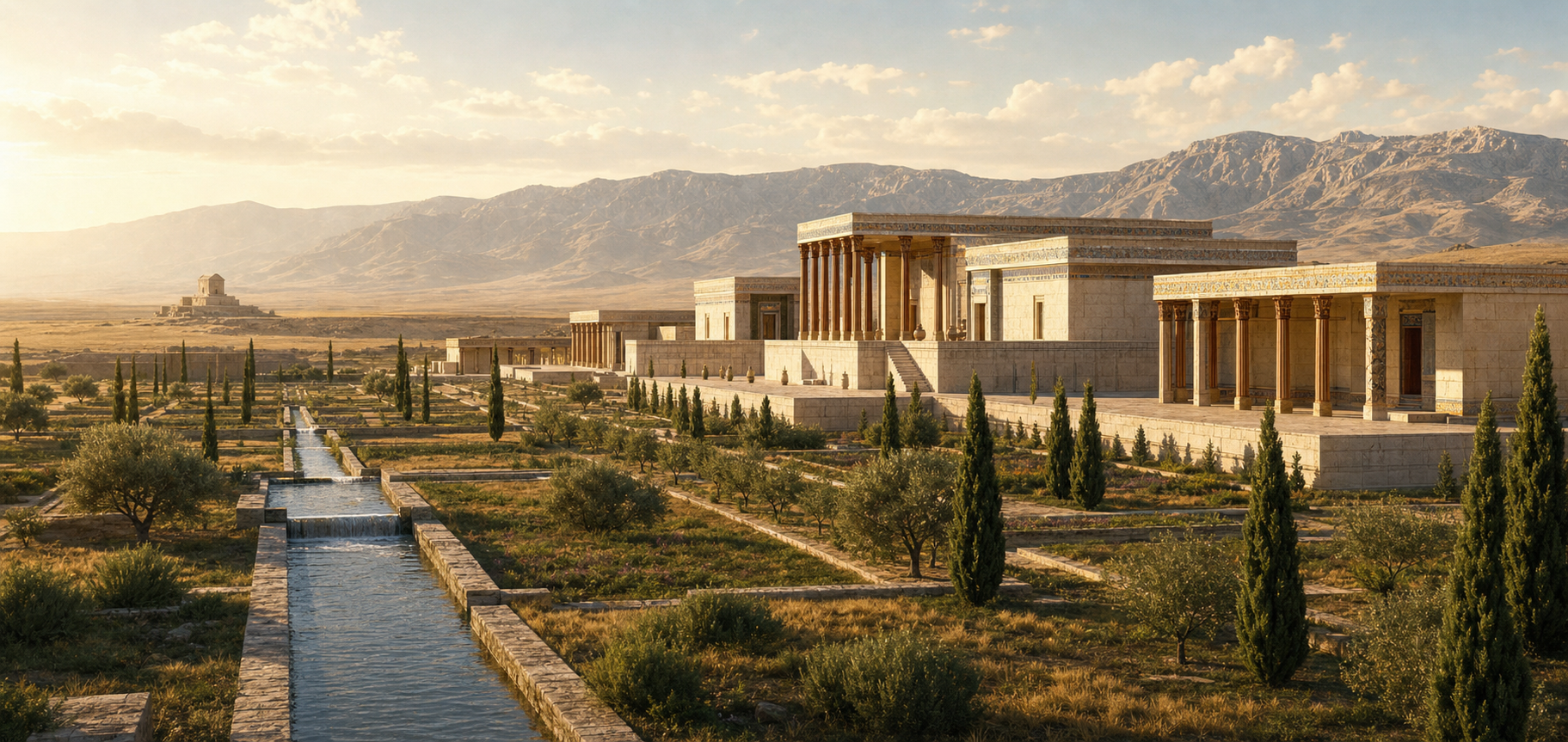
In June 323 BCE, Alexander the Great died in Babylon at the age of thirty-two. His death brought the extraordinary career of one of antiquity's greatest conquerors to an abrupt end and immediately created a political crisis across an empire stretching from Greece and Egypt to Central Asia and the northwestern Indian subcontinent.
Alexander had spent little more than a decade transforming the political map of the ancient world. Beginning his invasion of the Achaemenid Persian Empire in 334 BCE, he defeated King Darius III, conquered the Persian capitals, entered Egypt, crossed Central Asia and eventually campaigned beyond the Indus River.
Yet the empire depended heavily upon Alexander himself. He had not established an uncontested adult successor, and the structures necessary to transfer authority peacefully were incomplete. His death therefore did not simply mark the end of a reign. It triggered decades of conflict among his generals and ultimately produced the Hellenistic kingdoms that dominated the eastern Mediterranean and western Asia for centuries.
Alexander the Great
Alexander III of Macedon was born in 356 BCE at Pella, the capital of ancient Macedonia.
He was the son of King Philip II and Queen Olympias.
Philip transformed Macedonia into the strongest military kingdom in Greece and created the army that Alexander would later use to conquer Persia.
Alexander inherited the Macedonian throne after Philip's assassination in 336 BCE.
The Legacy of Philip II
Alexander's conquests cannot be understood without the achievements of his father.
Philip reorganised the Macedonian army, strengthened the use of the sarissa phalanx and developed powerful cavalry forces.
He also defeated a coalition led by Athens and Thebes at the Battle of Chaeronea in 338 BCE.
This victory established Macedonian supremacy over much of mainland Greece.
The League of Corinth
Philip organised many Greek states into an alliance conventionally known as the League of Corinth.
The alliance was intended partly to support a campaign against the Persian Empire.
Philip was preparing that expedition when he was assassinated.
Alexander inherited both the throne and his father's plans for war in Asia.
Alexander Becomes King
Alexander was only twenty years old when he became king.
His position was initially uncertain.
Potential rivals existed within Macedonia, while several Greek states saw Philip's death as an opportunity to challenge Macedonian authority.
Alexander responded rapidly and ruthlessly to secure his rule.
The Destruction of Thebes
In 335 BCE, Thebes rebelled against Macedonian dominance.
Alexander marched south with extraordinary speed.
The city was captured and largely destroyed.
Many inhabitants were killed or enslaved.
The fate of Thebes sent a powerful warning to other Greek states before Alexander began his Persian campaign.
The Invasion of Persia
In 334 BCE, Alexander crossed the Hellespont into Asia Minor.
He presented the campaign partly as a Greek war of revenge against Persia for the invasions of Greece during the fifth century BCE.
It was also a Macedonian campaign for conquest, wealth and imperial power.
The Battle of the Granicus
Alexander's first major victory in Asia came at the Granicus River in 334 BCE.
Persian satraps attempted to block his advance.
Alexander's cavalry crossed the river and defeated their forces.
The victory opened much of western Anatolia to Macedonian occupation.
Gordium
Alexander later visited Gordium in central Anatolia.
A famous tradition claimed that an ancient knot there could be undone only by the future ruler of Asia.
Alexander supposedly solved the problem either by cutting the knot with his sword or by discovering a hidden method of loosening it.
The story became a symbol of decisive action in the face of apparently impossible problems.
The Battle of Issus
In 333 BCE, Alexander confronted Darius III personally at the Battle of Issus.
The narrow battlefield reduced some of Persia's numerical advantages.
Darius eventually fled after the Persian line collapsed.
Members of the Persian royal family fell into Alexander's hands.
Darius III
Darius III was the final king of the Achaemenid Persian Empire.
His defeat at Issus did not immediately destroy Persian resistance.
He still controlled enormous territories and could raise new armies.
The decisive struggle between the two kings would come later at Gaugamela.
The Siege of Tyre
In 332 BCE, Alexander besieged the Phoenician city of Tyre.
The island city possessed formidable walls and naval defences.
Alexander constructed a causeway from the mainland and assembled naval forces to surround it.
After months of resistance, Tyre fell.
Gaza
Alexander continued south and captured Gaza after another difficult siege.
Control of the Levant secured his communication routes and helped isolate Persian naval bases from the Mediterranean.
Alexander in Egypt
Alexander entered Egypt in 332 BCE.
Persian rule there had been unpopular among sections of the population, and the Macedonian king encountered relatively little resistance.
He was recognised within Egyptian traditions as pharaoh.
Alexandria
Alexander founded the city of Alexandria on Egypt's Mediterranean coast.
He did not live to see its later greatness.
Under the Ptolemies, Alexandria would become one of the largest cities and greatest intellectual centres of the ancient world.
The Oracle of Siwa
Alexander travelled into the western desert to consult the oracle of Amun at Siwa.
The exact message he received is uncertain.
Later traditions connected the visit with claims concerning Alexander's divine ancestry.
The episode contributed significantly to the growing mythology surrounding his kingship.
The Battle of Gaugamela
In 331 BCE, Alexander and Darius met again at Gaugamela in northern Mesopotamia.
Darius assembled a large army on open terrain prepared for battle.
Alexander's forces used disciplined movement and coordinated cavalry attacks to break the Persian position.
Darius fled once again.
The Fall of the Achaemenid Empire
The victory at Gaugamela effectively destroyed Darius's ability to defend the principal centres of the Persian Empire.
Alexander entered Babylon and Susa.
He then advanced toward the ceremonial Persian capital of Persepolis.
Babylon
Babylon was one of the greatest cities of the ancient world.
Alexander entered it after Gaugamela and was welcomed as king.
The city impressed the Macedonians with its enormous temples, walls and ancient traditions.
Years later, Babylon would become the place where Alexander died.
Susa
Susa was another major Achaemenid royal centre.
Alexander captured substantial quantities of treasure there.
The accumulated wealth of the Persian monarchy helped finance his continuing campaigns.
Persepolis
Persepolis represented the ceremonial heart of Achaemenid kingship.
Alexander captured the city and its treasury.
Part of the palace complex was later destroyed by fire.
Ancient sources offered different explanations for the burning, including revenge for Persian destruction in Greece and an impulsive act during a celebration.
The Burning of Persepolis
The exact circumstances of the fire remain debated.
Whatever the immediate cause, the destruction possessed enormous symbolic significance.
The ceremonial centre of the dynasty Alexander sought to replace had been severely damaged.
The Pursuit of Darius
Darius continued retreating eastward after Gaugamela.
Alexander pursued him across Iran.
Before Alexander could capture him, Darius was seized by members of his own entourage.
The Death of Darius III
In 330 BCE, Darius was killed during the struggle among Persian commanders.
Alexander reportedly treated the dead king with respect and arranged a royal burial.
He increasingly presented himself as the legitimate successor to the Achaemenid monarchy rather than merely its destroyer.
Alexander as King of Asia
After Darius's death, Alexander's political identity changed.
The campaign could no longer be presented simply as a war against the Persian king.
Alexander now claimed authority over the enormous empire that Darius had ruled.
Adopting Persian Practices
Alexander increasingly adopted elements of Persian royal dress and court ceremony.
He appointed Iranian nobles to positions of authority and incorporated Persian soldiers into his military system.
These policies caused tension among some Macedonian companions.
Proskynesis
One controversial issue concerned a court practice known to Greek writers as proskynesis.
Forms of ceremonial bowing or prostration existed within Persian court culture.
Many Greeks associated such gestures with worship of gods and resisted performing them before a mortal king.
Alexander's attempt to introduce such customs among his companions created significant opposition.
The Philotas Affair
In 330 BCE, a conspiracy against Alexander was discovered or alleged.
Philotas, commander of the elite Companion cavalry and son of the powerful general Parmenion, was accused of failing to report knowledge of the plot.
He was tried and executed.
The Death of Parmenion
After Philotas's execution, Alexander ordered Parmenion killed.
Parmenion had been one of the most experienced Macedonian commanders and had served Philip II before Alexander.
His elimination demonstrated how dangerous internal politics had become within Alexander's army.
Central Asia
Alexander continued campaigning through Bactria and Sogdiana.
The war there differed significantly from the great set-piece battles against Darius.
Local resistance relied upon mobility, fortified settlements and difficult terrain.
Bactria
Bactria covered regions corresponding broadly to parts of modern Afghanistan and neighbouring areas.
It had been an important eastern territory of the Persian Empire.
Alexander faced prolonged resistance there after the collapse of central Achaemenid rule.
Sogdiana
Sogdiana lay farther north in Central Asia.
Its rulers and local military leaders resisted Macedonian occupation.
Alexander established garrisons and founded settlements to secure the region.
Spitamenes
Spitamenes became one of Alexander's most dangerous opponents in Central Asia.
He used mobile warfare and local alliances effectively.
His resistance demonstrated that conquering the Persian king did not automatically mean controlling every Persian province.
Marriage to Roxana
During the Central Asian campaigns, Alexander married Roxana, daughter of a local nobleman traditionally associated with Bactria or Sogdiana.
The marriage may have combined personal attraction with political strategy.
Roxana would later become pregnant with the child who became Alexander IV.
Cleitus the Black
In 328 BCE, Alexander killed Cleitus the Black during a drunken argument.
Cleitus had saved Alexander's life at the Granicus and was an experienced Macedonian officer.
The killing shocked the court and reportedly caused Alexander intense remorse.
Tension With the Macedonians
Episodes such as the death of Cleitus reflected growing tensions between Alexander and some of his older Macedonian companions.
Many believed the king was becoming increasingly influenced by Persian royal customs.
Alexander, however, needed to govern an empire much larger and more diverse than Macedonia itself.
The Pages' Conspiracy
Another conspiracy involving members of the royal pages was uncovered during the Central Asian campaigns.
The philosopher Callisthenes became associated with the episode and was arrested.
His eventual death further damaged Alexander's relationship with some Greek intellectual circles.
The Campaign Toward India
Alexander eventually turned southeast and crossed the Hindu Kush.
He entered regions corresponding to modern Pakistan and northwestern India.
His army encountered new political systems, landscapes and military traditions.
The Indus Valley
Alexander crossed major rivers and formed alliances with some local rulers while fighting others.
The campaign extended Macedonian power farther east than any previous Greek army had travelled.
Taxila
The ruler of Taxila cooperated with Alexander.
The alliance provided supplies and strategic assistance.
Alexander's campaigns repeatedly relied upon cooperation from local rulers as well as direct conquest.
King Porus
One of Alexander's most famous Indian opponents was King Porus.
He ruled territory beyond the Hydaspes River.
Porus assembled infantry, cavalry and war elephants to resist the Macedonians.
The Battle of the Hydaspes
In 326 BCE, Alexander crossed the Hydaspes River under difficult conditions and attacked Porus's army.
The battle was intense.
War elephants created serious problems for Macedonian infantry and cavalry.
Alexander eventually won.
Alexander and Porus
Ancient tradition states that Alexander was impressed by Porus's courage.
Instead of removing him completely, Alexander allowed him to continue ruling and expanded his territory.
This was consistent with Alexander's frequent willingness to govern through cooperative local rulers.
Bucephalus
Alexander's famous horse Bucephalus died around the time of the Indian campaigns.
Alexander founded a city named Bucephala in his memory according to ancient sources.
The horse had become closely associated with Alexander's heroic image.
The Hyphasis Mutiny
After years of campaigning, Alexander wanted to continue farther east beyond the Hyphasis River.
His soldiers refused.
They had marched thousands of kilometres and faced the prospect of fighting even larger Indian kingdoms.
For once, Alexander could not persuade them to continue.
Alexander Turns Back
After days of resistance, Alexander accepted the army's refusal.
He ordered the construction of monumental altars marking the eastern limit of the expedition.
The army then began the long journey westward.
The Journey Down the Indus
Alexander divided his forces and moved through the Indus river system.
Some communities submitted, while others resisted violently.
The campaign remained dangerous even though the army was officially returning west.
The Mallian Campaign
During an assault against a fortified settlement associated with the Mallians, Alexander personally climbed into the enemy position.
He became isolated from most of his troops.
An arrow struck him in the chest.
Alexander Nearly Dies
The wound was severe.
For a time, rumours spread that Alexander had died.
His eventual recovery strengthened his reputation for extraordinary endurance but also demonstrated the risks of his habit of leading from the front.
Nearchus
Alexander sent a fleet under Nearchus to explore the route from the Indus toward the Persian Gulf.
The voyage provided valuable geographical information.
It also formed part of Alexander's wider ambition to connect the eastern territories of his empire through sea routes.
The Gedrosian Desert
Alexander led part of his army through the harsh region of Gedrosia in southern Iran.
The march became disastrous.
Heat, lack of water and insufficient supplies caused heavy losses.
Why Alexander Crossed Gedrosia
Ancient writers offered several explanations for the decision.
Alexander may have wanted to surpass earlier conquerors, support the fleet or explore the region.
The precise motivation remains uncertain.
Whatever the reason, the march cost many lives.
Return to the Persian Heartland
By 324 BCE, Alexander had returned to the central territories of his empire.
He now faced the challenge of governing a vast state after years of constant campaigning.
Corruption, local power struggles and administrative problems had developed during his absence.
Susa
Alexander returned to Susa and organised one of the most famous ceremonies of his reign.
He arranged marriages between Macedonian officers and Persian noblewomen.
Alexander himself married Stateira, a daughter of Darius III, in addition to Roxana.
The Susa Weddings
The mass marriages symbolised Alexander's attempt to integrate Macedonian and Iranian elites.
Thousands of soldiers were also encouraged or recognised in marriages with Asian women.
The long-term success of this policy was limited, particularly after Alexander's death.
Persian Soldiers
Alexander trained large numbers of young Iranians in Macedonian-style warfare.
Ancient sources call some of these troops the Successors.
The policy alarmed Macedonian soldiers who feared they were becoming replaceable.
The Mutiny at Opis
In 324 BCE, Alexander's Macedonian troops mutinied at Opis when he announced plans to send veterans home.
Many interpreted the policy as evidence that the king preferred his new Asian troops.
Alexander responded with anger and arrested leading mutineers.
Reconciliation at Opis
The confrontation eventually ended in reconciliation.
Alexander held a great banquet involving Macedonians and Persians.
The event symbolised his vision of a politically integrated ruling system, although the exact nature and extent of that vision remain debated.
Hephaestion
Hephaestion was one of Alexander's closest companions.
The two had known one another for many years, and Hephaestion became one of the most powerful men in the empire.
Ancient sources emphasise the depth of Alexander's attachment to him.
The Death of Hephaestion
In late 324 BCE, Hephaestion became ill at Ecbatana and died.
Alexander was devastated.
He ordered elaborate mourning rituals and planned an enormous funeral monument.
The loss appears to have affected him deeply during the final months of his life.
Alexander's Grief
Ancient writers describe extreme expressions of mourning.
Some details may have been exaggerated, but there is little doubt that Hephaestion's death was a profound personal blow.
Alexander sought divine or heroic honours for his dead companion.
Plans for Arabia
Despite Hephaestion's death, Alexander continued planning new military campaigns.
Arabia was one of his principal intended targets.
Ships were assembled and harbours prepared in Babylonia for the expedition.
Why Arabia?
Arabia offered strategic control of routes linking the Persian Gulf, Red Sea and Indian Ocean.
Its incense trade also made parts of the region economically attractive.
Alexander may have intended to secure the coastline and extend his naval networks.
Further Western Plans
Some ancient sources claim Alexander also considered campaigns toward the western Mediterranean.
Possible targets included Carthage and territories farther west.
The evidence for the exact scale of these plans is uncertain and may include later exaggeration.
Alexander's Imperial Ambitions
What is clear is that Alexander had not retired from conquest.
He remained in his early thirties and possessed enormous military resources.
His death therefore ended plans that could have transformed the ancient world even further.
Return to Babylon
Alexander returned to Babylon in 323 BCE.
The city occupied a central position within his empire.
Its location between western and eastern territories made it an attractive administrative and strategic centre.
Babylon as an Imperial Capital
Alexander appears to have intended Babylon to play a major role in future government.
The city had enormous historical prestige and extensive infrastructure.
Its canals connected the region with the Euphrates and Persian Gulf.
Babylonian Scholars
Babylon remained home to ancient priestly and scholarly communities.
Babylonian astronomers possessed centuries of recorded observations.
Alexander's court existed alongside traditions far older than Macedonian civilisation.
Warnings About Babylon
Ancient sources claim that Babylonian priests warned Alexander against entering the city because omens predicted danger.
The historical details are difficult to establish.
Such stories became especially meaningful after Alexander died there.
Omens
The months before Alexander's death became filled in later accounts with strange omens.
Ancient historians recorded unusual events, prophecies and warnings supposedly predicting the king's fate.
Some may have been added or emphasised after his death.
Ancient Attitudes to Omens
People in the ancient world often believed unusual natural or religious events could reveal divine intentions.
Stories surrounding Alexander's final days therefore reflected genuine contemporary beliefs even when their exact historical details are uncertain.
Preparing the Arabian Expedition
At Babylon, Alexander inspected troops and prepared ships for the Arabian campaign.
Canals and harbour facilities were developed.
Diplomatic missions arrived from various parts of the known world.
The king appeared to be preparing for another major phase of expansion.
Alexander's Court at Babylon
Officials, generals, ambassadors and soldiers gathered around the king.
The empire depended upon Alexander's personal ability to distribute commands and resolve disputes.
This concentration of power would become a critical weakness when he suddenly fell ill.
The Final Banquets
Ancient sources describe Alexander attending banquets during his final days.
One gathering was associated with his companion Medius of Larissa.
After drinking and socialising, Alexander developed a fever.
The illness progressively worsened.
Medius of Larissa
Medius was a member of Alexander's circle.
His banquet became famous because it occurred shortly before the king became seriously ill.
Later rumours of poisoning sometimes focused upon people connected with these final gatherings.
The Beginning of the Illness
Alexander's symptoms appear to have begun with fever.
Over the following days, his strength declined.
Despite the illness, he initially continued discussing military and religious matters.
The Royal Diaries
Some ancient writers claimed access to records sometimes called the Royal Diaries or Ephemerides.
Accounts based on these traditions describe Alexander's condition worsening gradually over approximately ten to twelve days.
The reliability and exact transmission of these records remain debated.
A Gradual Decline
Alexander was eventually unable to walk and had to be carried.
His fever continued.
He gradually lost the ability to speak.
Members of the army became increasingly anxious as rumours spread.
The Soldiers Demand to See Him
According to ancient accounts, Macedonian soldiers feared Alexander had already died and that officials were hiding the truth.
They demanded to see their king.
The soldiers were allowed to pass before his bed.
The Final Review
Alexander was reportedly too weak to speak as his soldiers walked past.
He acknowledged them through movements of his eyes or head.
The scene became one of the most poignant episodes in ancient accounts of his death.
The Death of Alexander
Alexander died in Babylon in June 323 BCE.
The traditional date is often given as 10 or 11 June, depending upon chronological reconstruction.
He was thirty-two years old and only a few weeks short of his thirty-third birthday.
How Did Alexander Die?
The precise cause of Alexander's death remains unknown.
Ancient accounts provide descriptions of fever and progressive weakness but do not allow a secure modern diagnosis.
Numerous diseases and other explanations have been proposed.
Natural Illness
Many historians consider natural illness the most plausible broad explanation.
Possible suggestions have included malaria, typhoid fever and other infectious diseases.
None can be proven conclusively from the surviving evidence.
Malaria
Babylonia contained marshy environments where mosquito-borne disease could occur.
Malaria has therefore often been proposed as one possibility.
However, the surviving symptom descriptions are not precise enough to establish the diagnosis.
Typhoid Fever
Typhoid fever has also been suggested.
The disease can produce prolonged fever, weakness and serious complications.
Again, no medical evidence survives that could confirm this theory.
Other Medical Theories
Modern discussions have proposed numerous additional conditions.
These include various infections, neurological disorders and complications related to Alexander's previous wounds or physical exhaustion.
Such theories remain speculative.
Alexander's Physical Condition
Alexander had endured more than a decade of nearly continuous campaigning.
He had suffered several serious wounds.
He had crossed deserts, mountains and extreme climates.
Years of military stress may have weakened his overall health even if they were not the direct cause of death.
Previous Wounds
Alexander had been wounded repeatedly during his campaigns.
The arrow wound suffered during the Mallian campaign had been particularly severe.
Ancient medicine could not fully address the long-term effects of major injuries.
Alcohol
Ancient Macedonian elite culture included heavy drinking at banquets.
Alexander himself was known to participate.
Some later theories have associated alcohol with his final illness, although there is insufficient evidence to identify it as the direct cause.
Was Alexander Poisoned?
Rumours of poisoning appeared in antiquity.
Alexander had many political enemies, and his sudden death naturally encouraged suspicion.
Some traditions accused figures connected with Antipater, the Macedonian regent.
However, the surviving evidence for deliberate poisoning is weak.
Antipater
Antipater had governed Macedonia during Alexander's Asian campaigns.
Relations between him and Olympias, Alexander's mother, were deeply hostile.
Near the end of Alexander's life, Antipater may have feared being replaced or summoned to the royal court.
This provided later storytellers with a possible motive for conspiracy.
Cassander
Cassander, Antipater's son, later became one of the major rulers of Macedonia.
He was strongly hostile to Alexander's surviving family and eventually ordered the deaths of Roxana and Alexander IV.
Because of his later actions, rumours sometimes connected his family with Alexander's death.
No reliable evidence proves such involvement.
Iollas
Some poisoning stories named Iollas, another son of Antipater who served as Alexander's cupbearer.
The accusation is difficult to verify and appears within politically charged later traditions.
The Problem With Poisoning Theories
Alexander's illness apparently lasted several days rather than causing immediate death.
Ancient poisons capable of producing exactly the reported symptoms are difficult to identify.
The political advantages of accusing enemies after Alexander's death also make such stories suspect.
Modern Medical Certainty Is Impossible
No body known with certainty to be Alexander's has been medically examined.
No contemporary clinical record survives in sufficient detail.
Any precise modern diagnosis must therefore remain hypothetical.
The Question of His Final Words
Ancient writers preserved several traditions concerning Alexander's final words.
One famous story claims that when asked who should inherit his empire, he replied that it should go to the strongest.
The historical authenticity of this statement is uncertain.
To the Strongest
The phrase became famous because it seemed to predict the wars that followed.
Alexander's generals were indeed among the strongest military leaders of their generation.
After his death, they fought one another for decades.
Another Tradition
Other sources suggest that Alexander was too weak to speak clearly during his final hours.
He may instead have handed his signet ring to Perdiccas.
This act could have indicated temporary administrative authority rather than a clear appointment as permanent successor.
The Signet Ring
The royal signet carried enormous symbolic and practical importance.
Possession of it allowed official commands to be authenticated.
If Alexander gave it to Perdiccas, the gesture strengthened Perdiccas's immediate political position.
No Clear Heir
The central problem remained unchanged.
Alexander had no adult legitimate son ready to inherit.
His half-brother Arrhidaeus was alive but was not regarded as capable of ruling independently.
Roxana was pregnant, but the sex of the unborn child was not yet known.
Heracles
Alexander also had a son named Heracles according to ancient tradition, born to Barsine.
His legitimacy and political position were weaker than those of a child born to Roxana.
He would later become another victim of the successor struggles.
Alexander's Greatest Political Failure
The lack of a clear succession arrangement became one of the most consequential failures of Alexander's reign.
He had spent years conquering territory but had not created a stable mechanism for transferring supreme authority.
The empire was therefore extraordinarily vulnerable at the moment of his death.
Shock Across the Empire
News of Alexander's death created uncertainty throughout his territories.
Governors, generals and soldiers needed to know who now possessed legitimate authority.
No individual could simply assume Alexander's position without opposition.
The Macedonian Army
The army itself became an important political force.
Macedonian soldiers expected to participate in recognition of kings.
Different military factions supported different solutions to the succession crisis.
Perdiccas
Perdiccas held a powerful position among Alexander's senior commanders.
He favoured waiting for Roxana's child to be born before settling the succession permanently.
This would have allowed him and other senior officers to govern as guardians or regents.
Meleager
Meleager became associated with infantry soldiers who supported immediate recognition of Alexander's half-brother Arrhidaeus.
The dispute between supporters of Perdiccas and Meleager nearly produced open violence inside Babylon.
Philip III Arrhidaeus Becomes King
A compromise eventually recognised Arrhidaeus as King Philip III.
If Roxana's unborn child were male, he would also share the kingship.
When Alexander IV was born, the empire officially possessed two kings.
Two Kings Without Real Power
Neither Philip III nor the infant Alexander IV could exercise effective independent rule.
Actual authority therefore belonged to generals, regents and members of the royal household.
This arrangement guaranteed continuing competition.
Roxana
Roxana immediately became an important figure because she carried Alexander's potential heir.
Her position was nevertheless dangerous.
The royal court contained rival wives, relatives and generals whose interests conflicted sharply.
Stateira
Alexander had also married Stateira, daughter of Darius III.
According to ancient accounts, Roxana arranged for Stateira and possibly another royal woman to be killed after Alexander's death.
The episode illustrates the brutality of the succession struggle from its earliest days.
The Partition of Babylon
Alexander's commanders divided responsibilities across the empire in what is conventionally called the Partition of Babylon.
Generals received major regions to administer.
The arrangement formally preserved the empire under the kings but gave individual commanders strong territorial power bases.
Ptolemy Receives Egypt
Ptolemy became satrap of Egypt.
This proved one of the most important appointments.
Egypt's natural geography, agricultural wealth and defensible frontiers gave Ptolemy an exceptionally strong position.
Antigonus in Anatolia
Antigonus Monophthalmus already possessed important commands in Anatolia.
He would later become one of the most powerful contenders for Alexander's inheritance.
Seleucus
Seleucus initially held a senior military position rather than the vast kingdom later associated with his name.
He would eventually gain Babylon and create the Seleucid Empire.
Lysimachus
Lysimachus received Thrace.
His initial territory appeared modest compared with some other commands.
Over the following decades, he expanded dramatically and eventually ruled parts of Macedonia and Anatolia.
Antipater Retains Macedonia
Antipater remained responsible for Macedonia and Greece.
This placed him in control of Alexander's ancestral kingdom.
Almost immediately he faced a major revolt among Greek states.
The Greek Response
Alexander's death created hope among Greeks who wanted to escape Macedonian domination.
Athens became central to a new uprising.
The conflict became known as the Lamian War.
The Lamian War
Athens and its allies raised armies against Antipater.
For a time, the Macedonian regent was trapped at Lamia.
The revolt showed how quickly Alexander's political system could be challenged once his personal authority disappeared.
Macedonian Reinforcements
Additional Macedonian forces eventually arrived from Asia.
The balance shifted against the Greek coalition.
Athens and its allies were defeated in 322 BCE.
The End of Athenian Independence
After defeat, Athens was forced to accept a more restricted political system and Macedonian military presence.
The anti-Macedonian orator Demosthenes fled and later took his own life.
Alexander's death had therefore not restored Classical Greek political independence.
The Successor Wars Begin
Within only a few years, the generals themselves began fighting openly.
Perdiccas attempted to preserve central authority but encountered resistance from Ptolemy, Antigonus, Antipater and others.
The empire moved rapidly toward fragmentation.
The Body of Alexander
Alexander's corpse became an object of immense political significance.
Possession of the dead conqueror could provide prestige and legitimacy.
Plans were made for an elaborate funeral procession.
Embalming Alexander
Ancient sources describe Alexander's body being prepared for preservation.
The methods are uncertain, although embalmers from Egypt or Mesopotamia may have been involved.
Later stories claimed the body remained remarkably well preserved.
The Funeral Carriage
An elaborate carriage was constructed to transport Alexander's body.
Ancient descriptions portray it as richly decorated with gold and royal imagery.
The funeral procession itself became a statement of imperial magnificence.
Where Was Alexander Supposed to Be Buried?
Some traditions suggest that Alexander was intended to be buried at Aegae in Macedonia with earlier Macedonian kings.
Others connected his desired burial with the sanctuary of Amun at Siwa.
The precise original plan remains uncertain.
Ptolemy Seizes the Body
Ptolemy intercepted the funeral procession and brought Alexander's remains to Egypt.
This was a major political act.
Possession of Alexander's tomb associated Ptolemy directly with the memory of the conqueror.
Memphis
Alexander's body appears initially to have been placed at Memphis.
It was later transferred to Alexandria.
The tomb became one of the most famous monuments of the ancient city.
The Tomb at Alexandria
Alexander's burial place in Alexandria was known in antiquity and visited by famous rulers.
The body remained a powerful symbol of royal legitimacy.
Ptolemaic kings associated themselves closely with Alexander's memory.
Julius Caesar Visits Alexander
Centuries later, Julius Caesar reportedly visited Alexander's tomb while in Alexandria.
Roman commanders frequently admired Alexander as the supreme model of military conquest.
Augustus Visits the Tomb
After conquering Egypt, Octavian, later Augustus, also visited Alexander's remains.
Ancient tradition records that he placed a golden crown upon the body.
The visit symbolically connected Rome's new master with the great conqueror of the Hellenistic world.
Caracalla
The Roman emperor Caracalla was another admirer of Alexander.
He attempted to imitate aspects of Macedonian military style and reportedly visited Alexandria.
Alexander's reputation continued influencing rulers long after his empire had vanished.
The Lost Tomb
The exact location of Alexander's tomb is unknown today.
References to the monument become increasingly uncertain in late antiquity.
Changes to Alexandria, earthquakes, urban rebuilding and rising sea levels have complicated archaeological investigation.
Searches for Alexander's Tomb
Numerous attempts have been made to identify the tomb.
Many proposed locations have attracted public attention.
No discovery has yet gained broad scholarly acceptance as Alexander's burial place.
The Fragmentation of the Empire
The political consequences of Alexander's death developed quickly.
His generals initially claimed to preserve one empire.
In practice, each powerful commander needed territory, soldiers and money to survive.
Regional power bases gradually became independent kingdoms.
The Diadochi
The generals who fought over Alexander's empire became collectively known as the Diadochi.
Their wars continued for decades.
Alliances were repeatedly formed and broken.
Almost every member of Alexander's immediate royal family eventually died violently.
Perdiccas Falls
Perdiccas attempted to invade Egypt after conflict with Ptolemy.
The campaign failed.
His own officers killed him in 321 BCE.
The death of the first major regent demonstrated how difficult it was for any one commander to maintain central authority.
The Partition of Triparadisus
After Perdiccas's death, the surviving commanders reorganised the distribution of territories.
The settlement at Triparadisus represented another attempt to create political order.
Like the earlier division at Babylon, it proved temporary.
Antigonus Becomes Powerful
Antigonus Monophthalmus gradually emerged as one of the greatest military powers among the successors.
His campaigns gave him control over extensive territories in Asia.
Other generals increasingly feared that he intended to reunify Alexander's empire under his own dynasty.
Eumenes
Eumenes of Cardia was one of the most remarkable figures of the successor wars.
Unlike many leading commanders, he was Greek rather than Macedonian.
He remained loyal publicly to Alexander's royal family and fought against Antigonus.
The Silver Shields
Eumenes commanded veteran Macedonian soldiers known as the Argyraspids or Silver Shields.
Many had served under Philip and Alexander.
Their battlefield experience made them formidable even as they grew older.
The Death of Eumenes
After a complex campaign in Iran, Eumenes was betrayed and handed over to Antigonus.
He was executed.
Another potential defender of the unified royal inheritance had disappeared.
Olympias
Alexander's mother Olympias remained a powerful political figure after his death.
She fought to protect the claims of her grandson Alexander IV.
Her involvement in Macedonian succession struggles became increasingly violent.
The Death of Philip III
Philip III Arrhidaeus became caught in conflicts among rival factions.
Olympias eventually ordered his death in 317 BCE after regaining influence in Macedonia.
The killing removed one of the two official kings created after Alexander's death.
Cassander Defeats Olympias
Cassander returned to Macedonia and besieged Olympias.
She surrendered and was later killed.
Cassander now gained control over Roxana and the young Alexander IV.
The Murder of Alexander IV
Around 310 or 309 BCE, Cassander ordered the deaths of Roxana and Alexander IV.
The murder eliminated Alexander the Great's legitimate son and one of the last major symbols of the united empire.
The Death of Heracles
Heracles, Alexander's son by Barsine according to ancient tradition, was later promoted briefly as a possible royal claimant.
He too was murdered during the successor struggles.
Alexander's direct male descendants had effectively disappeared.
Cleopatra of Macedon
Alexander's sister Cleopatra also became politically important because marriage to her could strengthen a successor's claim to legitimacy.
She was eventually killed before such a marriage could reshape the political balance.
The Argead Dynasty Ends
The Macedonian royal house of Philip II and Alexander was destroyed within a generation of Alexander's death.
The generals who had once served the dynasty now ruled their own kingdoms.
The Successors Declare Themselves Kings
In 306 BCE, Antigonus and his son Demetrius openly assumed the title of king.
Ptolemy, Seleucus, Lysimachus and Cassander soon followed.
The fiction of one empire governed on behalf of Alexander's heirs had ended.
The Hellenistic Kingdoms
Alexander's empire ultimately produced several major states.
Ptolemaic Egypt became one of the wealthiest Mediterranean kingdoms.
The Seleucid Empire controlled much of western Asia.
The Antigonid dynasty eventually ruled Macedonia.
Other kingdoms emerged throughout Anatolia and Central Asia.
Ptolemaic Egypt
Ptolemy's decision to secure Egypt proved remarkably successful.
The dynasty he founded survived until the death of Cleopatra VII in 30 BCE.
Its capital at Alexandria became a great commercial and intellectual centre.
The Seleucid Empire
Seleucus eventually established control over Babylon and expanded across much of Alexander's former Asian territories.
The Seleucid Empire stretched from the Mediterranean deep into Iran and Central Asia during its early period.
The Antigonids
Antigonus I died at the Battle of Ipsus in 301 BCE, but his descendants continued fighting.
The Antigonid dynasty eventually secured Macedonia and ruled it until Roman conquest in the second century BCE.
The Battle of Ipsus
At Ipsus, rival successors united against Antigonus.
Seleucus's war elephants played an important role in preventing Demetrius's cavalry from returning to the main battlefield.
Antigonus was killed and his territories divided.
Alexander's Empire Could Not Be Recreated
After Ipsus, the possibility of restoring the entire empire under one of the original successors became increasingly remote.
The political world Alexander had conquered was permanently divided.
Why the Empire Fragmented
Several factors made fragmentation likely.
The empire was geographically enormous.
Communications could take weeks or months.
No adult heir possessed universal recognition.
Alexander's generals commanded their own armies and controlled wealthy provinces.
Personal Monarchy
Alexander's state had depended heavily upon his personal authority.
He was king of Macedonia, leader of a Greek alliance, conqueror of Persia and recognised ruler in several local traditions.
No institution could easily replace this collection of roles after his death.
Military Loyalty
Soldiers often followed successful commanders personally.
Generals who controlled troops could turn provincial commands into independent political power.
This made territorial fragmentation difficult to prevent.
Geographical Scale
Alexander's territories stretched from Macedonia to Central Asia.
Maintaining direct government over such distances was challenging even under a charismatic conqueror.
Without Alexander, regional commanders naturally gained greater independence.
Local Traditions
The empire also contained ancient societies with their own administrative structures and political identities.
Egypt, Babylonia, Iran and Central Asia could all support regional governments.
The successors therefore inherited territories capable of functioning independently.
Alexander and Administration
Alexander had preserved many Achaemenid administrative arrangements.
Satraps continued governing provinces.
This was practical during conquest but also meant individual governors possessed substantial regional authority.
The Persian Imperial Inheritance
The Achaemenid Empire had developed sophisticated systems of taxation, provincial administration and communication.
Alexander adapted rather than destroyed many of them.
His successors inherited these structures and used them to create new kingdoms.
The Beginning of the Hellenistic Age
For this reason, 323 BCE is conventionally used as the beginning of the Hellenistic Age.
Alexander's death did not end Greek cultural influence.
Instead, Greek language, art and institutions spread more widely through the kingdoms created by his successors.
The Meaning of Hellenistic
The term Hellenistic is a modern historical label.
It describes the centuries during which Greek cultural traditions interacted intensively with the peoples of Egypt, western Asia and other regions conquered by Alexander.
Greek Language
A common form of Greek known as Koine became increasingly widespread.
It was used by administrators, merchants, soldiers and writers throughout much of the eastern Mediterranean.
Local languages nevertheless continued to survive.
Alexander's Cities
Alexander founded or renamed numerous settlements during his campaigns.
Many were called Alexandria.
Some became important military or administrative centres.
Their Greek and Macedonian populations helped spread Hellenic institutions across the former Persian Empire.
Alexandria in Egypt
The most famous of these foundations became Alexandria in Egypt.
Under the Ptolemies, it developed into a centre of trade, scholarship and royal power.
The city's later greatness became one of the most enduring consequences of Alexander's conquests.
The Library of Alexandria
The famous Library of Alexandria was developed under the Ptolemies after Alexander's death.
It sought to gather and organise enormous quantities of Greek literature and scholarship.
Its existence symbolised the cultural world that arose from Alexander's empire.
Scientific Expansion
The Hellenistic period produced scholars such as Euclid, Archimedes and Eratosthenes.
Intellectual centres benefited from contact between Greek, Egyptian, Babylonian and other traditions.
The political fragmentation after Alexander therefore accompanied remarkable cultural creativity.
Greek Culture Moves East
Greek-style theatres, gymnasia, temples and civic institutions appeared far beyond mainland Greece.
In some regions, Greek and local traditions combined.
Hellenisation did not mean the disappearance of older cultures.
Babylonian Culture Continues
Babylonian scribes continued writing cuneiform under Alexander's successors.
Ancient temples remained active.
Babylonian astronomical knowledge eventually influenced Greek astronomy significantly.
Egyptian Culture Continues
The Ptolemies presented themselves as Macedonian kings to Greek subjects and as pharaohs within Egyptian religious traditions.
Egyptian temples continued to receive royal support.
Several of Egypt's best-preserved temples were constructed or expanded during the Hellenistic period.
Iranian Culture Continues
Iranian peoples likewise preserved traditions after the fall of the Achaemenids.
Centuries later, Parthian power would emerge from the Iranian world and replace much of Seleucid authority.
Central Asian Hellenism
Greek-speaking kingdoms eventually appeared in Bactria and regions beyond the Hindu Kush.
These states represented one of the most distant consequences of Alexander's campaigns.
Alexander's Cultural Legacy
Alexander did not create one uniform mixed civilisation.
Instead, his conquests brought previously separate political and cultural regions into sustained interaction.
The results varied enormously from place to place.
Alexander's Military Legacy
The successors inherited the Macedonian military system.
The sarissa phalanx remained the foundation of Hellenistic armies.
Cavalry, siege engines and war elephants became increasingly important.
The Macedonian Phalanx
Philip II had developed the famous phalanx armed with long sarissas.
Alexander used it in combination with cavalry and specialised troops.
The successors expanded these armies to enormous scale.
Companion Cavalry
Alexander's elite cavalry had provided decisive striking power in battles such as Gaugamela.
Later Hellenistic kings maintained their own elite cavalry formations.
War Elephants
Alexander's encounters in India helped introduce war elephants more fully into Macedonian warfare.
His successors adopted them enthusiastically.
Elephants became major features of battles such as Ipsus and Raphia.
Siege Warfare
Alexander had demonstrated exceptional skill in siege warfare at Tyre and elsewhere.
His successors expanded this tradition.
Engineers built increasingly enormous siege towers, artillery and fortifications.
Demetrius the Besieger
Demetrius Poliorcetes became famous for gigantic siege machines.
His career demonstrated how military engineering had advanced from the techniques developed under Philip and Alexander.
Alexander as a Model for Kings
Hellenistic rulers constantly compared themselves with Alexander.
They adopted royal imagery associated with him and competed to possess territories he had conquered.
Military success became central to royal legitimacy.
Alexander's Portrait
His distinctive portrait style, including flowing hair and an upward gaze, influenced Hellenistic royal art.
Coins and statues helped transform the historical king into an almost heroic archetype.
Alexander and Divinity
During his lifetime, Alexander increasingly accepted or encouraged forms of divine honour.
After his death, ruler cult became much more prominent among Hellenistic monarchies.
Kings and queens could receive worship and divine titles.
The Cult of Alexander
Alexander himself received cultic honours after his death.
In Ptolemaic Egypt, the cult of Alexander became connected with dynastic legitimacy.
Priests and festivals honoured the founder whose body lay in Alexandria.
Alexander in Greek Memory
Greek attitudes toward Alexander were complex.
Some admired his military achievements.
Others remembered Macedonian domination and the destruction of Thebes.
His reputation varied between communities and writers.
Alexander in Macedonian Memory
For Macedonian rulers, Alexander represented the greatest achievement of their monarchy.
Later dynasties attempted to inherit his prestige even when they were not direct descendants.
Alexander in Egyptian Memory
Egyptian traditions incorporated Alexander within the line of pharaohs.
His foundation of Alexandria further strengthened his significance in Egyptian history.
Alexander in Persian Memory
Persian and later Iranian traditions often remembered Alexander differently.
He was the conqueror who destroyed the Achaemenid dynasty and damaged important royal centres.
Later traditions sometimes portrayed him negatively, while others integrated him into legendary royal narratives.
The Alexander Romance
Centuries after his death, stories about Alexander were collected and transformed into a body of literature commonly called the Alexander Romance.
These tales mixed history with fantasy.
Alexander journeys to strange lands, encounters fantastic creatures and seeks the boundaries of the world.
Alexander Becomes a Legendary Hero
The historical Alexander gradually became a figure of global legend.
Versions of his story circulated in Greek, Latin, Syriac, Persian, Arabic and many other languages.
Few ancient rulers developed such an extensive cross-cultural literary afterlife.
Alexander in Islamic Tradition
Later Islamic literature contained stories sometimes associated with Alexander, although identifications with particular scriptural figures remain debated.
Medieval Persian literature also transformed Alexander into a complex heroic and philosophical ruler.
Alexander in Medieval Europe
Alexander became one of the great heroes of medieval European literature.
Writers expanded stories of his conquests with miraculous and fantastic adventures.
His reputation therefore survived long after accurate knowledge of the Hellenistic world had faded.
Alexander and Julius Caesar
Roman tradition claimed that Julius Caesar compared his own achievements with Alexander's.
The young Macedonian's conquest of an enormous empire before the age of thirty-three became a daunting standard for later ambitious commanders.
Alexander and Pompey
Pompey adopted the title Magnus, meaning Great, partly within a political culture fascinated by Alexander.
Roman commanders campaigning in the East repeatedly invoked the Macedonian conqueror.
Alexander and Augustus
Augustus visited Alexander's tomb after conquering Egypt.
The founder of Roman imperial rule thus consciously associated himself with the great conqueror whose successors Rome had defeated.
Alexander and Trajan
The Roman emperor Trajan later campaigned deep into Mesopotamia.
Ancient writers connected his ambitions with admiration for Alexander.
Alexander's eastern campaigns remained a model for Roman imperial expansion.
Alexander and Caracalla
Caracalla became particularly obsessed with Alexander.
He attempted to imitate Macedonian military traditions and promoted Alexander's memory.
His enthusiasm demonstrates how powerful the conqueror's image remained more than five centuries after his death.
Alexander and Napoleon
Much later military leaders continued studying Alexander's campaigns.
His combination of speed, logistics, cavalry and decisive battle made him a permanent subject of military history.
Was Alexander Truly Great?
The title Alexander the Great reflects the extraordinary scale of his achievements.
He defeated the largest empire of his age and remained undefeated in major set-piece battles.
Yet greatness should not obscure the immense violence of his campaigns.
The Cost of Conquest
Cities that resisted Alexander could suffer terrible consequences.
Thebes was destroyed.
Tyre endured siege and mass enslavement.
Campaigns in Central Asia and India caused heavy casualties among both soldiers and civilians.
Alexander the Destroyer
To communities that suffered during his campaigns, Alexander was not simply a heroic liberator.
He could be a ruthless conqueror.
Historical assessment therefore depends partly upon whose experience is being considered.
Alexander the Builder
At the same time, Alexander founded cities, protected some local institutions and created political connections that outlived his empire.
His legacy was simultaneously destructive and creative.
Alexander and Cultural Fusion
Older interpretations sometimes portrayed Alexander as deliberately seeking to create a universal brotherhood combining Greeks and Persians.
Modern historians are generally more cautious.
His integration policies were real, but they also served practical imperial and military objectives.
Marriage and Empire
Alexander's marriages to Roxana and Persian princesses connected him with regional elites.
The mass marriages at Susa similarly had political importance.
They helped symbolise the inclusion of Iranian aristocrats within the new ruling order.
Mixed Administration
Alexander employed both Macedonian and local officials.
He often kept existing tax and administrative systems.
This flexibility allowed him to govern vast territories without replacing every local institution.
Resistance to Integration
Many Macedonians resented Alexander's increasing reliance upon Persian nobles and soldiers.
The mutiny at Opis revealed how dangerous these tensions had become.
His death prevented historians from knowing how successfully he might have resolved them.
What If Alexander Had Lived?
Alexander's death at thirty-two inevitably encourages speculation.
He was preparing to campaign in Arabia.
He may have planned naval expansion and further administrative reforms.
How his empire would have developed had he lived another twenty years cannot be known.
Arabia
The Arabian expedition was the most immediate confirmed direction of future campaigning.
Ships and supplies were already being prepared.
Alexander's death cancelled the operation.
The Western Mediterranean
Some later sources claimed that Alexander planned campaigns against Carthage and perhaps other western Mediterranean powers.
These claims remain uncertain.
If genuine, such plans could have brought Macedon into contact with the rising Roman Republic much earlier.
Rome in 323 BCE
At the time of Alexander's death, Rome was still one regional power among several in Italy.
It had not yet conquered the Mediterranean.
The idea of an Alexander-Rome conflict belongs to speculation rather than documented history.
Carthage
Carthage was a major western Mediterranean power with strong naval and commercial networks.
A serious Macedonian campaign against it would have posed very different military challenges from those Alexander had encountered in Persia.
Could Alexander Have Held the Empire Together?
Even had he survived, governing such an enormous empire would have remained difficult.
Communication was slow.
Regional revolts were likely.
His Macedonian troops already showed signs of exhaustion and resentment.
Succession Would Still Matter
Alexander eventually would have needed a stable adult heir and rules for succession.
Without them, fragmentation might simply have been delayed.
The Empire as a Personal Achievement
The rapid collapse of unified authority after 323 BCE demonstrates how dependent the empire had been on Alexander's person.
He had built an enormous conquest state faster than durable political institutions could develop.
The Paradox of Alexander
Alexander was extraordinarily successful at conquering territory but far less successful at creating a clear political future for it.
His greatest military achievement therefore contained the seeds of immediate fragmentation.
The Immediate Legacy of His Death
The moment Alexander died, military glory became political uncertainty.
The generals who had conquered Asia together became rivals.
Royal women and children became political assets and targets.
The empire became a battlefield.
The Long-Term Legacy of His Death
Yet fragmentation created a new historical era rather than simple collapse.
The successor kingdoms lasted for generations.
They founded cities, sponsored scholars and connected regions through trade and migration.
The Hellenistic Age emerged directly from the crisis of 323 BCE.
The End of the Classical Age
Alexander's death is also sometimes treated as a symbolic boundary between the Classical and Hellenistic worlds.
The independent Greek polis remained important, but large territorial monarchies now dominated international politics.
Athens After Alexander
Athens continued as a centre of philosophy and culture.
However, it could no longer exercise the kind of independent imperial power associated with the fifth century BCE.
Macedonian kings and later Roman power increasingly determined the wider political environment.
Sparta After Alexander
Sparta survived but remained greatly reduced from its earlier dominance.
During the Hellenistic period, reforming kings attempted to revive its military system.
None restored the city to its fifth-century position.
Macedonia After Alexander
Macedonia itself became a prize in the successor wars.
Several dynasties and commanders struggled for the kingdom.
Eventually the Antigonids established stable rule.
Egypt After Alexander
Egypt became the most durable successor kingdom.
Ptolemy's dynasty survived until Cleopatra VII and Roman conquest.
The kingdom combined Greek-speaking monarchy with ancient Egyptian religious and administrative traditions.
Asia After Alexander
The Seleucid Empire inherited much of Alexander's Asian territory.
Its rulers faced constant challenges maintaining authority across enormous distances.
Over time, Parthians, Greco-Bactrians and other regional powers broke away.
Alexander's Eastward Legacy
Greek artistic and political influence remained visible deep into Central Asia.
Greek inscriptions and coins survive far from the Mediterranean.
The Indo-Greek kingdoms represent an especially remarkable continuation of this legacy.
Alexander and the Silk Roads
The later Silk Roads did not exist in their fully developed historical form during Alexander's lifetime.
However, the political and urban connections created after his campaigns contributed to long-distance exchanges across Central Asia.
Alexander and India
Alexander's invasion affected northwestern India but did not conquer the entire subcontinent.
Soon after his withdrawal, Chandragupta Maurya established the Mauryan Empire.
The Seleucids later negotiated with this powerful Indian state.
Chandragupta Maurya
Chandragupta's rise transformed the political landscape beyond Alexander's former eastern frontier.
Seleucus I eventually reached an agreement with him involving territorial concessions and war elephants.
This settlement created diplomatic links between Hellenistic and Indian rulers.
Ashoka
Later Mauryan ruler Ashoka issued inscriptions referring to Hellenistic kings.
The evidence demonstrates connections across enormous distances only generations after Alexander.
Alexander's Legacy in Geography
The campaigns dramatically expanded Greek geographical knowledge.
Officers and explorers recorded rivers, mountains and coastlines.
Later scholars such as Eratosthenes benefited from this enlarged picture of the world.
Alexander's Legacy in Trade
New settlements and political connections encouraged trade between the Mediterranean, Near East and regions farther east.
These networks grew gradually during the Hellenistic period.
Alexander's Legacy in Coinage
Alexander issued enormous quantities of coinage using silver and gold captured from Persian treasuries.
His designs continued to be imitated after his death.
Coins bearing Alexander's name remained widely used even under successor rulers.
The Image of Heracles
Many of Alexander's silver coins depicted Heracles wearing the lion skin.
The reverse commonly showed Zeus seated with an eagle.
These images spread widely through the territories conquered by Macedonia.
Coins After Alexander
Successor rulers initially continued issuing coinage in Alexander's name.
Eventually they placed their own portraits and titles on coins as independent kingship became openly established.
The Transformation of Kingship
Alexander helped change the political meaning of kingship in the Greek world.
The Hellenistic monarch was a military ruler commanding enormous territories rather than simply king of one traditional homeland.
Successors inherited this model.
Royal Courts
The Hellenistic kings developed elaborate courts containing generals, diplomats, scholars and administrators.
Royal favour became a crucial path to wealth and power.
These systems owed much to both Macedonian and Persian traditions.
Divine Kingship
Ruler cult expanded during the Hellenistic Age.
Kings could receive divine honours during their lifetimes or after death.
Alexander's own developing divine image provided an influential precedent.
Alexander's Personality
Ancient sources portray Alexander as intelligent, ambitious, physically courageous and intensely competitive.
They also describe anger, suspicion and increasing authoritarianism during later campaigns.
Separating the historical man from literary interpretation remains difficult.
Arrian
Arrian wrote one of the most important surviving histories of Alexander centuries after the king's death.
He relied partly upon earlier accounts written by people who had participated in the campaigns.
His work generally presents Alexander as a great military commander.
Ptolemy as Historian
Ptolemy, later king of Egypt, wrote an account of Alexander's campaigns that has not survived independently.
Arrian used it as one of his major sources.
Ptolemy's status as both participant and later monarch makes his lost work particularly significant.
Aristobulus
Aristobulus also wrote an account of Alexander used by later historians.
His work is lost except for fragments and references.
He was generally regarded as more favourable toward Alexander.
Plutarch
Plutarch wrote a biography of Alexander centuries later.
He was interested particularly in character and morality.
His work preserves many famous anecdotes but does not always prioritise strict military chronology.
Diodorus Siculus
Diodorus also preserved an extensive narrative of Alexander within his universal history.
His account draws upon earlier sources now lost.
Quintus Curtius Rufus
Curtius wrote a dramatic Latin history of Alexander.
He emphasised themes of fortune, ambition and the corrupting effects of power.
His narrative contributes significantly to later images of Alexander becoming increasingly despotic.
Justin
Justin preserved an abbreviated version of an earlier universal history written by Pompeius Trogus.
His account contains important traditions but also compresses events heavily.
The Problem of Sources
No complete contemporary narrative of Alexander's reign survives.
The principal surviving histories were written centuries later.
They relied upon earlier eyewitness accounts, many of which are now lost.
Historians therefore compare different traditions carefully.
Legend Begins Early
Alexander became legendary almost immediately after his death.
Political propaganda among the successors encouraged idealised memories.
Later writers added dramatic stories to an already extraordinary career.
The Historical Alexander
Behind the legend stands a ruler whose documented achievements remain remarkable.
He defeated Persia's armies, crossed thousands of kilometres, founded settlements and maintained command over a multinational force through years of continuous campaigning.
The Limits of Alexander's Control
Alexander's empire was not uniformly controlled.
Some distant regions were held only through governors, allied rulers or garrisons.
Rebellion remained possible.
The rapid fragmentation after his death reveals the uneven character of imperial integration.
The Myth of a Fully Unified Empire
Maps often show Alexander's empire as one solid territory.
This can create a misleading impression of modern-style centralised control.
Actual authority varied greatly between regions.
Communication
Messages between Babylon and Macedonia could require long journeys.
Orders to Central Asia took even longer.
Regional governors therefore possessed considerable practical independence.
Alexander's Death Exposes the Weakness
As long as Alexander was alive, his prestige could hold commanders and territories within one political system.
Once he died, there was no equally powerful individual capable of commanding universal obedience.
The Army's Loyalty Dies With the King
Soldiers remained loyal to the Argead royal name to varying degrees.
However, individual commanders increasingly controlled their own forces.
Personal military loyalty became the foundation of successor kingdoms.
Alexander's Family Becomes Vulnerable
The royal family lacked the military resources necessary to protect itself.
Olympias, Roxana, Philip III and Alexander IV became dependent upon powerful generals.
One by one, they were eliminated.
A Dynasty Destroyed by Its Own Generals
The commanders who had helped Alexander conquer Persia ultimately destroyed the dynasty whose authority they initially claimed to defend.
This is one of the great political ironies of the ancient world.
The Death That Created an Age
Alexander's death caused political collapse but also created the conditions for a new civilisation.
The Hellenistic Age emerged from the inability of his successors to restore unity.
Competition among kingdoms encouraged military, artistic and scientific innovation.
Alexandria Replaces the Mobile Court
Alexander had ruled largely while campaigning.
His successors increasingly created permanent royal capitals.
Alexandria, Antioch, Pergamon and Seleucia became centres of administration and culture.
The Shift From Conqueror to Dynasty
The successors had to accomplish something Alexander had not fully achieved.
They needed to transform military conquest into dynastic states capable of surviving changes of ruler.
Ptolemy's Success
Ptolemy demonstrated this especially effectively.
Rather than attempting constantly to reunify the entire empire, he concentrated on Egypt and adjacent regions.
The result was a kingdom that survived for almost three centuries.
Seleucid Challenges
The Seleucids inherited much larger territories.
Their empire experienced persistent difficulties because of distance, regional rebellion and rival kingdoms.
Nevertheless, it remained a major power for generations.
Alexander's Failure and Success
Politically, Alexander failed to leave behind a unified durable empire.
Historically, however, his conquests permanently transformed the regions he entered.
The Hellenistic kingdoms were different from the empire he imagined, but they could not have existed without him.
323 BCE as a Historical Boundary
Historians use dates as convenient boundaries even though historical change is gradual.
The year 323 BCE is especially useful because Alexander's death immediately altered political structures across a vast region.
It marks a genuine turning point.
Before 323 BCE
Before Alexander's death, one monarch claimed authority from Macedonia to regions beyond the Indus.
His generals technically served him.
There was still one recognised supreme military ruler.
After 323 BCE
After his death, authority became contested.
Generals became governors, governors became kings and provinces became independent states.
The map of the eastern Mediterranean began to change almost immediately.
The Classical and Hellenistic Worlds
The transition also reflected a broader political shift.
The Classical Age had been dominated in Greek history by city-states such as Athens, Sparta and Thebes.
The Hellenistic Age was dominated increasingly by territorial kingdoms commanding far greater resources.
The Polis Survives
Greek city-states did not disappear after Alexander.
They retained civic institutions, festivals and strong local identities.
However, they usually operated within a wider world controlled by powerful monarchies.
Alexander's Death and Athens
Athens immediately attempted to exploit the succession crisis through the Lamian War.
The failure of that revolt demonstrated that the political structures created by Macedonian conquest remained stronger than many Greeks had hoped.
Alexander's Death and Persia
The death did not restore the Achaemenid dynasty.
Persian nobles instead became participants within successor states or local power structures.
Iranian political independence would eventually revive through new dynasties rather than restoration of Darius's royal house.
Alexander's Death and Egypt
In Egypt, Ptolemy quickly established a durable monarchy.
The region's geographical defensibility protected it from some of the instability affecting the rest of the empire.
Alexander's Death and Babylon
Babylon changed from the place of Alexander's imperial planning to one of the central prizes of successor warfare.
Control of Babylonia became essential to Seleucus's eventual rise.
The Babylonian Era of the Seleucids
Seleucid dating systems later used an era connected with Seleucus's recovery of Babylon.
This became one of the longest-lasting chronological systems used in parts of the ancient Near East.
Alexander's Death and Central Asia
Macedonian garrisons in the eastern provinces faced uncertainty and occasional revolt.
Over later generations, these territories developed into increasingly independent Hellenistic states.
The Greco-Bactrian Kingdom
Bactria eventually separated from Seleucid authority.
Its Greek-speaking kings created a remarkable cultural environment combining Hellenistic and Central Asian traditions.
Alexander's Death and India
Macedonian control east of the Hindu Kush declined rapidly in some areas after Alexander's death.
The Mauryan Empire soon became the dominant power across much of northern India.
The Mauryan-Seleucid Settlement
Seleucus later reached an agreement with Chandragupta Maurya.
The settlement acknowledged the new political realities of the eastern frontier.
Alexander's former Indian territories would not simply return to Macedonian control.
A New Eurasian Political Map
Within a generation of 323 BCE, the political world from the Mediterranean to India had changed completely.
The Achaemenid Empire was gone.
Alexander's unified empire was gone.
Hellenistic kingdoms and the Mauryan Empire had taken their place.
The Death of a Conqueror
Alexander's death was remarkable because it interrupted a career still apparently accelerating.
He had not suffered a decisive military defeat.
No rival king had overthrown him.
Illness accomplished what the armies of Persia, Central Asia and India had failed to do.
The Vulnerability of Ancient Kings
The episode demonstrates the fragility of personal monarchy.
The health of one individual could determine the political fate of millions of subjects.
Without modern medicine, even the most powerful king remained vulnerable to disease.
A King Who Survived Battle but Not Illness
Alexander had personally exposed himself to danger repeatedly.
He survived arrows, swords, sieges and difficult marches.
His death in bed from illness therefore carried a powerful irony for later writers.
The Silence of the Final Days
Ancient accounts of the soldiers filing past their speechless king create an image very different from the energetic commander of Gaugamela.
The man whose commands had moved armies across continents could no longer speak.
Alexander's Soldiers
Many veterans had followed him from Macedonia through Anatolia, Egypt, Mesopotamia, Iran and Central Asia.
Some had marched with him for more than a decade.
His death left them uncertain about whom they now served.
The Emotional Crisis
Alexander's death was therefore both political and personal for the army.
The soldiers had lost the commander around whom their entire military identity had been constructed.
The Political Crisis
Within days, grief became argument over succession.
The empire could not remain leaderless.
Different factions quickly attempted to shape the future.
No One Could Replace Alexander
Perdiccas possessed authority but not Alexander's prestige.
Ptolemy possessed ambition but not control of the entire army.
Antigonus possessed military skill but no uncontested dynastic claim.
Each successor controlled only part of what Alexander had united.
The Wars Last for Decades
Fighting among the successors continued until the early third century BCE and beyond.
Several original commanders survived into old age only to die in battle or assassination.
The political consequences of Alexander's death therefore unfolded over generations.
From Companions to Kings
Men who had once stood beside Alexander as officers eventually wore royal crowns themselves.
Ptolemy became king of Egypt.
Seleucus became king of a vast Asian empire.
Lysimachus became king in Thrace and Anatolia.
Demetrius became king of Macedonia.
Alexander's Dream Divided
No successor possessed the resources to dominate all the others permanently.
The empire became a balance of competing states.
That political division defined the Hellenistic Age.
Alexander's Unintended Legacy
Alexander may have intended to maintain one enormous empire under his own dynasty.
Instead, his death produced a multilingual, interconnected world governed by competing Macedonian royal houses.
This unintended outcome proved historically durable.
The Great Cities of the Successors
The kingdoms that followed produced cities of extraordinary scale.
Alexandria became famous for its library and lighthouse.
Antioch became one of the great cities of Syria.
Seleucia on the Tigris became a major centre near Babylon.
Alexander's Name
Dozens of cities carried Alexander's name.
Some disappeared, while others endured for centuries.
The repeated name itself became a geographical record of his campaigns.
Alexander's Influence on Warfare
Generals studied his use of combined arms.
The coordination of phalanx, cavalry, missile troops and siege technology remained influential throughout the Hellenistic period.
Alexander's Influence on Leadership
Later rulers admired his willingness to share danger with soldiers.
He led cavalry charges personally and appeared at the front during sieges.
This created strong loyalty but exposed him repeatedly to potentially fatal wounds.
Charisma and Danger
Alexander's battlefield courage strengthened his authority because soldiers saw him facing the same risks they did.
Yet the Mallian wound demonstrated that the empire could have lost its king years before Babylon simply because of one reckless assault.
Alexander's Political Evolution
The king who crossed into Asia in 334 BCE was not politically identical to the ruler who entered Babylon in 323 BCE.
He had transformed from Macedonian king leading a Greek alliance into monarch of a multicultural empire.
Persian Royal Influence
His court became increasingly influenced by Achaemenid practices.
He employed Persian nobles, adopted elements of royal dress and used administrative traditions inherited from Darius.
This evolution created controversy but was partly necessary for ruling Asia.
A Macedonian King and Persian Successor
Alexander attempted to be both.
This dual role may have become central to his future imperial vision.
His sudden death prevented that system from reaching maturity.
The Unfinished Empire
At the time of his death, Alexander was still reorganising armies, planning campaigns and integrating elites.
The empire should therefore be understood as an unfinished political project.
Alexander's Final Year
The final year of Alexander's life included the Susa marriages, the mutiny at Opis, the death of Hephaestion and preparations for Arabia.
These events reveal both the ambition and instability of his imperial programme.
Grief and Expansion
Even after the devastating loss of Hephaestion, Alexander continued planning enormous projects.
Personal grief did not end his imperial ambitions.
Babylon and the Future
Babylon may have become the centre from which Alexander intended to organise the next stage of his empire.
Its location allowed access toward both the Mediterranean west and the Persian Gulf east.
A Future Never Realised
The ships assembled for Arabia never carried Alexander into another major conquest.
The troops waiting for orders instead became participants in a succession struggle.
From Expedition to Civil War
Military resources designed for expansion were soon used against other Macedonians.
Alexander's generals turned the machinery of conquest upon one another.
The Death of Unity
In this sense, Alexander's physical death also represented the death of political unity across his empire.
The title of king survived, but the authority behind it fractured.
Alexander and Historical Memory
Because Alexander died young, later generations could imagine countless unrealised possibilities.
His image remained frozen at the height of military success.
He never experienced the long decline that affected many rulers.
The Eternal Young Conqueror
Alexander's death before the age of thirty-three contributed to his legend.
He became permanently associated with youth, ambition and victory.
Unlike older monarchs who suffered decades of political decline, his career ended suddenly near its peak.
The Question of Greatness
Alexander's reputation must balance extraordinary ability with the realities of conquest.
His military record was remarkable.
His campaigns also caused destruction on an enormous scale.
His political legacy was both innovative and unstable.
A Conqueror of Empires
Alexander destroyed the Achaemenid dynasty that had ruled much of western Asia for more than two centuries.
Few individuals have changed the political map so dramatically in such a short period.
A Founder of Cities
His city foundations created lasting centres of Greek-speaking settlement.
Alexandria in Egypt became the greatest example.
Other settlements helped connect Hellenistic culture across Asia.
A Destroyer of Cities
The same ruler who founded cities also destroyed them.
Thebes and Tyre demonstrate the brutal consequences of resistance.
Alexander's historical legacy cannot be separated from both sides of this record.
A Cultural Catalyst
His conquests intensified contact between Greek and eastern traditions.
The resulting Hellenistic cultures were not created by Alexander alone, but his campaigns provided the political conditions from which they developed.
An Administrative Improviser
Alexander frequently adapted existing systems rather than replacing them.
This flexibility helped him govern conquered populations.
It also meant that his empire remained a collection of diverse regions tied together largely by monarchy and military power.
A Succession Failure
The absence of a secure heir turned his sudden death into catastrophe.
A clearly established adult successor might not have prevented all conflict, but it could have changed the political situation dramatically.
The Greatest Question of 323 BCE
The immediate question was simple but impossible to answer peacefully.
Who could replace Alexander?
No one possessed his combination of royal birth, military prestige and control over the entire army.
The Answer Was War
Instead of one successor, Alexander produced many.
The generals divided the empire because none could dominate all the others.
Their rivalry became the political foundation of the Hellenistic world.
323 BCE and the Ancient Timeline
The date stands alongside 480 BCE, 431 BCE and 31 BCE as one of the great chronological landmarks of Mediterranean history.
It ended the age of Alexander and opened the age of the successor kingdoms.
The End of Alexander's Campaigns
For eleven years, Alexander had marched almost continuously eastward and southward from Macedonia.
His death finally stopped an expansion that enemy armies had repeatedly failed to halt.
The Beginning of the Successor Wars
Within months, political tensions were already developing into armed conflict.
The generals inherited Alexander's soldiers but not his unity.
The Beginning of Ptolemaic Egypt
Ptolemy's acquisition of Egypt in the settlement following Alexander's death created the foundation of a dynasty that would eventually produce Cleopatra VII.
The Beginning of Seleucid Power
Seleucus's eventual rise from commander to king created another of the great states of the Hellenistic world.
The Beginning of Hellenistic Macedonia
Macedonia itself entered decades of dynastic struggle before the Antigonids eventually secured the kingdom.
The Beginning of a New Cultural World
Political fragmentation did not reverse Alexander's expansion of Greek-speaking settlement.
Instead, rival kings competed to found cities, sponsor art and attract scholars.
The Death That Changed Three Continents
Alexander's death affected political developments across Europe, Asia and Africa.
Macedonia faced succession conflict.
Egypt gained a new dynasty.
Asian provinces became battlegrounds between competing generals.
Babylon at the Centre
It was fitting that the crisis began in Babylon.
The city had witnessed the rise and fall of empires for more than a thousand years.
Now it became the place where Alexander's world empire began to fragment.
A King Dies in the City of Kings
Babylon had been ruled by Hammurabi, Nebuchadnezzar II, Cyrus the Great and generations of Persian kings before Alexander.
His death there linked the Macedonian conqueror symbolically with the long imperial history of Mesopotamia.
The Great Irony
Alexander conquered the Persian Empire because he repeatedly defeated its armies and survived enormous dangers.
Yet his own empire was destabilised not by military defeat but by his death from illness.
The Fragility of Conquest
An empire can be created rapidly by military victory but requires institutions to survive its founder.
Alexander's experience provides one of history's clearest examples of this distinction.
The Persistence of His Influence
The unified empire disappeared, but Alexander remained central to the political imagination of his successors.
Every major Hellenistic ruler operated within a world shaped by his memory.
The Successors Compete for His Legacy
Ptolemy possessed his body.
Seleucus controlled large parts of his Asian conquests.
Antigonid rulers eventually possessed his Macedonian homeland.
Each dynasty could claim part of Alexander's inheritance, but none possessed it all.
The World After 323 BCE
The decades after Alexander's death were violent but creative.
New capitals arose.
Greek became a common language across large regions.
Scientific and philosophical institutions flourished.
Trade networks expanded.
Alexander's Death and the Hellenistic Age
The relationship between the two is direct.
Had Alexander's empire transferred peacefully to a powerful heir, the political structure of the next century might have been very different.
Instead, fragmentation allowed several competing centres of power to flourish simultaneously.
The Long Shadow of Alexander
The Hellenistic kingdoms survived until Rome gradually absorbed them.
Even then, Alexander's cultural influence continued.
Roman generals studied him, artists copied his imagery and historians debated his character.
From Alexander to Cleopatra
The final major Hellenistic kingdom was Ptolemaic Egypt.
Its last ruler, Cleopatra VII, belonged to the dynasty established by Alexander's general Ptolemy.
When Egypt fell to Rome in 30 BCE, one of the last direct political legacies of Alexander's death disappeared.
From Alexander to Rome
Rome eventually conquered Macedonia, Greece, the Seleucid territories and Egypt.
Yet Greek remained a major language of the Roman East.
Hellenistic philosophy, art and science became essential parts of Roman civilisation.
An Empire Dies but a Culture Expands
This is perhaps the greatest paradox of 323 BCE.
Alexander's empire began to die politically almost immediately after Alexander himself.
The cultural world created by his conquests, however, expanded and endured.
The Historical Significance of Alexander's Death
Alexander's death is significant not merely because a famous conqueror died young.
It caused a succession crisis that transformed the political structure of the eastern Mediterranean and Near East.
The consequences lasted for centuries.
The Human Significance
Behind the empire stood one man whose physical survival had become essential to an enormous political system.
When his health failed, there was no institution capable of replacing him immediately.
The episode demonstrates how personal ancient monarchy could be.
The Military Significance
The armies Alexander had created remained among the finest in the world.
After his death, these same soldiers fought each other under rival commanders.
Macedonian military supremacy survived, but Macedonian unity did not.
The Political Significance
The successor kingdoms established a new model of Greek-speaking territorial monarchy.
Kings now governed populations far larger and more culturally diverse than traditional Greek city-states.
The Cultural Significance
The Hellenistic Age produced an unprecedented spread of Greek language and institutions.
At the same time, Greek culture itself absorbed influences from older eastern traditions.
Alexander's death therefore marks not the end of Greek expansion but its transformation.
The Scientific Significance
The great scholarly centres created by successor kings eventually supported some of antiquity's greatest scientists.
The political competition unleashed after Alexander's death helped kings use scholarship as another form of prestige.
The Artistic Significance
Hellenistic rulers commissioned monumental sculpture, architecture and royal portraits.
Artists expanded Classical traditions into increasingly dramatic forms.
The cultural patronage of the successor kingdoms became one of the defining legacies of the age.
The Religious Significance
Religious traditions interacted more intensively across the expanded Hellenistic world.
Egyptian gods spread through Greek-speaking cities.
Ruler cult became increasingly important.
Local traditions continued alongside new forms of religious identity.
Alexander's Final Legacy
Alexander's greatest lasting achievement may not have been the empire itself.
That empire survived intact for almost no time after his death.
His greatest legacy was the transformed world left behind by his campaigns.
The End of a Life
Alexander died at an age when many rulers had barely begun their careers.
He had already conquered territories beyond the ambitions of most ancient kings.
His unfinished plans ensure that his final days remain one of history's most fascinating turning points.
The End of an Empire
Although officials initially maintained the fiction of unity, the empire of Alexander as a single political system effectively died with its creator.
The wars that followed confirmed that no successor could replace him.
The Birth of the Hellenistic World
From the ruins of that unity emerged Ptolemaic Egypt, the Seleucid Empire, Antigonid Macedonia and numerous smaller kingdoms.
These states shaped the next three centuries of Mediterranean and Near Eastern history.
Death of Alexander the Great
In June 323 BCE, the thirty-two-year-old Alexander lay dying in Babylon while his soldiers filed past him. Only a few years earlier he had defeated the Persian Empire and pushed his army beyond the Indus. Now the greatest military machine of the age waited helplessly outside the chamber of a king increasingly unable to speak.
No enemy army had brought him down. His precise illness remains unknown, and theories ranging from infectious disease to poisoning cannot be proven. What mattered historically was the suddenness of the event. Alexander had no adult heir and had made no uncontested arrangement for succession.
Almost immediately, his generals began competing over who would control the empire. Philip III Arrhidaeus and the unborn Alexander IV were recognised as kings, but real power rested with commanders such as Perdiccas, Ptolemy, Antigonus, Seleucus and Lysimachus.
Within a generation, Alexander's family had been destroyed and his generals had declared themselves kings. The unified empire fragmented into the Ptolemaic, Seleucid, Antigonid and other Hellenistic states.
A Turning Point in Ancient History
The death of Alexander in 323 BCE ended one of the most extraordinary careers in world history and opened an entirely new age.
His empire proved too dependent upon his personal authority to survive intact, but the consequences of his conquests endured far longer than the state itself.
Greek language spread from the Mediterranean to Central Asia. Alexandria became a centre of global scholarship. Hellenistic kings combined Macedonian, Persian, Egyptian and local traditions. Trade and cultural exchange connected regions across unprecedented distances.
Alexander died young, but the world he had transformed continued developing for centuries. His death was therefore both an ending and a beginning: the end of the unified Macedonian conquest empire and the beginning of the Hellenistic Age.