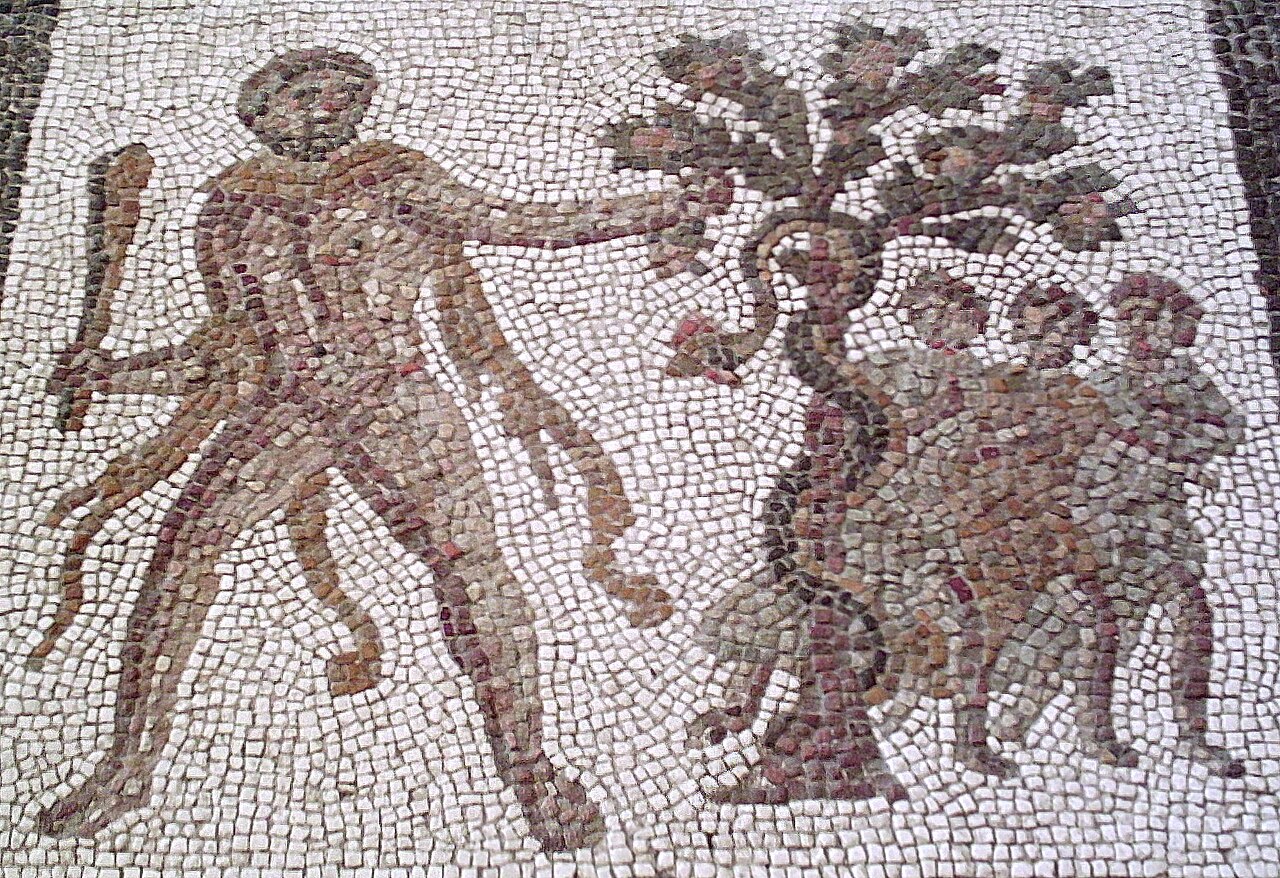
The eleventh labour of Heracles was the obtaining of the golden apples from the Garden of the Hesperides. These sacred fruits belonged to Hera and grew in a hidden garden located near the distant western edge of the world.
The Golden Apples of the Hesperides
The apples were guarded by the Hesperides, mysterious nymphs associated with evening and sunset, and by Ladon, an enormous serpent or dragon that never slept.
King Eurystheus ordered Heracles to find the secret garden, take several of the apples and bring them back to Mycenae.
The task was far more difficult than it first appeared. Heracles was not told where the garden was located, how to enter it or how to overcome its divine guardians.
The apples belonged to Hera, the goddess who had persecuted Heracles throughout his life. Taking them risked angering one of the most powerful deities on Olympus.
Heracles therefore had to travel through distant lands, seek information from gods and supernatural beings, confront several enemies and finally persuade the Titan Atlas to help him.
The eleventh labour tested intelligence, endurance, negotiation and the ability to escape a burden almost too great for any living being.
Heracles and the Labours
Heracles was the son of Zeus, king of the gods, and Alcmene, a mortal woman descended from the hero Perseus.
Hera, the wife of Zeus, hated Heracles because he was born from one of her husband’s relationships with a mortal.
She attempted to destroy him from infancy and later caused him to suffer a terrible period of madness.
During this madness, Heracles killed members of his own family.
When his sanity returned, he was overwhelmed by guilt, grief and horror.
He travelled to the Oracle of Apollo at Delphi and asked how he could be purified.
The oracle commanded him to serve King Eurystheus of Tiryns and Mycenae.
Eurystheus assigned Heracles a series of dangerous and humiliating tasks that became known as the Labours of Heracles.
Why There Were Twelve Labours
Heracles had originally been ordered to complete ten labours.
Eurystheus refused to count the destruction of the Lernaean Hydra because Heracles had received help from his nephew Iolaus.
The king also rejected the cleaning of the Augean Stables because Heracles had arranged to receive payment from King Augeas.
Two additional tasks were therefore added.
The first of these additional tasks became the journey for the golden apples of the Hesperides.
The second would require Heracles to descend into the Underworld and capture Cerberus.
The First Ten Labours
Before seeking the golden apples, Heracles had already completed ten extraordinary tasks.
He had killed the invulnerable Nemean Lion and taken its skin as armour.
He had destroyed the many-headed Lernaean Hydra with the assistance of Iolaus.
He had captured the sacred Ceryneian Hind alive after pursuing it for an entire year.
He had captured the Erymanthian Boar and carried it back to Eurystheus.
He had cleaned the Augean Stables in one day by redirecting rivers through them.
He had driven away the dangerous Stymphalian Birds with a bronze rattle given to him by Athena.
He had captured the Cretan Bull alive.
He had taken the man-eating Mares of Diomedes from their cruel Thracian owner.
He had obtained the belt of Hippolyta, queen of the Amazons.
He had travelled to the western edge of the world and captured the red cattle of Geryon.
The eleventh labour would take Heracles once again into the mysterious lands of the far west.
The Command of Eurystheus
Eurystheus ordered Heracles to bring back several golden apples from the Garden of the Hesperides.
The king may have believed that the location of the garden was impossible to discover.
Even if Heracles found it, the apples were divine property protected by supernatural guardians.
The task therefore involved danger from the journey, the guardians and the possible anger of Hera.
Unlike cattle or captured animals, the apples could be carried easily once obtained.
The true challenge was discovering where they were hidden and gaining possession of them.
The Golden Apples
The golden apples were sacred fruits of immortality, divine beauty or extraordinary power.
Ancient sources did not always explain exactly what would happen if a mortal ate one.
Their golden appearance marked them as objects belonging to the gods rather than ordinary food.
They were treasures that could not be grown, bought or safely taken by human beings.
The apples were sometimes imagined as shining like sunlight among the leaves of a divine tree.
The Wedding of Zeus and Hera
According to one tradition, the golden apples were presented to Hera as a wedding gift when she married Zeus.
Gaia, the ancient goddess of the earth, caused the tree to grow and offered it to the queen of the gods.
Hera valued the gift and planted it within a secret garden.
Because the apples were connected with her marriage and royal authority, their theft would be a serious offence.
Hera’s Sacred Garden
The garden was a place of divine beauty and abundance.
Its trees produced supernatural fruit, and its landscape remained separated from the ordinary world of human farming.
The garden was often placed in the far west, near the region of sunset and the river Oceanus.
Other traditions located it in Libya, North Africa or near Mount Atlas.
The changing location increased the mystery surrounding the labour.
The Hesperides
The Hesperides were nymphs associated with evening, sunset and the western sky.
Their name was connected with the Greek word for evening.
They were sometimes described as daughters of Atlas and the evening star Hesperus.
Other traditions named Nyx, the goddess of night, or different divine parents.
They lived within or near the sacred garden and cared for the tree bearing the golden apples.
The Names of the Hesperides
Ancient writers gave different names and numbers for the Hesperides.
They were commonly imagined as three nymphs, although some traditions described four or more.
Names associated with them included Aegle, Erytheia, Hesperia and Arethusa.
The variation reflects the flexible nature of Greek mythology.
Aegle
Aegle was one of the most frequently named Hesperides.
Her name was associated with brightness, radiance or sunlight.
This meaning suited a nymph who guarded shining golden fruit near the place of sunset.
Erytheia
Erytheia was another Hesperid whose name was associated with redness.
The same name appeared in the tenth labour as the island where Geryon kept his red cattle.
Both uses connected the far west with the red glow of the setting sun.
Hesperia
Hesperia was directly associated with the evening or western lands.
Her name sometimes became a poetic name for western regions such as Italy or Spain.
She represented the distant place where daylight ended and night began.
Arethusa
Arethusa was sometimes included among the Hesperides, although the name also belonged to other nymphs in Greek mythology.
Her presence reflected the way similar names and figures could appear in several different local traditions.
The Duties of the Hesperides
The Hesperides cared for Hera’s garden and watched over the golden apple tree.
Some traditions suggested that they occasionally took fruit for themselves.
Hera therefore placed an additional guardian beside the tree.
This guardian was Ladon, the sleepless dragon.
Ladon
Ladon was a gigantic serpent or dragon coiled around the tree of the golden apples.
He was said to possess many heads, allowing him to watch in several directions at once.
Some writers described one hundred heads, while ancient artists often gave him only one or a few.
Ladon never slept, making it almost impossible for a thief to approach unnoticed.
The Family of Ladon
Different traditions gave Ladon different parents.
He was sometimes called a child of Typhon and Echidna, the monstrous pair who produced many enemies of Heracles.
Other sources described him as the offspring of the sea gods Phorcys and Ceto.
Some made him a child of Gaia.
Each ancestry connected him with ancient, powerful and dangerous forces.
Ladon and the Children of Typhon
If Ladon was a child of Typhon and Echidna, he belonged to the same family as the Nemean Lion, Lernaean Hydra, Orthrus and Cerberus.
Heracles had already defeated several members of this monstrous family.
The eleventh labour would continue his struggle against creatures connected with primordial chaos.
The Sleepless Guardian
Ladon’s inability or refusal to sleep made him an ideal guardian.
Ordinary guards might be distracted, bribed or approached during the night.
Ladon remained constantly alert.
His many heads and serpent body allowed him to surround the sacred tree.
Anyone reaching for an apple risked being bitten or crushed.
The Secret Location
Eurystheus did not tell Heracles where the garden could be found.
The hero first had to discover its location.
This made the eleventh labour different from earlier tasks involving known monsters and places.
Heracles could not begin with combat because he did not know which direction to travel.
The first stage of the labour was a search for knowledge.
Heracles Begins His Search
Heracles travelled through Greece and beyond, asking gods, nymphs and travellers about the garden.
Most beings either did not know its location or refused to reveal it.
The garden existed at the edge of divine geography and was hidden from ordinary mortals.
Heracles needed to find someone possessing secret knowledge of the western world.
The River Nymphs
Heracles encountered nymphs associated with a river, sometimes identified with the Eridanus.
They advised him to seek Nereus, the Old Man of the Sea.
Nereus possessed knowledge of distant places and hidden events.
He knew the location of the Hesperides but would not give the information willingly.
Nereus
Nereus was an ancient sea god known for wisdom, prophecy and truthfulness.
He was the father of the Nereids, the sea nymphs who included Thetis and Amphitrite.
Nereus was generally peaceful, but he possessed the power to change his shape.
Anyone seeking knowledge from him had to hold him securely while he transformed.
Heracles Finds Nereus
Heracles approached Nereus while the sea god rested or emerged from the water.
He seized him before he could escape.
Nereus immediately began changing form.
He became dangerous animals, water, fire and other frightening shapes.
Heracles refused to release him.
The Shape-Changing Struggle
Nereus may have transformed into a lion, serpent, bull or other creature.
Each form attempted to frighten, burn, crush or slip away from Heracles.
The hero tightened his grip and endured every transformation.
The struggle resembled the later myth of Menelaus holding the shape-changing sea god Proteus.
Persistence rather than violence brought success.
Nereus Reveals the Way
When Nereus realised that Heracles would not release him, he returned to his ordinary form.
He revealed the route towards the Garden of the Hesperides.
Some traditions also told Heracles that he should seek help from Atlas rather than attempting to take the apples himself.
Heracles now possessed the knowledge needed to continue the labour.
Knowledge as a Prize
The encounter with Nereus demonstrates that information can be as valuable as physical treasure.
Heracles cannot reach the apples until he learns where they are.
His strength is used not to destroy the sea god but to hold him long enough to receive knowledge.
The Journey Continues
Heracles travelled through North Africa and other distant regions on his way towards the western garden.
Ancient storytellers connected several adventures with this journey.
The exact order differed between sources.
These episodes allowed the eleventh labour to become one of the longest and most eventful adventures of Heracles.
Antaeus
One of the most famous opponents encountered during the journey was Antaeus.
Antaeus was a giant and the son of Poseidon and Gaia, the earth goddess.
He lived in Libya and challenged travellers to wrestling matches.
After killing them, he used their remains or possessions to honour his father.
No ordinary opponent could defeat him because contact with the earth renewed his strength.
The Strength of Antaeus
Whenever Antaeus touched the ground, Gaia restored his energy.
A wrestler might throw him down repeatedly, but each fall made him stronger.
Heracles initially struggled to understand why the giant could not be exhausted.
He eventually recognised that the earth itself was the source of Antaeus’ power.
Heracles Lifts Antaeus
Heracles changed his method and lifted Antaeus from the ground.
He held the giant in the air, separating him from his mother Gaia.
Without contact with the earth, Antaeus could no longer renew his strength.
Heracles squeezed him until he died.
The Meaning of Antaeus
The defeat of Antaeus demonstrates the importance of understanding an opponent’s source of power.
Throwing the giant to the ground only strengthened him.
Heracles succeeded when he removed the connection that made the giant invincible.
The episode repeats the lesson of the Hydra, whose heads multiplied when attacked incorrectly.
Busiris
Another tradition placed Heracles in Egypt during the journey.
There he encountered King Busiris, a cruel ruler who sacrificed foreigners to Zeus.
Busiris had been told that human sacrifice would end a period of famine.
He therefore ordered strangers entering his kingdom to be seized and killed.
Heracles Is Captured
The servants of Busiris captured Heracles and prepared him for sacrifice.
They bound him and led him towards an altar.
Heracles appeared to allow the ceremony to continue until the correct moment.
When the attendants attempted to kill him, he broke his bonds.
The Death of Busiris
Heracles killed Busiris, the king’s son and the priests involved in the sacrifices.
The ruler who murdered foreign guests became a victim at his own altar.
The episode resembles the punishment of Diomedes, who was fed to the horses he had used to kill strangers.
Both stories defend the sacred importance of hospitality.
Different Traditions About Busiris
The story of Busiris was not included in every account of the eleventh labour.
Some ancient writers treated it as a separate adventure in the life of Heracles.
Its association with the journey reflects the flexible way myths were combined.
Emathion
Heracles was also said to encounter Emathion, a king associated with Arabia or Ethiopia.
Emathion attacked the travelling hero and was killed.
The details of the encounter varied and were less fully preserved than those involving Antaeus or Busiris.
The episode demonstrated the dangers of crossing distant kingdoms.
The Caucasus
Some versions sent Heracles far north and east before he reached the garden.
He travelled to the Caucasus Mountains, where the Titan Prometheus remained chained to a rock.
This route appears geographically indirect, but mythical geography did not always follow realistic maps.
The encounter with Prometheus became one of the most important side adventures of the labour.
Prometheus
Prometheus was a Titan who had supported humanity.
He stole fire from the gods and gave it to mortals.
Zeus punished him by chaining him to a mountain.
Each day, a great eagle arrived and ate his liver.
Because Prometheus was immortal, the organ grew back during the night, allowing the torment to continue endlessly.
The Eagle of Zeus
The eagle was an enormous supernatural bird associated with Zeus.
It attacked Prometheus every day and carried out the king of the gods’ punishment.
The repeated suffering had continued for many years before the arrival of Heracles.
Heracles Frees Prometheus
Heracles shot the eagle with an arrow and killed it.
He then broke or removed the chains holding Prometheus.
Zeus allowed the release because Heracles was his son and because certain conditions surrounding the punishment had been satisfied.
Prometheus was finally freed from his endless torment.
The Ring of Prometheus
In one later tradition, Prometheus continued wearing a ring containing a piece of the rock to which he had been chained.
This allowed the punishment of Zeus to remain symbolically fulfilled.
The story was sometimes used to explain the human custom of wearing rings set with stones.
Prometheus Gives Advice
Prometheus thanked Heracles and advised him about the golden apples.
He warned the hero not to enter the garden and take the apples directly.
Instead, Heracles should persuade Atlas to collect them.
Atlas was connected with the Hesperides and could enter the garden more safely than an ordinary mortal.
Why Atlas Was Needed
Atlas was the father or close relative of the Hesperides in several traditions.
He knew the garden and its guardians.
Because of his divine nature, he could approach the sacred tree more safely than Heracles.
Prometheus understood that intelligence and delegation would be more effective than direct attack.
Atlas
Atlas was a Titan who had fought against Zeus and the Olympian gods during the war known as the Titanomachy.
After the Titans were defeated, Atlas received a unique punishment.
He was forced to hold the heavens apart from the earth.
He stood at the western edge of the world supporting the weight of the sky.
Atlas and the Heavens
Atlas is often shown in later art carrying the globe of the earth.
In the original Greek tradition, he carried the heavens or celestial sphere rather than the planet.
His task prevented the sky god Uranus and the earth goddess Gaia from coming together again.
The burden was permanent and exhausting.
The Atlas Mountains
The mountain range in North Africa became associated with Atlas.
Ancient geography imagined the Titan standing in the far west near the mountains bearing his name.
The range appeared to support the sky when viewed from a distance.
Mythology transformed this visual impression into the punishment of a Titan.
Heracles Reaches Atlas
Heracles finally reached the place where Atlas supported the heavens.
He explained the command of Eurystheus and asked the Titan to retrieve the golden apples.
Atlas could not leave while carrying the sky.
Someone else had to take the burden temporarily.
The Agreement with Atlas
Heracles offered to hold the heavens while Atlas entered the garden.
The Titan agreed.
Atlas may have been eager to escape the burden he had carried for countless years.
The plan allowed him to leave his position for the first time since receiving his punishment.
Heracles Takes the Sky
Atlas carefully transferred the weight of the heavens onto the shoulders of Heracles.
The hero stood beneath the vast celestial structure and supported it with his strength.
No ordinary mortal could have survived the weight.
Heracles experienced directly the punishment that Atlas had endured through the ages.
The Greatest Burden
Holding the heavens may have been the greatest physical test faced by Heracles.
The Nemean Lion, Cretan Bull and Geryon were powerful opponents, but they could be defeated.
The sky could not be killed, exhausted or thrown aside.
Heracles had to remain standing and maintain the separation between heaven and earth.
The Pain of Atlas
By carrying the heavens, Heracles understood the suffering of Atlas.
The Titan’s punishment was not one dramatic act of pain but an endless burden without rest.
Even the extraordinary strength of Heracles was tested by holding it for a short time.
Atlas Enters the Garden
Freed from the sky, Atlas travelled to the Garden of the Hesperides.
Because the Hesperides were his daughters or relatives in many traditions, he could approach them directly.
He obtained three golden apples from the sacred tree.
Some accounts suggested that he killed or avoided Ladon, while others left the guardian untouched.
Atlas Returns
Atlas returned carrying the golden apples.
Heracles expected him to take back the heavens and hand over the fruit.
However, Atlas had experienced freedom and no longer wished to resume his punishment.
He proposed taking the apples to Eurystheus himself.
Atlas Attempts to Escape
Atlas told Heracles that he would deliver the apples while the hero continued holding the sky.
The offer was presented as helpful, but its true purpose was clear.
If Heracles agreed, Atlas could walk away and leave him trapped beneath the heavens forever.
Heracles could not simply drop the sky without risking cosmic disaster.
Heracles Pretends to Agree
Heracles understood that Atlas intended to escape.
He did not openly accuse or threaten the Titan.
Instead, he pretended to accept the arrangement.
He asked Atlas to hold the heavens for one brief moment while he adjusted his lion skin or placed a cushion beneath his shoulders.
Atlas Takes Back the Sky
Atlas believed that Heracles had accepted the permanent exchange.
He placed the golden apples on the ground and took the heavens back onto his shoulders.
As soon as Atlas held the burden securely, Heracles picked up the apples.
He thanked the Titan and departed.
Heracles Outwits Atlas
The victory over Atlas required intelligence rather than strength.
Heracles could hold the heavens, but he could not force Atlas to cooperate while carrying them.
He escaped through a simple deception that used Atlas’ own plan against him.
The Titan attempted to trap Heracles permanently and instead resumed his ancient punishment.
The Alternative Version
Ancient mythology preserved another major version of the eleventh labour.
In this account, Heracles did not ask Atlas to retrieve the apples.
He entered the Garden of the Hesperides himself and confronted Ladon.
Heracles shot the dragon with a poisoned arrow or killed it with another weapon.
He then took the golden apples directly from the tree.
The Death of Ladon
If Heracles killed Ladon, the dragon became another victim of the arrows poisoned with Hydra venom.
The sleepless guardian could not survive the deadly wound.
Its body remained coiled around or beside the tree.
The Hesperides mourned the creature that had protected their garden.
Ladon Among the Stars
Hera honoured Ladon by placing him among the stars.
He became associated with the constellation Draco.
The long twisting constellation circles part of the northern sky like a serpent guarding a celestial treasure.
The transformation preserved the dragon’s role as a divine guardian.
Atlas and Ladon Together
Some retellings combine elements from both main traditions.
Heracles may kill Ladon before Atlas enters the garden, or Atlas may retrieve the apples after the guardian is defeated.
Greek mythology did not require every storyteller to follow one fixed version.
The central requirement remained that Heracles obtained the sacred apples and returned with them.
The Return Journey
Heracles left the western lands carrying the golden apples.
The fruit was light compared with the cattle of Geryon, but it was far more sacred and dangerous to possess.
He had to protect the apples from thieves, rulers and supernatural beings during the return.
Most accounts focus less upon the journey home than upon the encounter with Atlas.
Heracles Returns to Mycenae
Heracles eventually reached the court of Eurystheus and presented the golden apples.
The king had expected the hero to fail in the distant west.
The sight of Hera’s sacred fruit proved that the eleventh labour had been completed.
Eurystheus accepted the apples but could not keep them permanently.
The Apples Belonged to the Gods
The golden apples were divine property and could not remain within a mortal palace.
They had been taken only because the labour required their temporary removal.
Keeping or eating them might have brought divine punishment.
The apples therefore had to be returned to their sacred garden.
Athena Takes the Apples
Athena took the golden apples from Eurystheus or Heracles.
She returned them to the Garden of the Hesperides.
This act restored the proper divine order.
Heracles had proved that he could obtain the apples, but the fruit ultimately remained where it belonged.
The Completion of the Eleventh Labour
Heracles fulfilled the command of Eurystheus.
He discovered the location of the hidden garden, overcame many dangers and returned with the sacred fruit.
Whether he used Atlas or killed Ladon himself, he accomplished a task beyond the abilities of ordinary mortals.
Only one labour remained.
The Meaning of the Eleventh Labour
The eleventh labour is a search for something hidden rather than a journey towards a known enemy.
Heracles must gather information before he can act.
The task therefore gives knowledge, guidance and negotiation greater importance than direct battle.
The Apples as Symbols of Immortality
Golden fruit is frequently associated with eternal life and divine power.
The apples grew in a garden belonging to the gods and remained protected from ordinary mortals.
Heracles’ ability to obtain them foreshadowed his own eventual immortality.
After his death, he would rise to Olympus and join the gods.
The Apples as Symbols of Divine Property
The apples cannot be permanently owned by Eurystheus.
They return to Hera’s garden after the labour is recognised.
The story distinguishes temporary possession from rightful ownership.
A mortal king may display the fruit, but he cannot make divine treasure his own.
The Apples as Symbols of Marriage
Because the tree was a wedding gift to Hera, the apples were connected with marriage and union.
Golden apples later appeared in other myths involving marriage, desire and rivalry.
Their beauty made them objects capable of inspiring competition among gods and mortals.
The Apple of Discord
Another famous golden apple appeared at the wedding of Peleus and Thetis.
Eris, goddess of strife, threw an apple among the guests marked for the most beautiful goddess.
Hera, Athena and Aphrodite each claimed it.
The dispute led to the Judgement of Paris and eventually the Trojan War.
This apple was not necessarily one of the Hesperides’ fruits, but later traditions sometimes connected the stories.
Atalanta and the Golden Apples
Golden apples also appeared in the story of Atalanta.
She agreed to marry only a man who could defeat her in a footrace.
Hippomenes received golden apples from Aphrodite and dropped them during the race.
Atalanta stopped to collect them, allowing him to win.
Some traditions identified these fruits with apples from the Garden of the Hesperides.
Golden Fruit in Mythology
Fruit made from gold combines nourishment with treasure.
Ordinary fruit is consumed and disappears, while gold appears permanent and incorruptible.
The golden apples therefore unite life, beauty, wealth and immortality within one image.
The Garden as a Symbol
The Garden of the Hesperides represents a perfect place beyond the ordinary world.
It contains beauty, abundance and divine life.
It is protected because mortal access to perfection must remain limited.
Heracles enters or reaches this hidden place only as part of a divinely authorised labour.
The Garden and Paradise
Later readers have compared the Garden of the Hesperides with other legendary gardens and paradises.
Such places often contain sacred trees, guarded fruit and boundaries between mortal and divine existence.
The similarities do not mean that every tradition has the same origin.
They reveal a widespread human fascination with hidden places of perfect abundance.
The Far West as a Symbol
The garden lies near the sunset at the edge of the world.
The west was associated with the end of the day, the dead and mysterious islands of immortality.
Heracles’ journey westward symbolically carries him towards the boundary between mortal life and divine existence.
Evening and the Hesperides
The Hesperides embody the beauty of evening light.
Their golden apples resemble the glowing sun as it approaches the horizon.
The red and gold colours of sunset shaped the mythology of the western garden.
Ladon as a Symbol of Guardianship
Ladon exists to prevent the wrong person from taking sacred treasure.
He is dangerous, but his role is protective rather than purely destructive.
Like Geryon defending his cattle, Ladon can be viewed as an opponent carrying out an assigned duty.
His death is therefore more morally complicated than the destruction of a creature attacking innocent people.
The Hesperides as Guardians
The Hesperides care for the garden rather than threaten the wider world.
Heracles enters their sacred space because Eurystheus commands him.
The labour again places the hero in conflict with beings who are not necessarily evil.
Atlas as a Symbol of Burden
Atlas carries the heavens without rest.
His name has become associated with the idea of bearing an enormous weight.
The image represents duties that seem permanent and impossible to escape.
The Burden of Heracles
Heracles also carries a symbolic burden throughout the labours.
He serves Eurystheus because of guilt over the deaths caused during his madness.
When he takes the heavens from Atlas, his internal burden becomes a visible physical weight.
The scene unites strength, punishment and the desire for freedom.
Atlas and Heracles Compared
Atlas is punished for rebelling against Zeus.
Heracles serves Eurystheus as part of his purification.
Both figures endure burdens imposed by higher authority.
Atlas attempts to escape permanently, while Heracles seeks only to complete his temporary duty.
The Trick Played on Atlas
Heracles escapes by pretending to accept Atlas’ proposal.
The trick may appear dishonest, but Atlas had first attempted to abandon the burden upon him.
Heracles uses deception defensively to restore the original agreement.
The scene celebrates practical intelligence over physical confrontation.
Strength and Intelligence
Heracles possesses enough strength to carry the sky.
Strength alone cannot free him once Atlas refuses to take it back.
He needs intelligence to persuade the Titan to resume the burden.
The labour demonstrates that even the greatest physical power may create a trap without careful judgement.
The Importance of Delegation
Prometheus advises Heracles not to collect the apples personally.
Atlas is better suited to enter the garden because of his relationship with the Hesperides.
Heracles succeeds by allowing another person to perform the part of the task they are best able to complete.
The labour shows that leadership can involve choosing the correct helper.
The Importance of Advice
Heracles receives guidance from river nymphs, Nereus and Prometheus.
Without their knowledge, he might never locate the garden or develop the plan involving Atlas.
Accepting advice becomes essential to completing the labour.
The Importance of Asking Questions
The search begins because Heracles does not know where to go.
He must admit his lack of knowledge and seek those who understand the hidden world.
The labour presents questioning as a form of strength rather than weakness.
The Importance of Persistence
Nereus changes form repeatedly in an attempt to escape.
Heracles continues holding him until the information is revealed.
The journey itself also requires persistence across enormous distances and repeated dangers.
The Importance of Understanding Power
Antaeus cannot be defeated while touching the earth.
Atlas cannot be forced to take back the heavens while Heracles remains beneath them.
Each problem requires an understanding of where power comes from and how it operates.
The Importance of Timing
Heracles asks Atlas to take the sky for only a moment.
He must move as soon as the Titan accepts.
Waiting too long or revealing the plan too early would leave him trapped.
Correct timing turns a simple request into a successful escape.
The Importance of Self-Control
Heracles cannot panic while carrying the heavens.
He must think clearly despite extraordinary pain and pressure.
Self-control allows him to create the plan that frees him.
The Importance of Trust
Heracles trusts Prometheus’ advice and initially trusts Atlas to fulfil the agreement.
Atlas attempts to betray that trust by refusing to resume his burden.
The labour demonstrates both the necessity and danger of relying upon others.
The Importance of Agreements
Heracles and Atlas agree to exchange the burden temporarily.
Atlas attempts to change the terms after receiving freedom.
Heracles’ trick forces the original arrangement to be restored.
The episode continues the recurring theme of broken promises in the myths of Heracles.
Atlas and Augeas
Augeas promises payment and refuses after Heracles completes the work.
Atlas agrees to take back the heavens but attempts to leave Heracles beneath them.
Both figures accept help and then try to avoid their obligations.
Heracles responds to Augeas through later warfare and to Atlas through immediate cleverness.
Atlas and Laomedon
Laomedon repeatedly refuses promised payment after receiving assistance.
Atlas also attempts to benefit from Heracles’ help without completing his part of the agreement.
The stories warn that broken agreements destroy trust and invite punishment.
Heracles and Prometheus
Both Heracles and Prometheus are closely connected with humanity.
Prometheus gives mortals fire and knowledge.
Heracles protects communities from monsters and unjust rulers.
By freeing Prometheus, Heracles assists a benefactor of humankind.
Heracles and Zeus
Heracles is the son of Zeus, while Prometheus is punished by Zeus.
The release therefore could have created conflict between father and son.
Greek tradition resolved this tension by suggesting that Zeus permitted or accepted the rescue.
The event became another step towards Heracles’ eventual place among the gods.
Heracles and Hera
The apples belong to Hera, the goddess who has persecuted Heracles.
The labour forces him to enter her sacred garden and temporarily take her treasure.
Hera does not permanently lose the apples because Athena returns them.
The event demonstrates that Heracles can overcome dangers associated with Hera without destroying the divine order she represents.
Hera and the Golden Apples
The apples symbolise Hera’s marriage, queenship and divine status.
Their temporary removal may appear like another challenge to her authority.
Their return ensures that the labour remains a test rather than permanent theft.
Athena’s Role
Athena frequently supports Heracles during the labours.
At the end of the eleventh labour, she restores the apples to the garden.
Her action confirms that the proper purpose of the task was proof of achievement, not mortal ownership of divine treasure.
The First Eleven Labours Compared
The Nemean Lion tests direct strength.
The Lernaean Hydra tests teamwork and adaptation.
The Ceryneian Hind tests patience and restraint.
The Erymanthian Boar tests hunting skill and the use of terrain.
The Augean Stables test engineering and creative thought.
The Stymphalian Birds test archery and specialised tools.
The Cretan Bull tests wrestling and controlled force.
The Mares of Diomedes test leadership and the defeat of cruelty.
The belt of Hippolyta tests diplomacy, trust and judgement.
The cattle of Geryon test endurance, navigation and responsibility.
The golden apples test the search for knowledge, negotiation, delegation and intelligence under an overwhelming burden.
The Apples and the Cattle of Geryon
Both the tenth and eleventh labours send Heracles towards the far west.
The cattle are living wealth protected by a monstrous ruler and guardians.
The apples are divine treasure protected by nymphs and a dragon.
The tenth labour requires Heracles to carry a herd eastward.
The eleventh requires him to bring back only a few small fruits whose sacred importance is greater than their size.
Orthrus and Ladon
Orthrus guards the cattle of Geryon, while Ladon guards the golden apples.
Both are supernatural creatures placed beside valuable property.
Heracles kills Orthrus directly.
Depending upon the version, he either kills Ladon or avoids fighting him through the help of Atlas.
The Hydra and Ladon
The Hydra and Ladon are both serpent-like monsters with multiple heads in some traditions.
Both may be children of Typhon and Echidna.
The Hydra threatens the region of Lerna, while Ladon protects a sacred garden.
The difference shows that monstrous appearance does not always indicate the same moral role.
The Lion and Antaeus
Heracles defeats both the Nemean Lion and Antaeus through close physical struggle.
He strangles the lion because its hide cannot be pierced.
He crushes Antaeus while holding him above the earth.
Each victory requires the hero to discover a special weakness.
The Hydra and Antaeus
Cutting the Hydra’s heads causes more to grow.
Throwing Antaeus to the ground restores his strength.
Both opponents become stronger when attacked through ordinary methods.
Heracles succeeds only after changing his strategy.
The Stables and Atlas
The Augean Stables cannot be cleaned through direct manual effort.
The burden of the heavens cannot be escaped through direct physical resistance.
In both situations, Heracles solves the problem through intelligence rather than greater force.
The Belt and the Apples
The belt of Hippolyta and the golden apples are both sacred objects associated with powerful goddesses or divine figures.
The belt is a symbol of military queenship.
The apples represent divine beauty, marriage and immortality.
Both labours involve obtaining an object rather than killing a monster as the central command.
The Eleventh Labour as a Quest
The search for the golden apples resembles a quest more than a hunt.
The goal is hidden, the road is uncertain and several guides are needed.
The hero must gather knowledge and pass through a series of episodes before reaching the final treasure.
This structure influenced many later stories of distant and sacred quests.
The Eleventh Labour as a Journey of Wisdom
Heracles begins without knowing where the apples are located.
By the end, he has learned from nymphs, sea gods, Titans and personal experience.
The labour expands his wisdom as much as his fame.
The Eleventh Labour as a Test of Humility
Heracles must accept that he cannot locate or obtain the apples through strength alone.
He seeks advice and asks Atlas for help.
The willingness to depend upon knowledge possessed by others demonstrates humility.
The Eleventh Labour as a Test of Leadership
Heracles identifies Atlas as the person best suited to retrieve the apples.
He accepts the supporting role of carrying the heavens while another performs the collection.
Leadership does not always require performing every visible action personally.
The Eleventh Labour as a Test of Endurance
The journey carries Heracles across many distant lands.
He fights giants and kings, frees Prometheus and reaches the western boundary of the world.
He then supports the heavens while waiting for Atlas.
The labour combines long travel with one of the greatest physical burdens imaginable.
The Eleventh Labour as a Test of Judgement
Heracles must decide whom to trust and when to use force.
He wrestles Nereus for information, kills Antaeus and Busiris, frees Prometheus and negotiates with Atlas.
Different people and problems require different responses.
The Eleventh Labour as a Test of Cleverness
The final obstacle is not Ladon, distance or the weight of the sky.
It is Atlas’ refusal to take back his burden.
Heracles wins by making the Titan believe that he has accepted defeat.
Cleverness completes what strength began.
The Eleventh Labour as a Test of Cosmic Strength
By holding the heavens, Heracles briefly performs the work of a Titan.
The scene places him between humanity and divinity.
He remains mortal, yet he possesses strength capable of supporting the cosmic order.
Foreshadowing Immortality
The golden apples, the rescue of Prometheus and the carrying of the heavens all bring Heracles closer to the divine world.
He is no longer confronting only earthly animals and kings.
He interacts directly with ancient Titans and sacred objects of the gods.
The labour prepares the audience for his eventual transformation into an immortal.
The Approach of the Final Labour
Only one task remained after the golden apples were returned.
Eurystheus would order Heracles to descend into the Underworld and bring back Cerberus.
The twelfth labour would require him to cross the boundary of death and return alive.
The journey for the apples prepared him by taking him to the limits of geography and into contact with immortal beings.
The Eleventh Labour in Ancient Art
Ancient artists represented the labour in several different ways.
Some showed Heracles holding the heavens while Atlas returned with the apples.
Others showed Heracles standing beside the apple tree and Ladon.
The variation reflected the different literary traditions of the myth.
Heracles Carrying the Heavens
Scenes of Heracles beneath the heavens emphasised physical strain.
The hero bent beneath the weight while Atlas stood nearby holding the apples.
The image allowed artists to represent an invisible cosmic burden through posture and movement.
Atlas in Ancient Art
Atlas was often shown as a powerful bearded figure supporting a sphere or the curved heavens.
Later artists increasingly represented him carrying a globe.
This image eventually produced the modern use of the word atlas for a collection of maps.
Why a Book of Maps Is Called an Atlas
The modern geographical use of the word atlas developed from Renaissance map collections decorated with figures associated with Atlas.
The Titan became a symbol of the world and the heavens.
His name was gradually applied to books containing maps.
Ladon in Ancient Art
Ladon was usually shown as a long serpent coiled around the trunk of the apple tree.
The Hesperides stood nearby gathering or watching the fruit.
Heracles could be shown approaching with a club or bow.
The Hesperides in Ancient Art
The Hesperides appeared as graceful young women within a peaceful garden.
Their calm beauty contrasted with the danger represented by Ladon and Heracles’ weapons.
Their presence made the scene different from the violent landscapes of many earlier labours.
The Temple of Zeus at Olympia
The labours of Heracles were represented upon the metopes of the Temple of Zeus at Olympia.
The golden apples were included within this sculpted sequence.
One famous scene showed Atlas bringing the apples while Heracles carried the heavens and Athena helped support the burden.
The sculpture emphasised cooperation between the hero, Titan and goddess.
Athena Supporting Heracles
In the Olympian sculpture, Athena appears to assist Heracles beneath the sky.
Her support may be symbolic rather than physically necessary.
It shows that wisdom and divine favour stand beside the hero during his greatest burden.
The Labour in Greek Literature
Greek poets and mythographers preserved several versions of the eleventh labour.
Some focused upon Atlas and the exchange of the heavens.
Others described Heracles killing Ladon and taking the apples directly.
Side adventures involving Nereus, Antaeus, Busiris and Prometheus varied between authors.
The Labour in Roman Tradition
The Romans called Heracles Hercules and continued telling the story of the golden apples.
Roman artists represented Hercules carrying the heavens or holding the apples after victory.
The labour suited the Roman image of Hercules as a hero capable of crossing the world and overcoming impossible burdens.
The Labour in Later Literature
Medieval and Renaissance writers interpreted the golden apples symbolically.
They could represent wisdom, virtue, immortality or rewards gained through hardship.
Atlas could represent the burden of worldly responsibility.
Heracles’ clever escape demonstrated the victory of intelligence over deceit.
The Labour in Modern Culture
The golden apples appear in modern novels, films, television programmes, comics and games inspired by Greek mythology.
The garden is often portrayed as a paradise filled with glowing fruit and guarded by an enormous dragon.
Atlas may appear as a giant carrying the earth rather than the ancient Greek heavens.
Modern retellings often combine the Atlas and Ladon versions into one adventure.
The Garden in Fantasy
The image of a hidden garden containing magical fruit has influenced many fantasy stories.
Such gardens are often protected by dragons, riddles or immortal guardians.
The hero must prove worthiness rather than simply enter and take the treasure.
Atlas in Modern Culture
Atlas remains a common symbol of strength, endurance and excessive responsibility.
Images of a figure carrying the world appear in art, architecture and political symbolism.
The phrase carrying the weight of the world reflects the ancient punishment of the Titan.
The Labour as a Lesson in Seeking Knowledge
Heracles cannot begin the task successfully until he finds someone who knows the route.
The story teaches that action without information may waste effort.
Learning where to go is the first real achievement of the labour.
The Labour as a Lesson in Using the Right Guide
Nereus knows the hidden geography of the world.
Prometheus understands the safest method for obtaining the apples.
Atlas knows the garden and its guardians.
Each guide provides a different part of the solution.
The Labour as a Lesson in Identifying the Source
Antaeus receives power from the earth.
Atlas seeks freedom from the heavens.
The garden is protected because the apples belong to Hera.
Understanding the source of each power allows Heracles to respond effectively.
The Labour as a Lesson in Temporary Burdens
Heracles agrees to carry the heavens only temporarily.
Temporary responsibilities can become permanent when agreements are ignored.
His experience with Atlas warns against accepting an enormous burden without a clear method of release.
The Labour as a Lesson in Boundaries
The Garden of the Hesperides lies beyond ordinary human access.
Its boundaries protect divine property and separate mortal life from immortality.
Heracles crosses the boundary but does not destroy it.
The apples are returned after the labour.
The Labour as a Lesson in Restoring Order
Heracles temporarily disrupts the garden by removing the apples.
Athena restores them once the command has been fulfilled.
The myth ends with divine order repaired rather than permanently damaged.
The Labour as a Lesson in Ownership
Eurystheus can demand that the apples be brought to him.
He cannot rightfully keep them.
Authority does not automatically create ownership over sacred objects.
The story distinguishes power to command from moral right to possess.
The Labour as a Lesson in Reward
Heracles receives no golden apple to keep.
His reward is the recognition that he completed the labour.
The true value lies in the journey, knowledge and achievement rather than permanent ownership of the treasure.
The Labour as a Lesson in Freedom
Atlas experiences freedom briefly and attempts to keep it by trapping Heracles.
His desire is understandable because his punishment is terrible.
However, he seeks freedom by transferring suffering unfairly to another person.
The story suggests that freedom gained through betrayal cannot create justice.
The Labour as a Lesson in Cosmic Order
The heavens must remain supported.
Neither Atlas nor Heracles can simply abandon the burden.
The scene reminds readers that some responsibilities exist because the wider world depends upon them.
The question is not whether the sky should be held but who has been assigned to hold it.
The Labour as a Lesson in Clever Escape
Heracles does not defeat Atlas in battle.
He creates a request so reasonable that Atlas accepts without suspicion.
The escape demonstrates the power of understanding another person’s expectations.
The Labour as a Lesson in Adaptability
Heracles wrestles Nereus, lifts Antaeus, breaks his bonds before Busiris, shoots the eagle of Prometheus and negotiates with Atlas.
No single method could solve every stage.
His adaptability remains one of the greatest sources of his success.
The Labour as a Lesson in Mercy
Heracles frees Prometheus even though the rescue is not the central command.
He uses his journey to end the suffering of another being.
This act presents him as more than a servant seeking a prize.
He becomes a liberator capable of compassion.
The Labour as a Lesson in Moral Complexity
Ladon guards property rather than attacking innocent people.
Atlas seeks freedom from a terrible punishment.
Prometheus has been condemned by Zeus but helped humanity.
The labour contains figures whose motives cannot be divided simply into good and evil.
The Legacy of the Golden Apples
The golden apples became enduring symbols of beauty, temptation, immortality and competition.
They appeared in stories involving Hera, Atalanta and the Judgement of Paris.
Their image continues to influence literature and art.
The Legacy of Atlas
Atlas became one of the most recognisable Titans in mythology.
His punishment created a lasting image of unbearable responsibility.
His name remains associated with mountains, maps and the bones supporting the human head.
The Atlas Bone
The first vertebra of the human neck is called the atlas.
It supports the skull in a way compared with the Titan supporting the heavens.
The name demonstrates the continuing influence of Greek mythology upon scientific language.
The Legacy of Antaeus
Antaeus remains a symbol of strength gained through connection with the earth.
Writers have used his story to represent people or nations drawing power from their homeland.
His defeat warns that separating an opponent from the source of strength may be more effective than attacking directly.
The Legacy of Prometheus
Prometheus remains a symbol of knowledge, rebellion and sacrifice for humanity.
His rescue by Heracles connects two of the greatest benefactors of humankind in Greek mythology.
One gives fire and knowledge, while the other frees the world from monsters and dangers.
The Legacy of the Eleventh Labour
The eleventh labour is remembered for its combination of exploration, cosmic strength and cleverness.
Heracles reaches a hidden paradise, frees a suffering Titan and briefly carries the heavens.
He obtains the apples not merely by fighting but by gathering advice and using another person’s abilities.
Conclusion
The eleventh labour of Heracles was the obtaining of the golden apples from the Garden of the Hesperides.
The apples had been given to Hera as a wedding gift and grew upon a sacred tree in a hidden western garden.
They were guarded by the Hesperides and by Ladon, a sleepless serpent or dragon.
King Eurystheus ordered Heracles to find the garden and bring back several of the apples.
The hero began without knowing where the garden was located.
River nymphs advised him to seek Nereus, the shape-changing Old Man of the Sea.
Heracles seized Nereus and held him through a series of transformations until the sea god revealed the route.
During the journey, Heracles confronted several dangers.
He defeated Antaeus by lifting him away from the earth that restored his strength.
In some traditions, he escaped sacrifice in Egypt and killed the cruel King Busiris.
He also travelled to the Caucasus and freed Prometheus by shooting the eagle that tortured him.
Prometheus advised Heracles to ask Atlas to collect the golden apples.
Atlas was a Titan condemned to hold the heavens upon his shoulders.
Heracles offered to carry the sky temporarily while Atlas entered the garden.
Atlas agreed, transferred the heavens to Heracles and returned with three golden apples.
After experiencing freedom, Atlas refused to take back his burden.
He offered to carry the apples to Eurystheus while Heracles remained beneath the sky.
Heracles pretended to agree and asked Atlas to hold the heavens for a moment while he adjusted the lion skin upon his shoulders.
Atlas took back the burden, believing the exchange would be brief.
Heracles immediately picked up the apples and departed.
Another ancient version claimed that Heracles entered the garden himself, killed Ladon and took the apples directly.
Hera then placed the dead dragon among the stars as the constellation Draco.
Heracles carried the apples to Eurystheus and proved that the eleventh labour had been completed.
Because the fruit belonged to the gods, it could not remain in the possession of a mortal king.
Athena returned the apples to the Garden of the Hesperides.
The eleventh labour demonstrates that knowledge and intelligence can be as important as physical strength.
Heracles needs guidance from Nereus and Prometheus before he can reach the goal.
He needs Atlas because the Titan can enter the garden more safely.
He needs cleverness to escape after Atlas attempts to leave him holding the heavens forever.
The labour also foreshadows the eventual immortality of Heracles.
He travels to a divine garden, handles sacred fruit, frees a Titan and briefly supports the cosmic order.
By the end of the adventure, he has moved far beyond the role of an ordinary human warrior.
Only one final labour remains.
Heracles must descend into the kingdom of the dead, confront the power of Hades and bring the three-headed Cerberus into the world of the living.