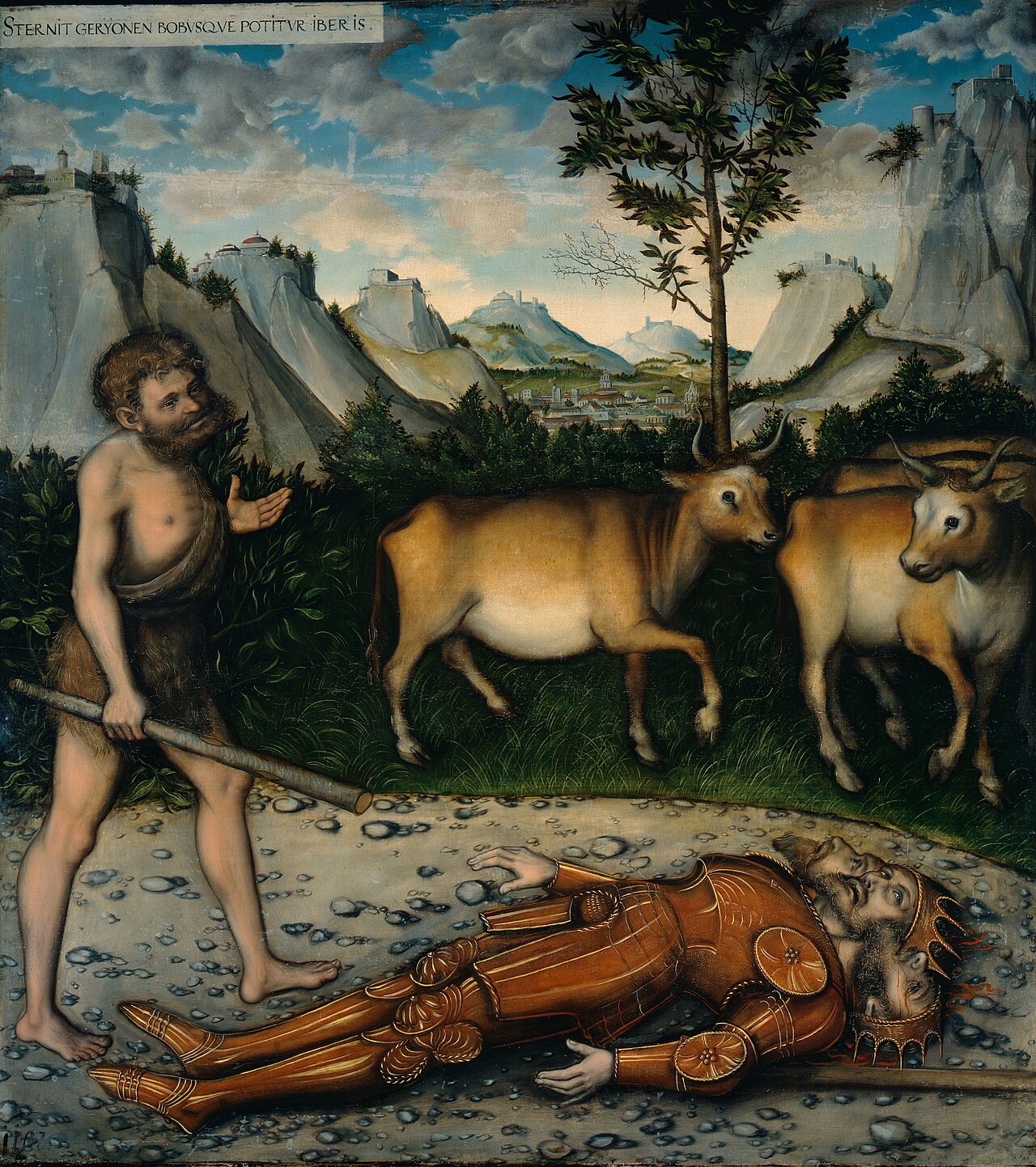
The tenth labour of Heracles was the capture of the cattle of Geryon, a powerful and monstrous ruler who lived upon the distant island of Erytheia at the western edge of the world.
The Cattle of Geryon
King Eurystheus ordered Heracles to travel far beyond Greece, seize the magnificent red cattle and bring them back alive to Mycenae.
This labour was one of the longest and most difficult journeys undertaken by Heracles. He had to cross unfamiliar lands, survive the burning heat of the sun, travel across the great Ocean and defeat several dangerous guardians.
The cattle were protected by Orthrus, a two-headed dog, and Eurytion, a powerful herdsman. Their owner, Geryon, was usually described as a giant with three bodies joined together.
After defeating the guardians and killing Geryon, Heracles still faced the enormous challenge of driving the cattle across vast distances towards Greece.
Hera interfered repeatedly, scattering the herd and making the journey more difficult.
The tenth labour therefore tested much more than physical strength. It required endurance, navigation, courage, patience and the ability to protect a herd through dangerous and unfamiliar territory.
Heracles and the Twelve Labours
Heracles was the son of Zeus, king of the gods, and Alcmene, a mortal woman descended from the hero Perseus.
Hera, the wife of Zeus, hated Heracles because he was born from one of her husband’s relationships with a mortal.
She persecuted him throughout his life and eventually caused him to fall into a terrible state of madness.
During this madness, Heracles killed members of his own family.
When his sanity returned, he was overwhelmed by grief and guilt.
Heracles travelled to the Oracle of Apollo at Delphi and asked how he might be purified.
The oracle ordered him to serve King Eurystheus of Tiryns and Mycenae.
Eurystheus assigned him a series of dangerous tasks that became known as the Labours of Heracles.
King Eurystheus
Eurystheus possessed royal authority over Heracles because Hera had interfered with the timing of their births.
Zeus had declared that the next descendant of Perseus to be born would rule over the others.
Hera delayed the birth of Heracles and caused Eurystheus to be born first.
Eurystheus therefore became king even though he was far weaker and less courageous than Heracles.
The king feared Heracles and hoped that one of the labours would destroy him.
As the hero continued returning successfully, Eurystheus sent him on journeys that became increasingly distant and dangerous.
The First Nine Labours
Before being sent after the cattle of Geryon, Heracles had completed nine great tasks.
He had killed the invulnerable Nemean Lion and taken its skin as armour.
He had destroyed the many-headed Lernaean Hydra with the help of his nephew Iolaus.
He had captured the sacred Ceryneian Hind alive after pursuing it for an entire year.
He had captured the Erymanthian Boar and carried it back to Eurystheus.
He had cleaned the Augean Stables in a single day by redirecting rivers through them.
He had defeated the Stymphalian Birds with a bronze rattle given to him by Athena.
He had captured the Cretan Bull alive.
He had taken the man-eating Mares of Diomedes from their cruel Thracian owner.
He had also obtained the belt of Hippolyta, queen of the Amazons.
The tenth labour would carry Heracles farther west than any previous task.
The Command of Eurystheus
Eurystheus ordered Heracles to bring back the cattle of Geryon.
The animals were famous for their beauty, strength and unusual red colour.
They belonged to a ruler who lived beyond the lands familiar to most Greeks.
Eurystheus may have believed that Heracles would become lost, die during the journey or be defeated by Geryon and his guardians.
The command required the cattle alive, meaning that Heracles had to protect them after seizing them.
Killing Geryon would not be enough. The herd had to survive the long return journey.
Geryon
Geryon was one of the strangest beings confronted by Heracles.
He was often described as a giant with three bodies joined at the waist.
Some traditions gave him three heads, six arms and six legs.
Others imagined three complete warriors connected together as one being.
This unusual form made Geryon appear capable of fighting several enemies at once.
He could carry multiple shields, throw several spears and attack from different directions.
The Family of Geryon
Geryon was usually described as the son of Chrysaor and Callirrhoe.
Chrysaor was born from the body of Medusa after Perseus cut off her head.
Callirrhoe was an Oceanid, one of the daughters of the sea gods Oceanus and Tethys.
Through this ancestry, Geryon was connected with both monstrous power and the ancient waters surrounding the world.
His lineage suited his home on a distant island beyond the ordinary boundaries of civilisation.
Chrysaor
Chrysaor was the brother of Pegasus, the famous winged horse.
Both emerged after Perseus killed Medusa.
Chrysaor was sometimes imagined as a warrior carrying a golden sword.
Although he played only a limited role in surviving myths, his son Geryon became one of the great opponents of Heracles.
Erytheia
Geryon lived upon the island of Erytheia.
The name was connected with redness and may have referred to the red light of the setting sun.
The island was placed in the far west, near the boundary where the sun appeared to sink into Ocean each evening.
Ancient writers associated Erytheia with different locations, including regions near modern southern Spain.
To Greek storytellers, it represented a distant land at the edge of the known world.
The Western Edge of the World
The Greeks imagined the inhabited world surrounded by the great river Oceanus.
The far west was a mysterious region associated with sunset, death, immortality and strange peoples.
Heracles had to travel beyond familiar cities and kingdoms into a landscape where geography became mixed with mythology.
The tenth labour therefore expanded his adventures from regional heroism into a journey across the boundaries of the world.
The Red Cattle
The cattle of Geryon were famous for their deep red colour.
They were healthy, valuable and carefully protected.
In the ancient world, cattle represented wealth, food, agricultural power and religious importance.
A large herd could support an entire royal household or community.
Taking the cattle therefore meant removing one of Geryon’s greatest sources of wealth and authority.
Cattle in Ancient Greece
Cattle were among the most valuable animals in ancient Mediterranean societies.
They provided meat, hides, milk and labour for ploughing.
Bulls and cows were also offered in important religious sacrifices.
Possession of large herds was a sign of status and prosperity.
The cattle of Geryon were therefore more than animals. They represented royal wealth and divine abundance.
Orthrus
The cattle were guarded by Orthrus, a monstrous two-headed dog.
Orthrus was usually described as the offspring of Typhon and Echidna.
This made him a brother of Cerberus, the three-headed guardian of the Underworld.
He was also connected with other monsters including the Lernaean Hydra.
Orthrus watched the herd and attacked anyone who approached without permission.
The Two Heads of Orthrus
Orthrus possessed two heads that could watch in different directions.
This made it difficult to approach him unnoticed.
One head could attack while the other remained alert to additional threats.
His supernatural body made him more dangerous than an ordinary guard dog.
Heracles would eventually defeat him with his club or another weapon.
Orthrus and Cerberus
Orthrus and Cerberus belonged to the same family of monstrous dogs.
Orthrus guarded cattle in the far west, while Cerberus guarded the entrance to the Underworld.
Heracles encountered Orthrus during the tenth labour and would later capture Cerberus during the final labour.
The two dogs helped connect the later stages of the heroic cycle.
Eurytion
The herd was also guarded by a herdsman named Eurytion.
Eurytion was a powerful warrior loyal to Geryon.
He lived near the cattle and worked closely with Orthrus.
Unlike the supernatural dog, Eurytion represented the human organisation required to protect and manage the herd.
Heracles had to defeat both guardian and herdsman before he could take the animals.
Menoetes
Another herdsman named Menoetes tended the cattle of Hades in the same distant region according to some traditions.
Menoetes witnessed Heracles attacking the herd of Geryon.
He escaped and warned Geryon that his cattle were being stolen.
This message gave Geryon time to arm himself and confront the intruder.
Heracles Begins the Journey
Heracles left Mycenae and travelled westward.
The exact route differed among ancient sources.
He may have passed through the Peloponnese, crossed parts of North Africa or followed the coast of southern Europe.
The journey carried him through lands known only through stories, trade and distant travel.
He faced dangerous terrain, unfamiliar peoples and extreme weather.
The Journey Through Libya
Some traditions described Heracles travelling across Libya, a name Greeks used for much of North Africa.
The region was associated with deserts, intense heat and distant tribes.
Heracles had to endure thirst, exposure and long stretches of barren land.
The landscape itself became an enemy before he ever reached Geryon.
The Heat of the Sun
As Heracles travelled through the western lands, the heat of Helios, the sun god, became unbearable.
The hero grew angry at the suffering caused by the sun.
He raised his bow and aimed an arrow towards Helios.
The action was extraordinary because a mortal hero appeared willing to challenge the sun itself.
Helios
Helios was the divine personification of the sun.
Each day, he crossed the sky in a shining chariot drawn by powerful horses.
At evening, he travelled through Ocean or beneath the world before rising again in the east.
His light allowed him to see events hidden from other gods and mortals.
Helios could have punished Heracles for threatening him, but instead he admired the hero’s courage.
The Golden Cup of Helios
Helios gave Heracles a magnificent golden cup or bowl.
The sun god used this vessel to travel across Ocean after completing his daily journey through the sky.
The cup was large enough to carry Heracles across the waters to Erytheia.
It functioned like a divine boat.
This gift allowed the hero to cross a boundary that ordinary ships could not easily pass.
Courage Before the Gods
Heracles’ threat against Helios was reckless, but it also revealed extraordinary courage.
The sun god respected the hero because he refused to surrender even before divine heat.
The episode reflects a recurring pattern in the myths of Heracles.
His boldness can offend powerful beings, but it can also earn their admiration.
Oceanus Challenges Heracles
While Heracles travelled in the golden cup, the waters of Ocean rose around him.
Some traditions said that Oceanus deliberately created waves to test or frighten him.
Heracles again raised his bow and threatened the ancient sea god.
Oceanus admired or feared his courage and calmed the waters.
The journey continued safely towards Erytheia.
The Pillars of Heracles
During the western journey, Heracles was associated with the creation of the Pillars of Heracles.
These pillars were identified with the mountains on either side of the Strait of Gibraltar.
One stood in Europe and the other in North Africa.
They marked the passage between the Mediterranean Sea and the Atlantic Ocean.
For ancient sailors, the pillars represented the western boundary of the familiar world.
Creating the Strait
One tradition said that Heracles found a great mountain blocking his path.
He split the mountain apart and created the channel connecting the Mediterranean with the Atlantic.
The two separated sides became the Pillars of Heracles.
Another tradition said that the passage already existed and Heracles narrowed it to stop sea monsters entering the Mediterranean.
The differing accounts reflected his role as a hero who reshaped geography.
Beyond the Pillars
The lands beyond the Pillars of Heracles were associated with mystery and danger.
Greek sailors viewed the Atlantic as vast and unfamiliar.
By travelling beyond the pillars, Heracles entered territory outside normal human experience.
The tenth labour therefore required a symbolic crossing beyond the limits of civilisation.
Arrival at Erytheia
Heracles reached the island of Erytheia in the golden cup of Helios.
He returned the vessel or secured it for his later journey.
The red cattle grazed upon the island under the protection of Orthrus and Eurytion.
Heracles approached carefully, knowing that the guardians would attack immediately.
Orthrus Attacks
Orthrus noticed the stranger and charged.
Both heads barked and snapped as the dog attempted to prevent Heracles from reaching the herd.
Heracles used his heavy wooden club against the creature.
One powerful blow crushed or killed the two-headed dog.
The first guardian of the cattle was defeated.
The Death of Orthrus
Orthrus belonged to the same monstrous family as several earlier enemies of Heracles.
By killing him, the hero continued his struggle against the descendants of Typhon and Echidna.
The victory also foreshadowed the later capture of Cerberus.
Heracles had already learned how to confront supernatural guardian dogs.
Eurytion Attacks
Eurytion saw the death of Orthrus and rushed to defend the cattle.
He carried weapons and may have possessed unusual strength.
Heracles fought and killed him.
With both guardians defeated, the herd was temporarily unprotected.
Menoetes Warns Geryon
Menoetes witnessed the attack and escaped before Heracles could stop him.
He travelled to Geryon and reported that a stranger had killed Orthrus and Eurytion.
Geryon armed himself and set out to defend his property.
The three-bodied ruler was determined to recover the cattle and punish the intruder.
Geryon Arms Himself
Geryon carried weapons suited to his unusual body.
He may have worn three helmets, carried three shields and held several spears.
His armour made him resemble an entire group of warriors joined together.
Against an ordinary opponent, such a body would have provided an overwhelming advantage.
The Approach of Geryon
Geryon confronted Heracles near a river, hill or the place where the cattle grazed.
The air filled with the sound of armour and weapons.
Heracles faced an enemy capable of attacking from several directions at once.
Direct wrestling might have allowed Geryon’s multiple arms to surround him.
The hero therefore relied upon his bow.
Heracles Fires an Arrow
Heracles placed one of his arrows upon the bowstring.
The arrow had been dipped in the poisonous blood of the Lernaean Hydra.
He aimed carefully at a vulnerable point in Geryon’s armour.
The arrow struck the monstrous ruler and carried the deadly venom into his body.
The Death of Geryon
The Hydra poison spread through Geryon’s body.
Even his enormous strength and triple form could not protect him from the venom.
Geryon collapsed and died.
Heracles had defeated the owner of the cattle and completed the violent part of the labour.
The difficult return journey had only begun.
Different Versions of the Battle
Ancient writers described the death of Geryon in different ways.
Some emphasised the poisoned arrow.
Others suggested that Heracles fought him with a club or sword.
Poetic accounts compared the fall of Geryon to a flower bending beneath rain or wind.
Despite variations, Heracles always defeats the three-bodied ruler and takes the herd.
Was Geryon a Monster or a King?
Geryon possesses a monstrous body, but he also behaves like a ruler defending his property.
He does not always appear as cruel in the same way as Diomedes.
Heracles enters his land, kills his guards and steals his cattle under the command of Eurystheus.
This makes the moral structure of the labour more complicated than a simple rescue from an evil monster.
Greek myth often measured heroism through the completion of a divine or royal command rather than modern ideas of ownership.
Heracles Gathers the Cattle
After killing Geryon, Heracles gathered the red cattle together.
He inspected the animals and prepared them for the journey.
The herd had been frightened by fighting, noise and the deaths of its guardians.
Heracles needed to calm the animals and prevent them from scattering across the island.
The Challenge of Herding
Driving a large herd across long distances required constant attention.
Cattle could wander, panic, become injured or refuse to cross difficult ground.
Heracles had to find water, grazing land and safe routes.
He also had to protect the herd from thieves, predators and hostile rulers.
The return journey became a labour within the labour.
Crossing Ocean with the Herd
Ancient stories differed over how Heracles transported the cattle from Erytheia.
He may have placed them in a vessel, driven them through shallow passages or used divine assistance.
The golden cup of Helios carried Heracles across Ocean, but moving an entire herd required a larger or more complex solution.
The mythology usually moves quickly past this practical difficulty and focuses upon the adventures of the return.
The Long Return Journey
Heracles drove the cattle eastward through many lands.
He did not simply retrace a safe and familiar road.
Every region presented new dangers and opportunities for local myths.
Communities across the Mediterranean later claimed that Heracles had travelled through their lands during the return from Erytheia.
Heracles in Iberia
The western lands associated with modern Spain and Portugal became strongly connected with the tenth labour.
Ancient writers sometimes identified Erytheia with an island or coastal region near Gades, later known as Cádiz.
The cattle journey allowed local peoples to connect their geography with the adventures of Heracles.
Temples and traditions dedicated to the hero developed in the region.
Gades
Gades was an important ancient settlement near the Atlantic coast.
It later became famous for a sanctuary of Melqart, a Phoenician god whom Greeks and Romans associated with Heracles or Hercules.
The location near the western sea made it a natural setting for myths of Geryon and Erytheia.
Heracles in Gaul
Some traditions said that Heracles drove the cattle through parts of Gaul.
Local myths explained roads, rivers and settlements through his passage.
The journey transformed the Greek hero into a figure associated with western Europe.
He was imagined fighting hostile peoples and founding routes useful to later travellers.
Heracles in Italy
The return journey became especially important in Italian and Roman mythology.
Heracles drove the herd through the Italian peninsula.
Several local rulers, monsters and communities became connected with his travels.
The Romans called him Hercules and treated the cattle journey as an important part of their own legendary past.
Cacus
One of the most famous Italian episodes involved Cacus, a monstrous thief who lived in a cave near the future site of Rome.
Cacus was often described as a fire-breathing giant or a son of the god Vulcan.
He terrorised the surrounding region and decorated his cave with the remains of his victims.
When Heracles arrived with the cattle, Cacus decided to steal part of the herd.
The Theft of the Cattle
While Heracles rested, Cacus took several cattle and dragged them backwards into his cave.
By pulling them by their tails, he caused their hoofprints to point away from the hiding place.
Anyone following the tracks would believe that the animals had left the cave rather than entered it.
The trick demonstrated that Cacus relied upon deception as well as strength.
Heracles Discovers the Theft
When Heracles prepared to continue, he noticed that several animals were missing.
He searched the surrounding land but initially found no tracks leading towards the cave.
One of the hidden cattle heard the rest of the herd and answered with a lowing sound.
The noise revealed the location of the stolen animals.
The Cave of Cacus
Cacus had sealed the entrance to his cave with a massive rock.
Smoke and fire protected the interior.
Heracles climbed above the cave or tore away part of the mountain.
He forced an entrance and confronted the thief inside.
The Death of Cacus
Cacus filled the cave with smoke and flame.
Heracles continued through the darkness and seized him.
He strangled the monster or killed him with the club.
The stolen cattle were recovered.
The defeat of Cacus freed the surrounding people from a violent robber.
Hercules and Early Rome
Roman tradition placed the battle with Cacus near the Palatine or Aventine hills.
The story connected Hercules with the landscape of Rome before the city was founded.
By defeating Cacus, the hero made the region safer for future settlement.
His victory became part of Roman religious tradition.
The Ara Maxima
After the defeat of Cacus, Hercules was honoured at an altar called the Ara Maxima.
The altar stood in the area of the Forum Boarium, the ancient cattle market of Rome.
The location was appropriate because the myth involved the cattle of Geryon.
Rituals performed there connected Roman worship with the journey of the Greek hero.
Evander
Some Roman traditions connected Hercules with Evander, an early ruler living near the future site of Rome.
Evander welcomed the hero and recognised his divine destiny.
He established worship in honour of Hercules after the defeat of Cacus.
The meeting linked Greek heroic mythology with Roman foundation legends.
Hercules as a Protector of Trade
In Rome, Hercules became associated with merchants, cattle, travel and honest exchange.
His protection of the herd and defeat of the thief Cacus suited this role.
Merchants could honour Hercules when seeking safety and success in trade.
King Eryx
Another episode involved Eryx, a powerful ruler or boxer in Sicily.
Eryx was often described as a son of Poseidon or Aphrodite.
He challenged Heracles to a wrestling or boxing contest, sometimes demanding part of the cattle as the prize.
Heracles accepted the challenge.
The Contest with Eryx
Eryx was confident in his strength and local reputation.
Heracles defeated him in the contest.
Some versions said that Eryx died during the struggle.
Heracles continued with the cattle and claimed the land or promised that his descendants would return.
Heracles in Sicily
The journey through Sicily produced several local traditions.
Heracles was associated with hot springs, cities and sacred sites.
Some stories said that nymphs created warm baths to refresh him after his travels.
The cattle labour allowed Sicilian communities to connect their landscape with the hero.
Scylla and the Cattle
In some traditions, the sea monster Scylla attacked and ate part of the herd as Heracles passed through the region near the Strait of Messina.
Heracles killed or wounded her in anger.
Her father, the sea god Phorcys, later restored her to life.
This episode linked the labour with the monster later encountered by Odysseus.
Hera Interferes
Hera remained determined to prevent Heracles from completing the labour.
She sent a gadfly or biting insect to attack the cattle.
The insect caused pain and panic throughout the herd.
The animals scattered in many directions.
Heracles lost the order he had maintained across the journey.
The Scattering of the Herd
Some cattle ran into mountains, forests or distant regions.
Heracles had to abandon the direct route and search for the missing animals.
Each day of delay increased the danger that cattle would be stolen, killed or permanently lost.
Hera’s interference transformed an already difficult journey into a prolonged recovery effort.
Recovering the Cattle
Heracles travelled across wide territories gathering the scattered herd.
He followed hoofprints, questioned local people and searched through difficult landscapes.
Some animals were never recovered in certain versions.
The hero collected enough of the herd to continue towards Greece.
Hera Floods the River
Another tradition said that Hera caused a river to rise and block Heracles’ path.
The water became too deep and powerful for the cattle to cross safely.
Heracles gathered stones and earth and filled part of the river channel.
He created a safer crossing and continued the journey.
The episode again showed his ability to reshape the environment.
The Theft of the Herd by Local Rulers
During the return, local rulers and thieves attempted to take cattle from Heracles.
The size and value of the herd attracted attention wherever he travelled.
Heracles had to defend the animals repeatedly.
Each attack delayed him and increased the risk of further scattering.
A Herd as a Moving Treasure
The cattle were living wealth rather than a treasure that could be locked inside a chest.
They needed food, water and rest.
They could move independently and become frightened.
Protecting such a treasure required greater effort than carrying gold or jewels.
Heracles Reaches Greece
After travelling through western Europe, Italy and other regions, Heracles finally approached Greece.
The journey had taken him across a large part of the ancient world.
He had defeated monsters, thieves and rulers while preserving most of the herd.
The final stages still required care before the cattle reached Eurystheus.
The Cattle at Mycenae
Heracles brought the surviving cattle before King Eurystheus.
The king saw that the hero had crossed the world, defeated Geryon and returned with the herd.
The tenth labour had been completed.
Eurystheus could not deny the success.
The Sacrifice to Hera
Eurystheus dedicated or sacrificed the cattle to Hera.
The animals obtained through the suffering of Heracles became offerings to the goddess who had caused many of his difficulties.
The ending contained deep irony.
Hera attempted to prevent the cattle from reaching Greece, yet they were ultimately offered in her honour.
The Original Ten Labours
The delivery of the cattle completed the original number of ten labours assigned to Heracles.
However, Eurystheus had refused to count two earlier tasks.
He rejected the slaying of the Hydra because Iolaus had helped.
He rejected the cleaning of the Augean Stables because Heracles had arranged payment.
Heracles was therefore ordered to complete two additional labours.
The Two Additional Labours
The eleventh labour required Heracles to obtain the golden apples of the Hesperides.
The twelfth required him to descend into the Underworld and capture Cerberus.
These final tasks would carry him beyond ordinary geography and into direct contact with Titans, gods and the dead.
The Completion of the Tenth Labour
Heracles fulfilled every essential part of the command.
He travelled to Erytheia, killed Orthrus, defeated Eurytion and killed Geryon.
He gathered the cattle and drove them across enormous distances.
He survived Hera’s interference and protected the herd against thieves and monsters.
He finally delivered the animals alive to Eurystheus.
The Meaning of the Tenth Labour
The tenth labour is a story of endurance on an extraordinary scale.
The battle with Geryon occupies only a small part of the adventure.
The greater challenge is the journey to the edge of the world and the return with a living herd.
Heracles must continue through heat, water, mountains and hostile lands.
The Labour as a Journey to the Unknown
Heracles leaves the familiar Greek world and travels towards sunset.
The west represents uncertainty, distance and the boundary between life and death.
Crossing that boundary demonstrates his willingness to enter places beyond ordinary human experience.
The Labour as a Test of Navigation
Heracles must find Erytheia before he can fight Geryon.
The journey requires knowledge of coastlines, rivers, mountains and routes through foreign lands.
The golden cup of Helios provides divine assistance, but Heracles must still survive the journey.
The Labour as a Test of Endurance
Heracles travels across enormous distances in extreme conditions.
He continues despite heat, thirst, attacks and the constant difficulty of managing cattle.
The labour proves that his strength can be sustained across months of travel rather than displayed only in a short battle.
The Labour as a Test of Courage
Heracles threatens Helios and Oceanus rather than surrendering to the dangers they represent.
He faces a two-headed dog, a powerful herdsman and a three-bodied ruler.
His courage allows him to continue when every stage presents a new obstacle.
The Labour as a Test of Responsibility
Once Heracles takes the cattle, he becomes responsible for their survival.
He must feed, guide and protect them.
The labour cannot be completed through destruction alone.
It requires care for living creatures throughout the return journey.
The Labour as a Test of Patience
When Hera scatters the herd, Heracles cannot simply abandon the missing animals.
He must search and gather them again.
The repeated work tests patience more deeply than one dramatic act of strength.
The Labour as a Test of Adaptation
Heracles uses different methods against different obstacles.
He threatens the sun with a bow, crosses Ocean in a golden cup, kills Orthrus with a club and shoots Geryon with a poisoned arrow.
He builds crossings, follows tracks and defeats thieves during the return.
The labour requires constant adaptation.
Geryon as a Symbol of Multiple Power
Geryon’s three bodies make him appear like several warriors combined.
He represents multiplied physical and military power.
Heracles defeats this strength through a single carefully aimed arrow.
The victory demonstrates that precision can overcome overwhelming size.
The Three Bodies of Geryon
The exact meaning of Geryon’s triple form is uncertain.
It may represent three connected rulers, three tribes or the imaginative exaggeration of a distant enemy.
It may also simply emphasise that he possesses more power than an ordinary human being.
Ancient art experimented with several ways of representing his body.
Geryon in Ancient Art
Greek vase painters often showed Geryon as three armed warriors joined together.
Each body wore armour and carried weapons.
Heracles stood opposite with his bow or club.
The scene allowed artists to contrast one hero with an enemy who appeared to be an entire battle line.
Orthrus in Ancient Art
Orthrus was shown as a dog with two heads.
He often appeared beside the cattle or beneath the attack of Heracles.
His unusual form made him immediately recognisable.
The presence of the dog helped viewers identify the labour even when Geryon was not shown.
The Red Cattle in Art
Artists represented the cattle as part of the background or central prize of the conflict.
Their colour could be shown through painted pottery or understood from the myth.
The herd emphasised that the battle was fought for living wealth rather than a weapon or magical object.
The Pillars of Heracles as a Symbol
The pillars marked the boundary between the known and unknown worlds.
Later traditions associated them with warnings against travelling farther.
Heracles crosses this boundary and returns successfully.
The pillars therefore represent both limitation and the possibility of surpassing limitation.
The Pillars and Ancient Exploration
Greek, Phoenician and later Roman sailors travelled through the Strait of Gibraltar.
The myth of Heracles gave the dangerous passage a heroic identity.
Sailors moving into the Atlantic could imagine themselves crossing the same boundary opened or marked by the hero.
Helios and the Golden Cup
The golden cup represents divine recognition of heroic courage.
Heracles does not receive it through obedience or prayer.
He gains it because Helios admires his refusal to surrender.
The episode presents courage as a quality capable of impressing even the gods.
The Golden Cup as a Vessel
The cup combines the form of a drinking vessel with the function of a ship.
Mythology often transforms familiar objects into divine tools.
The golden material marks it as immortal and sacred.
It carries Heracles through waters inaccessible to ordinary travellers.
The Setting Sun
Erytheia was associated with the red glow of sunset.
The red cattle may reflect the same colour.
The herd appears to belong to the landscape of the dying sun.
Heracles brings this western redness eastward into the Greek world.
Cattle and the Sun
Cattle were connected with solar gods in several ancient traditions.
Helios himself owned sacred cattle in the Odyssey.
The cattle of Geryon were not always described as belonging to Helios, but their red colour and western home created a solar association.
The Cattle of Geryon and the Cattle of Helios
The cattle of Geryon should not be confused with the sacred cattle of Helios encountered by Odysseus’ companions.
Heracles is commanded to take Geryon’s cattle and succeeds.
Odysseus’ men are forbidden to harm the cattle of Helios but kill them and are punished.
The different stories show that the morality of taking cattle depends upon divine command and ownership.
The Labour and Ownership
From the perspective of Eurystheus, the cattle are a required prize.
From the perspective of Geryon, Heracles is a thief and invader.
The myth does not always explain why Geryon deserves to lose the herd.
This creates moral ambiguity within the labour.
Heroic Command and Moral Ambiguity
Heracles acts because he must obey Eurystheus as part of his purification.
His personal motives are different from greed or conquest.
However, obedience still leads him to kill guards and seize property.
The labour shows that heroic duty does not always produce a simple conflict between innocence and evil.
Geryon as a Defender
Geryon responds after learning that his guards have been killed and his cattle taken.
He arms himself to defend his land and wealth.
Although his monstrous appearance marks him as an opponent, his actions resemble those of any ruler defending a kingdom.
The Monster at the Edge of the World
Greek mythology frequently placed unusual creatures in distant lands.
The farther a hero travelled from Greece, the stranger the inhabitants became.
Geryon’s triple body reflects the ancient association between foreign geography and supernatural difference.
The Labour and Cultural Expansion
The return journey allowed many regions to become part of the mythology of Heracles.
Spain, Gaul, Italy and Sicily could all claim that the hero had crossed their lands.
His story therefore helped connect the wider Mediterranean world through a shared heroic tradition.
Heracles as a Founder
During his travels, Heracles was often credited with founding cities, opening roads and establishing religious customs.
These stories transformed him from a wandering warrior into a civilising hero.
The tenth labour provided the geographical movement needed for many such traditions.
Heracles as a Road Builder
Some ancient communities believed that Heracles cleared dangerous routes during the cattle journey.
He defeated bandits and monsters that threatened travellers.
Roads associated with him became symbols of safe movement and expanding civilisation.
Heracles and Trade Routes
The route from the western Mediterranean towards Greece resembled paths used by traders and colonists.
The myth may reflect Greek awareness of distant trading networks.
By placing Heracles along these routes, storytellers gave unfamiliar geography a heroic structure.
Cacus as a Symbol of Theft
Cacus steals animals while Heracles rests.
He hides the evidence by reversing their tracks.
The episode presents theft as a combination of greed and deception.
Heracles restores order by recovering the cattle and punishing the thief.
The Backward Tracks
The reversed hoofprints are one of the most memorable details in the story of Cacus.
They create false evidence intended to mislead the searcher.
The lowing of the cattle defeats the deception.
The truth is revealed by the living animals rather than by visible tracks.
Cacus and the Cave
Cacus hides within a dark cave, like several monsters confronted by Heracles.
The Nemean Lion also retreats into a cave.
Caves represent hidden danger, isolation and the boundary between civilisation and wilderness.
Heracles repeatedly enters such places and brings concealed threats into the open.
Hera and the Gadfly
The gadfly appears small compared with Geryon or Orthrus.
However, it causes enormous disruption by attacking the cattle at the right moment.
The episode shows that a small force can create major consequences when applied to a vulnerable system.
Hera does not need another giant monster to delay Heracles.
The Scattered Herd as a Symbol
The scattered cattle represent the collapse of order.
Heracles has gathered and guided the animals successfully, but one sudden disturbance destroys that organisation.
Restoring the herd requires slow and repeated effort.
The Labour as a Herding Story
Heracles is famous as a warrior, but much of the tenth labour requires the work of a herdsman.
He guides cattle, finds grazing land and searches for missing animals.
The hero must perform ordinary agricultural tasks on an extraordinary scale.
The Hero and Ordinary Work
The tenth labour resembles the Augean Stables in showing Heracles performing work beyond combat.
He is responsible for animals and long-distance movement.
The mythology presents no necessary task as beneath a hero.
The First Ten Labours Compared
The Nemean Lion tests direct strength.
The Lernaean Hydra tests teamwork and adaptation.
The Ceryneian Hind tests patience and restraint.
The Erymanthian Boar tests hunting and use of terrain.
The Augean Stables test engineering and creative thought.
The Stymphalian Birds test archery and specialised tools.
The Cretan Bull tests wrestling and controlled force.
The Mares of Diomedes test leadership and the defeat of cruelty.
The belt of Hippolyta tests diplomacy and judgement.
The cattle of Geryon test endurance, navigation and responsibility across the widest journey yet attempted.
The Lion and Geryon
The Nemean Lion is defeated through direct hand-to-hand strength.
Geryon is defeated from a distance with a carefully aimed arrow.
The contrast demonstrates that Heracles can choose the method most suited to each opponent.
The Hydra and Geryon
The poison gained from the Hydra becomes the weapon used against Geryon.
The second labour therefore directly assists the tenth.
The victories of Heracles are connected because each experience provides tools for later challenges.
The Hind and the Cattle
The Ceryneian Hind requires a year-long pursuit of one sacred animal.
The cattle of Geryon require the management of an entire herd across distant lands.
Both labours demand patience, but the tenth adds responsibility for many animals at once.
The Boar and the Cattle
The Erymanthian Boar must be captured and carried to Eurystheus.
The cattle must be guided rather than physically carried.
The tenth labour shows Heracles moving from controlling one dangerous animal to organising a large group.
The Bull and the Cattle
The Cretan Bull and the cattle of Geryon are both connected with valuable bovine animals.
The bull is one supernatural creature subdued through wrestling.
The cattle are a herd protected by monsters and a king.
The tenth labour requires both combat and long-term care.
The Mares and the Cattle
The Mares of Diomedes and the cattle of Geryon must both be taken from foreign rulers and brought alive to Eurystheus.
The mares are dangerous because of their appetite.
The cattle are valuable but generally peaceful.
The danger in the tenth labour comes mainly from guardians and the journey rather than the animals themselves.
The Belt and the Cattle
The belt of Hippolyta is a small object carrying symbolic authority.
The cattle are living wealth requiring constant care.
The ninth labour concerns diplomacy and mistrust.
The tenth concerns distance, guardianship and endurance.
The Tenth Labour as a Turning Point
The cattle of Geryon complete the original set of ten tasks.
Heracles has travelled from the caves and marshes of the Peloponnese to the western boundary of the world.
He has developed from a local monster slayer into a universal travelling hero.
The Eleventh Labour Approaches
Eurystheus refused to free Heracles after the tenth labour.
Because two earlier tasks had been rejected, two more were required.
The next command sent Heracles in search of the golden apples of the Hesperides.
The eleventh labour would again carry him towards the distant west and involve the Titan Atlas.
The Labour as a Lesson in Determination
The distance to Erytheia could have discouraged Heracles before the journey began.
He continues despite not knowing every danger ahead.
Determination allows him to break the enormous task into one stage at a time.
The Labour as a Lesson in Resourcefulness
Heracles cannot cross Ocean through strength alone.
He gains and uses the golden cup of Helios.
Resourcefulness means accepting an unusual solution when ordinary travel is impossible.
The Labour as a Lesson in Precision
Geryon possesses several bodies, weapons and defences.
Heracles does not attempt to match every arm with another attack.
He uses one accurate poisoned arrow.
Precision overcomes multiplied strength.
The Labour as a Lesson in Logistics
Obtaining the cattle is only the beginning.
Heracles must organise food, water, routes and protection.
The labour demonstrates that great achievements depend upon practical management after the dramatic victory.
The Labour as a Lesson in Persistence
Hera scatters the herd after Heracles has already completed most of the journey.
He does not surrender or accept the loss.
He gathers the cattle again and continues.
Persistence becomes the difference between partial success and completed duty.
The Labour as a Lesson in Protecting What Is Gained
Winning something valuable does not guarantee that it will remain secure.
Heracles must defend the cattle against Cacus, local rulers and divine interference.
The story teaches that achievement must be followed by protection and maintenance.
The Labour as a Lesson in Unexpected Obstacles
Heracles expects to fight Geryon and his guardians.
He may not expect a gadfly, a thief using backward tracks or a flooded river.
The labour shows that small and unexpected obstacles can become as difficult as the main challenge.
The Labour as a Lesson in Courage Before Nature
Heracles threatens the sun and Ocean because their forces block his path.
The scenes symbolise human courage confronting the overwhelming powers of nature.
He cannot defeat the sun or sea, but his boldness earns cooperation.
The Labour as a Lesson in Divine Assistance
Helios provides the golden cup, making the journey possible.
Divine assistance does not remove every difficulty.
It gives Heracles an opportunity that he must use with courage and skill.
The Labour as a Lesson in the Cost of Obedience
Heracles travels across the world because Eurystheus commands him.
He risks death and kills beings defending their own land.
The labour raises questions about how far a person should go when bound by duty.
The Labour as a Lesson in Boundaries
The Pillars of Heracles represent a boundary that ordinary travellers fear to cross.
Heracles reaches the boundary, passes beyond it and returns.
The story suggests that boundaries can mark both danger and opportunity.
The Labour as a Lesson in Reputation
The journey spreads the name of Heracles across distant lands.
Every monster defeated and route opened adds to his fame.
The labour transforms him into a hero claimed by many different cultures.
The Labour as a Lesson in Civilisation
Heracles defeats thieves, monsters and violent rulers during the return.
His journey makes roads and settlements safer.
The cattle labour therefore becomes a movement of civilisation through wild and dangerous regions.
The Labour in Greek Literature
Greek poets and mythographers preserved different versions of the cattle adventure.
Some concentrated upon Geryon and the western island.
Others expanded the return journey with many local episodes.
The story became a framework into which communities could insert their own landscapes and traditions.
The Labour in Roman Literature
Roman writers gave special attention to the battle with Cacus.
They connected Hercules with the early religious and geographical history of Rome.
The cattle journey allowed a Greek hero to become an important protector within Roman culture.
The Labour in Ancient Poetry
Poets described Geryon as both monstrous and noble.
Some surviving fragments present his death with surprising beauty and sympathy.
This treatment reminds readers that the defeated opponent can possess dignity even within a heroic victory.
The Labour in Ancient Art
The battle with Geryon appeared frequently on Greek pottery.
Heracles was shown firing arrows at the triple-bodied ruler while Orthrus and Eurytion lay defeated nearby.
The unusual body of Geryon made the scene visually dramatic.
The Labour in Roman Art
Roman reliefs, mosaics and paintings showed Hercules fighting Cacus or driving the cattle.
The hero might carry his club and wear the Nemean Lion skin.
The scenes connected strength with the protection of property and travel.
The Labour in Later Art
Later European artists represented Heracles shooting Geryon, crossing the sea or fighting Cacus.
The western setting allowed painters to create dramatic sunsets, strange landscapes and enormous cattle herds.
The Labour in Modern Culture
The cattle of Geryon appear in modern novels, television programmes, comics and games inspired by Greek mythology.
Geryon is often portrayed as a giant with three heads or three connected bodies.
Modern versions may simplify the long return journey and focus mainly upon the battle.
More complete retellings preserve the golden cup, the Pillars of Heracles and the theft by Cacus.
Modern Interpretations of Geryon
Some modern writers present Geryon as a misunderstood ruler defending his homeland.
Others retain his traditional role as a monstrous enemy.
The uncertainty allows the labour to be retold from different moral perspectives.
Modern Interpretations of the Journey
The western voyage can be understood as an ancient story of exploration.
Heracles travels beyond maps, crosses dangerous seas and returns with proof of the distant world.
The labour reflects both fear and fascination surrounding unknown geography.
The Legacy of the Pillars
The Pillars of Heracles remained an important geographical idea for centuries.
They appeared in maps, literature and political symbolism.
The image of two pillars marking the edge of the world became associated with exploration and the crossing of limits.
The Legacy of Geryon
Geryon remains one of the most recognisable multi-bodied figures in mythology.
His unusual form inspired later monsters, giants and symbolic interpretations.
He represents the extraordinary enemies believed to inhabit the distant boundaries of the ancient world.
The Legacy of Cacus
Cacus became an important monster in Roman mythology.
His defeat by Hercules symbolised the replacement of theft, violence and wilderness with law, trade and settlement.
The story connected the hero directly with the sacred history of Rome.
The Legacy of the Tenth Labour
The tenth labour transformed the geography of Heracles’ mythology.
His adventures now stretched from Greece to the Atlantic and across the western Mediterranean.
The journey allowed many cultures to recognise him as a travelling protector and founder.
Conclusion
The tenth labour of Heracles was the capture of the cattle of Geryon, a three-bodied ruler living upon the island of Erytheia at the western edge of the world.
King Eurystheus ordered Heracles to seize the famous red cattle and bring them back alive to Mycenae.
Heracles travelled west through unfamiliar and difficult lands.
When the heat of Helios became unbearable, he aimed his bow at the sun.
Helios admired his courage and gave him a golden cup capable of carrying him across Ocean.
During the journey, Heracles was associated with the creation of the Pillars of Heracles at the Strait of Gibraltar.
These pillars marked the boundary between the Mediterranean and the great western Ocean.
Heracles reached Erytheia and confronted Orthrus, the two-headed dog guarding the herd.
He killed Orthrus with his club and then defeated the herdsman Eurytion.
Menoetes escaped and warned Geryon that the cattle were being stolen.
Geryon armed his three bodies and confronted Heracles.
Heracles fired an arrow poisoned with the blood of the Lernaean Hydra and killed the monstrous ruler.
He gathered the red cattle and began the long return journey to Greece.
The journey took him through many western lands and became associated with local myths across Europe and the Mediterranean.
In Roman tradition, the monster Cacus stole several cattle and dragged them backwards into his cave to hide their tracks.
The sound of one hidden animal revealed the theft.
Heracles entered the cave, killed Cacus and recovered the herd.
Hera sent a gadfly that caused the cattle to panic and scatter.
Heracles spent a long time searching for the animals and gathering them together again.
He crossed rivers, fought thieves and protected the herd through the remaining journey.
At last, he brought the surviving cattle before Eurystheus.
The king sacrificed or dedicated them to Hera.
The tenth labour had been completed, but Heracles was not yet free.
Eurystheus had rejected two earlier tasks and therefore demanded two additional labours.
The cattle of Geryon demonstrate that heroic achievement involves more than defeating a powerful enemy.
Heracles must travel to the edge of the world, navigate unknown seas and manage a living herd across enormous distances.
He must protect what he has gained against monsters, thieves, rivers and divine interference.
The battle with Geryon requires courage and precision, but the return requires patience and responsibility.
The labour also introduces moral complexity because Geryon can be viewed as a ruler defending his own cattle against an invading hero.
Despite this ambiguity, the adventure became one of the greatest journeys in Greek mythology.
It connected Heracles with Spain, Gaul, Italy, Sicily and the future site of Rome.
It transformed him from a hero of Greece into a figure whose fame reached the limits of the ancient world.
The tenth labour therefore stands as a story of exploration, endurance and the difficult responsibility of carrying a hard-won prize safely home.