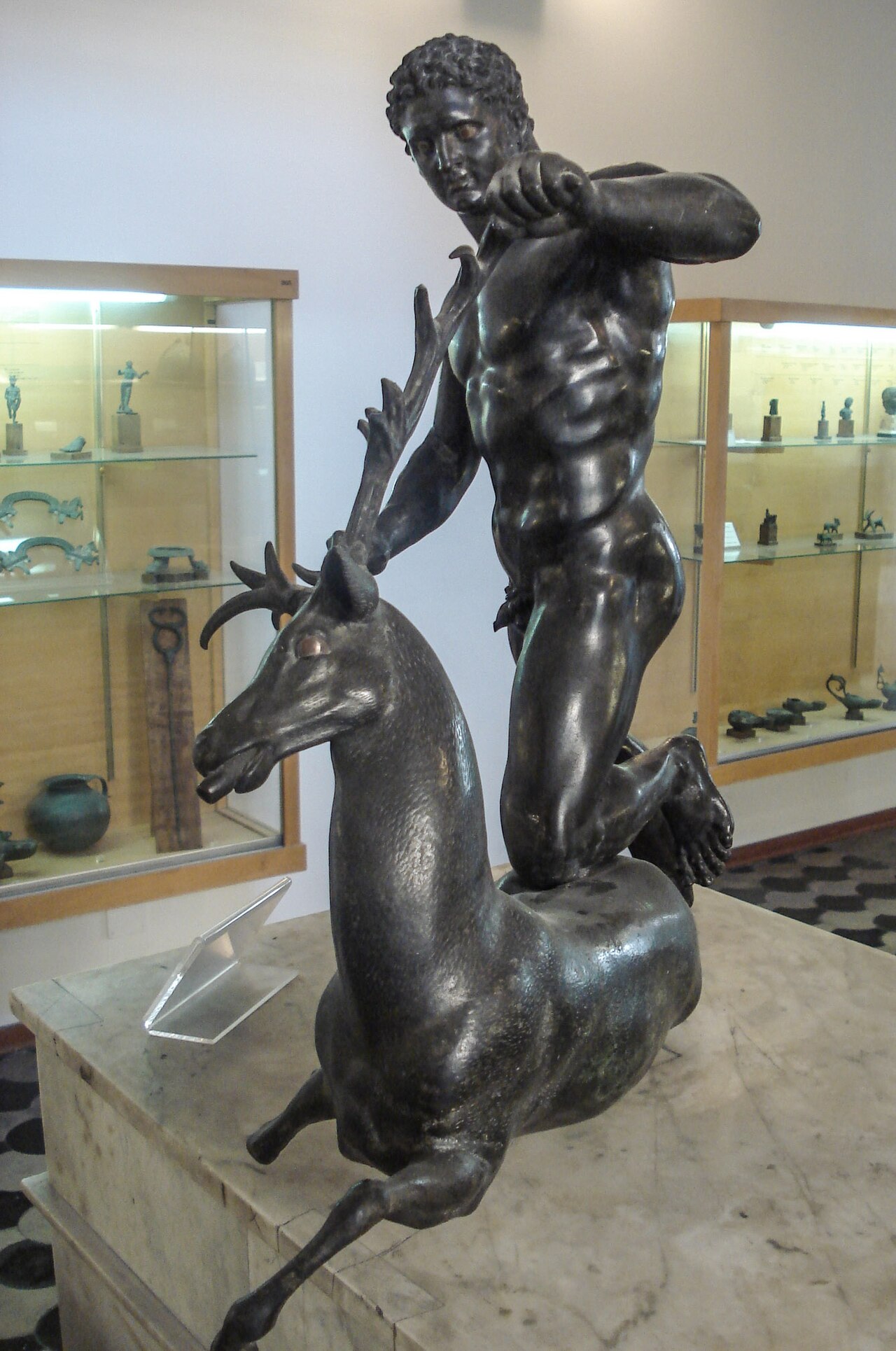
The third labour of Heracles was the capture of the Ceryneian Hind, a sacred deer belonging to Artemis, goddess of the hunt, wilderness and wild animals.
The Capture of the Ceryneian Hind
Unlike the Nemean Lion and the Lernaean Hydra, the Ceryneian Hind was not an evil monster that terrorised the countryside. It was a beautiful and holy animal protected by a powerful goddess.
King Eurystheus ordered Heracles to capture the hind alive and bring it to Mycenae. The command was carefully designed to place the hero in danger.
If Heracles failed to catch the animal, the labour would remain incomplete. If he injured or killed it, he risked the anger of Artemis.
The hind was extraordinarily swift. It could race across mountains, forests and rivers faster than any ordinary hunter could follow.
Heracles could not rely upon overwhelming violence. He had to demonstrate patience, restraint, endurance and respect for divine law.
The pursuit lasted an entire year and carried the hero through distant regions of the ancient world.
The third labour therefore differs greatly from the first two. Heracles had defeated the lion through physical strength and overcome the Hydra through cooperation and fire. To capture the hind, he had to control his strength and avoid destroying the creature he pursued.
Heracles and the Twelve Labours
Heracles was the son of Zeus, king of the gods, and Alcmene, a mortal woman.
Because Zeus had fathered Heracles outside his marriage, Hera became the hero’s lifelong enemy.
She attempted to destroy him from infancy and later caused him to fall into a state of madness.
During this madness, Heracles killed members of his own family.
When his sanity returned, he was overwhelmed by grief and guilt.
He travelled to the Oracle of Apollo at Delphi and asked how he could be purified.
The oracle ordered him to serve King Eurystheus of Tiryns and Mycenae.
Eurystheus would assign a series of dangerous tasks intended to test or destroy him.
These adventures became known as the Labours of Heracles.
King Eurystheus
Eurystheus belonged to the family line of Perseus and possessed royal authority over Heracles.
He was physically weaker and less courageous than the hero he commanded.
According to mythology, Hera had arranged for Eurystheus to be born before Heracles so that he would inherit the kingship promised to the next descendant of Perseus.
Eurystheus feared Heracles’ strength and growing fame.
He therefore selected tasks that appeared impossible.
When Heracles returned from the first labour wearing the skin of the Nemean Lion, Eurystheus was so frightened that he hid inside a large bronze jar.
After this, he sometimes delivered his commands through a herald rather than facing Heracles directly.
The First Labour
The first labour required Heracles to kill the Nemean Lion.
The lion possessed an invulnerable hide that could not be pierced by arrows, swords or spears.
Heracles followed the animal into its cave, blocked one entrance and strangled it with his bare hands.
He then removed its skin using one of the lion’s own claws.
The hide became his armour, while the lion’s head formed a helmet.
The victory demonstrated Heracles’ extraordinary strength and ability to adapt when ordinary weapons failed.
The Second Labour
The second labour required Heracles to destroy the Lernaean Hydra.
The Hydra was a poisonous serpent with many heads.
Whenever Heracles cut off one head, two new heads grew from the wound.
His nephew Iolaus helped by cauterising each neck with fire.
Heracles eventually buried the immortal head beneath a heavy rock and dipped his arrows into the monster’s poisonous blood.
Eurystheus refused to recognise the labour because Iolaus had assisted.
The unfair decision would later increase the original ten tasks to twelve.
A Different Kind of Challenge
After two violent battles, Eurystheus chose a very different task.
The Ceryneian Hind was not to be killed.
Heracles had to capture it alive and return it unharmed.
The king understood that Heracles was skilled at defeating monsters through force.
He therefore created a labour in which force could cause failure.
The hero had to pursue a creature that was sacred, innocent and faster than any ordinary animal.
The Ceryneian Hind
The Ceryneian Hind was a supernatural female deer associated with Artemis.
It was sometimes called the Hind of Ceryneia, the Cerynitian Hind or the Golden Hind.
The creature lived in the wild regions of the Peloponnese, although its movements carried it across a much larger landscape.
Ancient writers described it as unusually large and beautiful.
Its most famous features were its golden antlers and bronze or shining hooves.
It could run with incredible speed and continue travelling without exhaustion for long periods.
The Golden Antlers
Female deer do not normally possess antlers, making the hind’s appearance immediately supernatural.
Its golden antlers marked it as a creature belonging to the divine world.
Gold was associated with immortality, sacred power and objects beyond ordinary human possession.
The antlers made the hind both beautiful and unmistakably connected with Artemis.
The Bronze Hooves
The hind’s hooves were described as bronze, shining or extremely hard.
They allowed it to travel rapidly across rough ground, mountains and rocky paths.
The shining hooves may also have emphasised the creature’s divine nature.
It was not limited by the weaknesses of ordinary animals.
Its body combined the grace of a deer with the endurance and strength of supernatural metal.
The Speed of the Hind
The Ceryneian Hind was faster than any ordinary hunter, horse or hunting dog.
It could cross enormous distances and escape before an attacker came close.
Its speed protected it from humans and helped preserve its sacred freedom.
Heracles could not expect to capture it through a brief chase.
The labour would require extraordinary endurance and patience.
Artemis
Artemis was the daughter of Zeus and Leto and the twin sister of Apollo.
She was goddess of the hunt, wilderness, wild animals, childbirth and young women.
Artemis carried a bow and travelled through mountains and forests with nymphs and hunting dogs.
Although she was a huntress, she also protected animals and punished those who violated her sacred creatures or entered forbidden places.
The Ceryneian Hind was one of the animals under her special protection.
The Sacred Hinds of Artemis
According to one tradition, Artemis encountered several golden-horned hinds while still young.
She captured most of them and used them to draw her chariot.
One hind escaped and continued living freely in the wilderness.
This surviving animal became the Ceryneian Hind pursued by Heracles.
The story emphasised both its speed and its special relationship with the goddess.
The Danger of Offending Artemis
Artemis was known for punishing those who failed to respect her sacred authority.
The hunter Actaeon accidentally saw the goddess bathing and was transformed into a stag before being killed by his own hunting dogs.
King Agamemnon offended Artemis before the Trojan War and was required to sacrifice or attempt to sacrifice his daughter Iphigenia.
Other myths described the goddess bringing disease, wild animals or sudden death against those who insulted her.
Heracles therefore knew that harming the hind could have terrible consequences.
Eurystheus’ Trap
Eurystheus hoped to create a conflict between Heracles and Artemis.
If the hero killed the hind, the goddess might punish him.
If he refused the command, he would disobey the oracle and fail the labour.
If he attempted to capture the creature gently, its speed might keep it beyond his reach forever.
The labour was therefore a trap involving both divine law and practical impossibility.
Heracles Begins the Pursuit
Heracles travelled into the wilderness and began searching for the hind.
He followed tracks through forests, valleys and mountain paths.
The shining antlers or hooves may have revealed the animal briefly in the distance.
Whenever Heracles approached, the hind fled with extraordinary speed.
The hero began a pursuit that would last an entire year.
A Year-Long Chase
The length of the chase distinguishes the third labour from many other adventures of Heracles.
The Nemean Lion and Hydra were defeated through intense battles.
The hind could not be conquered in a single violent encounter.
Heracles had to continue following it through changing seasons.
Summer heat, winter cold, rain and difficult terrain could not cause him to abandon the task.
The labour tested his endurance more deeply than a brief display of strength.
Through the Peloponnese
The chase began within the Peloponnese, where the hind was associated with Ceryneia and the surrounding regions.
Heracles followed it through wooded hills and rocky landscapes.
The animal knew the wilderness and could disappear among trees or cross slopes that slowed a human hunter.
Heracles had to read tracks, broken branches and signs left in soft earth.
His success depended upon hunting knowledge as well as physical endurance.
Across Rivers and Mountains
The hind crossed rivers and climbed mountains while Heracles remained behind it.
Water could briefly hide its tracks, while high ground allowed it to see danger approaching.
Heracles continued through every landscape.
He could not rest for long without allowing the animal to gain an impossible distance.
The chase became a test of determination between hunter and sacred creature.
The Northern Lands
Some traditions claimed that the hind fled far beyond the Peloponnese into distant northern regions.
Heracles may have followed it towards the lands of the Hyperboreans, a legendary people living beyond the north wind.
The Hyperboreans were associated with peace, abundance and the worship of Apollo.
By carrying the pursuit into their distant world, the myth transformed a local hunt into a journey across the edges of known geography.
The River Ister
Some ancient accounts described Heracles pursuing the hind as far as the River Ister, usually identified with the Danube.
This would have carried him far north of Greece.
The enormous distance emphasised the supernatural speed of the animal and the endurance of the hero.
Heracles did not turn back even when the chase moved far beyond familiar lands.
Patience Instead of Violence
Heracles possessed arrows poisoned with the blood of the Hydra.
He could have killed the hind from a distance if he chose to use them.
However, the command required the creature alive, and its sacred status demanded caution.
The hero therefore restrained the destructive power he had gained during the previous labour.
The ability not to use a deadly weapon became as important as the ability to use one.
The Hero as Hunter
During the pursuit, Heracles acted more like a skilled hunter than a battlefield warrior.
He observed the animal’s habits, recognised its routes and waited for exhaustion or opportunity.
Hunting required silence, patience and understanding of the landscape.
The labour revealed qualities often hidden beneath stories of Heracles’ strength.
The Hind Grows Tired
After a year of pursuit, even the supernatural hind began to tire.
Its speed remained extraordinary, but the continued chase reduced its strength.
Heracles had endured long enough to create an opportunity.
The animal eventually slowed near a river or sacred place.
Heracles prepared to capture it without causing fatal injury.
The River Ladon
One version placed the final moment near the River Ladon in Arcadia.
The Ladon flowed through a region strongly associated with wilderness and mythology.
The hind paused to drink or cross the water.
The river limited its movement and gave Heracles a chance to approach.
The peaceful setting created a sharp contrast with the violent caves of the first two labours.
Different Versions of the Capture
Ancient mythology did not preserve one fixed account of how Heracles caught the hind.
In one version, he captured it with a net while it slept or rested.
In another, he seized it after the year-long pursuit had exhausted it.
Some traditions said that he carefully wounded it with an arrow.
The wound was slight and did not kill or permanently harm the sacred animal.
Every version emphasised that the hind had to remain alive.
The Net
If Heracles used a net, the method demonstrated planning and restraint.
A net could trap the animal without cutting its body or exposing it to poison.
Heracles would have needed to place the trap carefully along the hind’s path.
The capture depended upon predicting movement rather than overpowering the animal directly.
The Gentle Arrow
Some accounts said that Heracles fired an arrow between the hind’s legs or through a place that caused only a minor wound.
He may have used an unpoisoned arrow for this purpose.
The shot had to be extremely accurate.
A mistake could have killed the animal and provoked Artemis.
The method demonstrated control over archery rather than destructive force.
Capturing the Hind by Hand
Another tradition described Heracles seizing the hind while it slept or rested from exhaustion.
After a year of pursuit, the hero finally approached closely enough to take hold of it.
He restrained the animal without crushing or injuring it.
This required careful control over his extraordinary strength.
The Importance of Control
Heracles had strangled the Nemean Lion and cut the heads from the Hydra.
Such methods would have failed completely against the hind.
The third labour tested whether he could control the same strength that made him famous.
True mastery meant knowing when not to strike.
Artemis Appears
As Heracles prepared to carry the captured hind back to Eurystheus, Artemis appeared before him.
Her twin brother Apollo accompanied her in several versions.
Artemis was angry that a mortal had seized her sacred animal.
She accused Heracles of attempting to steal or injure what belonged to her.
The hero now faced a danger greater than the hind itself.
Heracles Explains the Labour
Heracles did not challenge Artemis or attempt to fight her.
He respectfully explained that he acted under the command of Eurystheus and the instructions of the Delphic Oracle.
He did not wish to insult the goddess or permanently possess the hind.
His purpose was only to complete the labour and then allow the sacred animal to return to freedom.
The explanation placed responsibility upon Eurystheus while showing that Heracles understood divine authority.
Respect Before the Goddess
Heracles’ behaviour before Artemis differs from his treatment of monsters and hostile rulers.
He uses humility rather than force.
He accepts that the goddess has a rightful claim over the animal.
His willingness to explain himself shows that courage includes respect for powers greater than one’s own.
Artemis Accepts the Explanation
Artemis recognised that Heracles had not acted from greed or cruelty.
She accepted his explanation and allowed him to continue towards Mycenae.
Heracles promised that the hind would not be kept permanently by Eurystheus.
The goddess trusted him to protect the animal and return it to the wilderness.
Apollo’s Presence
Apollo’s presence connected the labour with the oracle that had ordered Heracles into service.
Heracles was not acting only under the command of a mortal king.
His labours formed part of a divine process of purification.
The presence of Apollo helped confirm that the hero’s actions were not intended as an insult to Artemis.
The Journey Back
Heracles carried or led the hind back towards the court of Eurystheus.
The return required care because the animal remained sacred and extremely swift.
He may have carried it across his shoulders, held it gently or guided it with a rope.
Ancient artists often showed Heracles holding the hind by its antlers.
Whatever the method, he had to ensure that it did not escape before the king saw it.
Eurystheus Wants the Hind
When Heracles arrived, Eurystheus planned to place the hind within his own collection or dedicate it to Hera.
Keeping the creature would have violated the promise made to Artemis.
Heracles therefore needed to complete the official task without surrendering the animal permanently.
Once again, intelligence became necessary after the apparent danger had ended.
Heracles’ Plan
Heracles told Eurystheus that the king must receive the hind with his own hands.
He may have claimed that only direct acceptance would prove the labour complete.
Eurystheus approached and reached towards the animal.
At the correct moment, Heracles released his hold.
The hind immediately escaped.
The Hind Returns to Artemis
The sacred animal raced away before Eurystheus could seize it.
It returned to the wilderness and the protection of Artemis.
Heracles declared that he had brought the hind as commanded.
If Eurystheus had failed to catch it, the failure belonged to the king rather than the hero.
The labour was complete, and the promise to Artemis had been honoured.
Outwitting Eurystheus
The ending of the labour shows Heracles defeating Eurystheus without violence.
The king had attempted to trap him between obedience and divine punishment.
Heracles fulfilled the command while preventing Eurystheus from possessing the sacred animal.
He used the exact wording of the labour against the king’s hidden intention.
The Completion of the Third Labour
Eurystheus was forced to recognise that Heracles had captured and presented the Ceryneian Hind.
The animal had escaped only after reaching the court.
The hero had therefore completed the command without killing or permanently harming it.
The third labour ended with the hind free, Artemis respected and Eurystheus outwitted.
The Meaning of the Third Labour
The capture of the Ceryneian Hind demonstrates that heroism is not always measured through destruction.
Heracles succeeds by following, waiting, controlling himself and acting respectfully.
The labour requires qualities very different from those displayed against the lion and Hydra.
Patience becomes a greater strength than violence.
Strength Through Restraint
Heracles possessed the power to kill the hind easily if he used his poisoned arrows.
He chose not to use that power.
This restraint is itself a heroic achievement.
A person who can destroy but chooses a gentler method demonstrates mastery over both the situation and himself.
The Labour of Patience
The year-long pursuit is the central test of the labour.
Heracles does not abandon the chase when the animal remains far ahead.
He continues through season after season.
The story shows that some goals cannot be achieved quickly, regardless of strength or courage.
Endurance over time may be more difficult than one dramatic battle.
The Labour of Endurance
Heracles endures long travel, changing weather and unfamiliar landscapes.
He must find food, shelter and safe routes while continuing the pursuit.
The hind’s speed forces him to remain constantly active.
The labour proves that his strength is not limited to short bursts of effort.
He can continue working towards a distant goal for an entire year.
The Labour of Attention
Capturing the hind requires close attention to tracks, habits and terrain.
Heracles must recognise where the animal drinks, rests and crosses rivers.
He succeeds because he studies the creature rather than treating it as another enemy to be crushed.
Careful observation becomes a form of intelligence.
The Labour of Respect
The hind belongs to Artemis and cannot be treated as ordinary property.
Heracles respects the goddess by explaining his purpose and promising the animal’s return.
He also prevents Eurystheus from keeping it.
The labour teaches that completing a command does not excuse disrespect towards sacred obligations.
The Labour of Diplomacy
Heracles must negotiate with Artemis rather than defeat her.
He speaks honestly, explains the authority behind his actions and offers reassurance.
The goddess allows him to continue because he approaches her with humility.
This encounter shows Heracles using communication to escape danger.
The Labour of Intelligence
The conclusion requires cleverness.
Heracles cannot simply hand the hind to Eurystheus.
He creates a situation in which the king technically receives an opportunity to take the animal but fails.
The plan satisfies the command while preserving the sacred creature’s freedom.
The Hind as a Symbol of Freedom
The Ceryneian Hind belongs to the wilderness.
Its extraordinary speed prevents humans from controlling it.
The animal may therefore represent freedom that cannot be permanently possessed.
Heracles can capture it briefly, but it ultimately returns to the forests and mountains.
The Hind as a Symbol of Purity
Unlike many opponents of Heracles, the hind is innocent.
It does not attack travellers, destroy cities or feed upon human beings.
Its beauty and sacred nature connect it with purity.
The hero’s responsibility is to preserve that purity while completing the labour.
The Hind as a Symbol of the Unreachable
The hind’s speed makes it appear impossible to catch.
It remains visible enough to encourage pursuit but always moves beyond reach.
This quality allows it to represent distant goals that require extraordinary perseverance.
Heracles succeeds not because the hind becomes slow but because he refuses to stop.
The Golden Antlers as a Symbol
The golden antlers mark the hind as something more valuable than ordinary wealth.
Eurystheus may wish to possess the animal because of its beauty and rarity.
However, sacred beauty cannot be treated simply as royal property.
The antlers belong within the wilderness of Artemis rather than the collection of a fearful king.
Nature and Ownership
The labour raises questions about whether humans have the right to possess sacred or wild nature.
Eurystheus treats the hind as an object that can be captured and kept.
Artemis treats it as a protected creature belonging to the wilderness.
Heracles briefly controls the animal but ultimately returns it to freedom.
The story favours stewardship and respect over permanent possession.
Artemis as Huntress and Protector
Artemis carries a bow and hunts animals, yet she also protects the Ceryneian Hind.
This apparent contradiction reflects the ancient understanding of hunting as a sacred activity governed by limits.
A hunter could take animals but was expected to respect divine law, ritual and the balance of nature.
Heracles succeeds because he recognises those limits.
The Hero and the Wilderness
Heracles often enters wild landscapes and makes them safe for human communities.
In the third labour, however, the wilderness itself is not the enemy.
The hind belongs there and does not need to be destroyed.
The hero must enter nature without attempting to conquer everything within it.
This makes the labour unusually respectful towards the wild world.
The First Three Labours Compared
The first three labours test different aspects of Heracles’ character.
The Nemean Lion tests physical strength and courage.
The Lernaean Hydra tests cooperation, intelligence and adaptation.
The Ceryneian Hind tests patience, restraint and respect.
Together, they demonstrate that Heracles must develop beyond simple force.
The Lion and the Hind
The lion is a dangerous predator that must be killed.
The hind is a sacred animal that must remain alive.
Heracles strangles the lion but handles the hind carefully.
The contrast shows that wise action depends upon understanding the nature of each challenge.
Treating every creature in the same way would produce failure.
The Hydra and the Hind
The Hydra multiplies when attacked and must be destroyed through coordinated violence.
The hind flees when approached and must be captured through patience.
The Hydra represents a danger that grows if misunderstood.
The hind represents a goal that remains distant if pursued without endurance.
The Use and Rejection of Weapons
Weapons are central to the first two labours.
The lion resists them, while the Hydra is defeated through blades and fire.
During the third labour, weapons become dangerous because they might harm the sacred animal.
Heracles must decide not only how to use his equipment but whether it should be used at all.
The Poisoned Arrows
Heracles carried arrows coated with Hydra venom.
These were among the deadliest weapons in mythology.
The presence of such arrows made restraint especially important.
A single careless shot could have killed the hind and brought the anger of Artemis.
The hero’s control over his weapons becomes part of the labour’s achievement.
Heracles and Divine Law
Heracles serves Eurystheus because of a divine oracle, but he must also respect Artemis.
The commands of one authority appear to conflict with the rights of another.
Heracles resolves the conflict by completing the mortal king’s order without violating the goddess’s ownership.
The labour shows that obedience must be guided by moral and religious judgement.
Obedience and Conscience
Heracles cannot refuse every difficult command simply because Eurystheus has bad motives.
His service forms part of his purification.
However, obedience does not require him to ignore the sacred status of the hind.
He finds a path that satisfies duty without abandoning conscience.
The Failure of Eurystheus
Eurystheus creates the labour because he hopes Heracles will fail or anger Artemis.
He does not care about the welfare of the sacred creature.
His desire to keep it reveals greed and disrespect.
Heracles behaves more honourably than the king who commands him.
The labour therefore exposes the moral weakness beneath Eurystheus’ authority.
Royal Power and Sacred Limits
Eurystheus is a king, but kingship does not give him the right to possess everything he desires.
The hind belongs to Artemis and remains protected by divine law.
Heracles ensures that royal power does not permanently overcome sacred limits.
Heracles as Servant and Protector
Heracles is officially the servant of Eurystheus.
In practice, he becomes the protector of the hind against the king’s greed.
He completes the task but refuses to allow its purpose to become permanent captivity.
This reversal shows that service does not always mean complete submission to another person’s intentions.
The Value of a Promise
Heracles promises Artemis that the hind will be returned.
He honours this promise even though Eurystheus wants the animal.
The decision contrasts with dishonest rulers such as Laomedon and Augeas, who break agreements after receiving benefits.
Heracles’ reliability forms an important part of his heroic character.
The Hind and the Hunt
The pursuit reflects real knowledge of hunting but transforms it into supernatural adventure.
A hunter follows tracks, waits for the right moment and studies the landscape.
Heracles performs these activities on an enormous scale over an entire year.
The ordinary skills of hunting become heroic through endurance and divine danger.
The Importance of Timing
Heracles cannot capture the hind whenever he chooses.
He must wait until exhaustion, water or terrain creates an opportunity.
Acting too early would cause the animal to escape.
Acting too violently would cause injury.
The labour teaches that correct timing can matter more than immediate action.
The Importance of Persistence
The hind escapes repeatedly during the pursuit.
Each escape could appear to be a failure.
Heracles does not treat temporary failure as the end of the labour.
He continues until repeated effort creates success.
Persistence transforms an impossible chase into a completed task.
The Importance of Gentleness
Heracles is famous for strength, but strength can easily harm a delicate animal.
Capturing the hind alive requires gentleness.
The hero must restrain his grip, avoid poisoned weapons and transport the animal carefully.
The labour shows that gentleness can require as much skill as violence.
The Importance of Self-Control
Self-control is one of the central themes of Heracles’ mythology.
His greatest personal tragedies often occur when anger, madness or desire overwhelms him.
During the third labour, success depends upon controlling impulse for an entire year.
The task therefore becomes part of his moral development as well as his physical service.
The Labour and Heracles’ Madness
Heracles began the labours because he had lost control of himself during madness.
The capture of the hind requires the opposite condition.
He must remain patient, calm and careful.
The labour symbolically trains the quality that had been absent during his greatest tragedy.
The Labour as Purification
Purification is not achieved only through suffering.
Heracles must demonstrate that he can use power responsibly.
By sparing the hind and honouring Artemis, he shows that his strength can protect rather than destroy.
The labour becomes a step towards rebuilding his moral identity.
The Chase Through the Seasons
A year-long pursuit would carry Heracles through every season.
Spring might bring new vegetation that hid the hind’s tracks.
Summer would test the hero through heat and thirst.
Autumn rain could turn paths into mud.
Winter snow might reveal tracks while making travel difficult.
The changing seasons emphasise the length and endurance of the chase.
Time as an Opponent
During the first two labours, Heracles confronts visible monsters.
During the third, time itself becomes an opponent.
He must continue without knowing when the pursuit will end.
The uncertainty makes the labour psychologically difficult.
There is no immediate battle to win, only the demand to continue.
Loneliness During the Pursuit
Unlike the Hydra labour, the pursuit is generally described as an individual task.
Heracles travels through wilderness without the constant support of Iolaus.
The long chase may have required him to endure isolation as well as physical exhaustion.
The hero must depend upon his own determination across unfamiliar lands.
The Hind and the Hyperboreans
The possible journey into Hyperborean lands adds a sacred quality to the pursuit.
The Hyperboreans were imagined as a blessed people living beyond the cold north wind.
They enjoyed long lives, peace and a special relationship with Apollo.
The hind’s movement towards such a region suggests that it belongs partly to a world beyond ordinary human reach.
Geography and Myth
The pursuit allowed ancient storytellers to connect Heracles with distant places.
As the hero travelled farther from Greece, local communities could claim that he had passed through their lands.
This helped transform Heracles from a Peloponnesian hero into a figure known across the ancient world.
The Labour in Ancient Art
The capture of the Ceryneian Hind appeared frequently in Greek sculpture and pottery.
Artists often showed Heracles holding the animal by its antlers.
He might place one knee upon its back while carefully restraining it.
Artemis and Apollo sometimes appeared nearby to confront or observe him.
Heracles Holding the Antlers
The golden antlers created a clear visual feature for artists.
Heracles could be shown grasping them while the hind attempted to escape.
The image displayed his strength but also the delicacy of the task.
He had to restrain the animal without breaking its sacred horns or causing injury.
Artemis in Artistic Scenes
When Artemis appeared in artistic versions, she often reached towards the hind or confronted Heracles.
The scene captured the moment of tension before the hero explained himself.
Heracles stood between obedience to Eurystheus and respect for the goddess.
The presence of Artemis reminded viewers that the animal was not an ordinary hunting prize.
The Temple of Zeus at Olympia
The labours of Heracles were represented on the metopes of the Temple of Zeus at Olympia.
These sculpted scenes presented the hero completing his tasks under the guidance or observation of Athena.
The capture of the hind formed part of a larger visual story showing Heracles’ development through struggle.
He appeared not merely as a powerful man but as a hero learning discipline and divine order.
The Hind in Later Literature
Later Greek and Roman writers retold the labour with variations in geography and method.
Some emphasised the year-long pursuit.
Others focused upon the confrontation with Artemis or the trick played upon Eurystheus.
The flexibility of the story allowed writers to highlight endurance, sacred law or cleverness.
The Golden Hind in Later Storytelling
The image of a golden deer or hind has appeared in many later legends and works of fantasy.
Such animals often lead hunters into distant lands or represent something beautiful that cannot be permanently possessed.
Although not every golden deer comes directly from the Ceryneian Hind, the Greek myth helped establish this powerful pattern.
The Hind in Modern Culture
The Ceryneian Hind appears in modern books, games, films and television programmes about Heracles.
Adaptations may portray it as a magical deer with shining antlers or as a guardian of the forest.
Some versions turn the labour into a simple hunt.
More faithful retellings preserve the essential condition that the animal must be captured alive and returned unharmed.
A Labour Without a Monster
The third labour is important because it broadens the meaning of the heroic adventure.
Heracles does not need to kill an enemy.
He must complete a difficult task involving an innocent creature.
The story proves that danger and difficulty do not always take the form of a monster.
A Victory Without Death
The labour ends without the death of the creature at its centre.
The hind returns to freedom, and Heracles earns recognition for completing the task.
This makes the third labour one of the least destructive adventures in the cycle.
Its success depends upon preservation rather than killing.
The Meaning of Success
Heracles does not keep the hind or gain its antlers as a trophy.
His success lies entirely in completing the pursuit and then allowing the animal to go.
The labour challenges the idea that victory requires ownership.
Sometimes success means proving that something can be reached without claiming it permanently.
The Meaning of Failure
Heracles would have failed if he killed the hind, even though killing is normally treated as victory in heroic combat.
He would also have failed if Eurystheus kept the creature against the wishes of Artemis.
The correct outcome depends upon respecting conditions rather than merely overpowering the target.
The Hero’s Changing Character
By the third labour, Heracles is already becoming more than a man of uncontrolled strength.
He has learned to change methods, accept help and respect sacred boundaries.
The hind requires him to become patient and gentle.
These qualities prepare him for later tasks involving negotiation, travel and deception.
Preparation for Later Labours
Heracles will later need to capture the Erymanthian Boar alive.
He will subdue the Cretan Bull, take the cattle of Geryon and bring Cerberus from the Underworld without killing it.
The third labour introduces the discipline required for these future captures.
It teaches him that controlling a creature can be more difficult than destroying it.
The Fourth Labour Approaches
After the hind escaped and the third labour was recognised, Eurystheus assigned another task.
Heracles was ordered to capture the Erymanthian Boar alive.
The next labour would again test his ability to subdue a dangerous animal without killing it.
However, the boar was violent and destructive, unlike the peaceful hind.
The Central Contrast
The Ceryneian Hind is strong because it escapes rather than attacks.
Its protection comes from speed, wilderness and divine ownership.
Heracles cannot defeat it in the usual heroic sense.
He must prove that he can follow, capture and release it.
The Lesson of the Chase
The chase teaches that determination must sometimes be quiet and continuous.
There is no dramatic victory during most of the year.
Heracles advances through small signs, distant sightings and repeated pursuit.
The final capture becomes possible because he refuses to abandon the long process.
The Lesson of Restraint
Possessing power creates responsibility.
Heracles carries weapons capable of killing nearly any animal.
He proves his worth by refusing to use them carelessly.
The third labour presents restraint not as weakness but as controlled strength.
The Lesson of Sacred Boundaries
The hind belongs to Artemis, and even a son of Zeus must respect that relationship.
Heracles does not assume that his heroic mission places him above divine law.
He explains himself and fulfils his promise.
The labour warns that power without respect becomes arrogance.
The Lesson of Cleverness
Eurystheus attempts to use the hind against Heracles.
The hero reverses the trap by making the king responsible for taking the animal.
When the hind escapes, Heracles has technically completed the command.
Clever interpretation allows justice to overcome malicious authority.
The Lesson of Freedom
The ending restores the hind to the wilderness.
Neither Heracles nor Eurystheus becomes its permanent owner.
The creature’s freedom is part of the correct completion of the labour.
The story suggests that sacred and beautiful things may lose their meaning when confined for human pride.
The Legacy of the Third Labour
The capture of the Ceryneian Hind remains one of the most distinctive adventures of Heracles.
It contains no monstrous slaughter, collapsing city or great battle.
Its drama comes from duration, divine danger and the difficulty of acting with restraint.
The labour reveals a different form of heroism from the violence normally associated with Heracles.
Conclusion
The third labour of Heracles was the capture of the Ceryneian Hind, a sacred animal belonging to Artemis.
The hind possessed golden antlers, shining or bronze hooves and supernatural speed.
King Eurystheus ordered Heracles to bring it back alive.
The command was intended to create an impossible conflict.
If Heracles killed or injured the animal, he would offend Artemis. If he failed to catch it, he would not complete the labour.
Heracles pursued the hind for an entire year through forests, rivers, mountains and distant northern regions.
He did not use the deadly force that had defeated the Nemean Lion and Lernaean Hydra.
Instead, he relied upon patience, hunting skill and endurance.
Ancient traditions differed over the exact moment of capture.
Heracles may have trapped the hind in a net, seized it after exhaustion or lightly wounded it with a carefully aimed arrow.
In every version, he kept the sacred animal alive.
Artemis then confronted Heracles and accused him of violating her protection.
The hero respectfully explained that he acted under the command of Eurystheus and the Delphic Oracle.
He promised that the hind would be returned to the wilderness.
Artemis accepted his explanation and allowed him to continue.
When Heracles reached Mycenae, Eurystheus attempted to take permanent possession of the animal.
Heracles insisted that the king receive it with his own hands.
As Eurystheus reached forward, Heracles released the hind.
The swift creature escaped and returned to Artemis.
Heracles had completed the labour without breaking his promise or allowing the sacred animal to become a royal possession.
The third labour demonstrates that strength is not always shown through violence.
Heracles succeeds because he can wait, endure, negotiate and control his power.
The year-long pursuit teaches patience.
The confrontation with Artemis teaches respect.
The escape before Eurystheus teaches cleverness.
The survival of the hind teaches that a heroic victory can preserve life rather than destroy it.
Through the Ceryneian Hind, Heracles begins to master not only the creatures placed before him but also his own impulses.
The labour therefore marks an important stage in his journey from a man famous for strength into a hero capable of discipline, responsibility and wisdom.