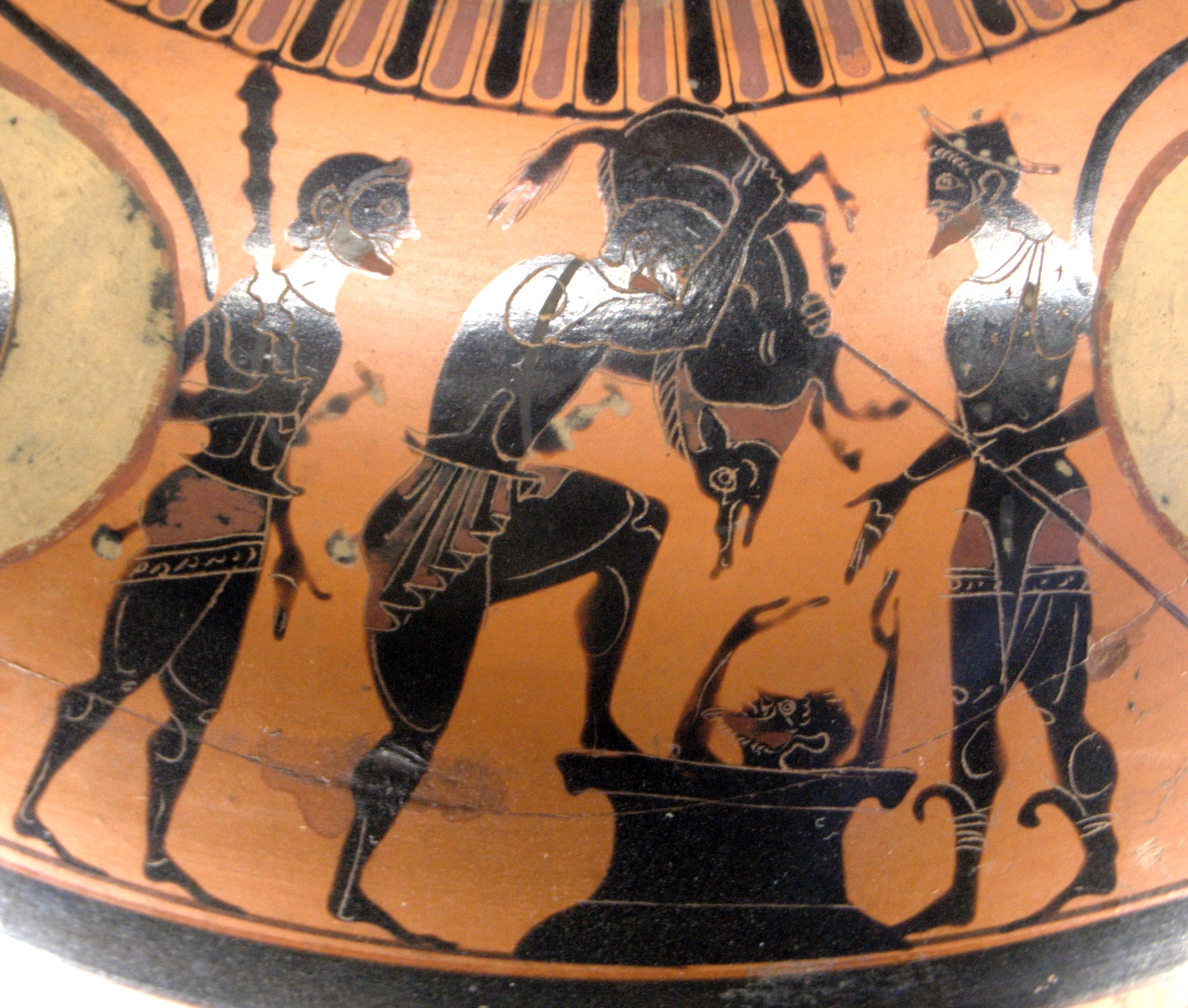
The fourth labour of Heracles was the capture of the Erymanthian Boar, a gigantic and violent animal that lived upon Mount Erymanthus in the north-western Peloponnese.
The Capture of the Erymanthian Boar
The boar terrorised the surrounding countryside, destroyed crops, attacked livestock and threatened anyone who travelled through the mountain region.
King Eurystheus ordered Heracles to capture the creature alive and bring it back to Mycenae.
This condition made the task especially difficult. Heracles was not permitted simply to kill the boar with his club or poisoned arrows.
He had to track the animal through mountainous wilderness, survive its attacks, overpower it without causing its death and carry it back to the king.
The fourth labour tested Heracles’ strength, endurance, hunting ability and control over violence.
It also became connected with a tragic conflict involving the centaurs, the death of Pholus and the accidental wounding of Chiron.
The capture of the Erymanthian Boar therefore became much more than a simple hunt. It was an adventure involving hospitality, wine, uncontrolled anger, accidental death and the dangerous consequences of the Hydra’s poison.
Heracles and the Labours
Heracles was the son of Zeus, king of the gods, and Alcmene, a mortal woman descended from the hero Perseus.
Hera, the wife of Zeus, hated Heracles because he was the child of one of her husband’s relationships with a mortal.
She attempted to destroy him from infancy and later caused him to suffer a period of madness.
During this madness, Heracles killed members of his own family.
When his mind returned to normal, he was overwhelmed by grief and guilt.
He travelled to the Oracle of Apollo at Delphi and asked how he might be purified.
The oracle ordered him to serve King Eurystheus of Tiryns and Mycenae.
Eurystheus assigned Heracles a series of tasks that became known as the Labours of Heracles.
King Eurystheus
Eurystheus possessed royal authority over Heracles but lacked the hero’s strength and courage.
According to mythology, Hera had arranged for Eurystheus to be born before Heracles so that he would receive the kingship promised to the next descendant of Perseus.
Eurystheus feared Heracles and hoped that one of the labours would kill him.
He selected monsters, dangerous animals and impossible journeys as tests.
When Heracles returned from the first labour wearing the skin of the Nemean Lion, Eurystheus became so frightened that he hid inside a large bronze storage jar.
The king later communicated with Heracles through a herald and required him to display captured creatures outside the city.
The First Three Labours
Before hunting the Erymanthian Boar, Heracles had already completed three extraordinary tasks.
He had killed the Nemean Lion, whose skin could not be pierced by ordinary weapons.
He had destroyed the Lernaean Hydra with the help of his nephew Iolaus.
He had also captured the sacred Ceryneian Hind alive after pursuing it for an entire year.
Each labour had tested a different part of his character.
The lion required strength and courage.
The Hydra required cooperation and strategy.
The hind required patience, restraint and respect for the goddess Artemis.
The fourth labour would combine hunting, endurance and controlled force.
The Erymanthian Boar
The Erymanthian Boar was an enormous wild pig associated with Mount Erymanthus.
Its tusks were powerful enough to tear through flesh, wood and farming equipment.
Its body was protected by thick hide and heavy muscle.
The creature could move rapidly through forests and mountain paths despite its great size.
It descended from the highlands and attacked farms, crops and herds.
Ordinary hunters could not safely approach it.
The boar’s combination of speed, aggression and strength made it one of the most dangerous animals in the region.
Wild Boars in the Ancient World
Wild boars were feared by hunters throughout the ancient Mediterranean.
An injured boar could turn suddenly and charge its attacker.
Its curved tusks could cause deep and fatal wounds.
Boar hunting required courage, skill and cooperation.
Greek mythology frequently used wild boars as destructive creatures sent by gods or associated with dangerous wilderness.
The Calydonian Boar became the centre of another famous heroic hunt.
The Erymanthian Boar belonged to this wider tradition of animals representing uncontrolled natural power.
Mount Erymanthus
Mount Erymanthus stood in the region of Arcadia and Achaea in the Peloponnese.
The mountain landscape included steep slopes, forests, rocky paths and deep snow during winter.
Such terrain gave the boar protection from hunters.
The creature could disappear among trees, hide in caves or charge downhill with great force.
Heracles would need to understand the mountain environment before attempting the capture.
The Command to Capture the Boar Alive
Eurystheus did not order Heracles to kill the boar.
He commanded him to bring it back alive.
This requirement prevented Heracles from using the poisoned arrows he had created after killing the Hydra.
A wound from one of those arrows would almost certainly kill the animal.
Heracles also had to avoid striking too hard with his club.
The task demanded controlled strength rather than destruction.
Heracles Begins the Journey
Heracles left the court of Eurystheus and travelled towards Mount Erymanthus.
He wore the skin of the Nemean Lion and carried his club, bow and arrows.
During the journey, he entered the land of the centaurs.
There he visited a centaur named Pholus.
This meeting led to one of the most tragic episodes associated with the Twelve Labours.
The Centaurs
Centaurs were mythical creatures with the upper body of a human and the body of a horse.
They were often associated with mountains, forests, hunting and uncontrolled behaviour.
Many centaurs were portrayed as violent and easily overcome by wine.
They represented the conflict between human intelligence and animal instinct.
Not every centaur was savage.
Chiron was wise, peaceful and famous as a teacher of heroes.
Pholus was also known for his hospitality and respectful behaviour.
Pholus
Pholus lived in a cave upon or near Mount Pholoe.
He was a friend of Heracles and welcomed him as a guest.
Unlike many other centaurs, Pholus behaved calmly and generously.
He provided Heracles with food and shelter during the journey.
The meeting showed that not every creature belonging to a wild race should be judged in the same way.
The Meal in the Cave
Pholus served Heracles cooked meat, while he ate his own portion raw.
This difference reflected the centaur’s mixed nature.
He practised hospitality like a civilised host but retained habits associated with the wilderness.
Heracles ate and rested before continuing towards the boar.
During the meal, he noticed a large sealed jar of wine.
The Jar of Wine
The wine had been given to the centaurs by Dionysus, god of wine.
It was intended to be opened when Heracles visited the region.
Some traditions described it as belonging collectively to all the centaurs rather than to Pholus alone.
Pholus therefore hesitated when Heracles asked him to open it.
He feared that the other centaurs would become angry.
Heracles insisted that the jar should be opened.
The Power of Wine
Wine held an important place in Greek society and religion.
When mixed with water and consumed in moderation, it belonged to civilised feasting and hospitality.
When taken without restraint, it could release violence, desire and irrational behaviour.
The centaurs were frequently portrayed as unable to control themselves after drinking.
The sealed jar therefore contained more than a beverage.
It contained the possibility of disorder.
The Jar Is Opened
Pholus opened the jar, and the smell of the wine spread through the surrounding mountains.
The scent attracted the other centaurs.
They realised that their shared wine had been opened without their permission.
Anger quickly replaced hospitality.
The centaurs gathered around the cave and prepared to attack.
The Attack of the Centaurs
The centaurs armed themselves with rocks, branches, trees and burning objects.
They charged towards the cave in a wild and violent group.
Heracles attempted to drive them back.
He first used firebrands and his club.
When the attack continued, he turned to the poisoned arrows coated with the venom of the Lernaean Hydra.
The Poisoned Arrows
The arrows of Heracles had become deadly during the second labour.
After killing the Hydra, he had dipped their points into its poisonous blood.
Even a small wound from one of these weapons could cause unbearable pain and death.
The arrows were highly effective against the attacking centaurs.
They were also impossible to control once fired.
The conflict showed the danger of using an overwhelming weapon in a chaotic battle.
The Centaurs Flee
Heracles killed several centaurs and drove the survivors away from the cave.
They fled through the mountains towards the home of Chiron.
Heracles pursued them.
The violence spread beyond the original disagreement over the wine.
A moment of hospitality had become a deadly conflict affecting innocent figures as well as attackers.
Chiron
Chiron was the wisest and most respected of the centaurs.
He differed greatly from the violent creatures attacking Heracles.
Chiron was a teacher of heroes, healers and warriors.
His pupils included Achilles, Asclepius, Jason and other famous figures of mythology.
He possessed knowledge of medicine, music, hunting and prophecy.
Chiron was also immortal.
The Accidental Wounding of Chiron
During the pursuit, one of Heracles’ poisoned arrows struck Chiron.
Some versions said that Heracles fired at another centaur and accidentally hit his old teacher.
Other accounts described an arrow falling or passing through another body before reaching him.
Heracles did not intend to harm Chiron.
Nevertheless, the Hydra poison entered the wound.
Heracles Attempts to Heal Chiron
Heracles was horrified by the accident.
He attempted to treat the wound using medicines and knowledge taught by Chiron himself.
No cure could remove the Hydra’s venom.
The poison was powerful enough to defeat the greatest healer among the centaurs.
Heracles’ regret could not undo the injury.
The Suffering of an Immortal
Because Chiron was immortal, the poison could not kill him immediately.
Instead, he experienced continuous and unbearable pain.
Mortality would have brought release, but immortality trapped him within suffering.
The situation transformed eternal life from a blessing into a punishment.
Chiron eventually surrendered his immortality.
In some traditions, Prometheus received it in his place.
Chiron was then allowed to die and escape the pain.
Chiron Among the Stars
After his death, Chiron was sometimes placed among the stars.
He became associated with the constellations Centaurus or Sagittarius.
His transformation preserved the memory of the wise centaur despite the tragic manner of his death.
The story also connected the adventures of Heracles with the night sky.
The Death of Pholus
After the battle, Pholus examined the body of one of the dead centaurs.
He removed or picked up one of Heracles’ poisoned arrows.
Pholus wondered how such a small weapon could kill a creature as powerful as a centaur.
The arrow slipped from his hand.
It fell point-first and pierced his foot.
The Hydra poison killed him quickly.
Heracles Mourns Pholus
Heracles returned and discovered that his peaceful host was dead.
Pholus had not attacked him and had opened the wine only after Heracles insisted.
His death was entirely accidental.
Heracles mourned him and arranged a respectful burial.
The mountain or region known as Pholoe was said to have received its name from the centaur.
The Cost of the Wine
The opening of the wine jar caused a chain of destruction.
The other centaurs became violent.
Heracles responded with poisoned arrows.
Chiron received an incurable wound.
Pholus died through accidental contact with an arrow.
A simple act during a meal therefore produced consequences far beyond anything originally intended.
Hospitality and Disaster
The meeting between Heracles and Pholus begins with good hospitality.
Pholus welcomes a traveller and offers food.
The conflict begins only after the boundaries surrounding the shared wine are ignored.
The story suggests that hospitality requires respect from both host and guest.
Pholus fulfils his duty, while Heracles’ insistence contributes to the later disaster.
Heracles Continues the Labour
Despite the deaths of Chiron and Pholus, Heracles still had to complete the task assigned by Eurystheus.
He left the region of the centaurs and continued towards Mount Erymanthus.
The boar remained alive and continued threatening the countryside.
Heracles carried grief and responsibility with him as he resumed the hunt.
Searching for the Boar
Heracles entered the mountain forests and searched for signs of the animal.
He looked for tracks, damaged trees, disturbed soil and the remains of crops or animals.
The boar knew the landscape and could hide among dense vegetation.
Heracles needed to drive it from cover without killing it.
Winter on Mount Erymanthus
The capture was often associated with winter and deep snow.
Snow made travel difficult for Heracles, but it also provided an advantage.
The boar’s heavy body sank into the snow and reduced its speed.
Tracks became easier to follow across the white ground.
Heracles realised that the winter landscape could help him complete the labour.
Driving the Boar from Its Lair
Heracles used loud shouting, thrown stones or his club against trees to frighten the boar from hiding.
The animal burst from its shelter and charged through the forest.
Heracles did not attempt to kill it.
He pursued it uphill and through deep snow.
The chase forced the creature to use its strength while the landscape gradually exhausted it.
The Boar Charges
The Erymanthian Boar could not simply be followed from a safe distance.
At times, it turned and charged Heracles.
Its tusks could have cut through his legs or body.
The lion skin offered protection, but Heracles still needed to avoid the direct force of the attack.
He moved aside, used his club to redirect the animal and continued driving it towards deeper snow.
The Use of the Landscape
Heracles did not rely only upon strength.
He used the mountain and weather as part of his plan.
The deep snow slowed the boar more effectively than any ordinary barrier.
The animal became trapped by the natural environment.
The strategy resembled the capture of the Ceryneian Hind, where patience and terrain created the opportunity for success.
The Boar Becomes Exhausted
The heavy creature struggled through the snow until it could no longer maintain its speed.
Its movements became slower and less controlled.
Heracles continued the chase until the animal was too tired to escape or charge effectively.
He then approached with a strong net or ropes.
Capturing the Boar Alive
Heracles threw a net over the boar and restrained it.
He bound its legs carefully so that it could not use its tusks or escape.
The capture required precise control.
If Heracles struck too hard, he might kill the animal.
If he failed to secure the ropes, the boar could recover and attack.
Heracles successfully subdued the creature without causing its death.
Carrying the Boar
Heracles lifted the bound boar upon his shoulders.
The image demonstrated his extraordinary strength.
A creature powerful enough to terrify an entire region was carried like a heavy burden by one man.
The boar may have continued struggling as Heracles began the journey back to Mycenae.
He had to maintain control over the animal throughout the return.
The Journey Back to Eurystheus
Heracles descended from the mountains carrying the living boar.
People who had suffered from its attacks could now travel and farm more safely.
The hero returned to the court of Eurystheus to display the result of the labour.
The king was not prepared for the sight of the enormous creature.
Eurystheus Hides Again
When Eurystheus saw Heracles approaching with the boar, he became terrified.
He hid inside his large bronze storage jar.
Heracles presented the animal outside the city while the frightened king looked out from his hiding place.
The scene became one of the most popular humorous images connected with the labours.
The contrast between royal authority and heroic courage could not have been clearer.
The Bronze Jar
Large jars were normally used for storing grain, oil, wine or other goods.
Eurystheus used one as a place of safety whenever Heracles returned with a dangerous creature.
The image reduced the powerful king to a frightened figure hiding inside a household container.
Ancient artists often showed Heracles holding the boar while Eurystheus raised his hands in fear from within the jar.
The Completion of the Fourth Labour
Heracles had fulfilled every condition of the command.
He had found the Erymanthian Boar, captured it alive and brought it before Eurystheus.
The countryside had been freed from the animal’s attacks.
Eurystheus was forced to recognise that the labour was complete.
The later fate of the boar is not clearly preserved in every tradition.
It may have been released, sacrificed or kept temporarily before disappearing from the myth.
The Meaning of the Fourth Labour
The capture of the Erymanthian Boar demonstrates that Heracles could control a dangerous animal without killing it.
He used terrain, endurance and planning rather than poisoned weapons.
The labour also reveals that a successful heroic task may be surrounded by tragedy.
The official challenge ends in victory, but Chiron and Pholus die during the journey.
The Boar as a Symbol of Wild Power
The boar represents destructive natural force.
It tears through crops, attacks humans and ignores the boundaries of farms and settlements.
Heracles restores order by removing the animal from the region.
Unlike the sacred Ceryneian Hind, the boar actively threatens human life.
It must be controlled, though Eurystheus requires that it remain alive.
The Boar and the Wilderness
The Erymanthian Boar belongs to the forests and mountains beyond organised human society.
Its movement from the highlands into cultivated land creates conflict.
Heracles acts as a figure standing between civilisation and wilderness.
He enters the dangerous landscape, masters the creature and restores safety to the farms below.
The Importance of Snow
The deep snow is one of the most important elements in the capture.
Heracles cannot easily outrun or overpower the boar while it moves freely through the forest.
He drives it into a place where its own weight becomes a disadvantage.
The landscape performs part of the work.
The labour teaches that success may depend upon choosing the correct environment rather than confronting strength directly.
The Importance of Endurance
Heracles must chase the boar until it becomes exhausted.
He cannot expect one blow to complete the task.
The hero’s stamina allows him to continue after the animal begins to weaken.
Endurance turns a dangerous opponent into a capturable creature.
The Importance of Restraint
Heracles possesses weapons capable of killing the boar quickly.
He refuses to use them because the animal must remain alive.
This restraint shows increasing control over his strength.
The labour continues the lesson of the Ceryneian Hind, where success depended upon avoiding unnecessary death.
The Importance of Strategy
Heracles does not wrestle the boar immediately on open ground.
He frightens it, drives it towards snow and waits for exhaustion.
Only then does he approach with ropes or a net.
The strategy reduces the risk to both hero and animal.
Heracles succeeds because he decides where and when the final confrontation will occur.
The First Four Labours Compared
The first four labours demonstrate the expanding abilities of Heracles.
The Nemean Lion requires direct strength.
The Lernaean Hydra requires teamwork and fire.
The Ceryneian Hind requires patience and gentleness.
The Erymanthian Boar requires hunting skill, endurance and the intelligent use of terrain.
Heracles is becoming a more adaptable hero with every task.
The Hind and the Boar Compared
Both the third and fourth labours require Heracles to capture an animal alive.
The Ceryneian Hind is sacred, peaceful and protected by Artemis.
The Erymanthian Boar is violent and destructive.
The hind escapes through speed, while the boar defends itself through aggression.
Heracles must treat each creature differently despite receiving a similar command.
The Lion and the Boar Compared
The Nemean Lion and Erymanthian Boar are both dangerous animals threatening human communities.
The lion must be killed, while the boar must be captured alive.
Heracles strangles the lion inside a cave but exhausts the boar in deep snow.
The contrast shows that the conditions of a task determine the meaning of victory.
The Hydra and the Boar Compared
The Hydra is a supernatural monster connected with poison and regeneration.
The boar is a giant but more recognisable wild animal.
Heracles uses deadly force against the Hydra but deliberately avoids the Hydra poison during the boar hunt.
The weapon gained from one labour would have caused failure in another.
The Tragedy of Chiron
The wounding of Chiron is one of the most important consequences surrounding the fourth labour.
Chiron is innocent, wise and beloved by heroes.
His suffering is caused accidentally by the weapons of Heracles.
The episode shows that heroic violence can harm people who are not intended targets.
Good intentions cannot always prevent tragic consequences.
Immortality as Suffering
Chiron’s wound transforms immortality into torment.
Because he cannot die, he cannot escape the poison.
The story challenges the idea that eternal life is always desirable.
Immortality without freedom from pain becomes worse than ordinary mortality.
The Tragedy of Pholus
Pholus dies because of curiosity and accidental contact with an arrow.
He had offered hospitality and had not joined the attack.
His death is especially painful because it follows a peaceful welcome.
The story warns that dangerous weapons remain dangerous even after battle has ended.
The Hydra’s Continuing Influence
The Hydra was killed during the second labour, but its poison continues shaping later events.
It kills attacking centaurs, wounds Chiron and kills Pholus.
Years later, the same poison contributes to the death of Heracles.
The labours are therefore connected through lasting consequences.
A victory in one adventure creates dangers in another.
The Ethics of Powerful Weapons
Heracles uses the poisoned arrows because he is attacked by many centaurs.
The weapons allow him to survive.
However, their effects cannot be limited to the guilty.
Chiron and Pholus suffer despite not being enemies.
The episode raises a lasting question about whether weapons of overwhelming power can ever be used without unintended harm.
Wine and Self-Control
The centaurs lose control when they smell or drink the wine.
Their violent reaction reflects the ancient association between drunkenness and the collapse of civilised behaviour.
Pholus remains calm, but the wider group becomes dangerous.
The story contrasts moderation with uncontrolled appetite.
Dionysus and the Wine
Dionysus was the god of wine, theatre, ecstasy and altered states of mind.
Wine could create joy, community and religious experience.
It could also produce madness and violence when used without restraint.
The centaur conflict displays both possibilities.
The jar begins as part of hospitality but becomes the cause of chaos.
The Centaurs as Symbols
Centaurs combine human and animal bodies.
They often symbolise the conflict between reason and instinct.
Pholus and Chiron show that this conflict does not produce the same result in every individual.
They control their nature and behave with wisdom.
The attacking centaurs surrender to anger and appetite.
Heracles and Anger
Heracles responds to the centaur attack with powerful violence.
His actions may be necessary for survival, but the pursuit extends the conflict and leads to further deaths.
The episode reflects a recurring danger within his character.
Heracles possesses great strength, but anger can cause that strength to spread suffering beyond its original target.
Heracles and Responsibility
Heracles does not intend to kill Pholus or wound Chiron.
Nevertheless, his insistence upon opening the wine and his use of poisoned arrows contribute to their deaths.
The story does not treat intention as the only measure of responsibility.
A person may regret an accident while still recognising that earlier decisions helped create it.
Heroism and Consequences
The official labour is completed successfully.
The boar is captured, and Eurystheus is humiliated.
Yet the journey leaves behind death and grief.
The myth refuses to present heroism as a simple path of victories without cost.
Great actions can create both protection and destruction.
Heracles as a Hunter
The fourth labour displays Heracles’ skill as a hunter.
He follows tracks, identifies the boar’s hiding places and understands how weather affects the animal.
He does not simply wait for the creature to attack.
He controls the chase and uses the environment to reduce its strength.
Heracles as a Problem Solver
The boar is too dangerous to approach directly while it remains fresh and mobile.
Heracles changes the problem by driving it into deep snow.
He turns the boar’s great weight into a weakness.
The solution shows the practical intelligence hidden beneath his reputation for brute force.
Heracles as a Servant
Heracles captures the boar because Eurystheus commands him.
He does not gain a kingdom, treasure or personal reward.
The labour forms part of a period of forced service and purification.
His obedience is difficult because the king who commands him is unworthy of the courage required.
Eurystheus as a Comic Figure
Eurystheus’ fear provides humour within an otherwise violent story.
The king creates the labour but cannot face the captured animal.
He hides while Heracles stands openly carrying the boar.
The scene mocks authority without courage.
It also provides temporary relief from the tragedy of the centaur episode.
Authority and Merit
Eurystheus has the right to give orders, but Heracles possesses the qualities normally expected of a great ruler.
He protects communities, confronts danger and completes difficult work.
Eurystheus remains safe and claims the authority over each success.
The relationship raises questions about whether political rank always reflects personal worth.
The Boar as a Trophy
Unlike the Nemean Lion, the Erymanthian Boar does not become part of Heracles’ permanent appearance.
He does not wear its skin or use its tusks as weapons.
The animal is displayed only long enough to prove the labour complete.
The absence of a permanent trophy emphasises that the task concerns obedience and capture rather than personal possession.
The Boar in Ancient Art
The capture of the Erymanthian Boar became a popular subject in Greek vase painting and sculpture.
Artists often showed Heracles carrying the bound boar upon his shoulders.
Eurystheus appeared inside the bronze jar, raising his hands in fear.
The composition created both heroic strength and comedy within the same scene.
Heracles Carrying the Boar
The image of Heracles carrying the boar emphasised the animal’s size and the hero’s strength.
The bound legs might hang on either side of his shoulders.
The boar’s head and tusks remained visible, reminding viewers that the creature was still alive and dangerous.
Eurystheus in Art
Eurystheus was often shown much smaller than Heracles or partly hidden within the jar.
His frightened expression contrasted with the hero’s calm control.
The visual joke would have been immediately understood by ancient audiences familiar with the story.
The Temple of Zeus at Olympia
The Twelve Labours were represented on the sculpted metopes of the Temple of Zeus at Olympia.
The Erymanthian Boar formed part of this larger sequence.
The images showed Heracles developing through effort, suffering and divine support.
They presented the labours as more than isolated adventures.
They were stages in the hero’s path towards purification and eventual immortality.
The Boar in Greek Mythology
Boars appear in several major Greek myths.
The Calydonian Boar was sent by Artemis to punish King Oeneus.
It was hunted by heroes including Meleager and Atalanta.
Adonis was killed by a boar in myths connected with Aphrodite.
Odysseus received a scar from a boar hunt during his youth.
These stories reflect the real danger and symbolic power associated with the animal.
The Erymanthian and Calydonian Boars
The Erymanthian Boar is captured by Heracles alone.
The Calydonian Boar requires a large group of heroes and hunters.
Both creatures destroy farmland and threaten communities.
The two myths present boar hunting as one of the greatest tests of heroic courage.
The Labour in Later Literature
Greek and Roman writers retold the fourth labour with different emphasis.
Some focused mainly upon the capture of the boar.
Others gave greater attention to the centaur conflict and the deaths of Chiron and Pholus.
The flexible structure of mythology allowed the same labour to become a hunting story, moral warning and tragedy.
The Labour in Modern Culture
The Erymanthian Boar appears in modern novels, films, games and television adaptations of Greek mythology.
Modern versions often portray it as an enormous animal with exaggerated tusks and supernatural strength.
Some focus upon direct combat and ignore the requirement that it be captured alive.
More faithful retellings preserve the use of snow and the humorous reaction of Eurystheus.
The Central Lesson of the Boar Hunt
The boar hunt teaches that a powerful opponent can be defeated by controlling the conditions of the struggle.
Heracles does not fight the animal at its strongest.
He drives it into snow, forces it to tire and captures it only when the danger has been reduced.
Planning becomes more effective than reckless attack.
The Lesson of the Centaurs
The centaur episode teaches that conflict can spread rapidly from a small disagreement.
The opening of a wine jar leads to anger, battle and death.
Once violence begins, innocent people may suffer alongside those who caused it.
The deaths of Chiron and Pholus give this lesson lasting emotional power.
The Lesson of Dangerous Power
The poisoned arrows protect Heracles during battle.
They also kill or wound his friends.
The story warns that powerful tools carry responsibilities extending beyond the moment of use.
A weapon cannot understand intention or distinguish between guilt and innocence.
The Lesson of Hospitality
Pholus performs the duties of a good host.
He offers food, shelter and friendship.
Heracles’ insistence upon opening the shared wine contributes to disaster.
The story suggests that guests as well as hosts must respect limits and property.
The Lesson of Self-Control
The boar is captured because Heracles controls his strength.
The centaur battle becomes tragic because anger and wine destroy control.
These two parts of the labour create a deliberate contrast.
Restraint brings success, while loss of restraint brings death.
The Lesson of Grief
Heracles cannot remain untouched by the deaths surrounding his adventures.
He mourns Pholus and regrets the wound of Chiron.
The labour becomes another stage in his experience of guilt and loss.
His path towards redemption is not free from new suffering.
The Fourth Labour as a Turning Point
The first three labours focus mainly upon the assigned creature.
The fourth expands into a larger narrative involving friends, wine, centaurs and accidental tragedy.
Heracles begins to discover that his journeys affect many lives beyond the official target.
The world of the labours is becoming increasingly complex.
Preparation for the Fifth Labour
After presenting the boar, Heracles received another command from Eurystheus.
He would be ordered to clean the vast stables of King Augeas in a single day.
The fifth labour would require engineering and intelligence rather than hunting or combat.
Heracles’ adventures continued to test new abilities with every task.
The Legacy of the Fourth Labour
The capture of the Erymanthian Boar remains one of the most recognisable labours of Heracles.
The image of the hero carrying the living animal while Eurystheus hides in a jar combines strength, humour and royal humiliation.
The surrounding story of the centaurs adds tragedy and moral complexity.
The labour shows Heracles at once as hunter, protector, guest, warrior and mourner.
Conclusion
The fourth labour of Heracles was the capture of the Erymanthian Boar, a gigantic wild animal that terrorised the countryside around Mount Erymanthus.
King Eurystheus commanded Heracles to bring the creature back alive.
This requirement prevented the hero from using the deadly force that had destroyed the Nemean Lion and Lernaean Hydra.
During the journey, Heracles stayed with the peaceful centaur Pholus.
Pholus offered him food and shelter, but the opening of a shared jar of wine attracted the other centaurs.
The centaurs attacked, and Heracles fought them with his club and Hydra-poisoned arrows.
The conflict led to tragedy.
The wise centaur Chiron was accidentally wounded by a poisoned arrow and suffered unbearable pain because he was immortal.
Pholus later dropped one of the arrows upon his foot and died from the venom.
Heracles mourned his friend but continued towards Mount Erymanthus.
He tracked the boar through the mountain forests and frightened it from its hiding place.
Rather than meeting the animal in direct combat, he drove it into deep winter snow.
The boar’s heavy body sank into the snow, and the continued chase exhausted it.
Heracles trapped the creature in a net, bound its legs and lifted it upon his shoulders.
He then carried the living boar back to Eurystheus.
When the king saw the enormous animal, he became terrified and hid inside his bronze storage jar.
Heracles had completed the labour through strength, endurance and intelligent use of the landscape.
The official task ended successfully, but the journey had caused the deaths of Chiron and Pholus.
The fourth labour therefore reveals both the greatness and danger of Heracles.
He can protect communities from wild creatures and overcome impossible challenges.
He can also bring destructive weapons into situations where innocent people suffer.
The capture of the boar teaches that restraint and planning can defeat a powerful enemy.
The tragedy of the centaurs teaches that violence, once released, can spread beyond its intended target.
For this reason, the fourth labour is not only a story of heroic hunting.
It is a story about self-control, responsibility and the heavy consequences carried by great strength.