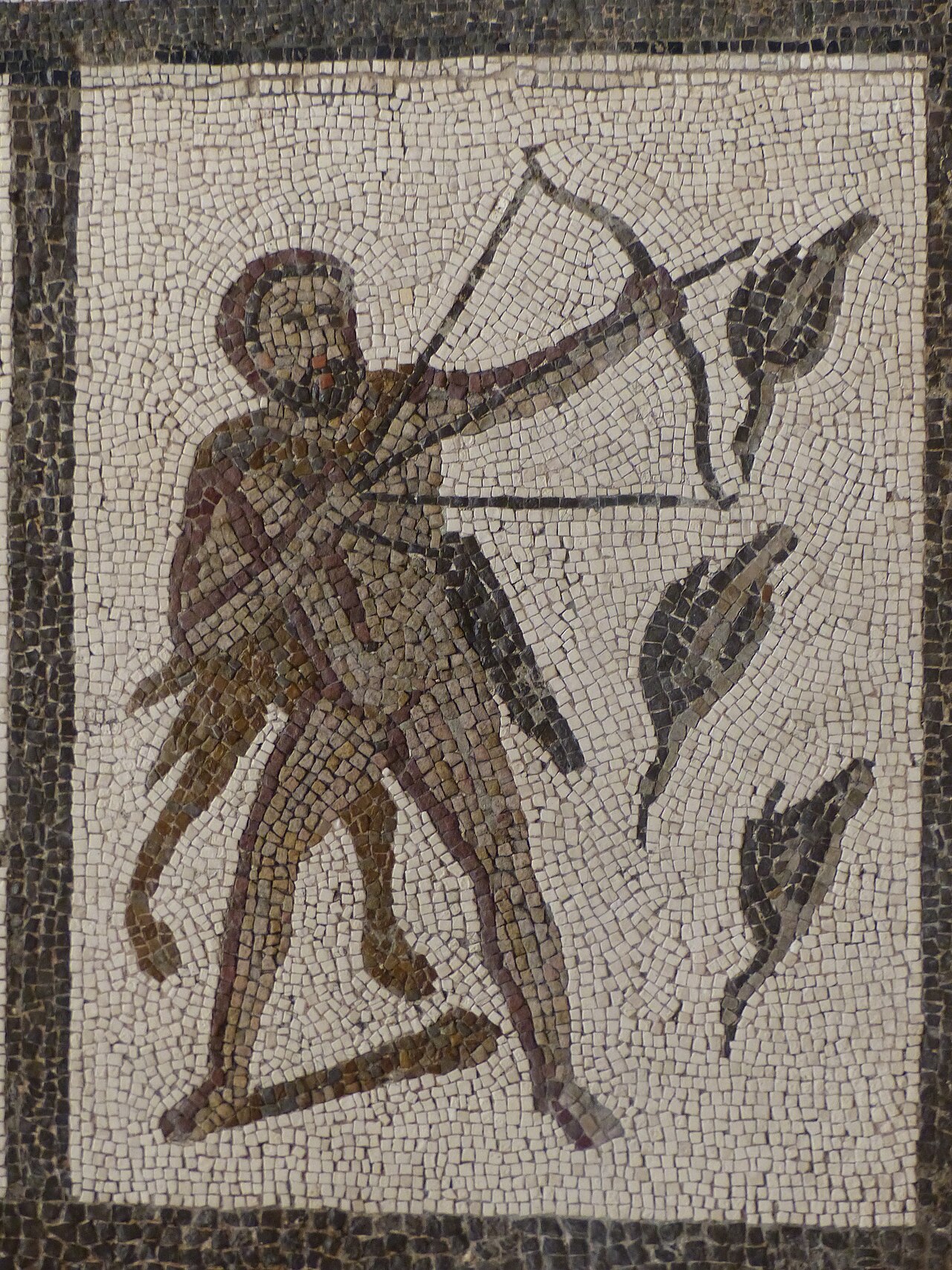
The sixth labour of Heracles was the defeat of the Stymphalian Birds, a terrifying flock of supernatural creatures that lived around Lake Stymphalus in Arcadia.
The Defeat of the Stymphalian Birds
The birds had gathered in such enormous numbers that they threatened the surrounding countryside. They damaged crops, attacked animals and made the marshlands dangerous for travellers and local inhabitants.
Ancient writers described them as fierce birds with sharp beaks, powerful claws and metallic feathers. Some traditions claimed that they could release their feathers like arrows, striking people from the sky.
King Eurystheus ordered Heracles to drive the birds away from Lake Stymphalus. The task appeared simple compared with fighting the Nemean Lion or Lernaean Hydra, but the landscape made the creatures almost impossible to reach.
The birds lived deep within a thick marsh. The soft and unstable ground could not safely support Heracles, while dense reeds concealed the flock from his arrows.
Heracles therefore needed to force the birds into the open before he could attack them.
With the assistance of Athena and a remarkable bronze instrument created by Hephaestus, Heracles frightened the birds from their hiding places and drove them into the sky.
The sixth labour demonstrated that strength alone could not solve every challenge. Heracles succeeded by using sound, strategy, divine assistance and skilled archery.
Heracles and the Twelve Labours
Heracles was the son of Zeus, king of the gods, and Alcmene, a mortal woman descended from the hero Perseus.
Because Zeus had fathered Heracles outside his marriage, Hera became the hero’s lifelong enemy.
She attempted to destroy him from infancy and later caused him to experience a terrible period of madness.
During this madness, Heracles killed members of his own family.
When his sanity returned, he was overcome with grief, guilt and shame.
Heracles travelled to the Oracle of Apollo at Delphi and asked how he might be purified.
The oracle instructed him to serve King Eurystheus of Tiryns and Mycenae.
Eurystheus assigned Heracles a series of dangerous and humiliating tasks that became known as the Labours of Heracles.
King Eurystheus
Eurystheus belonged to the royal family descended from Perseus.
According to mythology, Zeus had declared that the next descendant of Perseus to be born would become a powerful ruler.
Hera delayed the birth of Heracles and caused Eurystheus to be born first.
Eurystheus therefore gained the kingship, even though Heracles possessed far greater strength and courage.
The king feared Heracles and hoped that one of the labours would kill him.
Each time the hero returned successfully, Eurystheus searched for another challenge that appeared impossible.
The First Five Labours
Before travelling to Lake Stymphalus, Heracles had already completed five extraordinary tasks.
He had strangled the invulnerable Nemean Lion and taken its skin as armour.
He had destroyed the many-headed Lernaean Hydra with the assistance of his nephew Iolaus.
He had pursued and captured the sacred Ceryneian Hind without killing it.
He had captured the violent Erymanthian Boar alive and carried it back to Eurystheus.
He had also cleaned the vast Augean Stables in a single day by redirecting rivers through them.
These adventures had tested strength, intelligence, patience, cooperation and engineering ability.
The sixth labour would require Heracles to confront an enemy that could hide, fly and attack from a distance.
Lake Stymphalus
Lake Stymphalus was located in Arcadia, a mountainous region in the central Peloponnese.
The lake occupied a valley surrounded by hills and wooded landscapes.
Its waters were bordered by reeds, marshes and soft ground.
The area provided an ideal refuge for large numbers of birds.
Dense vegetation concealed their nests, while the unstable marsh prevented hunters from approaching easily.
The landscape itself protected the Stymphalian Birds almost as effectively as armour.
Arcadia
Arcadia was often associated with mountains, forests, shepherds and ancient rural traditions.
It was imagined as a land where human settlements existed beside deep wilderness.
Many myths connected Arcadia with the god Pan, woodland nymphs and wild animals.
The arrival of the Stymphalian Birds disturbed the balance of this landscape.
The creatures turned a natural wetland into a place of danger and fear.
The Stymphalian Birds
The Stymphalian Birds were not ordinary water birds.
They were supernatural creatures capable of threatening humans and animals.
Ancient descriptions differed, but they were generally imagined as large, aggressive and numerous.
Some accounts gave them bronze beaks and metallic claws.
Others described their feathers as sharp enough to pierce flesh.
The flock was so large that it could darken the sky when the birds rose together.
The Metallic Beaks
The birds were sometimes described as having beaks made of bronze or another hard metal.
These beaks could tear through flesh and damage armour.
A person attempting to enter the marsh might be attacked from several directions at once.
The metallic feature marked the birds as supernatural rather than ordinary animals.
The Metallic Claws
The claws of the Stymphalian Birds were also described as bronze, sharp or unusually powerful.
They could seize prey, tear animals and injure anyone who came close to their nests.
The birds were therefore dangerous both in flight and upon the ground.
The Deadly Feathers
One of the most famous traditions claimed that the birds could release their feathers like arrows.
The sharp feathers fell upon enemies with deadly force.
This ability allowed the flock to attack from a safe distance.
Heracles could not simply stand beneath the birds and fire his bow without risking a storm of metallic projectiles.
The feather weapons may have developed more fully in later accounts, but they became an important part of the birds’ legendary appearance.
The Birds as Man-Eaters
Some traditions described the Stymphalian Birds as man-eating creatures.
They attacked travellers and consumed human flesh.
Whether they literally ate people in every version, they were consistently portrayed as a serious threat to the region.
Their presence made farming, hunting and travel around the lake extremely dangerous.
The Growth of the Flock
The birds had multiplied until they occupied much of the marshland around Lake Stymphalus.
The thick reeds provided nesting places and protection from predators.
Without anyone able to enter the marsh and reduce their numbers, the flock continued to grow.
The problem became too large for ordinary hunters to solve.
The Destruction of Crops
The birds flew from the marsh into nearby fields.
They consumed seeds, grain and growing crops.
Farmers could lose much of their food and income within a short time.
The flock may also have contaminated fields and water with waste.
The creatures therefore threatened both immediate safety and the long-term survival of local communities.
The Threat to Livestock
The Stymphalian Birds also attacked animals grazing near the lake.
Their sharp beaks and claws could wound young livestock or drive herds into panic.
Shepherds could not protect their animals against a large flock attacking from above.
The Order of Eurystheus
Eurystheus commanded Heracles to remove the birds from the region.
Different versions described the task as killing them, driving them away or destroying enough of the flock to make the lake safe.
The king expected the marsh to defeat Heracles even if the birds did not.
If the hero stepped into the soft ground, he could sink or become trapped.
If he remained at the edge, the reeds prevented him from seeing his targets clearly.
Heracles Arrives at the Lake
Heracles travelled to Arcadia wearing the skin of the Nemean Lion.
He carried his bow, arrows, sword and wooden club.
When he reached Lake Stymphalus, he studied the marsh and the movement of the birds.
He quickly recognised that his ordinary weapons were not enough while the flock remained hidden.
The Problem of the Marsh
The ground surrounding the lake was soft, wet and unstable.
Heracles could not safely walk into the deepest parts of the marsh.
His weight might cause him to sink into the mud.
The reeds also limited his movement and prevented him from using his bow effectively.
The birds controlled the landscape because they could fly above obstacles that trapped human hunters.
The Problem of Concealment
The dense reeds hid the birds from view.
Heracles could hear them moving and calling, but he could not see enough clear targets.
Firing arrows blindly into the vegetation would waste ammunition and might not frighten the entire flock.
He needed a method that would force every bird to leave its hiding place at the same time.
The Problem of Numbers
Even if Heracles reached one nest, thousands of other birds could attack him.
The flock’s strength came from its size.
One bird might be easy for a hero to kill, but an entire cloud of aggressive creatures could surround and overwhelm him.
The labour required a solution affecting the flock as a whole.
Heracles Considers His Options
Heracles could not drain the lake or cut down every reed within the time available.
Entering the marsh directly was too dangerous.
Fire might have destroyed the vegetation, but it could also have spread uncontrollably and damaged the surrounding land.
The hero needed a method that would disturb the birds without trapping him in their territory.
Athena Comes to Heracles
Athena, goddess of wisdom, strategy and disciplined warfare, came to the assistance of Heracles.
She frequently supported him during the labours.
Athena recognised that the challenge required cleverness rather than direct physical force.
She brought Heracles a special bronze instrument capable of producing a loud and frightening sound.
The Bronze Rattle
The instrument was commonly described as a bronze rattle, clapper or pair of castanets.
It was known in Greek tradition as a krotalon.
When shaken or struck, it created an enormous metallic noise.
The sound was loud enough to carry across the entire marsh.
The instrument allowed Heracles to attack the birds through fear rather than physical contact.
Hephaestus
The bronze rattle was said to have been made by Hephaestus, the divine craftsman and god of metalworking.
Hephaestus created weapons, armour, jewellery and mechanical wonders for gods and heroes.
His craftsmanship transformed simple bronze into an instrument powerful enough to disturb a supernatural flock.
The labour therefore joined the wisdom of Athena with the technical skill of Hephaestus and the courage of Heracles.
Divine Assistance
Heracles had received help during earlier labours.
Iolaus had assisted against the Hydra, and Artemis had allowed the capture of the Ceryneian Hind.
During the sixth labour, divine assistance provided the tool needed to make the birds vulnerable.
Heracles still had to use the instrument correctly and face the flock when it emerged.
Heracles Finds Higher Ground
Heracles climbed onto a rocky hill, raised platform or secure area overlooking the lake.
From this position, he could remain above the unstable marsh.
He also gained a clear view of the sky and the reeds below.
The higher ground gave him room to use both the bronze rattle and his bow.
The Sound Begins
Heracles lifted the bronze instrument and began shaking or striking it.
The metallic sound spread across Lake Stymphalus.
It echoed from the surrounding mountains and disturbed the stillness of the marsh.
The noise was unfamiliar, powerful and impossible for the birds to ignore.
The Birds Panic
The Stymphalian Birds became frightened by the sound.
They left their nests and rose from the reeds in confusion.
The flock filled the air above the lake.
Birds flew in every direction as the continuing noise drove them away from their protected hiding places.
Heracles had changed the conditions of the labour.
The enemy that had been invisible and unreachable was now exposed in the open sky.
The Sky Darkens
The number of birds was so great that the flock appeared to darken the sky.
Beating wings, harsh cries and metallic feathers created chaos above the lake.
The scene may have resembled a violent storm made from living creatures.
Heracles remained upon secure ground and prepared his bow.
Heracles Uses His Bow
Heracles was an expert archer.
He had carried a bow from the beginning of the labours, although it had been useless against the invulnerable Nemean Lion.
Against the exposed Stymphalian Birds, archery became the ideal weapon.
Heracles fired arrows into the flock and struck birds as they passed overhead.
The Poisoned Arrows
Many of Heracles’ arrows had been dipped into the poisonous blood of the Lernaean Hydra.
A wound from one of these arrows could kill even a powerful supernatural creature.
The poison made his shots especially deadly.
However, ancient accounts do not always state whether every arrow used against the birds carried Hydra venom.
The hero’s accuracy and speed were enough to bring down many of the creatures.
The Birds Attack from Above
The flock did not necessarily flee without resistance.
Some birds may have turned upon Heracles and attacked from the sky.
Their beaks, claws and sharp feathers threatened him from several directions.
The Nemean Lion skin protected much of his body.
Heracles continued firing while avoiding or resisting the creatures that came close.
The Lion Skin as Protection
The hide gained during the first labour remained useful during later adventures.
Its invulnerability protected Heracles from claws, beaks and falling feathers.
The power of the defeated Nemean Lion helped him survive the attack of the birds.
The labours were connected because rewards gained in earlier tasks supported later victories.
Heracles Kills Many Birds
Heracles shot down a large number of the Stymphalian Birds.
Their bodies fell into the marsh, lake and surrounding ground.
The continued sound of the bronze rattle prevented the surviving birds from returning to their nests.
The flock began moving away from Lake Stymphalus.
The Surviving Birds Flee
Heracles did not need to kill every bird.
The surviving creatures fled from Arcadia and travelled towards distant lands.
They no longer threatened the people living around Lake Stymphalus.
The labour was complete because the region had been made safe.
The Birds of Ares
Some later traditions claimed that the surviving Stymphalian Birds travelled to an island in the Black Sea.
There they became associated with Ares, god of war.
They were sometimes called the Birds of Ares.
Their metallic weapons and aggressive behaviour suited their connection with the war god.
The Argonauts Encounter the Birds
The surviving birds appeared in the story of Jason and the Argonauts.
During their voyage, the heroes reached an island inhabited by dangerous birds resembling those driven from Lake Stymphalus.
The creatures attacked from the sky with their sharp feathers.
The Argonauts protected themselves with shields and created a great noise to frighten the flock away.
This later adventure repeated the method used by Heracles.
Heracles and the Argonauts
Heracles was himself connected with the voyage of the Argonauts in many traditions.
He travelled with Jason for part of the expedition before leaving the group.
The appearance of the birds in both heroic cycles connected the labours of Heracles with the wider mythology of Greece.
The Return to Eurystheus
After driving the birds from the lake, Heracles returned to Eurystheus.
He may have carried some of the dead birds or their metallic feathers as proof of the victory.
The people around Lake Stymphalus could also confirm that the dangerous flock had disappeared.
Eurystheus was forced to recognise the completion of the sixth labour.
The Region Is Restored
With the birds gone, farmers could return to their fields.
Shepherds could bring animals near the lake without constant fear of attack.
Travellers could pass through the region more safely.
The marsh returned to a more natural balance.
Heracles had restored order without destroying the lake itself.
The Meaning of the Sixth Labour
The sixth labour demonstrates the importance of changing the conditions surrounding a problem.
Heracles cannot defeat the birds while they remain hidden inside the marsh.
He first uses sound to force them into the open.
Only then does he use his bow.
The solution succeeds because it separates the labour into two different stages.
Forcing the Problem into the Open
The hidden birds represent a danger that cannot be confronted directly.
The bronze rattle reveals what the reeds conceal.
Once the danger becomes visible, Heracles can act effectively.
The labour suggests that difficult problems often need to be exposed before they can be solved.
Sound as a Weapon
Heracles usually fights with physical weapons such as his club, bow and sword.
During the sixth labour, sound becomes his first weapon.
The bronze rattle does not kill the birds directly.
It attacks their sense of safety and forces them to abandon their defensive position.
The labour expands the meaning of heroic power beyond physical violence.
Fear as a Strategy
The birds had used fear to control the people living around the lake.
Heracles turns fear against them.
The metallic noise causes the flock to panic and flee from its nests.
The creatures that once terrified Arcadia become terrified themselves.
The Use of Technology
The rattle created by Hephaestus represents specialised technology.
Heracles could not solve the labour through natural strength alone.
A carefully designed tool gave him the advantage he required.
The story celebrates craftsmanship alongside courage.
The Wisdom of Athena
Athena understands the true structure of the challenge.
She does not give Heracles a larger club or stronger sword.
She gives him an instrument capable of changing the behaviour of the entire flock.
Her assistance shows that wisdom chooses the correct tool rather than simply increasing force.
The Craftsmanship of Hephaestus
Hephaestus creates an object suited to a specific purpose.
The bronze instrument is small compared with the enormous flock.
Its effect is powerful because it produces exactly the kind of sound the birds cannot tolerate.
The labour demonstrates how skilled craftsmanship can multiply human ability.
Heracles and Divine Help
Heracles is the hero who completes the labour, but he does not act entirely alone.
Athena provides the solution, and Hephaestus provides the instrument.
The victory results from cooperation between mortal courage and divine knowledge.
Accepting help does not remove Heracles’ heroism because he must still face the birds and use the bow accurately.
Strength and Intelligence
The sixth labour continues a central lesson of the Heracles cycle.
Strength is most effective when guided by intelligence.
Heracles possesses the power to fight the birds, but he first needs a method of reaching them.
Planning makes physical ability useful.
The First Six Labours Compared
The first six labours test a wide range of heroic qualities.
The Nemean Lion tests direct strength and courage.
The Lernaean Hydra tests cooperation and adaptation.
The Ceryneian Hind tests patience and restraint.
The Erymanthian Boar tests hunting skill and use of terrain.
The Augean Stables test engineering and creative thought.
The Stymphalian Birds test strategy, archery and the use of specialised technology.
The Lion and the Birds
The Nemean Lion must be confronted at extremely close range because arrows cannot pierce its skin.
The Stymphalian Birds are defeated from a distance through archery.
The two labours demonstrate Heracles’ ability to fight effectively at both close and long range.
The Hydra and the Birds
The Hydra becomes more dangerous when attacked without a plan.
The birds remain safe while hidden within the marsh.
Both labours require Heracles to understand the enemy before using force.
He seals the Hydra’s wounds with fire and exposes the birds through sound.
The Hind and the Birds
The Ceryneian Hind is a sacred and peaceful animal that must remain alive.
The Stymphalian Birds are violent creatures that threaten an entire region.
Heracles pursues the hind gently but shoots the dangerous birds.
The contrast shows that he must judge each creature according to its nature and behaviour.
The Boar and the Birds
The Erymanthian Boar is captured by using snow to restrict its movement.
The birds are defeated by using sound to drive them from concealment.
In both labours, Heracles changes the environment before completing the task.
The Stables and the Birds
The Augean Stables are cleaned by using the force of rivers.
The birds are driven away by using the force of sound.
Both labours demonstrate that Heracles can direct natural or created forces rather than relying entirely upon his own muscles.
The Birds as Symbols of Disorder
The enormous flock represents disorder spreading beyond control.
Individual birds may not appear dangerous, but together they overwhelm the landscape.
The labour shows how a large number of smaller threats can become as dangerous as one great monster.
The Birds as Symbols of Hidden Danger
The Stymphalian Birds remain concealed among the reeds.
Their hidden position allows them to attack without exposing themselves.
They can represent dangers that remain powerful because they are difficult to identify or reach.
Heracles succeeds by forcing concealment to end.
The Birds as Symbols of Destructive Numbers
The strength of the flock comes partly from multiplication.
This quality connects the birds with the many heads of the Hydra.
Heracles must deal with a large and repeated threat rather than one isolated enemy.
The Marsh as a Symbol
The marsh is neither solid land nor open water.
It is an uncertain environment in which movement becomes difficult.
Such landscapes were often associated with hidden dangers, disease and mystery.
The birds use this uncertain ground against human beings.
Higher Ground as a Symbol
Heracles gains an advantage by standing upon firm and elevated ground.
From there, he can see more clearly and avoid becoming trapped in the marsh.
The position symbolises the importance of gaining perspective before acting.
The Rattle as a Symbol
The bronze rattle may symbolise the revelation of hidden corruption or danger.
Its noise disturbs what has remained protected by silence.
The instrument does not solve the entire problem, but it makes a solution possible.
Bronze in Greek Mythology
Bronze was widely used for tools, weapons, armour and ritual objects in the ancient Greek world.
Its metallic sound could be powerful and frightening.
Bronze instruments were used in ceremonies, warfare and communication.
The divine bronze rattle transformed a familiar material into a supernatural tool.
Noise in Ancient Warfare
Armies used horns, shouting, shields and weapons to create intimidating noise.
Sound could frighten enemies, coordinate soldiers and disrupt animals.
The method used against the birds reflects a real understanding of the psychological effect of noise.
Birds and Omens
Birds were important within Greek religion because their flight could be interpreted as a sign from the gods.
Prophets observed direction, movement and behaviour in the sky.
The Stymphalian Birds differed from sacred birds of omen because they represented unnatural aggression and disorder.
Their forced departure restored the sky above Arcadia to a more peaceful condition.
Birds in Greek Mythology
Many birds appeared in Greek myths.
Eagles were associated with Zeus.
Owls were connected with Athena.
Peacocks became associated with Hera.
Ravens and swans appeared in stories of Apollo.
The Stymphalian Birds belonged to a darker tradition of creatures whose natural features had become monstrous.
The Connection with Ares
The later connection between the birds and Ares emphasised their violent nature.
Ares represented the brutal and chaotic side of warfare.
The birds’ metallic feathers and attacks from the sky resembled weapons released in battle.
The Connection with Artemis
Although Artemis was a goddess of wild animals and birds, the Stymphalian creatures were not described as sacred to her in the same way as the Ceryneian Hind.
The sixth labour therefore did not require the same careful negotiation with the goddess.
The birds had become destructive and could be driven away for the protection of the region.
Heracles as an Archer
The sixth labour highlights Heracles’ skill with the bow.
He is often remembered mainly for his club and physical strength.
However, he was also one of mythology’s greatest archers.
He could strike moving targets in a crowded sky while avoiding attacks from the flock.
The Accuracy of Heracles
Shooting birds in flight required speed and precision.
The targets changed direction quickly and moved across different distances.
Heracles needed to release arrows rapidly while selecting clear shots.
The labour proves that his abilities extended beyond wrestling and close combat.
The Bow and Distance
Distance becomes essential against flying enemies.
Heracles cannot seize the entire flock with his hands or reach it with his club.
The bow allows him to project his strength into the sky.
The weapon turns careful aim into deadly force.
The Dangers of the Hydra Poison
If Heracles used his poisoned arrows, the sixth labour continued the influence of the Hydra.
The monster killed during the second labour remained present through its venom.
The poison increased the power of Heracles but also carried the possibility of accidental harm.
The arrows would later contribute to the suffering of Chiron, Pholus, Nessus and Heracles himself.
The Use of Appropriate Force
Heracles does not destroy the entire wetland in order to remove the birds.
He targets the dangerous creatures and allows many survivors to flee.
The labour restores safety without requiring the complete destruction of the landscape.
Driving Away Rather Than Destroying
The purpose of the labour is achieved when the birds no longer control Lake Stymphalus.
Heracles kills enough of them to break the flock and frighten the remainder into leaving.
The solution shows that a threat does not always need to be completely destroyed if it can be removed from the place where it causes harm.
The Question of the Birds’ New Home
The surviving birds may have created danger in another region after fleeing Arcadia.
Their later appearance in the Argonautic tradition suggests that the problem was displaced rather than entirely eliminated.
This detail gives the victory a complicated legacy.
Heracles protects one community, but the surviving creatures may threaten another.
Local Victory and Wider Consequences
Many heroic actions solve immediate problems without removing every future danger.
The sixth labour succeeds according to the command of Eurystheus and the needs of Arcadia.
The wider mythology reminds readers that displaced threats can return elsewhere.
The Labour as a Lesson in Strategy
Heracles does not begin by attacking blindly.
He identifies concealment as the main advantage of the birds.
He then uses the rattle to remove that advantage.
Only after changing the situation does he use force.
The Labour as a Lesson in Preparation
Heracles chooses firm, elevated ground before making the sound.
This preparation protects him from the marsh and provides a clear shooting position.
The success of the attack depends upon the place from which it begins.
The Labour as a Lesson in Adaptation
Heracles cannot use the same method that defeated the lion, Hydra or boar.
He adapts his strategy to an enemy capable of flight.
The hero’s greatness lies partly in refusing to treat every challenge as identical.
The Labour as a Lesson in Cooperation
The victory combines the work of Athena, Hephaestus and Heracles.
Wisdom identifies the solution.
Craftsmanship creates the tool.
Courage and skill complete the task.
The labour demonstrates that different abilities can work together towards one result.
The Labour as a Lesson in Innovation
The bronze instrument is an unexpected answer to a hunting problem.
Instead of building a larger weapon, the gods provide a tool that changes animal behaviour.
Innovation often succeeds by approaching a problem from a direction the opponent does not expect.
The Labour as a Lesson in Perspective
From the edge of the marsh, Heracles cannot see or reach the birds.
From higher ground, he understands the wider shape of the problem.
The change in position creates a change in possibility.
The story suggests that gaining perspective may reveal solutions hidden at ground level.
The Labour as a Lesson in Courage
The bronze rattle forces the birds into the open, but it also directs their attention towards Heracles.
He deliberately exposes himself to a massive and aggressive flock.
His strategy reduces one danger while creating another.
Courage remains necessary after intelligence has prepared the way.
The Labour as a Lesson in Timing
Heracles must prepare his bow before frightening the birds.
Once the flock rises, he has only a limited opportunity to strike before it scatters.
The correct sequence of actions is essential.
Sound must come first, followed immediately by archery.
The Labour as a Lesson in Revealing Problems
A hidden problem can remain powerful because it cannot be measured or confronted.
The rattle brings the birds into view.
The labour teaches that exposure is often the first stage of reform or protection.
The Labour as a Lesson in Specialised Tools
A club is useful against a lion but useless against a flock hidden in reeds.
The bronze rattle is designed for one unusual situation.
The story shows that the correct specialised tool can be more valuable than a generally powerful weapon.
The Labour as a Lesson in Controlled Fear
Fear causes the birds to abandon their strong position.
Heracles uses fear deliberately rather than becoming controlled by it himself.
The difference lies in understanding how emotion affects behaviour.
Heracles and Self-Control
Heracles must remain calm while the sky fills with hostile creatures.
Panic would ruin his aim and leave him exposed.
He controls his breathing, movement and attention as he fires.
The labour tests mental discipline as well as physical skill.
The Sixth Labour and Purification
The labours formed part of Heracles’ attempt to gain purification after the tragedy of his madness.
By removing the birds, he protects farmers, shepherds and travellers.
His personal suffering is transformed into service for a wider community.
Heroism and Public Service
Heracles receives no personal kingdom or lasting treasure from the sixth labour.
The main reward is the safety restored to Arcadia.
The story presents heroism as useful action performed for people who cannot solve the danger alone.
Heracles as a Protector
The people around Lake Stymphalus were unable to fight the flock effectively.
Heracles confronts the danger on their behalf.
His strength and skill become valuable because they protect ordinary life, agriculture and travel.
Heracles as a Civilising Hero
Many labours involve making dangerous landscapes safe for human settlement.
Heracles kills monsters, captures destructive animals and removes supernatural threats.
At Stymphalus, he restores a wetland occupied by unnatural and violent creatures.
He acts as a hero who brings order to places dominated by chaos.
The Difference Between Nature and Monstrosity
Ordinary birds belong naturally around lakes and marshes.
The Stymphalian Birds have become monstrous because of their metallic bodies, violent behaviour and overwhelming numbers.
The labour does not present all wildlife as an enemy.
It focuses upon creatures whose supernatural aggression has destroyed the balance between nature and human society.
The Restoration of Balance
After the flock leaves, the lake remains.
The reeds, water and surrounding mountains are not destroyed.
The labour restores balance rather than replacing wilderness with complete human control.
The Sixth Labour in Ancient Art
The Stymphalian Birds appeared in Greek vase painting, sculpture and other forms of ancient art.
Artists often showed Heracles aiming his bow at birds flying overhead.
He might hold the bronze rattle in one hand or have it placed nearby.
Athena sometimes appeared beside him, offering the instrument or observing the victory.
Representing the Flock
Ancient artists faced the challenge of showing a large number of birds within a limited space.
They often included only a few creatures to represent the entire flock.
Sharp beaks, open wings and aggressive movement communicated the danger.
The Appearance of Heracles
Heracles was usually shown wearing the Nemean Lion skin.
He carried a bow and quiver rather than relying upon his club.
This appearance allowed viewers to recognise both his identity and the specialised nature of the labour.
Athena in Artistic Scenes
Athena’s presence reminded viewers that the labour required wisdom and divine support.
She could be shown handing the bronze rattle to Heracles.
The image emphasised the partnership between intelligent planning and heroic action.
The Temple of Zeus at Olympia
The Twelve Labours were represented on the sculpted metopes of the Temple of Zeus at Olympia.
The Stymphalian Birds formed part of this visual sequence.
The sculptures presented Heracles developing through effort, divine guidance and varied challenges.
The Sixth Labour in Greek Literature
Greek writers preserved different descriptions of the birds and the instrument used against them.
Some emphasised their numbers and aggressive behaviour.
Others described metallic feathers or connections with Ares.
The central action remained the same.
Athena gave Heracles a noise-making device, and the hero forced the birds into the open.
The Sixth Labour in Roman Literature
Roman writers adopted the story as part of the mythology of Hercules.
They often emphasised the hero’s archery and the unnatural weapons of the birds.
The labour became part of the wider Roman image of Hercules as a conqueror of chaos and protector of civilisation.
The Birds in Later Art
Later European artists represented the Stymphalian Birds as enormous cranes, vultures or eagle-like monsters.
Some gave them metal wings or dragon-like features.
Others focused upon Heracles standing alone beneath a darkened sky.
The Sixth Labour in Modern Culture
The Stymphalian Birds appear in novels, films, television programmes, comics and games inspired by Greek mythology.
Modern versions often exaggerate their size, armour and ability to fire feathers.
Some portray the bronze rattle as a magical weapon capable of producing a shockwave.
Although details change, the basic idea of forcing hidden flying monsters into the open usually remains.
The Birds as Fantasy Creatures
The combination of animal bodies and metallic weapons makes the Stymphalian Birds well suited to modern fantasy.
They can appear as natural animals transformed by magic, creations of a god or living machines.
The ancient myth leaves enough uncertainty for many visual interpretations.
The Expression Stymphalian
The name Stymphalian refers to the birds’ connection with Stymphalus.
It identifies them through the landscape they occupied rather than through a single parent or individual name.
The creatures and the lake became permanently connected through the labour of Heracles.
Was Lake Stymphalus Real?
Lake Stymphalus was a real geographical location in the north-eastern Peloponnese.
The lake and surrounding wetlands changed in size according to rainfall, drainage and the seasons.
The real landscape may have inspired stories about large flocks of birds living among difficult marshes.
Myth transformed natural observations into an adventure involving bronze weapons and divine assistance.
Possible Natural Origins of the Myth
The story may have been influenced by real problems caused by large bird populations.
Flocks can damage crops, spread disease and create loud disturbances.
People have long used noise to scare birds from fields and settlements.
The myth enlarges this practical method into a heroic battle against supernatural creatures.
Noise as a Real Bird Deterrent
Farmers have used clappers, bells, shouting and other sounds to frighten birds for thousands of years.
The bronze rattle given to Heracles may reflect this real practice.
The supernatural scale of the instrument matches the supernatural scale of the flock.
Myth and Practical Knowledge
The sixth labour combines fantasy with practical observation.
Birds hidden in reeds are difficult to hunt.
Loud noises can force them into flight.
Once airborne, they become visible targets for an archer.
The myth turns this sequence into an adventure worthy of the greatest Greek hero.
The Central Challenge
The main difficulty is not simply killing birds.
The main difficulty is reaching an enemy protected by landscape, concealment and numbers.
Heracles succeeds only after removing those advantages.
The Central Solution
The solution has two parts.
First, the bronze rattle drives the birds from the reeds.
Second, Heracles uses his bow to kill or scatter them.
Neither action would be enough alone.
Sound without arrows would frighten the birds temporarily, while arrows without sound could not reach the hidden flock.
The Importance of Sequence
The labour demonstrates that correct actions performed in the wrong order may fail.
Heracles cannot shoot effectively before exposing the birds.
He must first create fear and movement.
The story values sequence, timing and preparation.
The Importance of the Right Tool
Heracles owns powerful weapons, but none can solve the problem while the birds remain hidden.
The simple-looking bronze instrument becomes more useful than his club or sword.
The labour teaches that the right tool is defined by the problem rather than by its size or appearance.
The Importance of Skill
Athena and Hephaestus make the victory possible, but they do not complete it for Heracles.
He must stand before the flock, operate the rattle and shoot accurately.
Divine help creates opportunity, while heroic skill turns opportunity into success.
The Importance of Courage
Forcing the birds into the sky also exposes Heracles to attack.
He knows that the flock may turn towards him.
He accepts the danger because remaining hidden would allow the creatures to continue threatening Arcadia.
The Importance of Calmness
The noise, movement and attacks of the birds could easily create panic.
Heracles remains focused and continues using his bow.
His mental control allows him to act effectively within chaos.
The Importance of Community Protection
The labour is not performed for personal wealth.
Its greatest result is the protection of farmers, animals and travellers.
Heracles’ strength gains moral value when it serves people who cannot defend themselves.
The Seventh Labour Approaches
After the defeat of the Stymphalian Birds, Eurystheus assigned Heracles another task.
The hero was ordered to travel to Crete and capture the Cretan Bull alive.
The seventh labour would carry Heracles beyond the mainland of Greece and connect him with the myths of King Minos and Poseidon.
The Legacy of the Sixth Labour
The defeat of the Stymphalian Birds remains one of the most imaginative adventures within the Twelve Labours.
It contains no single giant monster standing before Heracles.
Instead, he faces a vast flock protected by flight and marshland.
The victory reveals his skill as an archer and his willingness to use an unusual tool.
It also highlights the importance of Athena and Hephaestus within his heroic journey.
Conclusion
The sixth labour of Heracles was the defeat of the Stymphalian Birds, a dangerous supernatural flock living around Lake Stymphalus in Arcadia.
The creatures were described as possessing sharp beaks, powerful claws and metallic feathers.
Some traditions claimed that they attacked people and released their feathers like arrows.
The birds occupied a thick marsh where the soft ground prevented ordinary hunters from reaching them.
Dense reeds hid their nests and protected them from the bow of Heracles.
King Eurystheus ordered the hero to remove the flock, expecting the landscape and the great number of birds to make the task impossible.
Heracles travelled to the lake and recognised that direct attack would fail.
Athena came to his assistance and gave him a bronze rattle or pair of clappers made by Hephaestus.
Heracles climbed onto secure higher ground and used the instrument.
The enormous metallic noise echoed across the lake and frightened the birds from the reeds.
The flock rose into the open sky, where it could no longer rely upon concealment.
Heracles then used his bow and arrows to kill many of the creatures.
The surviving birds fled from Arcadia and travelled towards distant lands.
Some later traditions claimed that they settled upon an island in the Black Sea and were encountered by Jason and the Argonauts.
With the birds gone, the people around Lake Stymphalus could return to farming, herding and travelling safely.
The sixth labour demonstrated that Heracles was more than a hero of physical strength.
He succeeded because he understood the true difficulty of the challenge.
The birds were powerful because they remained hidden and unreachable.
The bronze rattle removed that advantage, while Heracles’ archery completed the task.
The labour combines the wisdom of Athena, the craftsmanship of Hephaestus and the courage of Heracles.
It teaches that hidden dangers must often be exposed before they can be defeated.
It also shows that a specialised tool can be more useful than overwhelming force.
Through sound, strategy and skill, Heracles restored order to Lake Stymphalus and completed the sixth stage of his journey towards purification, fame and immortality.