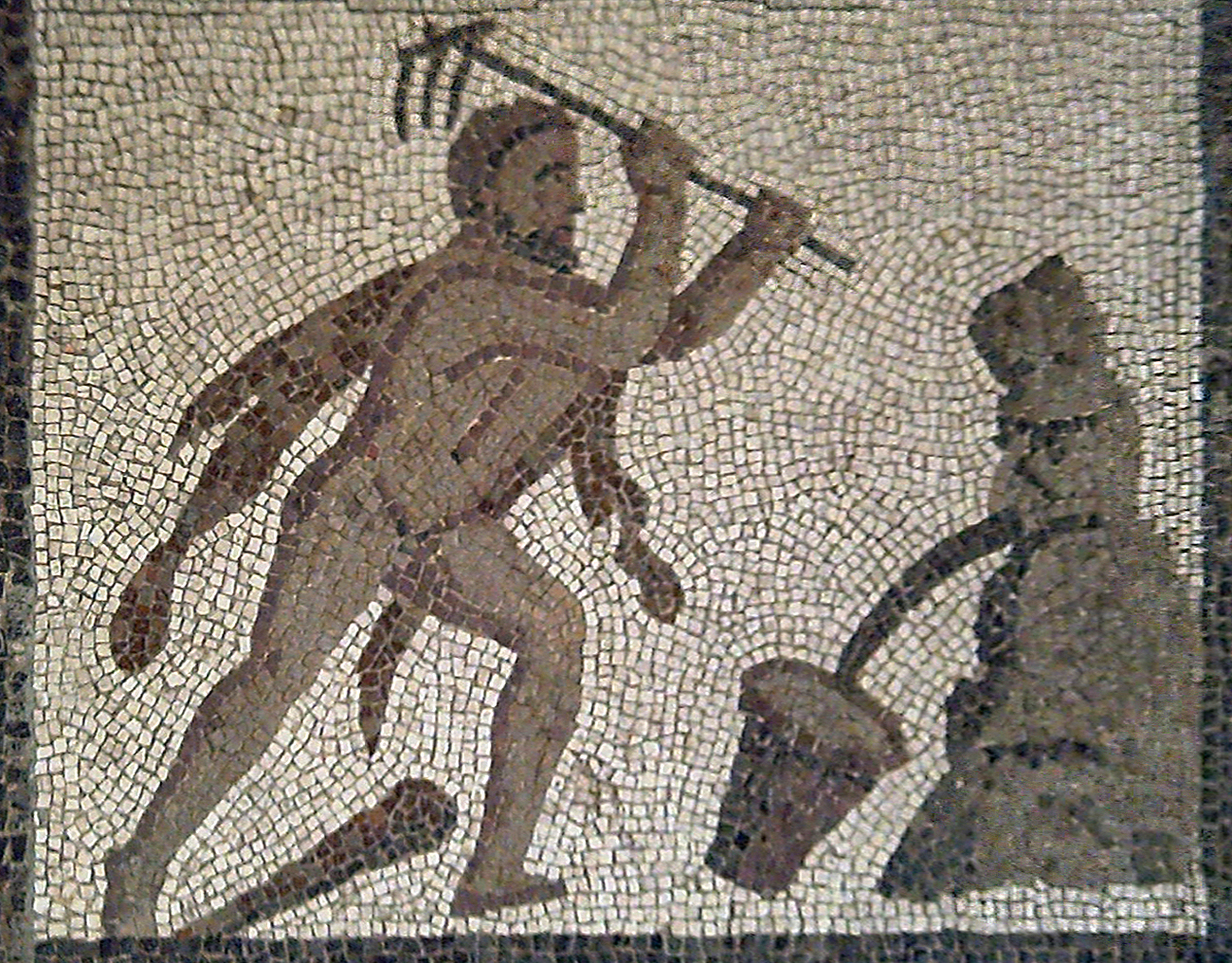
The fifth labour of Heracles was the cleaning of the vast stables belonging to King Augeas of Elis. Unlike the earlier labours, this task did not require Heracles to kill a monster, capture a sacred animal or fight a dangerous beast.
The Cleaning of the Augean Stables
Instead, Heracles was ordered to remove an enormous quantity of animal waste from buildings that had remained uncleaned for many years.
King Eurystheus expected the task to humiliate the hero. Heracles was famous for defeating the Nemean Lion, destroying the Lernaean Hydra and capturing powerful animals. Cleaning filthy stables appeared unworthy of such a celebrated warrior.
The task was also designed to be impossible. Eurystheus commanded Heracles to clean the entire stable complex in a single day.
Thousands of cattle lived upon the lands of Augeas, and their waste had accumulated into enormous piles. No ordinary worker could have completed the task within the allowed time.
Heracles did not attempt to remove the waste by hand. He studied the surrounding landscape and developed a remarkable solution.
He broke openings in the walls and redirected nearby rivers through the stables. The rushing water carried away years of filth before the day ended.
The fifth labour demonstrated that Heracles possessed intelligence, practical judgement and engineering ability as well as physical strength.
However, the labour also became a story about broken promises, dishonest kingship and unfair judgement.
Heracles and the Twelve Labours
Heracles was the son of Zeus, king of the gods, and Alcmene, a mortal woman descended from the hero Perseus.
Hera, the wife of Zeus, hated Heracles because he was the child of one of her husband’s relationships with a mortal.
She persecuted him throughout his life and eventually caused him to fall into a state of madness.
During this madness, Heracles killed members of his own family.
When his sanity returned, he was overcome with grief and guilt.
He travelled to the Oracle of Apollo at Delphi and asked how he might be purified.
The oracle commanded him to serve King Eurystheus of Tiryns and Mycenae.
Eurystheus assigned Heracles a series of dangerous and humiliating tasks.
These adventures became known as the Labours of Heracles.
King Eurystheus
Eurystheus possessed royal authority over Heracles because of divine interference surrounding their births.
Zeus had declared that the next descendant of Perseus to be born would become a powerful ruler.
Hera delayed the birth of Heracles and caused Eurystheus to be born first.
Eurystheus therefore gained the kingship, even though Heracles possessed far greater courage and strength.
The king feared Heracles and hoped that one of the labours would destroy him.
When Heracles repeatedly returned in victory, Eurystheus became increasingly determined to find tasks that could not be completed through ordinary heroism.
The First Four Labours
Before travelling to Elis, Heracles had completed four difficult labours.
He had strangled the Nemean Lion and taken its invulnerable skin as armour.
He had destroyed the many-headed Lernaean Hydra with the assistance of his nephew Iolaus.
He had captured the sacred Ceryneian Hind alive after pursuing it for an entire year.
He had also captured the dangerous Erymanthian Boar and carried it back to Eurystheus.
These adventures had established Heracles as a hunter, warrior and monster slayer.
The fifth labour would test him in an entirely different way.
A Labour Intended to Humiliate
Eurystheus wanted to reduce the dignity of Heracles.
Cleaning animal waste was normally performed by servants or labourers rather than famous warriors.
The king hoped that the task would dishonour the hero even if he somehow completed it.
Eurystheus may also have believed that no amount of strength could remove so much filth in a single day.
The task was therefore both humiliating and practically impossible.
The Kingdom of Elis
Elis was a region in the western Peloponnese.
It contained fertile land suitable for farming, grazing and the raising of livestock.
The region later became closely connected with Olympia and the ancient Olympic Games.
King Augeas ruled Elis and was famous for possessing enormous herds of cattle.
His wealth was measured partly through the number and quality of his animals.
King Augeas
Augeas was a wealthy ruler whose ancestry differed among ancient traditions.
Some stories described him as a son of Helios, the god of the sun.
Other accounts gave him a mortal father or connected him with Poseidon.
His supposed relationship with Helios helped explain the extraordinary brilliance and abundance of his cattle.
Augeas possessed great wealth, but he failed to maintain the buildings in which his animals were kept.
His neglect created the enormous problem that Heracles was ordered to solve.
The Cattle of Augeas
The herds of Augeas were said to contain thousands of cattle.
Some traditions described three thousand animals, while others gave different numbers.
The cattle were healthy, powerful and valuable.
Many had been given to Augeas by the gods or inherited through his royal family.
The size of the herds made Augeas one of the richest livestock owners in the Greek world.
However, the animals produced a vast quantity of waste every day.
The Neglected Stables
The stables had not been properly cleaned for many years.
Some accounts claimed that the waste had accumulated for thirty years.
Layers of manure covered the floors and blocked passages.
The smell would have filled the buildings and surrounding land.
Insects, disease and contamination may have threatened workers, animals and nearby water sources.
The neglect of Augeas had transformed a symbol of wealth into a place of decay.
The Command of Eurystheus
Eurystheus ordered Heracles to clean all the stables before sunset.
The hero was not given a large workforce or several days to complete the task.
Everything had to be finished within a single day.
The command appeared to require the physical removal of years of waste by one person.
Even Heracles could not shovel such an enormous quantity by hand before nightfall.
Heracles Travels to Elis
Heracles travelled across the Peloponnese towards the kingdom of Augeas.
He wore the skin of the Nemean Lion and carried the weapons associated with his earlier adventures.
However, swords, arrows and clubs offered no obvious solution to the task ahead.
The fifth labour required Heracles to look beyond the tools that had made him famous.
Heracles Meets Augeas
When Heracles arrived, he approached King Augeas and examined the stable complex.
According to the most familiar version of the story, Heracles did not initially reveal that Eurystheus had commanded him to perform the work.
Instead, he offered to clean the stables in a single day in exchange for a reward.
Augeas laughed at the proposal because he believed the task was impossible.
The king agreed to give Heracles a portion of his cattle if the work was completed before sunset.
The Promised Reward
The exact reward differed among ancient accounts.
In one version, Augeas promised Heracles one tenth of the entire herd.
This would have been an extremely valuable payment.
Augeas accepted the agreement because he believed that he would never need to honour it.
He expected Heracles to fail long before the stables were clean.
Phyleus Witnesses the Agreement
Phyleus was the son of Augeas.
He witnessed the agreement between his father and Heracles.
His presence later became important when Augeas denied making the promise.
Phyleus was placed between loyalty to his father and loyalty to the truth.
Heracles Examines the Problem
Heracles inspected the stables and the surrounding countryside.
He recognised that direct labour would not be enough.
Removing every pile by hand would require many workers and a long period of time.
The hero therefore studied the position of the buildings, the walls and the nearby rivers.
He understood that flowing water could perform work far beyond the strength of one person.
The Nearby Rivers
Two rivers were usually associated with the fifth labour.
They were the Alpheus and the Peneus.
Different versions used one or both rivers and sometimes named other streams.
The rivers carried enormous volumes of moving water through the region.
Heracles realised that this natural force could be redirected through the stables.
The River Alpheus
The Alpheus was one of the most important rivers of the Peloponnese.
It flowed through Arcadia and Elis before reaching the Ionian Sea.
The river was associated with the river god Alpheus, who appeared in several myths.
Its strong current made it suitable for the plan created by Heracles.
The River Peneus
The Peneus mentioned in the labour was usually imagined as another river or stream near the lands of Augeas.
It should not always be confused with the better-known river of the same name in Thessaly.
By combining the flow of two rivers, Heracles could create enough force to move years of accumulated waste.
Breaking the Stable Walls
Heracles began by creating openings in the stable walls.
He broke through the structure at one end and opened an exit at the other.
The water needed a clear path through the entire complex.
Without an exit, the stables would merely fill and flood without carrying the waste away.
The openings transformed the buildings into a channel through which the rivers could flow.
Digging New Channels
Heracles then dug trenches or channels between the rivers and the stables.
This work required great physical strength.
He moved soil, stones and obstacles that would normally require teams of labourers.
His power allowed him to reshape the landscape quickly enough to meet the deadline.
However, strength served a plan rather than replacing one.
Redirecting the Rivers
When the channels were prepared, Heracles broke or moved the barriers holding the water in its original course.
The rivers rushed towards the stables.
The powerful current entered through the opening he had made.
Water spread across the floors and into every passage.
The accumulated waste was lifted and carried forward.
The Stables Are Cleansed
The rushing water swept through the entire complex.
Years of manure and dirt were forced from the buildings.
The waste flowed out through the opening on the opposite side.
Areas that could not have been reached quickly by hand were washed clean by the current.
Before sunset, the stable floors were cleared.
Restoring the Rivers
After the work was complete, Heracles redirected the rivers towards their original channels.
He repaired or adjusted the earthworks so that the water would not continue flooding the land.
The rivers had served as temporary tools and were then allowed to resume their natural courses.
The task demonstrated both the use and control of natural power.
The Labour Completed in One Day
Heracles had fulfilled the apparently impossible condition.
He had cleaned the enormous stable complex before the end of the day.
He had not moved every pile personally, but he had designed and completed the system that removed it.
The labour showed that success depends upon results rather than using the most obvious method.
Augeas Sees the Clean Stables
Augeas was astonished when he saw that the stables were clean.
He had expected Heracles to fail and had promised a valuable reward only because he believed he would never have to pay it.
The success of the hero now forced the king to confront his own agreement.
Instead of honouring the promise, Augeas attempted to avoid it.
Augeas Refuses Payment
Augeas denied that he had promised Heracles a share of the cattle.
In some versions, he changed his position after learning that Eurystheus had ordered the task.
He argued that Heracles had already been required to complete the work and therefore did not deserve additional payment.
The king benefited from the clean stables while refusing the agreed reward.
The Dispute Goes Before Judges
Heracles demanded that Augeas honour the agreement.
The dispute was brought before judges or an assembly.
Heracles stated that the king had promised payment.
Augeas denied the claim.
Phyleus was called as a witness.
Phyleus Tells the Truth
Phyleus confirmed that his father had made the agreement.
He supported Heracles even though doing so challenged the authority of his own family.
His testimony demonstrated loyalty to justice rather than blind obedience.
Augeas became furious when his son spoke against him.
Augeas Expels Heracles
Augeas refused to accept the judgement.
He drove Heracles and Phyleus from Elis.
The king kept the cattle and continued denying the reward.
Heracles had completed the work but received neither payment nor gratitude.
The episode transformed the fifth labour into a story of exploitation and broken trust.
The Return to Eurystheus
Heracles returned to Eurystheus and reported that the stables had been cleaned.
The task had been completed within a single day, exactly as commanded.
Eurystheus could not deny that the buildings were clean.
However, he refused to count the task among the completed labours.
Eurystheus Rejects the Fifth Labour
Eurystheus argued that Heracles had attempted to receive payment from Augeas.
The labours were supposed to be acts of service performed under royal command.
By arranging a reward, Heracles had supposedly gained personal benefit.
Eurystheus therefore declared the labour invalid.
The decision was another example of the king using technical arguments to deny Heracles recognition.
Two Labours Rejected
Eurystheus had already refused to count the destruction of the Lernaean Hydra.
He claimed that the second labour was invalid because Iolaus had helped Heracles.
He now rejected the Augean Stables because Heracles had negotiated payment.
The original requirement of ten labours was therefore increased to twelve.
The additional tasks eventually included the golden apples of the Hesperides and the capture of Cerberus.
Was the Fifth Labour Fairly Rejected?
The rejection raises questions about fairness.
Heracles had completed the exact work ordered by Eurystheus.
The stables were clean before sunset.
The agreement with Augeas did not make the task easier.
Heracles still developed the plan, dug the channels and redirected the rivers.
Eurystheus appeared more interested in extending the hero’s service than judging the achievement honestly.
Heracles Remembers the Betrayal
Heracles did not forget the broken promise of Augeas.
After completing his service to Eurystheus or during a later period, he returned to Elis with an army.
He intended to punish the king for his dishonesty and recover justice for Phyleus.
The conflict became one of the later military adventures of Heracles.
The First Attack on Elis
Some traditions described Heracles launching an initial attack that ended unsuccessfully.
Augeas received help from powerful warriors known as the Molionides.
These brothers or joined twins were famous for their unusual strength.
They defeated or delayed the forces of Heracles.
Heracles may also have been weakened by illness during the campaign.
The Molionides
The Molionides were usually named Eurytus and Cteatus.
Some stories described them as twins, while others imagined them sharing one body or possessing connected forms.
They were sons of Actor or Poseidon and defended the kingdom of Augeas.
Their strength made them dangerous opponents even for Heracles.
Heracles Defeats the Molionides
Heracles later attacked the Molionides by surprise.
He ambushed them while they travelled to a religious or athletic festival.
The method differed from the direct battles normally associated with the hero.
After their deaths, the military protection of Augeas became much weaker.
The Defeat of Augeas
Heracles returned to Elis and defeated the forces of Augeas.
Different traditions described the king being killed, expelled or removed from power.
Heracles then placed Phyleus upon the throne.
The son who had testified honestly received the kingdom lost by his dishonest father.
Phyleus Becomes King
Phyleus had suffered exile because he told the truth.
His later restoration represented justice within the mythology.
Augeas lost the kingdom he had ruled dishonestly.
Phyleus gained authority because he had respected his promise and supported truthful judgement.
Heracles and the Olympic Games
Some traditions connected Heracles’ victory over Augeas with the establishment or reorganisation of the Olympic Games.
After defeating the king, Heracles founded a festival at Olympia in honour of Zeus.
He marked the sacred area and organised athletic competitions.
Other myths gave different founders for the games, including Pelops and earlier divine figures.
The connection with Heracles reflected his importance as a symbol of athletic strength and achievement.
The Stadium at Olympia
One tradition claimed that Heracles measured the length of the Olympic running track with his own footsteps.
The distance became known as a stadion.
This story linked the physical body of the hero with a standard used in ancient athletics and measurement.
Whether historical or mythical, the tradition strengthened the association between Heracles and the Olympic festival.
The Olive Wreath
Heracles was also connected with the olive wreath awarded to Olympic victors.
He was said to have brought a sacred olive tree from the land of the Hyperboreans or selected its branches for prizes.
The wreath represented honour rather than material wealth.
This tradition contrasts with the broken payment promised by Augeas.
True athletic glory came through recognised achievement, while dishonest rulers withheld deserved rewards.
The Fifth Labour as an Engineering Achievement
The cleaning of the Augean Stables is one of the clearest examples of practical engineering in Greek mythology.
Heracles surveys the landscape, identifies available water sources and creates channels.
He breaks walls, controls the current and provides an exit for the waste.
The solution depends upon understanding movement, gravity and water pressure.
Strength Guided by Intelligence
Heracles still uses physical strength during the labour.
He must move stones, break walls and dig channels quickly.
However, strength is effective only because it serves an intelligent design.
Without the plan, even the strongest man could not finish the work in one day.
The labour demonstrates that intelligence can multiply the value of physical effort.
Working With Nature
Heracles does not attempt to overpower the entire task alone.
He uses the rivers as partners in the work.
The water already possesses the force needed to move the waste.
Heracles changes its direction and gives it a useful path.
The labour shows how natural forces can be guided rather than resisted.
The Rivers as Tools
A tool does not need to be a manufactured object.
Heracles turns the rivers into enormous cleaning instruments.
Their current performs the repetitive labour that would otherwise require thousands of human movements.
His achievement lies in seeing a resource that others had ignored.
The Importance of Observation
Heracles succeeds because he examines the entire environment rather than looking only at the waste.
If he had focused entirely upon shovelling, the task would have remained impossible.
By studying the rivers and the stable walls, he discovered a larger solution.
The labour teaches that the best answer may exist outside the immediate problem.
The Importance of Scale
The scale of the waste makes ordinary methods useless.
A small stable can be cleaned by one worker with simple tools.
A complex containing thousands of animals requires a solution operating on the same enormous scale.
Heracles matches the size of the problem with the power of two rivers.
The Importance of Time
The one-day limit is central to the labour.
Heracles cannot rely upon slow and careful manual work.
The deadline forces innovation.
He must create a method capable of completing years of neglected work within hours.
The time pressure transforms an unpleasant task into an extraordinary heroic achievement.
The Importance of Preparation
The water does not clean the stables until Heracles prepares its path.
He must break the correct walls, dig the channels and create an exit.
Careless flooding could have damaged the buildings, drowned the animals or spread waste across valuable farmland.
Preparation determines whether natural power becomes useful or destructive.
The Importance of an Exit
Bringing water into the stables is only half of the solution.
The waste must also have somewhere to go.
Heracles creates an opening on the opposite side so that the dirty water can leave.
This detail shows that removing a problem requires a complete system rather than a dramatic beginning.
The Labour as a Lesson in Problem Solving
The fifth labour remains a powerful example of creative problem solving.
Heracles refuses to accept the obvious interpretation of the task.
He is told to clean the stables, but he is not told that every piece of waste must be carried by hand.
He focuses upon the required result and chooses the most effective method.
The Labour as a Lesson in Efficiency
Efficiency means achieving a result with the best use of time, effort and available resources.
Heracles uses a brief period of intense preparation to release a much greater natural force.
The rivers complete work that would otherwise consume months or years.
The labour demonstrates that harder work is not always better than smarter work.
The Labour as a Lesson in Innovation
No previous worker had solved the problem because they accepted the stable walls and river courses as fixed.
Heracles imagines that both can be changed.
Innovation begins when he questions the limits that others assume cannot move.
His solution is successful because it transforms the structure of the problem.
The Labour as a Lesson in Leadership
Heracles takes responsibility for a task everyone else considers impossible.
He examines the situation, forms a plan and accepts the risk of failure.
He does not complain that the work is beneath him.
His leadership appears through action rather than command.
The Labour as a Lesson in Humility
Cleaning stables is not glamorous work.
Heracles could have refused because he believed such labour was unworthy of a hero.
Instead, he accepts the task as part of his purification.
His willingness to perform unpleasant work demonstrates humility.
Heroism Beyond Battle
The fifth labour expands the meaning of heroism.
No monster is slain, and no enemy army is defeated.
The achievement comes from solving a practical problem that affects animals, workers and land.
Heroism can therefore involve sanitation, organisation and public benefit as well as combat.
The Filth as a Symbol
The accumulated waste can be interpreted as a symbol of long-neglected problems.
Years of avoidance allow a manageable duty to become overwhelming.
Augeas possesses wealth but refuses to maintain the foundation supporting it.
The filth represents the consequences of prosperity without responsibility.
Neglect and Consequence
The stables did not become filthy in a single day.
The problem grew gradually because Augeas failed to deal with it.
Every day of neglect added another layer.
The story warns that ignored responsibilities do not disappear.
They accumulate until ordinary solutions are no longer enough.
Wealth Without Responsibility
Augeas takes pride in the size of his herds.
He enjoys the wealth produced by the animals but neglects the difficult work required to care for them properly.
His kingdom displays abundance on the surface and decay beneath it.
The myth criticises rulers who enjoy rewards while ignoring maintenance and public welfare.
The Stables as a Reflection of the King
The condition of the stables reflects the character of Augeas.
Both are rich in appearance but corrupted by neglect.
The buildings contain hidden filth, while the king hides dishonesty beneath royal authority.
Heracles cleans the physical stables, but Augeas refuses moral cleansing.
The Rivers as Purification
Water frequently symbolises purification in Greek religion and mythology.
People washed before sacred ceremonies and used water to remove ritual pollution.
The rivers cleanse the stables physically, but they also suggest the removal of accumulated corruption.
The labour belongs to Heracles’ own wider search for purification after tragedy.
Physical and Moral Pollution
The stable waste represents physical pollution.
The broken promise of Augeas represents moral pollution.
Heracles can wash away the first form with rivers.
The second form requires judgement and later punishment.
The myth shows that not every kind of corruption can be removed by the same method.
Augeas and Broken Promises
Augeas agrees to pay because he believes Heracles will fail.
His promise is sincere only while he expects it to cost nothing.
When the condition is fulfilled, he denies his own words.
The story condemns agreements made without the intention of honouring them.
Phyleus and Truth
Phyleus represents honesty within a dishonest royal household.
He could have protected his position by supporting his father’s false claim.
Instead, he confirms what he witnessed.
His loyalty to truth leads to exile but eventually brings restoration.
Family Loyalty and Justice
Phyleus faces a conflict between loyalty to his father and loyalty to justice.
Greek mythology frequently places family duty beside moral duty.
Phyleus chooses truth even though it harms his immediate relationship with Augeas.
The story presents this choice as honourable.
The Unfairness of Eurystheus
Eurystheus rejects the labour for a reason unrelated to whether the work was completed.
His judgement resembles the dishonesty of Augeas.
Both kings benefit from the efforts of Heracles while denying him proper recognition.
The fifth labour therefore places the hero between two rulers who exploit authority.
Heracles Between Two Kings
Augeas controls the stables and the promised payment.
Eurystheus controls whether the labour receives official credit.
Heracles performs the difficult work, but both kings attempt to define its value.
The story exposes the frustration of achievement under dishonest leadership.
Authority Without Honour
Augeas and Eurystheus possess crowns, land and legal power.
Neither behaves with the honour expected of a good ruler.
Heracles possesses no authority over them during the labour, yet he demonstrates courage, intelligence and service.
The myth separates political rank from moral worth.
The Question of Payment
Heracles’ agreement with Augeas creates an important debate.
Was he wrong to seek payment for work he had already been ordered to perform?
One interpretation suggests that the labours required selfless service and that payment changed the nature of the task.
Another interpretation emphasises that Augeas freely agreed to reward an apparently impossible achievement.
The mythology leaves room to question whether Eurystheus used a genuine rule or merely another excuse.
Work and Reward
The story explores the relationship between labour and fair compensation.
Augeas receives enormous benefit from the cleaning.
His animals, buildings and land become safer and more useful.
Refusing payment allows the king to gain value from another person’s work without fulfilling his obligation.
The myth strongly associates such behaviour with dishonour.
Credit for Achievement
Heracles also loses official credit when Eurystheus rejects the labour.
He therefore suffers twice.
Augeas withholds the promised cattle, and Eurystheus withholds recognition.
The hero completes an extraordinary task but receives neither material reward nor official acknowledgement.
Continuing Despite Injustice
Heracles does not abandon the labours after the unfair judgement.
He continues serving Eurystheus and accepts the next command.
This endurance is part of his path towards purification.
He cannot control whether rulers behave honestly, but he can control whether he fulfils his duty.
Redemption Through Unpleasant Work
The fifth labour is important to Heracles’ redemption because it is humiliating.
Purification cannot consist only of glorious battles that increase his fame.
He must also accept work associated with dirt, service and low status.
His willingness to complete such work shows that redemption requires humility as well as courage.
The Labour and Public Health
Although ancient myth focuses upon heroic achievement, cleaning the stables would have practical benefits.
Removing accumulated animal waste would reduce insects, foul air and contamination.
It would protect the cattle and improve conditions for workers.
The fifth labour therefore produces a form of public good rather than merely a dramatic trophy.
The Labour and Agriculture
Cattle were important to ancient agriculture.
They provided meat, milk, hides, religious sacrifices and labour for ploughing.
Healthy herds could support the wealth of an entire kingdom.
Neglecting their living conditions threatened a major economic resource.
Heracles restores the infrastructure supporting the prosperity of Elis.
The Disposal of the Waste
The myth does not always explain where the river carried the waste.
It may have spread across fields, washed towards the sea or settled downstream.
Ancient audiences focused upon the miraculous cleaning rather than modern environmental concerns.
The story nevertheless shows awareness that waste must be moved beyond the place where it has accumulated.
The Phrase Augean Stables
The expression Augean stables is still used to describe a place, institution or situation affected by extreme corruption, disorder or neglect.
Cleaning the Augean stables means carrying out a complete and difficult reform.
The phrase may refer to physical dirt, but it is more often used symbolically.
It suggests that small improvements will not be enough.
A powerful and thorough solution is required.
A Herculean Task
The expression Herculean task describes work requiring extraordinary effort, strength or determination.
The Augean Stables provide one of the clearest examples.
The problem appears impossible because of its scale and deadline.
Heracles succeeds by combining effort with innovation.
Modern Interpretations of the Labour
Modern readers often interpret the fifth labour as a story about reforming a corrupt system.
The waste represents problems allowed to accumulate over many years.
The rivers represent a powerful new method capable of removing the corruption quickly.
The dishonest kings represent leaders who benefit from reform while refusing to reward or recognise those who perform it.
The Labour in Ancient Art
The fifth labour was represented less frequently than battles with visually dramatic monsters.
Artists could easily show Heracles wrestling a lion or fighting a Hydra.
Representing redirected rivers and the cleaning of buildings was more difficult.
When the labour appeared, artists might show Heracles digging, breaking a wall or directing water through the stable complex.
The Temple of Zeus at Olympia
The Twelve Labours appeared upon the metopes of the Temple of Zeus at Olympia.
The cleaning of the Augean Stables was included within this sculpted sequence.
Heracles was shown performing difficult physical work under the guidance or observation of Athena.
The setting was especially appropriate because Augeas ruled Elis, the region containing Olympia.
Athena and the Labour
Athena frequently assisted or encouraged Heracles during the labours.
She represented wisdom, strategy and controlled strength.
Her presence in artistic scenes of the Augean Stables emphasised that the solution required intelligence.
The hero’s strength became most effective when guided by thoughtful planning.
The Fifth Labour and Olympia
The connection between Augeas, Elis and the Olympic Games gave the labour special importance at Olympia.
Visitors to the Temple of Zeus saw the local landscape included within the heroic story of Heracles.
The myth connected athletic competition, religious worship and the punishment of dishonest kingship.
The Fifth Labour in Literature
Greek and Roman writers preserved different versions of the story.
Some named two rivers, while others mentioned only one.
Some described Heracles receiving or seeking payment, while others focused mainly upon the engineering achievement.
The disagreement between Augeas and Heracles also appeared in several forms.
These variations reflect the flexible nature of ancient mythology.
The Fifth Labour in Modern Culture
The Augean Stables appear in books, films, television programmes, comics and games inspired by Greek mythology.
Modern retellings often emphasise the unpleasant smell and the disbelief of Augeas.
Some portray Heracles digging channels with superhuman speed.
Others turn the labour into a puzzle that must be solved without direct strength.
A Labour Without Combat
No monster attacks Heracles during the central task.
The danger comes from failure, humiliation and the possibility of working without reward.
This makes the fifth labour unusual within the cycle.
It proves that the hero’s greatness does not depend entirely upon battle.
A Labour of Transformation
The stable complex begins as a place of filth and neglect.
By sunset, it becomes clean and usable.
The transformation is immediate and visible.
Heracles changes both the buildings and the surrounding system of water.
The First Five Labours Compared
The first five labours test an expanding range of abilities.
The Nemean Lion tests direct strength.
The Lernaean Hydra tests teamwork and strategy.
The Ceryneian Hind tests patience and restraint.
The Erymanthian Boar tests hunting skill and use of terrain.
The Augean Stables test intelligence, planning and engineering.
Heracles is becoming a hero capable of solving many different kinds of problems.
The Lion and the Stables
The Nemean Lion can be defeated only through direct physical contact.
The Augean Stables cannot be cleaned through direct physical effort alone.
In the first labour, Heracles succeeds because he uses his own body as a weapon.
In the fifth, he succeeds because he uses rivers as tools.
The Hydra and the Stables
The Hydra becomes more dangerous when attacked without understanding.
The stables remain impossible when approached through ordinary cleaning.
Both tasks require Heracles to identify the true structure of the problem.
He cauterises the Hydra’s necks and redirects rivers through the stables.
The Hind and the Stables
The Ceryneian Hind requires a year of patience.
The Augean Stables must be completed in one day.
One labour tests long endurance, while the other tests rapid innovation.
Heracles must adapt his sense of time to each challenge.
The Boar and the Stables
Heracles captures the Erymanthian Boar by using deep snow to weaken it.
He cleans the stables by using rivers to carry away the waste.
Both labours demonstrate his ability to turn the natural environment into an advantage.
The Sixth Labour Approaches
After the fifth labour was rejected, Eurystheus assigned another dangerous task.
Heracles was ordered to deal with the Stymphalian Birds.
These creatures lived in a marsh and possessed deadly beaks, claws and feathers.
The sixth labour would again require intelligence and the assistance of Athena.
The Central Lesson of the Fifth Labour
The fifth labour teaches that impossible work may become possible when the problem is viewed differently.
Heracles does not ask how one man can shovel years of waste before sunset.
He asks what force already exists that can move the waste for him.
The rivers provide the answer.
The Lesson of Creative Thinking
Creative thinking involves refusing to accept unnecessary limits.
The stable walls and river courses appear permanent, but Heracles recognises that they can be changed.
By changing the environment, he changes the task itself.
The Lesson of Preparation
Powerful resources are useful only when carefully directed.
The rivers could have caused destruction if released without proper channels.
Heracles prepares every part of the route before allowing the water to flow.
The success of the dramatic final action depends upon quiet preparation.
The Lesson of Humility
Heracles does not reject dirty work as unworthy of him.
He accepts the labour and completes it with the same determination used against monsters.
The story suggests that no necessary task is beneath a true hero.
The Lesson of Maintenance
Augeas allows the problem to accumulate for years.
Regular cleaning would have prevented the stables from becoming impossible to manage.
The myth warns that maintenance is easier than recovering from long neglect.
The Lesson of Honest Agreements
A promise should remain binding even when fulfilling it becomes expensive.
Augeas agrees to pay because he expects failure.
His refusal after success reveals that he never respected the agreement.
The story presents dishonest promises as a failure of kingship and character.
The Lesson of Truth
Phyleus speaks honestly despite the personal cost.
He loses his home but preserves his integrity.
His eventual restoration suggests that truth may suffer temporarily without losing its value.
The Lesson of Recognition
Eurystheus refuses to recognise an achievement that is obvious to everyone.
The clean stables remain proof of what Heracles accomplished.
Official denial cannot erase the reality of the work.
The myth distinguishes genuine achievement from the recognition granted by authority.
The Lesson of Persistence
Heracles receives neither the promised cattle nor credit for the labour.
He nevertheless continues with the remaining tasks.
Persistence becomes necessary when success is met with unfairness rather than reward.
The Legacy of the Augean Stables
The fifth labour remains one of the most influential stories in the cycle of Heracles.
Its name has become a lasting expression for corruption and accumulated disorder.
Its solution remains an example of intelligence overcoming impossible scale.
Its broken promises reveal the dangers of dishonest authority.
Conclusion
The fifth labour of Heracles was the cleaning of the Augean Stables in a single day.
King Augeas of Elis possessed thousands of cattle, but their stables had not been properly cleaned for many years.
Enormous quantities of waste filled the buildings and made ordinary cleaning impossible.
King Eurystheus assigned the task because he hoped to humiliate Heracles and force him to fail.
Heracles travelled to Elis and offered to clean the stables in exchange for a portion of the cattle.
Augeas agreed because he did not believe the task could be completed.
His son Phyleus witnessed the promise.
Heracles did not attempt to remove every pile by hand.
He studied the landscape and recognised that the nearby rivers possessed enough force to perform the work.
He broke openings in the stable walls, dug channels and redirected the Alpheus and Peneus through the complex.
The rushing water swept away years of accumulated waste.
Before sunset, the stables were clean.
Augeas then refused to provide the promised reward.
He denied making the agreement and rejected the testimony of Phyleus.
When Phyleus supported Heracles, Augeas expelled them both from Elis.
Eurystheus also refused to count the labour because Heracles had attempted to receive payment.
The rejection became one of the reasons the original ten labours were increased to twelve.
Heracles later returned to Elis, defeated Augeas and placed the truthful Phyleus upon the throne.
Some traditions connected this victory with the foundation or reorganisation of the Olympic Games.
The fifth labour reveals a different side of Heracles.
He does not win through combat or the destruction of a monster.
He succeeds through observation, planning, engineering and the intelligent use of natural power.
The rivers accomplish what direct strength could not.
The labour also teaches that wealth without responsibility creates decay.
Augeas enjoys the value of his herds while neglecting the work required to maintain them.
His filthy stables reflect his dishonest character.
Heracles cleans the buildings, but the king refuses the moral cleansing offered by truth and justice.
The story of the Augean Stables remains relevant because neglected problems still grow until ordinary solutions are no longer enough.
It reminds readers that difficult work can require new thinking, that promises must be honoured and that real achievement remains valuable even when dishonest rulers refuse to recognise it.