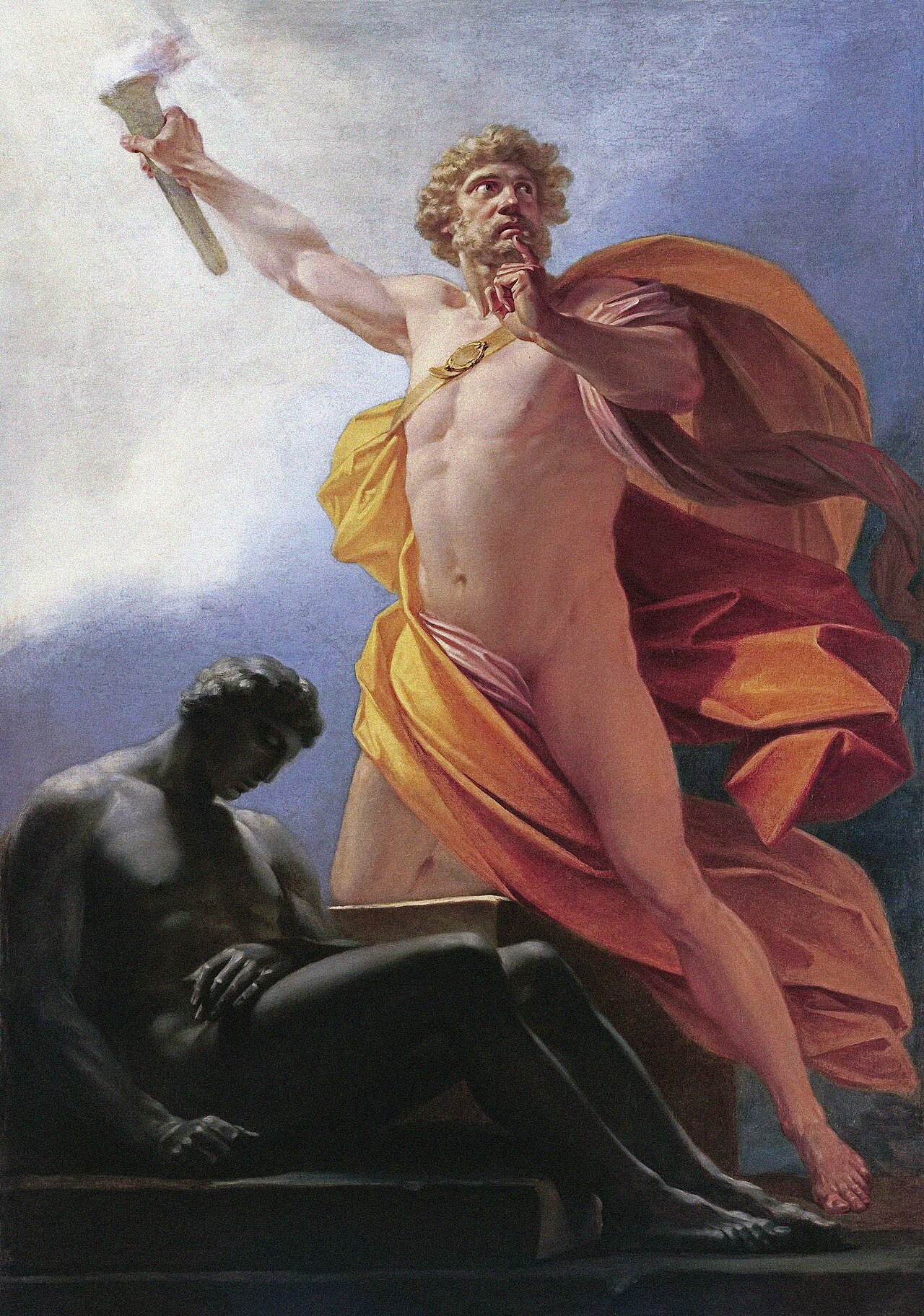
Prometheus is one of the most important and enduring figures in ancient Greek mythology. A member of the older generation of gods known as the Titans, he was remembered as a clever protector of humanity who defied Zeus, king of the Olympian gods. His greatest act was stealing divine fire and giving it to mortals, allowing human civilisation to advance.
Introduction
The myth of Prometheus explores the origins of knowledge, technology, sacrifice and human suffering. It also examines the conflict between authority and rebellion. Prometheus helped humanity despite knowing that he would face a terrible punishment, making him a symbol of courage, intelligence, endurance and resistance against injustice.
The Meaning of the Name Prometheus
The name Prometheus is commonly interpreted as meaning forethought. This meaning suited his reputation as a wise and calculating figure who could anticipate the consequences of actions before they occurred.
Prometheus had a brother named Epimetheus, whose name meant afterthought. While Prometheus considered events in advance, Epimetheus often acted first and understood the consequences only afterward.
The contrast between the brothers became especially important in the myth of Pandora. Prometheus warned Epimetheus not to accept gifts from Zeus, but Epimetheus ignored the warning and welcomed Pandora into his home.
The Family of Prometheus
Prometheus belonged to the race of Titans who ruled the cosmos before Zeus and the Olympian gods. His father was usually identified as the Titan Iapetus. Ancient sources gave different names for his mother, including Clymene and Themis.
His brothers included Epimetheus, Atlas and Menoetius. Each brother met a different fate after the war between the Titans and the Olympians.
Atlas was condemned to support the heavens, while Menoetius was struck down and sent into the underworld. Epimetheus remained closely connected with humanity through his marriage to Pandora.
Prometheus escaped the punishment suffered by many Titans because he did not remain loyal to Cronus during the great divine war. In several traditions, he supported Zeus and helped the Olympians gain victory.
The War of the Titans
Before Zeus became ruler of the universe, the cosmos was governed by his father Cronus and the Titans. Cronus feared that one of his children would overthrow him, so he swallowed them shortly after their births.
Zeus escaped this fate and later forced Cronus to release his brothers and sisters. A great war known as the Titanomachy followed between the younger Olympian gods and the older Titans.
Prometheus recognised that intelligence and strategy would decide the conflict. Rather than supporting the Titans simply because he belonged to their race, he joined Zeus and the Olympians.
After ten years of war, Zeus and his allies defeated the Titans. Many of the defeated gods were imprisoned in Tartarus, but Prometheus was allowed to remain free because of his assistance.
Prometheus and the Creation of Humanity
Later traditions described Prometheus as the creator of human beings. According to these stories, he shaped the first people from clay and water.
The goddess Athena then breathed life into the figures or helped Prometheus give them intelligence and reason. Human beings were therefore connected both with the earth from which their bodies were formed and with the divine world that gave them life.
Prometheus became deeply attached to his creations. He wanted mortals to survive, develop skills and improve their condition rather than remain weak and helpless.
Not every ancient account described Prometheus as the physical creator of humanity. However, he was consistently remembered as a benefactor who protected mortals and gave them knowledge.
Humanity Before Fire
Before receiving the gifts of Prometheus, humans were often imagined as vulnerable creatures living in darkness. They lacked the knowledge needed to build secure homes, prepare food or protect themselves from the cold.
They could see and hear, but they did not fully understand the world around them. They lived without organised crafts, agriculture, writing, navigation or medicine.
Prometheus took pity on humanity. He believed that mortals deserved the opportunity to develop intelligence, culture and civilisation.
His efforts to help them eventually brought him into direct conflict with Zeus, who wished to maintain a clear separation between gods and humans.
The Sacrifice at Mecone
One of the earliest disputes between Prometheus and Zeus concerned the division of a sacrificed animal. The event took place at Mecone and was intended to establish which parts of an animal would be offered to the gods and which parts could be kept by humans.
Prometheus killed a large ox and divided it into two portions. In one pile, he placed the meat and valuable organs but covered them with the unattractive stomach of the animal.
In the other pile, he placed the bones and covered them with shining white fat, making the portion appear more desirable.
Prometheus invited Zeus to choose between the two offerings. Zeus selected the pile covered in fat and discovered that it contained only bones.
This trick explained why Greek worshippers burned bones and fat for the gods while keeping the edible meat for themselves during sacrifices.
Zeus Withholds Fire
Zeus was furious that Prometheus had attempted to deceive him. To punish humanity, he withheld fire from mortals.
Without fire, people could not cook food, warm themselves during winter, light the darkness or produce metal tools. The loss of fire threatened human survival and prevented civilisation from developing.
Prometheus refused to accept Zeus’s decision. His loyalty to humanity was stronger than his fear of the king of the gods.
He therefore planned to steal fire from the divine realm and return it to mortals.
The Theft of Fire
Prometheus secretly entered the dwelling of the gods and took a flame. Different versions of the myth placed the fire in the forge of Hephaestus, in the workshop of Athena or in the chariot of the sun.
Prometheus concealed the flame inside the hollow stalk of a fennel plant. A fennel stalk could hold a glowing ember while protecting it from the wind.
He carried the hidden fire down from the divine world and gave it to humanity. For the first time, mortals possessed a power that had previously belonged only to the gods.
Fire became the foundation of human progress. It provided warmth, light and protection. It allowed people to cook food, shape materials and create new technologies.
The Importance of Fire
In the Prometheus myth, fire represented far more than a physical flame. It symbolised knowledge, creativity, technology and the ability to transform the natural world.
With fire, humans could harden clay into pottery and melt metal into tools and weapons. They could clear land, preserve food and gather together safely at night.
Fire also separated human beings from other animals. Although mortals remained physically weaker than many creatures, technology allowed them to survive and build communities.
The gift of fire therefore marked the beginning of civilisation. Prometheus gave humanity not simply comfort but the power to shape its own future.
Prometheus as the Teacher of Humanity
Some ancient accounts credited Prometheus with teaching humanity many skills in addition to fire. He showed people how to build houses and observe the movements of the stars.
He taught them how to understand numbers, use writing and measure the passage of time. He also introduced animal domestication, sailing, medicine and the interpretation of dreams.
Through these gifts, human beings moved from confusion toward knowledge. They learned to cooperate, preserve information and organise their societies.
Prometheus became the mythical source of the arts and sciences that allowed civilisation to flourish.
The Anger of Zeus
Zeus viewed the theft of fire as an act of open rebellion. Prometheus had ignored his command and weakened the boundary between gods and mortals.
The king of the gods decided to punish both Prometheus and humanity. The Titan would suffer physically, while mortals would receive a gift that concealed hardship beneath an attractive appearance.
Zeus ordered Hephaestus, the divine craftsman, to create the first woman. The gods named her Pandora.
The Creation of Pandora
Hephaestus shaped Pandora from clay, and the gods gave her many qualities. Aphrodite granted her beauty, Athena taught her skilled crafts and Hermes gave her a persuasive voice and curious nature.
Her name is commonly interpreted as meaning all-gifted because many gods contributed to her creation. However, she was not simply a reward for humanity.
Zeus intended Pandora to become part of the punishment caused by Prometheus’s theft of fire. Her beauty concealed the suffering that would enter the human world through her actions.
Epimetheus Accepts Pandora
Prometheus had warned his brother Epimetheus never to accept a gift from Zeus. He understood that the king of the gods might disguise punishment as generosity.
When Pandora arrived, however, Epimetheus was captivated by her beauty and accepted her despite the warning.
Pandora brought with her a sealed container. Later versions often described it as a box, although the earliest Greek account referred to a large storage jar.
Driven by curiosity, Pandora opened the container. Illness, pain, sorrow, old age and countless other troubles escaped into the world.
She quickly closed it, but only hope remained inside. From that moment onward, humanity possessed both the benefits of fire and the burdens of suffering.
The Meaning of Pandora’s Story
The story of Pandora explained why human life contained hardship despite the gifts of civilisation. Fire had improved the condition of mortals, but it had also caused conflict between Prometheus and Zeus.
The myth suggested that progress came with a price. Human beings gained knowledge and technology, yet they could not escape illness, labour, grief and death.
The survival of hope offered a more uncertain message. Hope could comfort people during suffering, but some ancient interpretations questioned whether it was a blessing or another force that prolonged human struggle.
The Punishment of Prometheus
Zeus ordered Prometheus to be captured and taken to a remote mountain. Hephaestus was commanded to chain him to a rock with unbreakable bonds.
In many later traditions, the place of punishment was located in the Caucasus Mountains. Prometheus was left exposed to cold, heat, wind and storms.
His punishment did not end with imprisonment. Each day, a great eagle came to tear open his body and eat his liver.
Because Prometheus was immortal, his liver grew back during the night. The eagle returned the following day, forcing him to endure the same agony again.
The Eagle of Zeus
The eagle was sacred to Zeus and represented his authority. By sending it against Prometheus, Zeus demonstrated that rebellion against divine rule would receive a severe punishment.
The attack on the liver was especially meaningful because the ancient Greeks sometimes associated the organ with emotion, life and inner strength.
Prometheus’s suffering was endless because his immortality prevented him from dying. He could neither escape the chains nor find relief in death.
Despite the pain, Prometheus refused to regret helping humanity. His endurance made him one of mythology’s greatest symbols of resistance.
Prometheus Bound
The ancient tragedy Prometheus Bound presents Prometheus as a defiant prisoner who condemns the harsh rule of Zeus. Chained to a remote rock, he describes the many gifts he gave humanity.
Other divine figures visit him and encourage him to submit. Prometheus refuses because he believes that Zeus has acted unjustly.
The drama presents a conflict between political power and moral responsibility. Zeus possesses authority, but Prometheus claims that his own actions were guided by compassion.
The play helped shape later interpretations of Prometheus as a rebel who suffers for defending the weak.
The Secret of Prometheus
Prometheus possessed knowledge that made him dangerous to Zeus. He knew of a prophecy concerning a woman whose son would become greater than his father.
If Zeus married this woman, the resulting child might overthrow him just as Zeus had overthrown Cronus.
Prometheus refused to reveal the name connected with the prophecy unless Zeus released him from punishment.
The woman was the sea goddess Thetis. After learning of the danger, Zeus arranged for her to marry a mortal man named Peleus.
Their son was Achilles, the greatest Greek warrior of the Trojan War. Because his father was mortal, Achilles did not become a threat to the rule of Zeus.
Heracles Frees Prometheus
Prometheus’s punishment continued until the hero Heracles passed through the region during one of his adventures.
Heracles saw the eagle attacking Prometheus and shot it with an arrow. He then broke or removed the Titan’s chains.
In many versions, Zeus allowed the rescue because Heracles was his son and because Prometheus had revealed the important prophecy about Thetis.
Prometheus was finally freed after enduring generations of suffering. His release showed that even the anger of Zeus could eventually be overcome through courage, negotiation and changing circumstances.
The Ring of Prometheus
Some traditions stated that Zeus required Prometheus to continue wearing part of his chain after being released.
A piece of the rock was placed into an iron ring that Prometheus wore on his finger. In this way, he remained symbolically bound to the mountain.
Later storytellers connected this detail with the human custom of wearing rings set with stones. The ring became a permanent reminder of Prometheus’s punishment.
Prometheus and Chiron
Another tradition connected the release of Prometheus with Chiron, the wise and immortal centaur. Chiron had been accidentally wounded by one of Heracles’s poisoned arrows.
Although immortal, Chiron suffered from a wound that could not heal. He wished to surrender his immortality so that he could die and escape the pain.
In some accounts, Chiron gave up his immortality in exchange for the freedom of Prometheus. This allowed Chiron to die and Prometheus to return to the world.
The story connected two suffering immortals whose different fates were resolved through sacrifice.
Prometheus and Zeus
The conflict between Prometheus and Zeus was not simply a struggle between good and evil. Both figures represented important forces within the Greek view of the universe.
Zeus represented divine authority, political order and the boundaries that separated gods from mortals. Prometheus represented intelligence, progress and compassion for humanity.
Prometheus’s actions helped people, but they also challenged the authority of the ruler who had recently established order after a destructive divine war.
The myth therefore raises difficult questions about whether rulers should be obeyed when their commands cause suffering and whether knowledge should be restricted by those in power.
Prometheus as a Trickster
Prometheus shared several qualities with trickster figures found in myths from many cultures. He used intelligence and deception to challenge a stronger authority.
At Mecone, he tricked Zeus during the division of the sacrifice. Later, he secretly stole fire and hid it inside a fennel stalk.
Unlike tricksters who acted only for amusement or personal advantage, Prometheus used deception mainly to benefit humanity.
His cleverness made it possible for the physically weak to gain advantages over stronger beings. Intelligence became a form of power capable of challenging divine authority.
Prometheus as a Culture Hero
A culture hero is a mythical figure who gives humanity the knowledge, tools or customs needed for civilisation. Prometheus is one of the clearest examples from Greek mythology.
He provided fire and was credited with teaching medicine, writing, mathematics, astronomy and navigation.
These gifts allowed people to overcome natural dangers and organise complex societies. Prometheus therefore represented the creative intelligence behind human achievement.
His myth explained both the brilliance of humanity and the suffering that accompanied its progress.
Fire as Knowledge
The fire stolen by Prometheus can be understood as a symbol of knowledge. Like fire, knowledge can illuminate darkness and reveal what was previously hidden.
Knowledge can improve life, but it can also create danger. Fire cooks food and warms homes, yet it can also destroy cities and weapons can be forged within it.
The myth does not present human progress as entirely safe or simple. The same intelligence that produces medicine and art can also produce conflict and destruction.
Prometheus gave humanity the ability to create, but humans became responsible for deciding how that power would be used.
Prometheus and Human Mortality
Prometheus could improve human life, but he could not make mortals equal to the gods. Humans continued to experience age, illness and death.
This limitation was central to the Greek understanding of humanity. Mortals could achieve greatness through intelligence and courage, but they could not escape the boundaries of their nature.
Prometheus reduced human helplessness without eliminating mortality. His gifts allowed people to build meaningful lives within the short time available to them.
Prometheus and Sacrifice
The myth of Mecone explained the structure of Greek animal sacrifice. Worshippers burned bones and fat for the gods while sharing the meat among the human community.
Sacrifice created a connection between gods and mortals, but the unequal division also reminded people that the two groups occupied different worlds.
The gods received smoke rising toward the heavens, while humans consumed the physical food required for survival.
Prometheus stood between these worlds, arranging the division and defending human interests.
Prometheus as a Symbol of Rebellion
In later literature and philosophy, Prometheus became a symbol of rebellion against tyranny. He challenged Zeus even though he understood the terrible risks.
His resistance was not motivated by a desire for wealth or personal power. He acted because he believed humanity deserved knowledge and protection.
This made Prometheus especially attractive to writers and political thinkers who questioned unjust authority.
His chains symbolised oppression, while the stolen flame represented freedom of thought.
Prometheus as a Symbol of Endurance
Prometheus endured repeated physical torture without surrendering his beliefs. Every day brought renewed suffering, yet he remained defiant.
His endurance transformed him from a clever trickster into a tragic hero. He accepted the consequences of his actions rather than abandoning humanity.
For this reason, Prometheus has often represented people who suffer for their principles, discoveries or attempts to improve society.
Prometheus in Ancient Greek Religion
Prometheus was more than a character in stories. He received religious honours in some parts of ancient Greece, especially in Athens.
He was associated with craftspeople, potters and metalworkers because their work depended on fire.
A torch race was held in his honour. Participants carried flames while running, reflecting the divine fire that Prometheus had delivered to humanity.
His worship was closely connected with Athena and Hephaestus, two gods associated with intelligence, craftsmanship and technology.
Prometheus and Athens
Athens valued intelligence, skilled craftsmanship and civic culture, making Prometheus an appropriate figure for the city.
He was honoured near the Academy, an area later famous for its connection with philosophy and education.
The Athenians saw fire as essential to pottery, metalworking and other crafts that supported the city’s economy and culture.
Prometheus therefore represented both practical labour and the intellectual energy that shaped civilisation.
Prometheus in Greek Art
Ancient artists depicted several moments from the Prometheus myth. Popular scenes included his punishment, the attack of the eagle and his rescue by Heracles.
Prometheus was often shown chained to a rock while the eagle approached his body. Such images emphasised his vulnerability and endurance.
Other artworks showed Heracles drawing his bow or killing the eagle. These scenes celebrated the end of the Titan’s suffering.
Prometheus also appeared in representations of the creation of humanity, shaping human figures from clay.
Prometheus in Roman Culture
The Romans adopted the Greek story of Prometheus and continued to represent him in literature and art.
Roman writers were especially interested in his role as the creator of humanity and the giver of fire.
He appeared in wall paintings, carved stones and decorated objects. His punishment remained a powerful image of suffering and endurance.
Through Roman culture, the Prometheus myth was preserved and passed into later European traditions.
Prometheus in Renaissance Art
During the Renaissance, European artists and scholars renewed their interest in Greek and Roman mythology. Prometheus became an important subject in painting, sculpture and literature.
Artists depicted his creation of humanity, his theft of fire and his punishment on the mountain.
The myth suited Renaissance interest in human intelligence and creativity. Prometheus could be seen as a figure who encouraged people to explore nature and develop new skills.
At the same time, his punishment warned that ambition and knowledge could bring suffering.
Prometheus and Romanticism
Prometheus became especially important to writers of the Romantic period. They often admired rebels, outsiders and individuals who resisted oppressive authority.
For these writers, Prometheus represented the creative spirit refusing to submit to tyranny.
The poet Percy Bysshe Shelley presented a transformed version of the myth in Prometheus Unbound. His Prometheus becomes a symbol of moral resistance and liberation.
Lord Byron and other Romantic writers also used Promethean themes to explore suffering, defiance and the power of the human mind.
Frankenstein and the Modern Prometheus
Mary Shelley gave her novel Frankenstein the subtitle The Modern Prometheus. The title connected the scientist Victor Frankenstein with the ancient Titan.
Like Prometheus, Victor attempts to take control of a power associated with the gods. He discovers how to create life and brings a new being into the world.
However, Victor fails to care responsibly for his creation. His scientific achievement leads to fear, isolation and tragedy.
The comparison shows how the Prometheus myth can be used to question the responsibilities that accompany knowledge and invention.
Promethean Ambition
The word Promethean is often used to describe bold creativity, revolutionary discovery or an attempt to overcome traditional human limitations.
A Promethean individual may challenge accepted boundaries in science, art, politics or technology.
The term can be positive when it describes courageous innovation. It can also be critical when ambition becomes reckless or ignores possible consequences.
This double meaning reflects the myth itself. Prometheus’s gift improved human life, but it also brought punishment and new forms of suffering.
Prometheus and Science
Prometheus is frequently used as a symbol of scientific discovery. Researchers seek knowledge that can transform the world, just as divine fire transformed human existence.
Scientific advances can cure disease, improve communication and expand understanding. However, they can also create dangerous technologies.
The Prometheus myth asks whether every form of knowledge should be pursued and who should decide how new powers are used.
It also suggests that inventors have responsibilities toward the people affected by their discoveries.
Prometheus and Technology
Fire was one of humanity’s earliest and most important technologies. It allowed people to alter materials rather than simply use them in their natural state.
For this reason, Prometheus remains an appropriate symbol for modern technological development.
Electricity, engines, computers and advanced machines can all be seen as later forms of the transformative fire he gave humanity.
Like fire, technology can liberate or destroy depending on how it is controlled.
Prometheus and Freedom of Thought
Prometheus has also become a symbol of intellectual freedom. He refused to allow Zeus to keep humanity in ignorance.
His stolen flame can represent education, independent thought and access to information.
Authorities may attempt to restrict knowledge because knowledge gives people greater control over their own lives.
The Prometheus myth celebrates the belief that understanding should not belong only to the powerful.
Prometheus as a Tragic Figure
Prometheus is heroic because he helps humanity, but his story is also tragic. His intelligence allows him to foresee suffering, yet he chooses the path that leads directly toward it.
He knows that Zeus will punish him, but he values human survival more than his own comfort.
His tragedy comes from the conflict between two loyalties. Obedience would protect him, while compassion requires rebellion.
Prometheus accepts pain because he believes that helping humanity is morally necessary.
The Differences Between Prometheus and Epimetheus
Prometheus and Epimetheus represent two opposite approaches to decision-making. Prometheus thinks before acting, while Epimetheus understands only after events have taken place.
Prometheus anticipates that Zeus’s gifts may be dangerous. Epimetheus is attracted by Pandora and ignores the warning.
Together, the brothers symbolise the human struggle between careful planning and impulsive desire.
Their stories suggest that intelligence is not simply the possession of knowledge but the ability to recognise future consequences.
Prometheus and the Human Condition
The Prometheus myth provides an explanation for the complicated nature of human life. People possess intelligence and creativity but remain vulnerable to suffering and death.
They can build cities, produce art and study the stars, yet they cannot control every force of nature.
Human greatness comes from the ability to create despite these limits. Fire does not make mortals immortal, but it allows them to improve the world in which they live.
Prometheus represents the hope that knowledge can reduce suffering even when it cannot remove it entirely.
Different Versions of the Myth
Greek mythology did not have a single official version of the Prometheus story. Poets and storytellers changed details according to their own purposes.
In some accounts, Prometheus was mainly a trickster who deceived Zeus. In others, he was a noble defender of humanity.
Some writers emphasised his creation of humans from clay, while others focused on the theft of fire or the secret prophecy.
These different versions allowed Prometheus to develop into one of the most complex figures in Greek mythology.
The Moral Complexity of Prometheus
Prometheus cannot easily be described as entirely obedient or entirely lawless. He helps humanity through actions that involve deception and theft.
Zeus appears harsh when he punishes mortals, yet he also represents the order that prevents the universe from returning to chaos.
The myth does not offer a simple answer about which figure is completely right. Instead, it presents a conflict between authority, justice, compassion and progress.
This moral uncertainty helps explain why the story remains meaningful to modern audiences.
The Legacy of Prometheus
Prometheus has influenced literature, theatre, philosophy, science and political thought for thousands of years.
He has been portrayed as a thief, teacher, creator, prophet, revolutionary and martyr. Each interpretation emphasises a different part of his complicated character.
Artists remember his terrible punishment, while writers celebrate his refusal to surrender. Scientists and inventors identify with his search for transformative knowledge.
His name continues to represent the desire to challenge limitations and improve the human condition.
Conclusion
Prometheus was the Titan who risked everything to help humanity. Through cunning, he secured the best part of the sacrifice for mortals. Through courage, he stole fire from the gods and brought it to the earth.
His gift allowed human beings to cook, build, create tools and establish civilisation. He was also credited with teaching writing, mathematics, medicine, navigation and other essential skills.
Zeus punished Prometheus by chaining him to a mountain where an eagle repeatedly consumed his liver. Despite his suffering, the Titan refused to abandon his principles or surrender the knowledge he possessed.
Prometheus was eventually freed by Heracles, but his story continued to represent the price of rebellion and progress. His flame became a symbol of knowledge that could illuminate the world while also creating danger.
The myth of Prometheus asks lasting questions about the ownership of knowledge, the responsibilities of inventors and the right to resist unjust authority. It celebrates human creativity while warning that every powerful discovery carries consequences.
For ancient and modern audiences, Prometheus remains one of mythology’s greatest champions of humanity, a figure whose intelligence, compassion and endurance transformed him into an enduring symbol of freedom and hope.