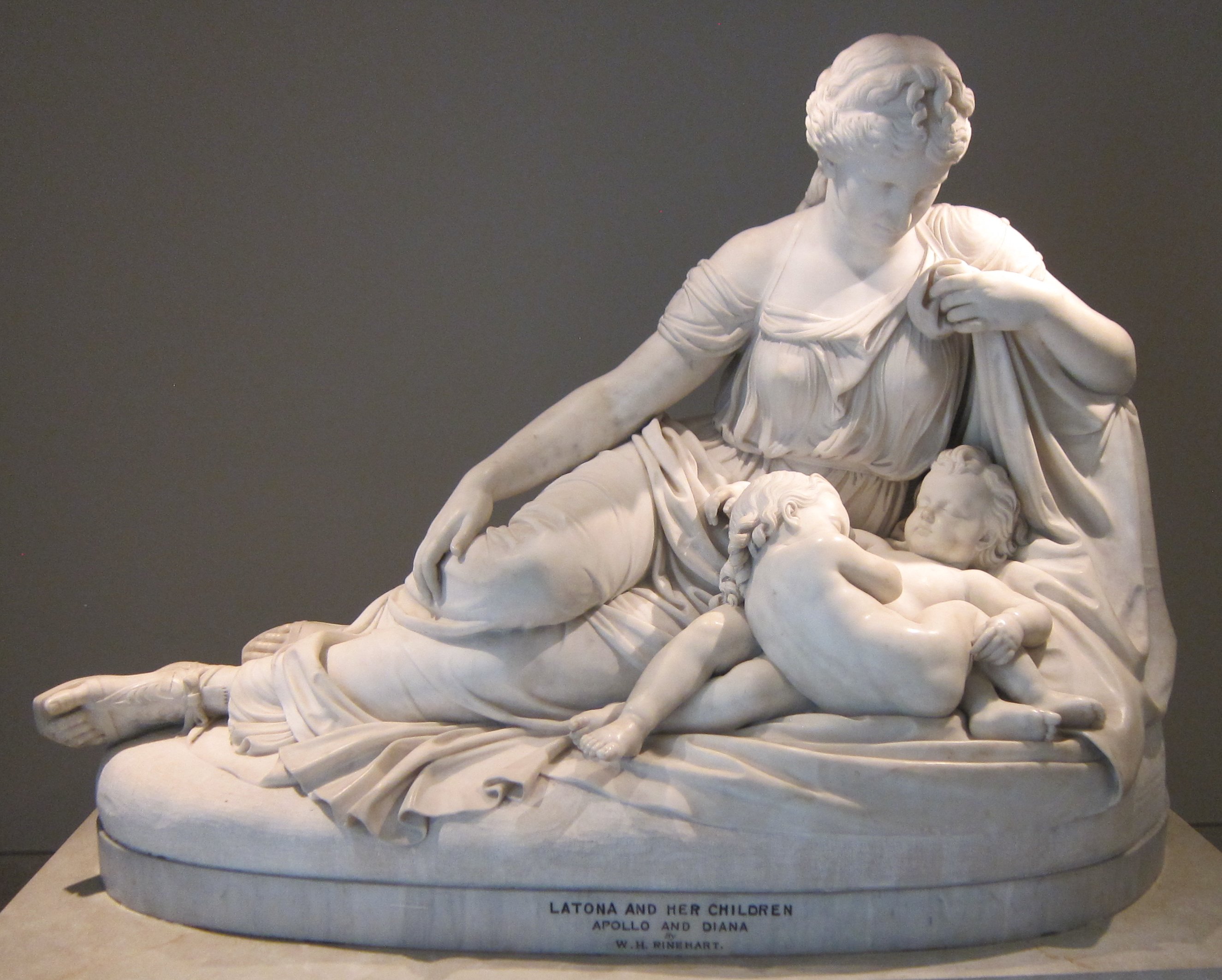
Leto – The Titan Goddess of Motherhood and Mother of Apollo and Artemis
Leto was one of the most important Titan goddesses in ancient Greek mythology, celebrated as the mother of the divine twins Apollo and Artemis. Associated with motherhood, maternal protection, and the dignity of divine birth, she occupied a significant position within the Greek pantheon. Although Leto rarely appeared as the central figure in the great adventures of Greek mythology, her influence extended throughout the ancient religious world through her famous children and the sanctuaries dedicated to her worship.
As the daughter of the Titans Coeus and Phoebe, Leto belonged to an ancient generation of divine beings whose origins preceded the establishment of the Olympian gods. Her relationship with Zeus, king of the gods, made her the mother of two of the most influential Olympian deities: Apollo, the god of prophecy, music, archery, and healing, and Artemis, the goddess of hunting, wild animals, and the protection of young life.
Leto's mythology is particularly famous for the suffering she endured during her pregnancy. Pursued and persecuted by Hera, the jealous wife of Zeus, she wandered across the world searching for a place where she could safely give birth. Her eventual refuge on the island of Delos became one of the most celebrated events in Greek religious history.
Despite the hardships she faced, Leto emerged as a powerful and respected divine mother. Her children defended her honour, and her worship spread across Greece and Asia Minor. Her mythology reflects themes of perseverance, maternal devotion, divine protection, and the importance of family relationships among the gods.
The Origins of Leto
According to Hesiod's Theogony, Leto was the daughter of Coeus and Phoebe, two members of the original generation of Titans.
Coeus was the son of Gaia, the primordial goddess of the Earth, and Uranus, the personification of the Sky. Phoebe was likewise one of their children, making Leto a descendant of the earliest divine generation.
Leto's sister was Asteria, a Titan goddess associated in later traditions with the stars and nocturnal divination. Asteria became the mother of Hecate, the powerful goddess connected with crossroads, magic, and the boundaries between different realms.
Through this family, Leto was connected with several important divine figures associated with prophecy and the celestial world.
Her mother Phoebe was linked in some ancient traditions with prophetic knowledge, while her son Apollo eventually became the principal god of the celebrated oracle at Delphi.
Although Leto belonged to the Titan family, she was not portrayed as an enemy of the Olympian gods. Instead, her relationship with Zeus and her position as the mother of Apollo and Artemis connected her directly with the Olympian order.
The Meaning of Leto's Name
The name Leto was written in ancient Greek as Lētō. Its precise etymology remains uncertain, and scholars have proposed several possible explanations.
Ancient and later interpretations sometimes connected her name with ideas of concealment, obscurity, or hidden things. However, these interpretations are not universally accepted, and no definitive meaning has been established.
In Roman mythology, Leto was known as Latona, the Latin form of her name.
Her Roman identity preserved the central features of her Greek mythology, particularly her relationship with Jupiter, the Roman counterpart of Zeus, and her motherhood of Apollo and Diana.
The survival of her name in Greek and Roman traditions demonstrates the importance of Leto as a figure whose influence extended beyond the earliest stories concerning her children's birth.
Leto and the Titan Generation
Leto belonged to the generation of divine beings descended from the original Titans, who played a central role in the earliest stages of Greek mythology.
The Titans were the children of Gaia and Uranus and represented an ancient divine order that existed before Zeus established his supremacy.
Among the most prominent Titans were Cronus, Rhea, Oceanus, Hyperion, Themis, Mnemosyne, Coeus, and Phoebe.
When Zeus and his allies challenged Cronus during the Titanomachy, the older divine order was transformed.
Many Titans who opposed Zeus were defeated and imprisoned in Tartarus, while other members of the Titan family continued to occupy important positions within the mythological universe.
Leto was among those whose divine status remained significant under Olympian rule.
Her story illustrates that the distinction between Titans and Olympians was not simply a division between hostile groups. Divine relationships frequently crossed generational boundaries, and many descendants of the Titans became central figures in the Olympian world.
Leto and Zeus
One of the defining relationships in Leto's mythology was her union with Zeus, the supreme ruler of the Olympian gods.
Zeus was famous for his relationships with numerous goddesses and mortal women, many of whom became the mothers of important divine or heroic figures.
Leto became the mother of Apollo and Artemis through her relationship with Zeus.
According to Hesiod, Leto was among the divine consorts of Zeus and gave birth to two extraordinary children whose powers would become essential to the Olympian order.
However, Leto's pregnancy brought her into conflict with Hera, the wife of Zeus and queen of the Olympian gods.
Hera frequently appeared in Greek mythology as a defender of marriage whose anger was directed towards women involved with Zeus.
In several traditions, Hera's jealousy caused Leto to experience tremendous suffering before she could give birth.
The conflict between the two goddesses became central to the mythology explaining the birth of Apollo and Artemis.
The Jealousy of Hera
Hera was one of the most powerful goddesses of Olympus, associated with marriage, queenship, and the protection of lawful unions.
When Leto became pregnant with the children of Zeus, Hera reacted with jealousy and anger.
According to several later mythological traditions, Hera attempted to prevent Leto from finding a place where she could safely give birth.
Some accounts describe Hera forbidding the lands of the Earth from welcoming Leto, forcing the pregnant goddess to wander in search of sanctuary.
Other traditions describe Hera delaying the birth by preventing Eileithyia, the goddess of childbirth, from assisting Leto.
The different accounts emphasise the extraordinary difficulties faced by Leto as she approached the end of her pregnancy.
Her suffering became one of the most memorable examples of divine persecution in Greek mythology.
Despite Hera's power, Leto ultimately found refuge and successfully brought her children into the world.
Leto's Wanderings Across the World
One of the most famous stories concerning Leto describes her desperate search for a place where she could give birth.
Pregnant with the children of Zeus and threatened by Hera's hostility, Leto travelled through different regions of the Greek world.
Ancient poets described her journey as a prolonged search for a land willing to receive her.
In the Homeric Hymn to Apollo, Leto approaches numerous locations before reaching the island of Delos.
The poem names places throughout the Aegean world, creating an expansive geographical setting for her journey.
Many lands were unwilling to welcome her because they feared the extraordinary power of the child she carried.
The unborn Apollo was destined to become a mighty god, and the inhabitants of the places Leto visited worried about the consequences of his birth.
Eventually, Leto reached Delos, a small island in the Aegean Sea.
There she found the refuge that would make the island sacred for generations to come.
The Island of Delos
Delos became one of the most important sacred locations in ancient Greek religion because of its association with Leto and the birth of Apollo and Artemis.
The island lies in the Aegean Sea, near Mykonos, and belongs to the Cyclades.
In mythological tradition, Delos was initially reluctant to receive Leto because it feared that Apollo would become a powerful and demanding deity.
Leto reassured the island that her son would honour the place of his birth.
In the Homeric Hymn to Apollo, she promised that Apollo would establish a magnificent sanctuary and receive religious offerings there.
Delos eventually agreed to welcome the goddess.
This agreement transformed the island into a sacred birthplace and established its special relationship with Apollo.
In later mythology, Delos was sometimes described as a floating island that became fixed in place after Leto gave birth.
Although these details vary between ancient traditions, the essential theme remains the same: Delos offered sanctuary to Leto when other lands refused her.
The Birth of Artemis
Artemis, daughter of Zeus and Leto, was one of the most important goddesses of the Olympian pantheon.
She became associated with hunting, wild animals, wilderness, young life, and the protection of childbirth.
Some ancient traditions described Artemis as being born before her twin brother Apollo.
According to a later account preserved by Apollodorus, Artemis was born on the island of Ortygia, while Apollo was born on Delos.
Other traditions identified Ortygia with Delos or treated the two locations as closely connected.
In a popular later interpretation, Artemis assisted Leto during the birth of Apollo, demonstrating her extraordinary divine abilities immediately after her own birth.
This story helped explain the apparent paradox of Artemis becoming associated with childbirth despite remaining an eternal virgin goddess.
Her association with the protection of women giving birth reflected the divine assistance she was believed to provide during one of the most dangerous experiences of ancient life.
Through Artemis, Leto became the mother of a goddess whose influence extended across the natural world and the lives of women and children.
The Birth of Apollo
The birth of Apollo was one of the most celebrated events in Greek mythology.
According to the Homeric Hymn to Apollo, Leto endured nine days and nights of labour before her son was born.
Several goddesses gathered around her, including Dione, Rhea, Themis, Amphitrite, and other divine figures.
However, Eileithyia, the goddess of childbirth, remained absent because Hera had prevented her from learning of Leto's suffering.
The assembled goddesses eventually sent Iris, the divine messenger, to summon Eileithyia.
When Eileithyia arrived, Leto's labour reached its conclusion.
Leto embraced a palm tree, and Apollo was born upon the sacred island of Delos.
The newborn god was washed, wrapped in fine cloth, and given divine nourishment.
According to the hymn, Apollo immediately declared his association with the lyre, the bow, and the prophetic will of Zeus.
His birth marked the arrival of a deity who would become one of the most influential gods of the ancient Greek world.
The Sacred Palm Tree of Delos
The palm tree associated with Apollo's birth became one of the most important symbols of Leto's mythology.
In the Homeric Hymn to Apollo, Leto grasps a palm tree while giving birth to her son.
The image became closely connected with the sacred landscape of Delos.
Ancient visitors recognised the island as the birthplace of Apollo, and its religious traditions preserved memories of the divine event.
The palm tree symbolised the physical location of the birth and the transformation of Delos into a sacred sanctuary.
It also represented the endurance of Leto during her suffering and the successful arrival of her divine child.
The story demonstrates how natural features could acquire religious importance through their association with mythological events.
Leto – The Mother of Apollo and Artemis
Leto's greatest mythological importance came from her position as the mother of Apollo and Artemis.
Her children represented two of the most influential divine powers in Greek mythology.
Apollo became the god of prophecy, music, archery, healing, and purification. He was especially associated with the oracle at Delphi, where his priestess delivered prophetic responses to those seeking divine guidance.
Artemis became the goddess of hunting, wild animals, wilderness, and the protection of young life.
Although the twins possessed different responsibilities, they were closely connected through their shared parentage and frequently acted together in mythological stories.
Both were renowned for their skill with the bow and their ability to deliver swift divine punishment.
They also shared a profound loyalty towards their mother.
Several famous myths describe Apollo and Artemis defending Leto against those who insulted or threatened her.
Through these stories, Leto became a symbol of maternal dignity and the powerful bonds between parents and children.
Leto and Apollo
Apollo was one of the most celebrated gods of ancient Greece, and his relationship with Leto remained an important part of his divine identity.
As the son of Zeus and Leto, Apollo possessed extraordinary authority within the Olympian pantheon.
He became associated with the arts, music, prophecy, healing, archery, and divine purification.
His sanctuary at Delphi became one of the most important religious centres of the Greek world.
Although Apollo frequently appeared independently in mythology, ancient poets continued to identify him through his maternal ancestry.
He was sometimes described as Leto's son or the Letoid, emphasising his relationship with the Titan goddess.
Apollo's devotion to Leto was particularly evident in stories concerning the punishment of those who challenged her honour.
His extraordinary power ensured that insults directed towards his mother could provoke severe divine consequences.
Leto and Artemis
Artemis shared a similarly close relationship with her mother Leto.
As the goddess of the hunt and wilderness, Artemis represented independence, purity, and mastery over wild nature.
She was also associated with the protection of young animals, children, and women during childbirth.
Her mythology frequently emphasised her determination to defend her personal dignity and the honour of her family.
Artemis was particularly protective of Leto and appeared alongside Apollo in stories involving divine punishment.
In the myth of Niobe, Artemis and Apollo acted together to avenge an insult directed against their mother.
The relationship between Leto and Artemis contributed to the wider Greek understanding of maternal bonds and divine family loyalty.
Leto and Niobe
One of the most famous myths involving Leto concerns Niobe, the proud queen of Thebes.
Niobe was the wife of Amphion and the mother of numerous children. Ancient sources differed concerning their exact number, although a common tradition described seven sons and seven daughters.
Niobe became arrogant because of her large family and began comparing herself favourably with Leto.
She questioned why the people of Thebes should honour Leto, who had only two children, when she herself possessed so many.
Her words were interpreted as an insult against the divine mother of Apollo and Artemis.
When Leto learned of Niobe's arrogance, her children responded with terrible punishment.
Apollo struck down Niobe's sons with his arrows, while Artemis killed her daughters.
The destruction of Niobe's family became one of the most tragic examples of divine retribution in Greek mythology.
The story reflected the ancient Greek belief that excessive pride, particularly when directed against the gods, could bring disaster.
The Punishment of Niobe
The punishment of Niobe became one of the most emotionally powerful stories in ancient Greek literature and art.
After her children were killed by Apollo and Artemis, Niobe was overwhelmed by grief.
According to Ovid's Metamorphoses, she eventually became transformed into stone.
Even after her transformation, the stone continued to shed tears, symbolising her endless sorrow.
The petrified Niobe was associated with Mount Sipylus in Asia Minor, where natural rock formations became connected with her legend.
The myth demonstrates the destructive consequences of hubris, the excessive pride that caused mortals to challenge divine authority.
However, it also reveals the severe and sometimes frightening nature of divine punishment in Greek mythology.
Leto herself did not personally kill Niobe's children in the principal surviving versions of the story. Instead, Apollo and Artemis acted to defend their mother's honour.
The episode established Leto as a goddess whose dignity commanded extraordinary respect.
Leto and the Giant Tityos
Another important myth describes Leto's encounter with the giant Tityos.
Tityos was a gigantic figure associated with the Earth and the Underworld.
According to several ancient traditions, he attempted to assault Leto while she was travelling.
In some versions, his actions were encouraged by Hera, whose hostility towards Leto continued after the birth of Apollo and Artemis.
Apollo and Artemis intervened to protect their mother.
They attacked Tityos with their arrows and defeated him.
As punishment for his offence, Tityos was condemned to suffer in the Underworld.
In Homer's Odyssey, Odysseus sees Tityos stretched across an enormous area while vultures tear at his liver.
The punishment reflected the seriousness of attempting violence against a goddess.
The myth also reinforced the reputation of Apollo and Artemis as powerful defenders of Leto.
Leto and Python
The serpent Python was one of the most famous creatures associated with Apollo's early mythology.
Python was connected with the region of Delphi, which later became the principal centre of Apollo's prophetic worship.
According to several traditions, Apollo killed Python with his arrows and established his authority over the sanctuary.
Some later accounts connected Python with Hera's hostility towards Leto, describing the serpent as a creature that threatened the pregnant goddess.
However, this connection was not universal in ancient Greek mythology.
In the Homeric Hymn to Apollo, the story of the serpent at Delphi forms part of Apollo's establishment of his sanctuary rather than a simple account of revenge for persecution during Leto's pregnancy.
The different versions demonstrate how mythological traditions evolved and became connected with one another over time.
Through Apollo's victory at Delphi, Leto's divine family acquired an enduring association with prophecy and sacred religious authority.
Leto and the Lycian Peasants
One of the most famous later stories concerning Leto describes her encounter with a group of peasants in Lycia, a region of southwestern Asia Minor.
The story is especially well known from Ovid's Metamorphoses.
According to this account, Leto was travelling with her young children when she became desperately thirsty.
She approached a pond where local peasants were collecting reeds and asked permission to drink from the water.
Instead of helping her, the peasants refused and attempted to drive her away.
They then disturbed the water, stirring up mud and making it unsuitable for drinking.
Angered by their cruelty and lack of hospitality, Leto called upon divine power to punish them.
The peasants were transformed into frogs, condemned to live in the muddy waters they had deliberately spoiled.
The story became a memorable example of divine punishment for refusing assistance to someone in need.
The Meaning of the Lycian Frog Myth
The transformation of the Lycian peasants into frogs carried several moral and symbolic meanings.
Hospitality and kindness towards strangers were important values in the ancient Greek world.
Travellers depended upon the generosity of local communities for water, food, and shelter.
By refusing Leto a drink and deliberately muddying the pond, the peasants violated the expectations of hospitality.
Their transformation into frogs reflected the principle that actions could bring consequences appropriate to the offence.
Because they had disturbed the water, they were condemned to remain associated with it.
The myth also emphasised the hidden danger of insulting a divine being who appeared in an ordinary or vulnerable situation.
Leto's apparent helplessness concealed the extraordinary power of a goddess whose authority could transform human lives.
Leto and the Island of Ortygia
Ortygia was another location associated with the birth traditions of Apollo and Artemis.
Ancient Greek writers used the name Ortygia in several geographical and mythological contexts.
Some traditions identified Ortygia as the birthplace of Artemis and Delos as the birthplace of Apollo.
Other accounts treated Ortygia as an alternative name or earlier identity of Delos.
The name itself was associated with the Greek word for quail, an animal that appeared in some stories concerning the island.
The different traditions demonstrate the importance of sacred geography in Greek mythology.
Communities often preserved local stories connecting their landscapes with the births and adventures of the gods.
Leto's mythology became particularly significant because several places claimed associations with her journey and the birth of her children.
Leto and the Floating Island
In later mythological traditions, Delos was sometimes described as a floating island that wandered across the sea before becoming fixed in place.
According to these accounts, the island was initially unstable and lacked a permanent position.
Its wandering nature allowed it to offer refuge to Leto when other lands refused to welcome her.
After Apollo was born, the island became firmly established and acquired its sacred importance.
Some traditions connected the floating island with Asteria, Leto's sister, who had transformed herself to escape the unwanted advances of Zeus.
The island's mythological transformation symbolised the establishment of permanence and religious order through the birth of Apollo.
These stories also reflected the Greek tendency to explain geographical features through divine events and transformations.
The Worship of Leto in Ancient Greece
Although Leto was not among the most prominent Olympian deities, she received religious honours in several parts of the ancient Greek world.
Her worship was closely connected with that of Apollo and Artemis.
Sanctuaries dedicated to the divine twins frequently included representations or references to their mother.
Delos became the most famous location associated with Leto because of its sacred birth traditions.
The island developed into an important religious centre attracting visitors and worshippers from across the Greek world.
Leto also possessed significant cult associations in Asia Minor, particularly in Lycia.
Her worship reflected her importance as a divine mother and as an ancestral figure within the Olympian family.
Although the surviving evidence does not establish a single universal festival dedicated to Leto throughout Greece, her religious presence remained important within regional traditions.
The Sanctuary of Leto at Delos
The sacred island of Delos became one of the principal religious centres associated with Apollo, Artemis, and Leto.
The island's importance grew because of the belief that it had provided refuge to Leto during her pregnancy.
Religious buildings, altars, and sacred monuments were established to honour the divine family.
A sanctuary of Leto existed within the wider sacred landscape of Delos.
The site became a destination for pilgrims who wished to honour the birthplace of Apollo and Artemis.
Delos also hosted religious celebrations and festivals connected with Apollo.
The island's sanctity influenced its political and cultural history, particularly during the classical and Hellenistic periods.
Today, the archaeological remains of Delos provide important evidence of its religious significance in the ancient Mediterranean world.
The Letoon of Lycia
One of the most important sanctuaries associated with Leto was the Letoon, located near Xanthos in ancient Lycia, in what is now southwestern Turkey.
The Letoon became a major religious centre dedicated to Leto, Apollo, and Artemis.
Its importance reflected the strong association between Leto and the Lycian region.
The sanctuary contained temples dedicated to the three deities and played a significant role in the religious and political life of ancient Lycia.
Archaeological remains indicate that the site developed over several centuries and incorporated Greek and local religious traditions.
The Letoon was also associated with important inscriptions, including texts that provide valuable evidence for the languages and political history of ancient Lycia.
Together with Xanthos, the sanctuary is recognised as a UNESCO World Heritage Site.
The survival of the Letoon demonstrates that Leto possessed a substantial religious identity beyond her role in the birth myths of Apollo and Artemis.
Leto and Lycia
Lycia was one of the regions most strongly associated with the worship of Leto.
Located along the southwestern coast of Anatolia, Lycia possessed distinctive cultural traditions that interacted with the wider Greek world.
Ancient Greek writers connected the region with several myths involving Leto.
The story of the peasants transformed into frogs became one of the most famous examples.
The establishment of the Letoon further strengthened her religious importance in the region.
Scholars have also investigated possible relationships between the Greek goddess Leto and local Anatolian religious traditions.
Although the exact origins and development of these connections remain debated, the evidence demonstrates that her worship extended across cultural boundaries.
Leto's importance in Lycia illustrates the interaction between Greek mythology and the religious traditions of Asia Minor.
Leto as a Goddess of Motherhood
Leto's mythology made her an important figure associated with motherhood and maternal endurance.
Her journey while pregnant, the hardships imposed by Hera, and her eventual successful childbirth formed the central narrative of her divine identity.
Unlike some goddesses whose myths emphasised romantic relationships, warfare, or political authority, Leto was most frequently celebrated through her role as a mother.
Her children became among the most powerful members of the Olympian pantheon, yet the stories of their origins continually returned to the suffering and perseverance of Leto.
Her experience reflected the dangers associated with pregnancy and childbirth in ancient societies.
Maternal survival and the successful birth of children were matters of profound personal and communal importance.
Although Leto did not possess the same specialised association with childbirth as Eileithyia, her mythology provided a powerful image of the difficulties and triumphs of motherhood.
Leto and Divine Protection
The protection of family honour was another important theme in Leto's mythology.
Her children Apollo and Artemis repeatedly acted as defenders of their mother's dignity.
In the myth of Niobe, they punished a mortal queen whose arrogance had insulted Leto.
In the story of Tityos, they intervened against a giant who threatened her.
These episodes reflected the ancient Greek importance attached to family loyalty and the defence of one's relatives.
They also illustrated the extraordinary authority possessed by divine family relationships.
Leto herself was not generally portrayed as a goddess of warfare, but the power of her children made her a formidable figure within the mythological world.
Her role as a protected and respected mother reinforced the dignity associated with her divine status.
Leto and the Olympian Gods
Although Leto descended from the Titans, she remained closely associated with the Olympian gods.
Her relationship with Zeus and her motherhood of Apollo and Artemis placed her within the central divine family.
In Homer's Iliad, Leto appears among the gods involved in the events surrounding the Trojan War.
During the conflict among the deities in Book Twenty-One, Leto encounters Hermes, who declines to fight her.
Artemis is humiliated by Hera during the same episode, and Leto gathers up her daughter's fallen bow and arrows.
The scene presents Leto as a maternal figure concerned with the welfare of her daughter.
It also demonstrates that she possessed a recognised place among the divine beings who interacted during the Trojan War.
Her presence within Homeric epic confirms that Leto was more than a distant genealogical figure remembered only through the birth of her children.
Leto and Hera – Rivalry Among the Goddesses
The relationship between Leto and Hera reflected the complicated family politics of the Olympian gods.
Hera was the wife of Zeus and the principal goddess associated with marriage and queenship.
Leto became the mother of two of Zeus's most celebrated children, creating a source of tension within the divine family.
The persecution of Leto during her pregnancy became the most famous expression of Hera's hostility.
However, the different surviving sources do not present a single continuous narrative of an eternal war between the two goddesses.
Instead, their rivalry appears through particular episodes in which jealousy, divine status, and family relationships become important.
The myths reflect the Greek tendency to portray the gods as powerful beings whose emotions and conflicts could resemble those experienced by mortals.
Despite Hera's hostility, Leto retained her dignity and eventually became the mother of two major Olympian gods.
Leto in the Trojan War
Leto appears in Homer's Iliad, particularly during the divine conflicts accompanying the Trojan War.
In Book Twenty, she is listed among the gods who become involved in the struggle.
In Book Twenty-One, the Olympian deities confront one another in a series of dramatic encounters.
Artemis, Leto's daughter, is attacked and humiliated by Hera.
After Hera strikes Artemis with her own bow, the goddess flees in tears.
Leto then gathers the fallen bow and arrows, demonstrating her maternal concern.
Hermes refuses to fight Leto, explaining that he does not wish to contend with the consorts of Zeus.
The episode reveals Leto's recognised status within the Olympian hierarchy.
It also preserves a rare literary scene in which she appears directly within the dramatic action rather than being mentioned only as the mother of Apollo and Artemis.
Leto in Ancient Greek Literature
Leto appears in several important works of ancient Greek literature.
Hesiod's Theogony identifies her as the daughter of Coeus and Phoebe and the mother of Apollo and Artemis.
The Homeric Hymn to Apollo provides the most celebrated account of her search for a place to give birth and the arrival of Apollo on Delos.
Homer's Iliad includes references to Leto and portrays her participating in the divine events surrounding the Trojan War.
Later writers, including Apollodorus and Pausanias, preserved additional traditions concerning her children, sacred places, and regional worship.
Roman authors such as Ovid developed famous stories involving Latona, including the transformation of the Lycian peasants into frogs.
These sources demonstrate that Leto remained an important figure across several centuries of Greek and Roman literary tradition.
Although her independent myths were relatively limited, her relationships with Apollo, Artemis, Zeus, and Hera ensured her continuing importance.
Leto in Ancient Greek Art
Ancient Greek artists frequently represented Leto alongside Apollo and Artemis.
She was generally portrayed as a dignified female deity, often wearing a long robe and a veil or mantle.
Unlike Athena, who could be identified by her helmet and shield, or Artemis, who frequently carried a bow, Leto did not possess a single universally recognised attribute.
Her identity was often established through her association with her children or through the mythological scene being represented.
One common artistic subject was the birth of Apollo and Artemis.
Another was the punishment of Niobe, in which Leto's divine family became central to the narrative.
Ancient reliefs, vase paintings, and sculptures preserved different aspects of her mythology.
Roman artists continued these traditions, especially in representations of Latona and her children.
The Statue Group of Leto, Apollo, and Artemis
One of the most enduring artistic arrangements involving Leto depicts her standing with Apollo and Artemis.
Such representations emphasised the unity of the divine family and the importance of their shared ancestry.
Leto was commonly shown as a mature and dignified mother, while Apollo appeared as a youthful male deity and Artemis as a young goddess associated with hunting.
The visual contrast between the maternal figure and her powerful children reinforced the central themes of her mythology.
At important sanctuaries, the three deities could be honoured together.
Their shared worship reflected the close relationship between divine genealogy and religious practice in ancient Greece.
Leto in Roman Mythology
In Roman mythology, Leto was known as Latona.
Her identity remained closely connected with that of the Greek goddess, particularly through her relationship with Jupiter and her children Apollo and Diana.
Roman poets preserved and expanded several of her mythological stories.
Ovid's Metamorphoses includes the famous account of Latona transforming the Lycian peasants into frogs after they refuse her access to water.
The story became one of the most recognisable representations of Latona in later European literature and art.
Roman artists also depicted the birth of Apollo and Diana and other episodes concerning their mother.
Through Roman cultural influence, Latona became a familiar figure in Renaissance and Baroque art.
Her mythology continued to represent maternal suffering, dignity, and the power of divine retribution.
The Fountain of Latona at Versailles
One of the most famous artistic monuments inspired by Leto's mythology is the Latona Fountain at the Palace of Versailles in France.
The fountain depicts Latona with her children Apollo and Diana, surrounded by figures associated with the transformation of the Lycian peasants.
The sculptural composition reflects the story told by Ovid in the Metamorphoses.
The fountain became an important feature of the gardens of Versailles during the reign of Louis XIV.
Its imagery also acquired political significance within the courtly symbolism of the French monarchy.
The transformation of the peasants into frogs was interpreted in connection with the punishment of those who challenged legitimate authority.
The monument demonstrates how Greek and Roman mythology continued to influence European artistic and political culture long after antiquity.
Leto and the Symbolism of Motherhood
The central symbolism of Leto concerns the strength and endurance of motherhood.
Her mythology begins with vulnerability, as she faces persecution while pregnant and struggles to find refuge.
Yet her suffering ultimately leads to the birth of two of the most important Olympian gods.
This transformation from hardship to triumph gives her story much of its emotional power.
Leto represents perseverance in the face of hostility and the determination to protect unborn children.
Her relationship with Apollo and Artemis also illustrates the importance of mutual loyalty between parents and children.
The divine twins defend their mother's honour, while Leto remains an important maternal presence in their mythology.
These themes helped establish her as one of the most recognisable mother figures in ancient Greek religion.
Leto and the Sanctity of Childbirth
Childbirth was a dangerous and significant event in ancient Greek society.
Women faced considerable physical risks during pregnancy and labour, and successful childbirth was often associated with divine favour.
Leto's prolonged labour on Delos reflected these concerns within a mythological setting.
The absence of Eileithyia, the goddess who assisted childbirth, demonstrated how divine intervention could influence the process.
When Eileithyia finally arrived, the birth of Apollo became possible.
The story emphasised the sacred importance of bringing new life into the world.
Although Leto was not universally worshipped as the principal goddess of childbirth, her mythological experiences connected her strongly with maternal suffering and successful delivery.
Her daughter Artemis later became especially associated with the protection of women during childbirth.
Leto and the Protection of Family Honour
Family honour was an important principle in ancient Greek heroic and divine mythology.
Insults directed against a family member could provoke serious conflict, particularly when the reputation of powerful gods was involved.
Leto's mythology illustrates this principle through the actions of Apollo and Artemis.
Niobe's arrogant comparison between herself and Leto brought terrible punishment upon her children.
Tityos's attack upon Leto likewise resulted in his defeat and condemnation.
These stories portrayed the divine twins as defenders of their mother's dignity.
They also demonstrated the severe consequences that could follow disrespect towards the gods.
Although modern readers may regard these punishments as excessive, the myths reveal important ancient Greek ideas concerning divine authority, pride, and the obligations of family loyalty.
Leto and the Ancient Greek Concept of Hubris
The mythology of Leto frequently illustrates the Greek concept of hubris, meaning excessive pride or conduct that violates proper limits.
Niobe's claim that she deserved greater honour than Leto was regarded as an act of arrogance towards a goddess.
Her punishment demonstrated the danger of comparing mortal achievements with divine status.
Similarly, the refusal of the Lycian peasants to assist Leto reflected behaviour that violated expectations of respect and hospitality.
These stories emphasised the importance of recognising the authority of the gods.
They also suggested that apparently vulnerable individuals might possess powers or connections far greater than their outward circumstances revealed.
Leto's mythology therefore contributed to broader Greek moral and religious teachings about humility, respect, and the consequences of arrogance.
Leto and Sacred Geography
Several important locations in the ancient Mediterranean became connected with the mythology and worship of Leto.
Delos was the most famous because of its association with the birth of Apollo and Artemis.
Ortygia appeared in alternative birth traditions, particularly those concerning Artemis.
Lycia became important through the sanctuary of the Letoon and the story of the peasants transformed into frogs.
Delphi, although primarily associated with Apollo, also formed part of the wider sacred geography of Leto's divine family.
These locations demonstrate how Greek mythology connected divine stories with identifiable landscapes.
Religious communities preserved the memory of mythological events through temples, festivals, sacred objects, and local traditions.
Leto's influence therefore extended beyond literature into the religious geography of the Greek world.
Leto and the Relationship Between Titans and Olympians
Leto provides an important example of the continuity between the Titan generation and the Olympian gods.
Although her parents belonged to the older divine order, Leto became closely associated with Zeus and the Olympian family.
Her children Apollo and Artemis were among the most powerful and widely worshipped Olympian deities.
Through them, the ancestry of the Titans remained connected with the ruling generation of gods.
This relationship demonstrates that Greek mythology did not portray every Titan as permanently hostile to Zeus.
Instead, divine families frequently included relationships extending across different generations and cosmic roles.
Leto's place within this structure made her an important link between the primordial ancestry of the gods and the mature Olympian order.
Leto and the Legacy of Apollo and Artemis
The lasting importance of Leto was closely connected with the extraordinary influence of her children.
Apollo became one of the central gods of Greek religion, with major sanctuaries at Delphi and Delos.
His authority extended across prophecy, music, healing, archery, and purification.
Artemis became one of the principal goddesses of the Greek world, with important cult centres at Ephesus, Brauron, and numerous other locations.
Her worship was associated with hunting, wilderness, young life, and important transitions in the lives of women.
Through these two deities, Leto's divine ancestry became connected with a remarkable range of religious traditions.
Although she remained less prominent than Apollo and Artemis in surviving mythology, her role as their mother ensured her continuing recognition and respect.
Leto in Modern Literature and Art
Leto continues to appear in modern interpretations of Greek mythology, particularly in works exploring the origins of Apollo and Artemis.
Her story has inspired paintings, sculptures, literary retellings, and historical studies of ancient religion.
The themes of persecution, refuge, childbirth, and maternal protection remain central to modern portrayals of the goddess.
Artists frequently depict her as a dignified woman accompanied by her divine children.
Other representations focus upon her desperate search for sanctuary or her confrontation with the Lycian peasants.
The enduring popularity of the Niobe myth also preserves Leto's association with divine honour and the punishment of arrogance.
Through these stories, Leto remains a recognisable figure whose mythology continues to express powerful human emotions and family relationships.
The Legacy of Leto
Leto occupies a distinctive position in ancient Greek mythology as a Titan goddess whose greatest achievements were connected with motherhood.
Her story united several important themes, including divine ancestry, jealousy, suffering, endurance, and the protection of family honour.
Her journey to Delos became one of the most celebrated birth narratives in Greek religion.
The island's transformation into a major sanctuary demonstrated the lasting religious significance of her experience.
Her children Apollo and Artemis became among the most influential Olympian gods, while their devotion to Leto reinforced her dignity within the divine family.
The myths of Niobe, Tityos, and the Lycian peasants demonstrated that the mother of the divine twins possessed extraordinary authority even when she appeared vulnerable.
Her worship at Delos and the Letoon of Lycia provides archaeological evidence of her importance across different regions of the ancient Mediterranean.
Through Greek literature, Roman mythology, religious sanctuaries, and later European art, Leto's legacy has endured for more than two thousand years.
Conclusion – Leto, the Divine Mother of Apollo and Artemis
Leto was one of the most significant maternal figures of ancient Greek mythology. As the daughter of the Titans Coeus and Phoebe and the mother of Apollo and Artemis, she connected the ancient Titan generation with the powerful Olympian gods.
Her mythology was shaped by the jealousy of Hera, the hardships of pregnancy, and her desperate search for a place where she could safely give birth.
Her eventual refuge on Delos transformed the island into one of the most sacred locations in the Greek world.
Through Apollo and Artemis, Leto became the mother of two extraordinary deities whose powers influenced prophecy, music, healing, hunting, wilderness, and the protection of young life.
Her children repeatedly defended her against those who insulted or threatened her, demonstrating the strength of their family bond.
The myths of Niobe, Tityos, and the Lycian peasants established Leto as a goddess whose dignity demanded respect and whose apparent vulnerability concealed immense divine power.
For the ancient Greeks, Leto represented perseverance, maternal devotion, and the enduring importance of family loyalty.
Her worship at Delos and in Lycia demonstrated that her significance extended far beyond the stories of her children's birth.
Today, Leto remains an enduring symbol of motherhood, resilience, and divine protection, remembered as the Titan goddess whose suffering and determination brought Apollo and Artemis into the world.